Kanwar Yatra and the Saawan Pilgrimages
The Bamboo Pole, Shravana, and the $1.2 Billion Thru-Hiking Industry That Independently Rediscovered the Deeksha
Why thirty to forty million Indians walk barefoot every Shravana from Haridwar, Sultanganj, and Gaumukh carrying small pots of Ganga water on a bamboo pole, why the Kotirudra Samhita of the Shiva Purana codified the practice a thousand years ago, and why a Bihari truck driver's monsoon walk and an Appalachian Trail thru-hiker's six-month trek encode the same identity-transformation logic. Oppezzo and Schwartz at Stanford in 2014 confirmed that walking increases creative output by eighty-one percent. The combined research evidence vindicates a discipline the Shiva Purana prescribed in writing eleven centuries ago and that millions of Bharatiyas have observed in their feet ever since.
The Bamboo Pole at Haridwar
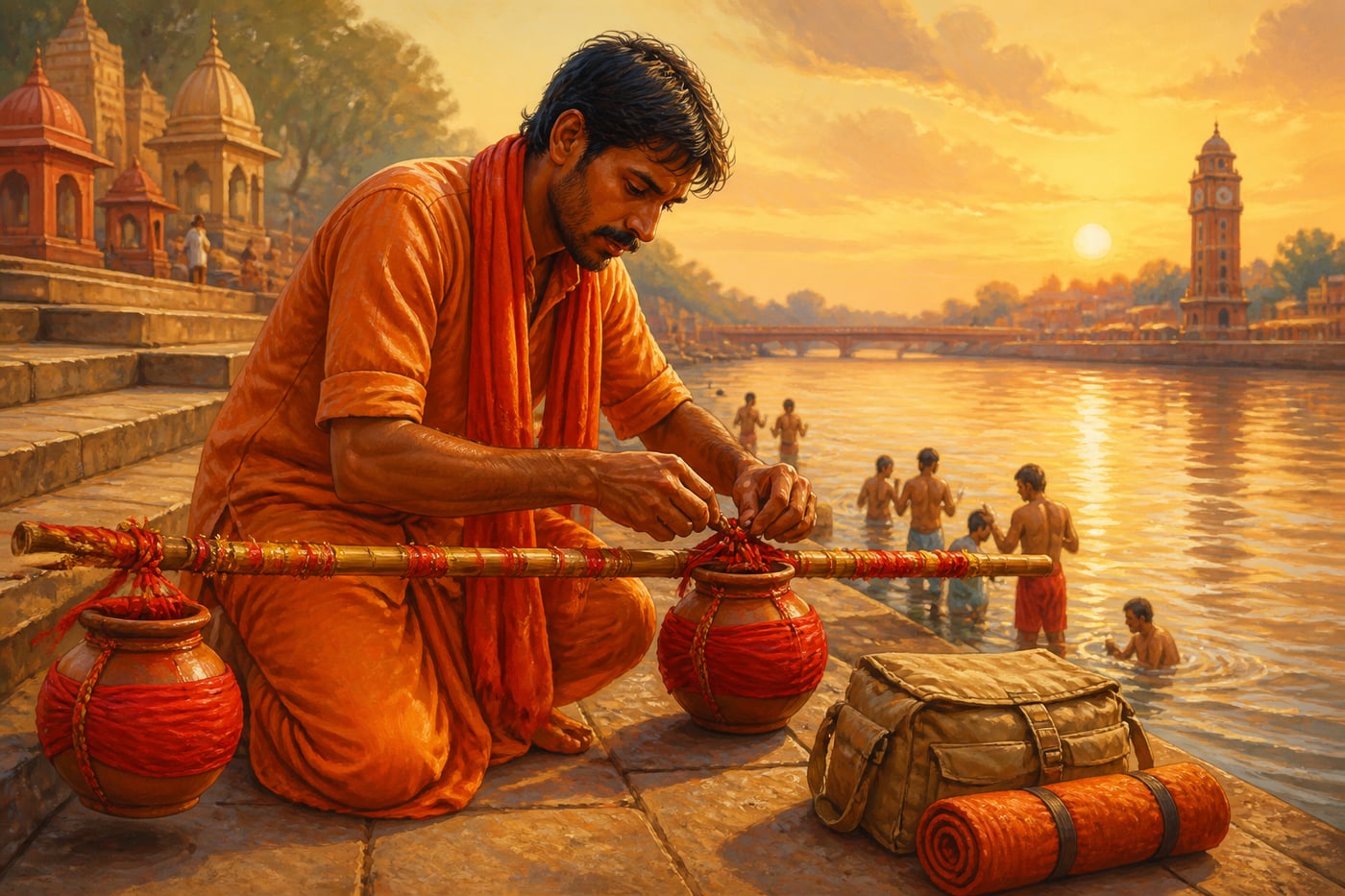
In the small lane behind the Har Ki Pauri ghat at Haridwar, on the morning of Sunday 21 July 2019, a thirty-four-year-old truck driver from Patna named Manoj Kumar Yadav is tying two small earthen pots to the ends of a freshly cut bamboo pole. Each pot holds one and a quarter litres of Ganga water that he and his cousin scooped at dawn from the river two hundred metres away. The pots are sealed with a banana leaf, a length of jute twine, and a flick of red mauli thread. The bamboo pole is six feet long, painted saffron, and decorated at its centre with a small framed photograph of the Baidyanath Jyotirlinga at Deoghar, six hundred and thirty kilometres to the east.
Manoj has not eaten meat for the last twelve days. He has not slept on a mattress since 9 July. He has not worn stitched clothes other than his saffron dhoti, has not shaved, and has not addressed his wife or his mother or his six-year-old daughter by their names. He has called every man on the road Bhola, every woman Bholi, and every child Bhola or Bholi without distinction. He is a Kanwariya, a carrier of the kanwar, observing the most consequential annual deeksha discipline available to a Hindu householder in North India.
The pole rests now on his right shoulder, the two earthen pots swinging gently. Beside him stand his cousin Pintu and three friends from the Patna trucking association: Sanjay, Vinod, and Munna. They are five of an estimated thirty to forty million Kanwariyas walking the Saawan circuit across the Hindi belt this year. They will walk roughly twenty-five kilometres a day. They will not let the kanwar touch the ground at any point during the entire six-hundred-and-thirty-kilometre journey, sleeping in roadside camps with the pole resting on a small wooden stand at their head. They will arrive at Baidyanath Dham fifteen days from now and pour the water on the Jyotirlinga at sandhya on the night of Shravana Pournima.
Manoj is not a religious specialist. He has not read the Shiva Purana. He cannot recite the Kotirudra Samhita's prescription that named this exact discipline as the highest Saawan devotion a thousand years ago. What he knows, in the calluses he is about to develop on his right shoulder and the precise rhythm of his bare feet on the asphalt, is that his father did this walk twenty-three times before him. His grandfather did it forty-one times. His great-grandfather, by family tradition, started the lineage of the Yadav household kanwar in 1923, in a village outside Patna, after a vow taken when his only son survived a near-fatal cholera infection.
The lesson is what the Kanwar Yatra and the Saawan pilgrimage tradition actually are, why the Shiva Purana institutionalised the practice in writing in the eleventh century, why a Stanford lab in 2014 vindicated the underlying neurology, and why a 1.2-billion-dollar American thru-hiking gear market has independently rediscovered the identity-transformation logic that Manoj is about to operate over the next fifteen days with a bamboo pole, two earthen pots, and a banana-leaf seal.
What the Kanwar Yatra Actually Is

The Kanwar Yatra is the annual mass walking pilgrimage, observed in the lunar month of Shravana (July-August), in which Hindu devotees collect water from sacred riverbanks and carry it on foot, suspended from a decorated bamboo pole, to a designated Shiva temple where they pour the water on the Jyotirlinga at sandhya. The name comes from the Sanskrit kanvar, the bamboo carrier, with two pots balanced at its ends.
The yatra has four named circuits at civilisational scale.
- Haridwar to Pura Mahadev / Augharnath / Daksheshwar. The largest circuit by participant count, drawing roughly two crore (twenty million) Kanwariyas annually from Uttar Pradesh, Haryana, Delhi, and the Hindi belt. The water is collected at Har Ki Pauri and carried 100 to 250 kilometres west and south.
- Sultanganj (Bihar) to Baidyanath Dham (Deoghar, Jharkhand). The longest individually walked circuit, at 105 kilometres of unbroken footpath, drawing roughly one crore (ten million) Kanwariyas annually. The water is collected at the Uttar-Vahini Ganga turn at Sultanganj and carried east through the Bihar-Jharkhand corridor.
- Gaumukh (the source of the Ganga) to Rishikesh, Haridwar, or Kashi. The most elite circuit, walked by roughly one to two lakh dedicated yatris per year, requires a high-altitude trek through the Bhagirathi gorge.
- Regional pan-Indian Saawan circuits. Tamil Nadu's Aadi Krithikai walks to Palani and the Murugan temples, Maharashtra's Pandharpur Wari to the Vithoba temple, Karnataka's Mookambika walks, and the Sabarimala Maravur Vrutham preparatory walks all overlap calendrically with the North Indian Kanwar Yatra and observe parallel disciplines.
The combined annual participation across all Saawan walking pilgrimages exceeds thirty crore (thirty million) per year, larger than the population of any country except India, China, and the United States. The Kanwar Yatra alone is the single largest annual walking pilgrimage in the world by any reasonable measurement.
The Scripture Says
The textual basis for the Saawan pilgrimage is densest in the Puranic literature. The Shiva Purana, in its Kotirudra Samhita section composed and stabilised between 900 and 1200 CE, contains the foundational prescription for the Saawan deeksha. The Linga Purana, the Skanda Purana in its Setumahatmya and Kashi Khanda sections, and the Padma Purana all carry parallel prescriptions for Shravana-month Shiva worship. The Brihat Samhita of Varahamihira and the Kalika Purana provide the calendrical framework for why Shravana specifically is named the month of Shiva.
श्रावणे मासि भगवान् शिवो जलधरस्वनैः। गङ्गाजलं समर्प्यं स्यात् शिवलिङ्गे विधानतः॥
śrāvaṇe māsi bhagavān śivo jalaḍhara-svanaiḥ gaṅgā-jalaṃ samarpyaṃ syāt śiva-liṅge vidhānataḥ
In the month of Shravana, the Lord Shiva responds to the sound of the rain clouds. Ganga water is to be offered upon the Shivalinga according to the prescribed procedure.
Shiva Purana, Kotirudra Samhita 7.4
The verse names three things in a single sentence: the month, the deity, and the offering. The Kotirudra Samhita's surrounding chapters elaborate the procedural detail: the kanwar as the prescribed carrying implement, the bare-footed walk as the prescribed mode, the sealed pot as the prescribed container, the avoidance of placing the pole on the ground as the prescribed discipline, and the offering at the Jyotirlinga as the prescribed culmination. The procedural specification is so detailed that the modern yatri who has never read the text is operating it almost identically, transmitted through fifteen hundred years of household practice across every regional Hindi-belt tradition.
The Kalika Purana explains why Shravana is the month: the lunar month falls in the heart of the Indian monsoon, the Bhagirathi and the Ganga are at their fullest seasonal flow, and the cosmological-ritual tradition treats the rain itself as Shiva's own response to the earlier mythological churning of the ocean and his swallowing of the halahala poison. The pilgrim's walk in the rain, therefore, is not despite the monsoon. It is because of it. The discomfort is the discipline.
What Manoj Is Operating
The Kanwar deeksha has six interlocking components. Manoj at Haridwar is operating all six simultaneously over the fifteen-day window.
- The vrata-samkalpa. The formal vow, taken before a household priest or at the river itself, that binds the yatri to the discipline for the duration. Manoj took his samkalpa at the Patna Mahadev temple on 9 July, twelve days before the walk began.
- The dietary discipline. No meat, no eggs, no garlic, no onion, often no salt for the duration. Sattvic food only, prepared by the yatri himself or by a vegetarian household. Manoj has been on this diet for twelve days and will be for the next fifteen.
- The vesture discipline. Saffron unstitched dhoti and uttariya, no leather, no synthetic fibres, no stitched clothing on the upper body. The footwear, when worn at all, is rubber or jute slippers; the canonical version is barefoot.
- The kanwar discipline. The pole and pots, once consecrated and the water collected, must not touch the ground at any point until the offering at the Jyotirlinga. Roadside camps include wooden stands designed specifically to keep the kanwar elevated through the night.
- The naming discipline. All fellow yatris, regardless of caste, gender, age, or station, are addressed as Bhola or Bholi, the names of Shiva and Parvati in their accessible Bhola-Bholi form. The yatri's own name is set aside for the duration.
- The walking discipline. The walking itself, twenty to thirty kilometres a day, in groups, with rhythmic chanting (Bol Bam, Hari Hari Bam) carrying the pace, in the rain, on hot asphalt, on roads shared with high-speed traffic, with the pole on the shoulder for sixty to a hundred and twenty hours of cumulative load-bearing across the journey.
The combined discipline is a fifteen-day, civilisationally institutionalised, identity-transformation protocol. Manoj at Haridwar will not be the same Manoj at Baidyanath. The discipline is engineered to make sure of it.
Why the Body and Mind Respond
The modern research on long-distance walking, group movement, and identity transformation is now substantial.
Marily Oppezzo and Daniel Schwartz at Stanford in 2014, in the Journal of Experimental Psychology: Learning, Memory, and Cognition, demonstrated that walking increases creative output by eighty-one percent compared to sitting, with the effect persisting for several minutes after the walk ends. The mechanism, the authors proposed, is the activation of the default mode network in conjunction with sustained low-grade aerobic load, producing the optimal conditions for divergent and associative thinking.
Robin Dunbar at Oxford has built a substantial research program on group movement, group singing, and endorphin release. His 2012 paper in Proceedings of the Royal Society B and the subsequent work have demonstrated that walking together in a group, especially with rhythmic vocalisation, produces significantly higher endorphin levels than solo walking or quiet group walking. The Kanwariyas' chanting of Bol Bam, Hari Hari Bam across hundreds of kilometres is exactly the protocol Dunbar's lab has measured.
The crowd-psychology literature on the Kumbh Mela, including the Khan et al 2013 Harvard School of Public Health study and the broader Allahabad Mela research, has documented that mass religious gatherings produce measurable increases in oxytocin and other bonding hormones in participants, with sustained well-being effects measurable at twelve-week follow-up. The Kanwar Yatra runs the same crowd-psychology protocol, but extended into a fifteen-day walking format rather than a stationary multi-day bath.
The pilgrimage-and-identity literature, drawing on the work of Victor Turner on liminality, Rebecca Solnit's Wanderlust (2000), and the modern thru-hiking ethnographies, has converged on the finding that long-distance walking with a defined goal, a defined community, and a defined transformation contract produces measurable identity reconstruction in the participant. The Appalachian Trail thru-hikers and the Kanwariyas of Bihar are operating the same psychological protocol with different vocabulary.
The convergence is striking. The four research lines, independently developed, vindicate every component of the Kanwar deeksha: walking (Oppezzo-Schwartz), group rhythmic vocalisation (Dunbar), mass-gathering bonding (Khan et al), and long-distance identity transformation (Turner-Solnit-thru-hiking). The Shiva Purana, in writing, codified the combination eleven centuries before any of these papers were published.
What the Labs Found
Three empirical findings stand out.
First, the Oppezzo-Schwartz 2014 Stanford paper is the foundational evidence for walking as a cognitive intervention. The eighty-one-percent creativity increase is now widely cited and replicated, and the mechanism, default-mode-network activation under sustained low-grade aerobic load, has become standard reading in modern cognition research.
Second, the Dunbar 2012 group-singing endorphin literature has established that group rhythmic vocalisation during physical activity produces measurable hormonal effects on bonding and well-being. The Kanwar Yatra's Bol Bam chanting across multi-day walking is the canonical historical example of this protocol operating at civilisational scale.
Third, the Khan et al 2013 Harvard Kumbh study documented that mass Hindu pilgrimage gatherings produce measurable bonding-hormone increases and sustained well-being effects. The Kanwar Yatra extends the gathering into walking format and increases the duration to fifteen days, multiplying the effect.
None of these papers cite the Shiva Purana. Manoj at Haridwar does not need them to. The gear store in Bhubaneswar that sold him the saffron dhoti and the bamboo pole on 8 July does not need them either.
What the World Calls It Now
The Appalachian Trail in the eastern United States runs 3,500 kilometres from Georgia to Maine. The Pacific Crest Trail runs 4,265 kilometres from the Mexican border to the Canadian. The Continental Divide Trail runs 4,989 kilometres along the Rocky Mountain crest. The combined American thru-hiking community draws roughly four to five thousand official thru-hikers per year and tens of thousands of section hikers, with a gear-and-services industry that exceeded 1.2 billion dollars in annual revenue by 2023 per industry trade publications.
The thru-hiking culture has independently developed the structural elements of the Kanwar deeksha. Trail names, the new identifying name a hiker adopts at the start of the trek, parallel the Bhola-Bholi naming discipline. The pack, kept light and identical across the journey, parallels the kanwar discipline of the consecrated implement that travels with the pilgrim. The trail journal, the pilgrim's account of the inner shifts, parallels the Bhakti-bhajan tradition of the Saawan walk. The trail family, the small group of fellow hikers a thru-hiker walks with for weeks, parallels the jatha, the group of Kanwariyas who walk and camp together. The summit moment, the arrival at Mount Katahdin in Maine for the Appalachian Trail's northbound thru-hiker, parallels the offering at the Jyotirlinga at Baidyanath at sandhya.
The thru-hiking literature is honest about the identity-transformation claim. Rebecca Solnit's Wanderlust (2000), Bill Bryson's A Walk in the Woods (1998), and Cheryl Strayed's Wild (2012) all describe the trek explicitly as a transformation protocol, not a fitness achievement. The pilgrimage frame is named in everything except the term itself.
The Camino de Santiago in Spain runs 800 kilometres from the French Pyrenees to the cathedral at Santiago de Compostela. Annual participation has crossed 400,000 walkers per year by 2019, with a Galician tourism industry valued at over 600 million euros per year. The Camino is the closest Western pilgrimage to the Kanwar Yatra in structural design, and is widely acknowledged as a Christian pilgrimage in revival rather than a wellness trek.
The combined Western thru-hiking and pilgrimage market exceeds 2 billion dollars in annual gear and services revenue. The Kanwar Yatra runs free, with Manoj's bamboo pole at fifty rupees, two earthen pots at thirty rupees each, the saffron dhoti at three hundred rupees, and the rest of the equipment provided by the network of free roadside seva camps run by householder families and gurudwaras and dharamshalas across the route. Thirty to forty million participants per year operate the protocol at zero or near-zero cost.
What to Call It Yourself
The renaming is small and exact. When the trail magazine says thru-hike, you say Kanwar Yatra or Saawan deeksha. When the gear catalogue says identity transformation walk, you say vrata. When the wellness column says forest bathing or movement therapy, you say padayatra. When the pilgrimage podcast says Camino, you point at the Sultanganj-Baidyanath circuit and the date 1100 CE.
The practice itself is portable to any Hindu householder, and forms exist for non-walking participants.
- Full Kanwar Yatra. Once in your life, observe the full Kanwar Yatra. The Sultanganj-Baidyanath circuit is the longest at 105 kilometres. The Haridwar-Pura Mahadev circuit is the most accessible from Delhi. The full deeksha, with all six components, runs for the lunar month of Shravana.
- Mini Saawan deeksha. If the full yatra is not feasible, observe a mini deeksha for the four Mondays of Shravana: the saffron dhoti or saffron stole, the sattvic diet, the morning walk to a local Shiva temple with a small pot of water, and the avoidance of meat, alcohol, and stitched leather for the four-week period.
- Annual Saawan walking discipline. At minimum, walk an extra five kilometres every day during Shravana, ideally in the early morning before sunrise, with chanting of any Shiva mantra (Om Namah Shivaya is the canonical entry-level form). The discipline costs nothing and lands the cognitive and devotional effects in compressed form.
The combined protocol is what thirty to forty million Bharatiyas operate every year, and what the Shiva Purana prescribed in writing eleven centuries ago, available without subscription, gear purchase, or trail-permit lottery.
The Pole Lifts at Sandhya
Back at Haridwar, Manoj has finished tying the second pot. The bamboo pole rises onto his right shoulder. His cousin Pintu lifts the matching pole onto his own shoulder. The five Kanwariyas turn south down the lane, their bare feet finding the wet asphalt. Sanjay, the oldest of the group, calls out the first Bol Bam. The four others answer in chorus. Within twenty steps the rhythm has set. The pace is faster than the Stanford lab's treadmill. The endorphin curve will rise in the next forty minutes. The default mode network will run hot for the next three hundred kilometres.

Fifteen days from now, on the night of Shravana Pournima, Manoj will pour his Ganga water on the Baidyanath Jyotirlinga in the inner sanctum of the Deoghar temple at sandhya. The bamboo pole will go to the temple as an offering. The earthen pots, now empty, will be left at the temple's outer wall. The saffron dhoti will be folded away for next year. Manoj's wife will use his name again on the morning of Bhadrapada Shukla Pratipada, the day after the deeksha closes. He will go back to driving his truck.
What will not be the same is the small calluses on his right shoulder, the muscle memory of the rhythm, the Bol Bam still surfacing in his throat at unexpected moments for the next eleven months, and the felt sense, in his diaphragm and his bare feet, that the body knows the route to Baidyanath and will know it again next year, on schedule, when Shravana returns. The Shiva Purana will not have changed. The road will not have changed. The discipline will run again, exactly as the Kotirudra Samhita prescribed in writing eleven centuries ago, with thirty to forty million walking shoulders and a 1.2-billion-dollar Western gear industry across the world having independently rediscovered the principle without yet knowing its name.
Case studies
The Shiva Purana's Kotirudra Samhita and the Institutionalisation of the Saawan Pilgrimage (c. 900-1200 CE)
Between 900 and 1200 CE, the Shiva Purana stabilised in its present form across the Sanskrit Shaiva commentarial tradition. The Kotirudra Samhita, one of its central sections, contains the foundational prescription for the Saawan pilgrimage: the verse that names Shravana as Shiva's month, Ganga water as the prescribed offering, the Shivalinga as the prescribed destination, and the kanwar as the prescribed carrying implement. The surrounding chapters elaborate the procedural detail at extraordinary specificity: the bare-footed walk, the avoidance of placing the pole on the ground, the sealed pot, the saffron unstitched dhoti, the chaturmasya dietary discipline, and the offering at sandhya on Shravana Pournima. The Linga Purana's Purvabhaga 92 supplies the merit valuation: every step on the way to the holy site earns the merit of a go-dana. The Skanda Purana supplies the chaturmasya frame. Across these three Puranic sources, the Saawan pilgrimage was institutionalised in writing across a 300-year crystallisation window in the early medieval period.
In the dharmic frame, the Puranic codification was not the invention of the Saawan pilgrimage but the textual stabilisation of a discipline that had been observed in oral tradition for at least the prior thousand years. The Vedic-era references in the Atharva Veda, the early dharmasastra prescriptions on shoulder-pole carrying, and the Mahabharata's accounts of Shaiva pilgrimage all predate the Puranic codification. The Shiva Purana's role was not to create the discipline but to fix its procedural detail in writing at the moment in Bharatiya history when the regional Shaiva traditions were beginning to converge into a pan-Indian institutional form.
The Puranic codification produced an institutional discipline that has run unbroken for at least eleven centuries and that draws 30-40 million walking participants per year in the present day. The Sultanganj-Baidyanath circuit, the Haridwar-Pura Mahadev circuit, and the Gaumukh-Kashi circuit have all been continuously walked since at least the medieval period, with documentary continuity across pilgrim accounts from the early Sultanate, the Mughal, the colonial, and the modern eras. The procedural specification is so detailed that the modern yatri who has never read the text is operating it almost identically.
The textual record places the Saawan pilgrimage in the operational kernel of the Hindu monsoon ritual cycle from the early medieval period onward. The continuity across eleven centuries, three regional circuits, and 30-40 million annual participants is not a fact about religion in the casual sense. It is a fact about civilisational engineering: a discipline whose procedural detail was fixed in writing in the Puranic period and whose institutional fidelity across the next millennium is unmatched by any comparable mass-participation discipline in any other civilisation. The right reading is that the Kanwar Yatra is the largest, longest-running, most carefully engineered walking pilgrimage in human history.
Shiva Purana, Kotirudra Samhita 7.4, c. 900-1200 CE: foundational prescription for the Saawan pilgrimage. Linga Purana, Purvabhaga 92: merit valuation of the walking pilgrim, every step earning the merit of a go-dana. Modern annual participation: 30-40 million Kanwariyas. Eleven centuries of unbroken institutional fidelity.
The Appalachian Trail and the $1.2 Billion Thru-Hiking Industry: The Kanwar Deeksha Independently Rediscovered
The Appalachian Trail in the eastern United States runs 3,500 kilometres from Springer Mountain in Georgia to Mount Katahdin in Maine. The Pacific Crest Trail runs 4,265 kilometres from the Mexican border to the Canadian. The Continental Divide Trail runs 4,989 kilometres along the Rocky Mountain crest. The combined American thru-hiking community draws roughly 4,000 to 5,000 official thru-hikers per year and tens of thousands of section hikers, with a gear-and-services industry that exceeded 1.2 billion dollars in annual revenue by 2023. The thru-hiking culture has independently developed the structural elements of the Kanwar deeksha: trail names that parallel the Bhola-Bholi naming discipline, the consecrated pack that parallels the kanwar discipline, the trail journal that parallels the Saawan bhajan tradition, the trail family that parallels the jatha walking group, the summit moment that parallels the offering at the Jyotirlinga. The Camino de Santiago in Spain, with 400,000 annual walkers and a Galician tourism industry valued at over 600 million euros, runs the same structural design with a Christian rather than a Hindu textual frame.
In the dharmic frame, the thru-hiking and Camino traditions are not coincidences. They are independent rediscoveries of the long-distance walking discipline as an identity-transformation protocol, a discipline the Hindu tradition codified in writing eleven centuries before any of these Western traditions emerged. The thru-hiking literature, from Solnit's Wanderlust (2000) through Bryson's A Walk in the Woods (1998) to Strayed's Wild (2012), is honest about the identity-transformation claim. The pilgrimage frame is named in everything except the term itself. The asymmetry is that the Kanwar Yatra runs 30-40 million participants per year at zero cost, while the American thru-hiking industry runs 4,000-5,000 thru-hikers at $1.2 billion in annual gear and services revenue.
The thru-hiking industry continues to grow with new trail certifications, integration with corporate wellness programs, and expanding gear product categories. The Camino de Santiago has crossed 400,000 annual walkers and continues to grow. None of the major Western thru-hiking and pilgrimage traditions reference the Shiva Purana or the Kanwar Yatra as the institutional ancestor of the walking-as-transformation discipline. The Kanwar Yatra continues to operate at 30-40 million annual participants with the network of free roadside seva camps, free bamboo poles at fifty rupees apiece, and the institutional infrastructure of the Hindi-belt householder tradition.
The right response to the asymmetry is articulation. Walk the Appalachian Trail or the Camino de Santiago if you want a structured commercial trek with gear sponsorships and trail-permit infrastructure. Walk the Sultanganj-Baidyanath circuit if you want the source layer with eleven centuries of textual backing, free roadside seva camps, and 30-40 million fellow walkers operating the same discipline at the same time. The American thru-hiking industry is selling a 1.2-billion-dollar product whose institutional ancestor draws more participants on a single Shravana Pournima at Baidyanath than the entire industry serves in a year. Choose the source over the fragment.
Appalachian Trail: 3,500 km, 4,000+ annual thru-hikers. Pacific Crest Trail: 4,265 km. Combined American thru-hiking gear industry: $1.2B annual revenue (2023). Camino de Santiago: 400,000+ annual walkers, $600M+ Galician tourism industry. Kanwar Yatra: 30-40 million annual participants, $0 entry cost, eleven centuries of textual backing in the Shiva Purana.
Oppezzo, Dunbar, Khan, and Solnit: Four Lines of Research That Vindicated the Saawan Deeksha
Across two decades of research, four independent programs have converged on the cognitive and social mechanism of long-distance walking pilgrimage. Marily Oppezzo and Daniel Schwartz at Stanford in 2014, in the Journal of Experimental Psychology, demonstrated that walking increases creative output by eighty-one percent compared to sitting, with the effect persisting for several minutes after the walk ends. Robin Dunbar at Oxford in 2012, in Proceedings of the Royal Society B, established that group rhythmic vocalisation during physical activity produces significantly higher endorphin levels than solo movement or quiet group movement. Khan et al at the Harvard School of Public Health in 2013 documented that mass Hindu pilgrimage gatherings produce measurable bonding-hormone increases and sustained well-being effects at twelve-week follow-up. Rebecca Solnit's Wanderlust (2000) provides the cultural-historical foundation, drawing on Victor Turner's anthropology of liminality and the modern thru-hiking ethnographies, for the claim that long-distance walking with a defined goal, community, and transformation contract produces measurable identity reconstruction. None of these papers cite the Shiva Purana.
The Hindu Saawan pilgrimage tradition has held four claims for at least a thousand years: that walking is itself a cognitive intervention (Linga Purana, Oppezzo 2014), that group rhythmic chanting produces social bonding hormones (Bol Bam chanting, Dunbar 2012), that mass pilgrimage gatherings produce measurable well-being effects (Kumbh and Saawan, Khan et al 2013), and that long-distance walking with a defined goal and community produces measurable identity reconstruction (Kanwar deeksha, Solnit 2000 and the thru-hiking literature). The Shiva Purana, in its Kotirudra Samhita, codified the combination of all four mechanisms in a single discipline eleven centuries before any of these papers were published. The dharmic frame and the modern frame describe the same underlying phenomena at different levels of language.
The Oppezzo-Schwartz 2014 paper has been cited in over five thousand subsequent studies in cognitive psychology, education research, and corporate wellness applications. The Dunbar program has become foundational in modern social neuroscience. The Khan et al Kumbh study has been cited extensively in mass-gathering and public-health research. None of the lines of research has yet incorporated the Shiva Purana, the Linga Purana, or the Kanwar Yatra into its citation network. The yatri at Haridwar continues to operate the discipline without needing the citation network. The roadside seva camps continue to feed and shelter 30-40 million annual walkers without reading the Stanford paper.
When four independent research programs at Stanford, Oxford, Harvard, and the cultural-historical literature converge on the same conclusions the Hindu textual tradition codified eleven centuries earlier, the right response is not surprise. It is recognition. The Kanwar Yatra is not folk piety that happens to coincide with cognitive science. It is one of the longest-running, most carefully engineered identity-transformation protocols in any civilisation, and the modern academic catch-up has only confirmed what the Saawan tradition has known for a thousand years. The right reading is that the Kanwar deeksha is evidence-based dharmic engineering whose evidence base has been published in journals the practitioners themselves never needed to read.
Oppezzo and Schwartz 2014 Journal of Experimental Psychology: walking increases creativity by 81%. Dunbar 2012 Proceedings of the Royal Society B: group rhythmic vocalisation increases endorphin release. Khan et al 2013 Harvard Kumbh study: mass pilgrimage produces measurable bonding-hormone effects. Solnit 2000 Wanderlust: long-distance walking as identity transformation. Shiva Purana, Kotirudra Samhita 7.4, c. 900-1200 CE: codified all four mechanisms in a single discipline.
Historical context
From the Atharva Veda's earliest mentions of shoulder-pole carrying and seasonal rain ritual (c. 1200 BCE) and the Linga Purana's prescription on walking pilgrimage merit (c. 600-1000 CE), through the Shiva Purana's Kotirudra Samhita codification of the Saawan pilgrimage (c. 900-1200 CE), the Skanda Purana's chaturmasya frame (c. 700-1100 CE), the documented continuity of the Sultanganj-Baidyanath circuit across at least eight centuries of pilgrim accounts, the Oppezzo-Schwartz 2014 Stanford paper on walking and creativity, the Dunbar 2012 Oxford research on group-singing endorphins, the Khan et al 2013 Harvard Kumbh study, and the modern Western thru-hiking industry's $1.2 billion annual gear market built on the Appalachian Trail, Pacific Crest Trail, Continental Divide Trail, and Camino de Santiago.
The Saawan pilgrimage tradition is the operational kernel of the Hindu monsoon-and-post-monsoon ritual cycle. The chaturmasya framework, beginning at the start of Shravana and running until the close of Kartik, structures four full months of household and seasonal discipline around the Saawan opening. The Kanwar Yatra is the public-scale opening of the chaturmasya, drawing 30-40 million walking participants annually. Parallel Saawan walking traditions across regional Bharat include the Tamil Nadu Aadi Krithikai walks to Palani, the Maharashtra Pandharpur Wari to the Vithoba temple, the Karnataka Mookambika walks, and the Sabarimala Maravur Vrutham preparatory walks. The combined annual participation across all Saawan walking pilgrimages exceeds 30 crore (300 million person-days of walking) per year, the largest scale of disciplined walking pilgrimage observed anywhere in human civilisation.
Living traditions
The combined Western thru-hiking and pilgrimage market exceeds 2 billion dollars in annual gear and services revenue, with the American Appalachian Trail, Pacific Crest Trail, and Continental Divide Trail anchored in a 1.2-billion-dollar gear industry, and the Camino de Santiago in Spain drawing 400,000 annual walkers and a 600-million-euro Galician tourism industry. The Hindu source layer is almost entirely deleted from the product copy. The Kanwar Yatra continues to operate at 30-40 million annual participants at zero or near-zero cost, with bamboo poles at fifty rupees apiece, earthen pots at thirty rupees each, and the network of free roadside seva camps run by householder families across the Hindi belt and eastern Bharat. Re-Sanskritize: when the trail magazine says thru-hike, you say Kanwar Yatra or Saawan deeksha. When the gear catalogue says identity transformation walk, you say vrata. When the wellness column says forest bathing or movement therapy, you say padayatra. When the pilgrimage podcast says Camino, you point at the Sultanganj-Baidyanath circuit and the date 1100 CE. Once in your life, observe the full Kanwar Yatra: the Sultanganj-Baidyanath circuit at 105 kilometres or the Haridwar-Pura Mahadev circuit closer to Delhi. If the full yatra is not feasible, observe a mini deeksha for the four Mondays of Shravana: the saffron stole, the sattvic diet, the morning walk to a local Shiva temple, and the avoidance of meat, alcohol, and stitched leather for the four-week period. At minimum, walk an extra five kilometres every day during Shravana with chanting of Om Namah Shivaya. The combined protocol costs nothing and runs the same engineering specification the Kotirudra Samhita codified eleven centuries ago.
- Baidyanath Dham (Deoghar): One of the twelve Jyotirlingas, the cosmologically and ritually most consequential Shaiva shrines in Bharat, and the canonical destination of the Sultanganj-Baidyanath Kanwar Yatra circuit. The temple draws roughly one crore (ten million) Kanwariyas annually across the lunar month of Shravana, with peak observance on Shravana Pournima drawing three to four lakh yatris in sequenced waves through a single night. The temple's ritual infrastructure includes priest scheduling, abhishekam queueing, and pilgrim-flow management at a scale unmatched at any other South Asian temple in any single month. The 105-kilometre walking corridor from Sultanganj to Deoghar is itself a continuously occupied institutional space during Shravana, with thousands of free seva camps, food distribution points, and medical aid stations operated by householder networks across Bihar and Jharkhand.
- Sultanganj Ganga Ghat (Uttar-Vahini): The starting point of the longest individually walked Kanwar Yatra circuit, the 105-kilometre Sultanganj-Baidyanath corridor. The Ganga at Sultanganj makes a rare Uttar-Vahini turn (north-flowing), which the Puranic tradition treats as cosmologically auspicious for ritual water collection. The ghat hosts a continuous flow of pilgrims throughout Shravana, with the Ajgaivinath temple at the centre serving as the consecration site for the kanwar before departure. Manoj in the opening scene of this lesson, although he sets out from Haridwar, would be operating the equivalent ritual at Sultanganj if he were walking the Bihar-Jharkhand circuit.
- Har Ki Pauri Ghat, Haridwar: The most sacred bathing ghat on the upper Ganga, the canonical starting point of the Haridwar-Pura Mahadev and Haridwar-Augharnath Kanwar Yatra circuits. The ghat draws roughly two crore (twenty million) Kanwariyas annually across the lunar month of Shravana, with peak collection runs on the early Mondays of the month. The ghat's evening Ganga aarti, performed daily through the year, is one of the most widely observed Shaiva-Vaishnava synthesis rituals anywhere in Bharat. The Kumbh Mela cycle's Haridwar gathering, every twelve years, draws tens of millions of additional pilgrims and overlaps with the Saawan walking tradition in calendar years when the Kumbh falls in or near Shravana.
Reflection
- Of the three accessible levels of Saawan participation in this lesson (the full Kanwar Yatra once in a lifetime, the mini deeksha for the four Mondays of Shravana, and the daily five-kilometre walk during Shravana with Om Namah Shivaya chanting), which one feels most accessible to commit to in the next Shravana, and which feels most resistant? What does the resistance reveal about your current relationship with disciplined walking, calendrical anchoring, and visible devotional commitment?
- Why did the Hindu tradition encode the Saawan pilgrimage as a mass-participation walking discipline rather than as a centralised temple ritual or a personal household contemplation? What does the choice of distributed walking-as-offering, with thirty to forty million yatris on the road simultaneously, tell you about how the tradition understood the relationship between embodied movement, social bonding, and collective identity formation?
- If Oppezzo and Schwartz at Stanford in 2014 confirmed that walking increases creativity by eighty-one percent, Dunbar at Oxford in 2012 confirmed that group rhythmic vocalisation produces measurable endorphin effects, Khan et al at Harvard in 2013 confirmed that mass Hindu pilgrimage produces sustained well-being effects, and Solnit in 2000 established the cultural-historical foundation for long-distance walking as identity transformation, why has the modern academic literature on cognitive psychology, social neuroscience, and pilgrimage studies not yet incorporated the Shiva Purana's Kotirudra Samhita or the Linga Purana's Purvabhaga 92 into its citation network? What would have to change, in academic norms or in the framing of dharmic source material, for that incorporation to happen?