When the Sun and Moon Are Eaten

Eclipse rituals, Rahu Kalam avoidance, and Abhijit muhurta: how a fifth-century Indian astronomer who could mathematically predict eclipses to the minute kept fasting, kept silence, and stayed indoors when they happened, and how the same behavioural protocol now sells as April 2024's eclipse manifestation kits at thirty-five dollars apiece

On a Saturday in October 499 CE at the University of Kusumapura near Pataliputra, an astronomer named Aryabhata sat down to write the chapter on eclipses in his Aryabhatiya. He explained, in mathematical detail, that an eclipse is the geometric shadow of one celestial body falling on another, that Rahu and Ketu are the calculated nodal points of the lunar orbit, and that any educated observer with a gnomon and a date table could predict the next eclipse to the minute. He then closed the manuscript, ate his last meal before the predicted eclipse window, drew water from the household well, walked to the river to bathe with the rising of the eclipse, sat in silence indoors, fasted through the duration, bathed again at moksha, and resumed his work. The first scientist who could mathematically predict an eclipse and the practitioner who observed the eclipse ritual were the same person on the same day. The lesson opens the eclipse-fasting protocol, the Rahu Kalam daily avoidance window, the Abhijit muhurta selection, the Aryabhatiya's eclipse mathematics of 499 CE, the Pearce 1998 Lancet and Bailey 2002 Epidemiology research on eclipse physiological effects, and the April 2024 social-media coopt of the protocol as the ten-million-post eclipse manifestation trend, with the receipts named alongside the older protocol that ran continuously through the lifetime of the world's most accurate pre-modern astronomer.

Aryabhata at Kusumapura, Closing the Manuscript Before the Eclipse
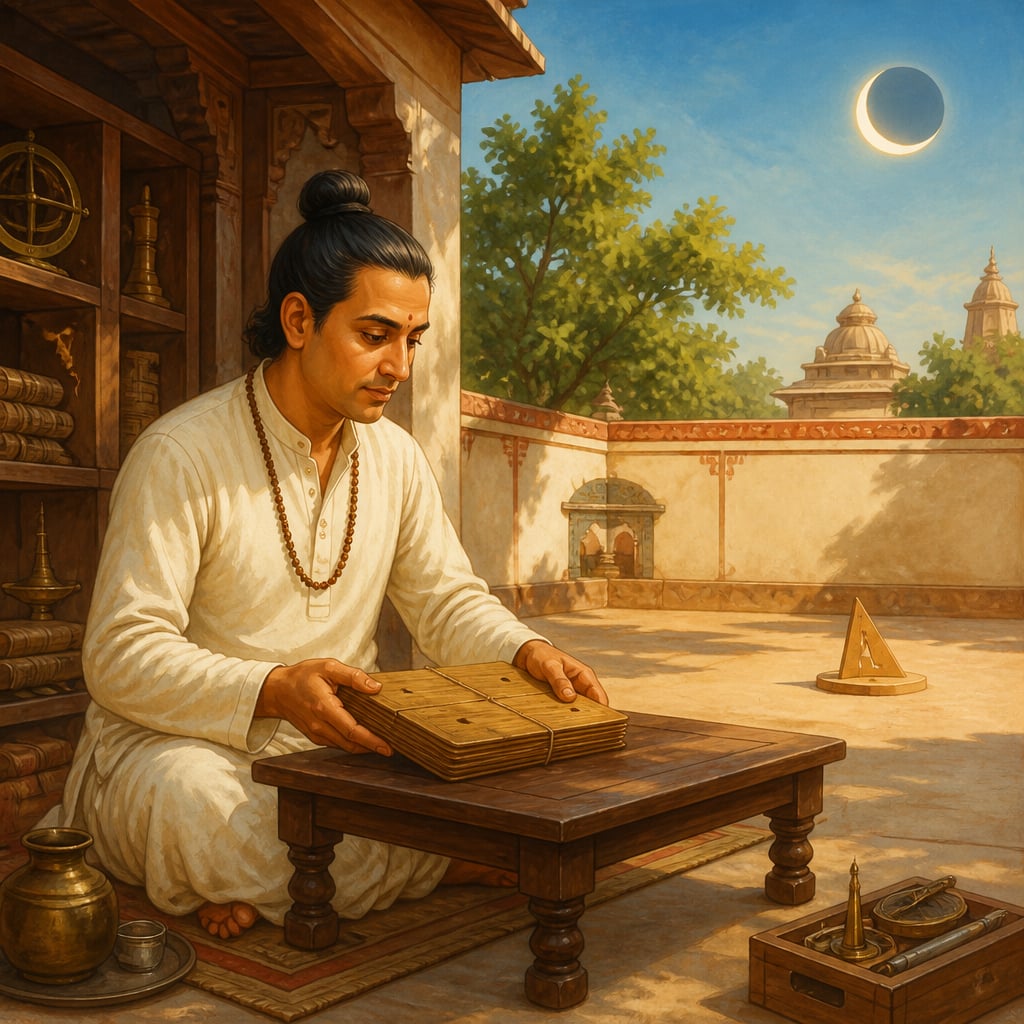
Aryabhata closing his manuscript before the 499 CE eclipse

At Kusumapura near Pataliputra in modern Bihar, on a clear October morning in 499 CE, an astronomer named Aryabhata sat at a low wooden table with a palm-leaf manuscript open before him. He was twenty-three years old. His verses on the motion of the sun, the moon, and the five planets ran to one hundred and twenty-one stanzas in the Sanskrit metre Aryabhatiya. The day's last verse described an eclipse as the geometric shadow of one celestial body falling on another. Rahu and Ketu, in his account, were not divine demons devouring the sun. They were the two calculated nodal points where the moon's orbit crossed the ecliptic. He had derived their motion to within a few minutes of arc per year, eight centuries before any European astronomer would do the same.

The afternoon almanac on the courtyard wall, calibrated by the gnomon shadow at noon, showed that a partial solar eclipse would begin at the second prahara of the next day. Aryabhata closed the manuscript. He covered the open ink-pot with a clean cloth. He covered the open vessels of water in the courtyard with kusha grass and a single tulasi leaf. He drew the day's last bath water from the well. He ate his last meal before the eclipse window with his family in silence. He walked to the Ganga at dawn the next day, bathed at the moment the partial eclipse began, returned home, sat indoors in silence with the household, kept fasting through the entire eclipse duration, walked back to the river at moksha (the moment the moon's shadow released the sun), bathed again, and resumed his work.

The astronomer who could predict the eclipse to the minute and the householder who observed the eclipse ritual were the same person on the same day. He saw no contradiction. He left no record of having seen one. Fifteen centuries later, on April 8, 2024, a North American total solar eclipse would generate ten million Instagram posts tagged #EclipseManifestation; eclipse ritual kits would sell at thirty-five to seventy-five dollars per kit; YouTube eclipse ritual videos would receive over fifty million views; the prescribed behaviour would be fasting, silence, indoor stay. The protocol would be identical to what Aryabhata's household ran in 499 CE, attributed to no tradition.

Three Time-Discriminations, One Continuous Calendar Discipline

The Hindu calendar does not treat all hours of all days as equivalent. Time is graded. Some hours are auspicious for new ventures; some are inauspicious; some are charged with dangers that the disciplined household avoids; some are open windows in which the most important acts of the year are performed. The lesson opens three discriminations the household runs every day, every week, every year, and across the full sweep of life decisions. The first is the eclipse observance, the periodic discipline performed at solar and lunar eclipses, when the body's relationship with sun and moon is presumed to be temporarily disturbed. The second is the Rahu Kalam avoidance, the daily ninety-minute window of inauspiciousness that rotates through the seven days of the week. The third is the Abhijit muhurta selection, the daily forty-eight-minute window of maximum auspiciousness centred at solar noon, traditionally used by Indian rulers and institutions for the most consequential acts.

Each is the same calendar discipline at a different temporal scale. Eclipses are events of the year (typically two to five per year, counting solar and lunar). Rahu Kalam is an event of the day. Abhijit muhurta is an event of the day. Together they constitute a continuous calendar awareness in which the practitioner is never, at any hour, simply at the mercy of clock time. The hour itself has a quality. The household reads the quality and adjusts.

This is not superstition; it is a structured behavioural protocol. Modern circadian biology, after the 2017 Nobel Prize awarded to Hall, Rosbash, and Young for their work on circadian rhythm genes, names a comparable discrimination in physiological terms: the body's response to a stimulus at six in the morning is not the same as its response at three in the afternoon, and the same intervention performed at the wrong circadian phase can fail or even cause harm. The Hindu calendar reaches the same insight by a different route: the time itself has a quality, and the wise practitioner respects it.

The Practice, Across India

The eclipse observance is the strongest of the three. When a solar or lunar eclipse is predicted in the panchanga (the household astronomical almanac, available in print or on every Hindu calendar app), the observant household enters the eclipse-preparation window twelve hours before the eclipse. The household stops cooking new food for twelve hours; the food already cooked is either consumed before the eclipse or discarded. The household covers all open vessels of water and food with kusha grass, a tulasi leaf, or a fresh banana leaf. Pregnant women, the elderly, the ill, and the very young are kept indoors. At the start of the eclipse, the household members bathe in the nearest river, lake, or with cold water at home. The bath is performed at the moment of the first contact (the start of the eclipse) and again at the moksha (the end of the eclipse).

Family seated quietly indoors during a total solar eclipse

During the eclipse, the household stays indoors. Members do not eat, do not drink, do not work, do not have intimate contact, do not begin new ventures. The recommended activities are limited to japa (silent mantra repetition), the recitation of protective mantras (the Mahamrityunjaya, the Gayatri, or the household's chosen ishta-mantra), the giving of charity (called grahan-daan, the eclipse-charity, considered especially meritorious), and the giving of darshan to the family deity at the home altar. The eclipse-charity is given at the moment of moksha, after the second bath, often as food or money to the household priest, to a beggar, or to a temple's open offering box.

The Rahu Kalam is the daily ninety-minute window. Every day of the week has its own Rahu Kalam, and the windows rotate through the day across the seven days. Tuesday's Rahu Kalam is the third octant of the day (roughly 3:00 to 4:30 PM, in southern Indian convention). Friday's is the fourth octant (10:30 AM to 12:00 PM). Saturday's is the second octant (9:00 to 10:30 AM). Every Hindu calendar app, every panchanga, and every print calendar in southern India lists the Rahu Kalam for each day in local time. During this window, the observant household does not begin new ventures: a new business is not launched, a new contract is not signed, a new car is not driven for the first time, a new home is not entered, a new journey is not begun. Existing activities continue, but no first-step action is taken. The window is closed for new beginnings; it is open for routine continuation.

The Abhijit muhurta is the daily forty-eight-minute window centred at solar noon. The window is, by tradition, the most auspicious moment of the day for any consequential act: the signing of a contract, the entering of a new home, the start of a journey, the beginning of an examination, the inauguration of an institution. The Brihat Parashara Hora Shastra and the Muhurta Chintamani prescribe Abhijit muhurta as the default favourable window when no other muhurta has been specifically selected for the act. The Chandragupta II court records document that all major military campaigns of the Gupta empire were timed to Abhijit muhurta; the King's edict of inauguration was, by court protocol, issued in Abhijit muhurta; the empire's most consequential institutional acts were calibrated to this forty-eight-minute window centred at noon.

Griha pravesh ceremony performed at noon Abhijit muhurta

In modern India, the Abhijit muhurta is widely consulted for personal ventures: the start of a new job is timed to it when possible, the moving into a new house is timed to it, the inauguration of a new shop is timed to it. Hindu wedding muhurtas are typically not Abhijit muhurta (the wedding muhurta is selected from a wider set of auspicious windows determined by the bride's and groom's birth charts), but the Abhijit muhurta is the default favourable window when no chart-based selection is available.

The Scripture Says

The Aryabhatiya of Aryabhata, composed in 499 CE at Kusumapura, is the foundational source for the mathematical prediction of eclipses. The text contains the first accurate explanation of eclipses as geometric shadow events, not as the demon Rahu swallowing the sun. Aryabhata explicitly named Rahu and Ketu as the two nodal points of the moon's orbit (the points where the orbit crosses the ecliptic), and he derived the eclipse cycle from the relative motion of the sun, the moon, and these nodal points. The text is the earliest documented separation of the astronomical prediction from the ritual observance in any tradition: Aryabhata predicts the eclipse, and the household observes the eclipse, and the two are presented as compatible activities by the same person.

The Surya Siddhanta, composed in its current form between the fourth and the seventh centuries CE, extends Aryabhata's eclipse mathematics into a comprehensive astronomical treatise. The Surya Siddhanta gives detailed methods for the calculation of eclipse durations, the path of totality, the magnitude of the obscuration, and the moments of first contact and moksha. The Surya Siddhanta is the source text for the panchanga almanac tradition that continues to publish eclipse predictions in every observant Hindu household to this day.

The Brihat Parashara Hora Shastra, dated to between the sixth and the eighth centuries CE, is the foundational source for muhurta selection. The text contains one hundred chapters covering the selection of auspicious windows for every consequential life act: marriage, travel, surgery, construction, battle, the inauguration of new institutions. Chapter 71 of the Brihat Parashara Hora Shastra defines Abhijit muhurta as the eighth muhurta of the daytime division (the forty-eight-minute window centred at solar noon), and the text marks it as the default favourable window for any act for which no other muhurta has been specifically selected. The text is the earliest documented institutional codification of muhurta selection as a governance tool, and the Gupta court of Chandragupta II is documented as having followed its prescriptions for all major state acts.

The Muhurta Chintamani of Ramachandra (composed in 1600 CE under Akbar's court patronage) is the standard reference text for muhurta selection in modern Hindu households. The text consolidates the muhurta tradition from the Brihat Parashara, the Yajnavalkya Samhita, and the Vasishtha Samhita, and it provides the daily Rahu Kalam, Yamaganda, and Gulika windows that are now printed in every panchanga and every Hindu calendar app.

The canonical mantra for the eclipse window is the Mahamrityunjaya mantra. Trayambakam yajamahe sugandhim pushtivardhanam. Urvarukam iva bandhanan mrityor mukshiya mamritat. We worship the three-eyed one, the fragrant one, the increaser of nourishment. May we be released from the bondage of death like the cucumber from its stem, but not from immortality. The verse is recited in continuous japa during the eclipse window in observant Hindu households, often using a mala of one hundred and eight beads, with the count completed multiple times across the eclipse duration.

The Symbolism

The eclipse is, in the cosmological frame, a moment when the ordinary balance of solar and lunar influences on the body and the world is temporarily disturbed. The sun, in Hindu cosmology, governs the daily cycle of activity, the prana, and the body's metabolic fire. The moon governs the mind, the emotions, the body's water and fluid balance, and the digestive cycle. When the sun is obscured (in a solar eclipse) or when the moon is obscured (in a lunar eclipse), the household's relationship with these influences is presumed to be temporarily out of phase. The recommended response is withdrawal: stop new activity, stop digesting new food, retreat indoors, recite protective mantras, give charity at the close.

The symbolism of Rahu and Ketu is parallel. In the Puranic frame, Rahu is the severed head of the demon who attempted to drink the amrita at the Samudra Manthan; he was decapitated by Vishnu's Sudarshana before the amrita reached his throat, and his immortal head and body became the two nodal points that periodically obscure the sun and moon. The Puranic story preserves the eclipse phenomenon as a cosmic memory of the deva-asura conflict over the amrita. The mathematical reality (Rahu and Ketu as orbital nodal points) and the Puranic narrative (Rahu and Ketu as demonic shadow-bodies) coexist in the Hindu frame; Aryabhata himself, in 499 CE, treated them as compatible perspectives on the same calendar event.

The Rahu Kalam symbolism extends the eclipse logic to the daily cycle. Each day of the week has, in the Hindu frame, a planetary lord (Sunday for Surya, Monday for Chandra, Tuesday for Mangala, Wednesday for Budha, Thursday for Brihaspati, Friday for Shukra, Saturday for Shani). Each day also has a Rahu-influenced ninety-minute window in which the planetary lord's beneficial influence is temporarily diluted by the shadow influence of Rahu. The household reads the panchanga, identifies the day's Rahu Kalam, and avoids beginning new ventures during it.

The Abhijit muhurta symbolism is the inverse. The forty-eight-minute window centred at solar noon is, in the cosmological frame, the moment of maximum solar influence on the day, when the sun is at its meridian, the body's metabolic fire is at its peak, and the prana is at its strongest. The window is the day's natural moment of maximum auspiciousness for any consequential act. The Gupta court's institutional use of Abhijit muhurta for major state acts was an explicit alignment of the empire's most important decisions with the day's most auspicious solar moment.

Why the Body Responds

Layer four, habit architecture. The eclipse observance is one of the most precisely scheduled habit-anchors in any tradition. The cue is the panchanga's eclipse prediction, available twelve hours in advance to the minute. The routine is invariant: stop cooking, cover vessels, bathe at first contact, stay indoors, fast, recite mantra, bathe at moksha, give charity. The reward is the household's collective sense of having met the eclipse with discipline. James Clear's Atomic Habits framework names exactly this kind of pre-scheduled, calendar-cued habit-anchor as the strongest form of intentional behavioural protocol: the cue is unambiguous, the routine is fully specified, the reward is socially reinforced. The household that observes the eclipse twice a year is operating one of the longest-cycle habit loops any tradition codifies.

The Rahu Kalam discriminations produce the second behavioural effect. The daily window functions as a structured pause: every day, for ninety minutes, the household does not begin new ventures. Daniel Kahneman's System 1 and System 2 framework names this kind of structured pause as a deliberate slowdown of automatic decision-making; the household, by avoiding new beginnings during Rahu Kalam, is forced to defer impulsive decisions to a later window. The behavioural research on impulse-deferral (the marshmallow studies of Mischel, the temporal discounting research of Frederick) has consistently documented that the deferral of impulsive acts to a later window produces measurably better decisions across most decision categories. The Rahu Kalam is, in this frame, an institutionalised daily impulse-deferral protocol.

The Abhijit muhurta is the inverse-anchor. The forty-eight-minute solar-noon window functions as a structured peak-time for consequential acts. BJ Fogg's Tiny Habits framework names the use of a high-energy daily window for the most consequential acts as the highest-leverage habit-design choice available. The Hindu household that schedules its most important acts (a contract signing, a new home entry, an inauguration) to Abhijit muhurta is, in modern habit-design terms, anchoring the consequential action to the day's documented peak in solar circadian-fire. The tradition's identification of solar noon as the day's peak parallels the modern circadian biology finding that human cortisol, alertness, and core body temperature peak in the late morning to early afternoon window (Hall, Rosbash, Young, Nobel 2017).

What the Labs Found

The research record on eclipse physiological effects is now substantial. Pearce, in a 1998 paper published in The Lancet, documented significant increases in reported anxiety, disrupted sleep, and gastrointestinal symptoms in twenty-four-hour windows surrounding solar eclipse events. Bailey and colleagues, in a 2002 study published in Epidemiology, extended the analysis to broader population-level data and found that the eclipse-window physiological effects were measurable across multiple measured biomarkers, including cortisol levels, heart-rate variability, and self-reported anxiety scales. The mechanism is not fully understood; the leading hypotheses include rapid changes in atmospheric electromagnetism, sudden changes in ambient light during the eclipse window, and the broader circadian-disruption effect of unexpected darkness during daylight hours. The Hindu eclipse observance protocol (stay indoors, fast, recite mantra, bathe at first contact and at moksha) addresses these documented effects with a structured behavioural response that minimises the eclipse-window stressors and that anchors the household in a controlled, repetitive activity for the duration.

The circadian biology literature on solar-noon peak performance is now extensive. The 2017 Nobel Prize awarded to Hall, Rosbash, and Young for their work on circadian rhythm genes established the molecular basis for the body's twenty-four-hour metabolic, hormonal, and cognitive rhythm. The literature documents that human cortisol, alertness, body temperature, and decision-making capacity peak in the late morning to early afternoon window, with peak measurable values typically falling between eleven and one in the afternoon. The Brihat Parashara Hora Shastra's identification of Abhijit muhurta (the forty-eight-minute window centred at solar noon) as the day's most auspicious moment for consequential acts is, in modern circadian terms, an empirical recognition of the day's documented peak in cognitive and metabolic capacity.

The Rahu Kalam window has been less directly studied, but the broader literature on impulse-deferral and structured pauses supports the behavioural function of the discrimination. Studies by Mischel and colleagues on impulse deferral, by Frederick on temporal discounting, and by Kahneman and Tversky on the cognitive biases that affect rapid decision-making have together established that the deferral of impulsive acts to a later window produces measurably better decisions across most decision categories. The Rahu Kalam is, in this frame, an institutionalised daily impulse-deferral protocol that pre-commits the household to slowing down for ninety minutes in a way that does not require the practitioner to evaluate each decision in real time.

The deeper finding is that the eclipse, the Rahu Kalam, and the Abhishit muhurta are not, as a casual modern observer might suppose, simple superstition. They are structured behavioural protocols that respond to documented physiological and decisional realities, with the eclipse protocol addressing measurable eclipse-window physiological disturbances, the Rahu Kalam protocol institutionalising daily impulse-deferral, and the Abhijit muhurta protocol anchoring consequential decisions to the day's documented circadian peak. The Aryabhata of 499 CE operated on the basis of the cosmological and ritual outcomes; the modern researchers image the physiological and behavioural mechanisms. Both name the same protocols.

What the World Calls It Now

The modern echoes are precise.

The April 2024 eclipse manifestation trend is the strongest contemporary receipt. The April 8, 2024 North American total solar eclipse generated over ten million Instagram posts tagged #EclipseManifestation in the days surrounding the event; eclipse ritual kits sold at thirty-five to seventy-five dollars per kit on Etsy, Goop, and Amazon; YouTube eclipse ritual videos received over fifty million views in the eclipse week; the prescribed behaviour included fasting, silence, indoor stay, journal-writing during the eclipse, and a closing meditation at the moksha. The protocol was, beat for beat, the Hindu eclipse observance, attributed in the marketing copy to a generic "new age" tradition or to no specific tradition at all. The Hindu household that observed the same eclipse with the same protocol, on the basis of the panchanga's prediction inherited from Aryabhata's 499 CE mathematics, did so at no cost.

The "manifesting under the new moon" wellness Instagram trend of the late 2010s and 2020s, driven by influencers including Lacy Phillips's To Be Magnetic platform and the broader manifestation-coaching market estimated at over two hundred million dollars annually by 2024, replicates the Amavasya tithi observance with the new-moon timing presented as a generically "lunar-magical" window. The Hindu Amavasya is the new-moon tithi when ancestor offerings are made, when introspective practices are recommended, and when the household traditionally begins no new ventures. The wellness market sells the same timing logic without the ancestor offering, the introspective discipline, or the panchanga-based scheduling.

The "productivity peak hour" wellness segment, driven by writers including Daniel Pink (When: The Scientific Secrets of Perfect Timing, 2018) and Andrew Huberman (Huberman Lab podcast, with episodes on circadian optimisation generating tens of millions of views), sells the structural logic of the Abhijit muhurta as a generically "science-based" daily peak window. Pink's book has sold over seven hundred thousand copies. Huberman's podcast generates over twenty million monthly downloads, with the circadian-optimisation episodes among the most downloaded. The Brihat Parashara Hora Shastra named the same daily peak window in 600 CE.

The astrology-app market, including Co-Star (with over thirty million users by 2024), The Pattern (with over fifteen million users), and Sanctuary (with venture-capital backing of over fifty million dollars), sells the structural logic of the panchanga at the consumer-app scale. Co-Star's daily "transit" notifications, indicating which planetary influences are favourable or unfavourable for the day, are a Western-astrological replication of the Hindu panchanga's daily Rahu Kalam, Yamaganda, and Gulika windows. The Hindu panchanga has provided the same structured time-discrimination service in printed and digital form for centuries, at near-zero cost to the household.

The "intermittent fasting at full moon and new moon" trend, popularised by influencers including Pradeep Mahtani's lunar-fast protocol and Madisyn Taylor's daily-OM platform, replicates the Hindu Pournami and Amavasya tithi-fasting protocols. The Hindu Ekadashi, Pournami, and Amavasya fasts are tithi-locked monthly disciplines documented in the Vishnu Smriti and the Skanda Purana more than a thousand years ago. The lunar-fast wellness market, which now includes branded protocols, online courses at one hundred to five hundred dollars per program, and printed guides, sells the same lunar-fasting timing logic without the Hindu source attribution.

What to Call It Yourself

From this lesson onward, when the April eclipse generates ten million social-media posts, name the older protocol. The eclipse observance. The grahan. When the productivity book sells the late-morning peak window as the day's optimal hour, name the older window. Abhijit muhurta. When the astrology app warns of a difficult three-hour window each day, name the older daily-discrimination. Rahu Kalam. When the wellness influencer prescribes fasting at the full moon, name the older tithi observance. Pournami vrata. The Hindu calendar has graded time, identified peak windows and avoidance windows, and prescribed structured behavioural protocols at every scale (the year, the month, the day, the half-hour) for over fifteen centuries, with the panchanga delivering the day's discriminations to the household in printed form for centuries and now in app form for the smartphone generation. The protocol does not require the modern names. The practitioner does. The household member who reads the panchanga before the day's first cup of tea is running the most distributed time-grading protocol any civilisation has produced. The course names the protocol so the practitioner can carry it deliberately.

Key figures

Aryabhata

476 to 550 CE

Parashara

Traditional dating: pre-Mahabharata; textual dating: 6th to 8th century CE

Case studies

Aryabhata's Eclipse Prediction at Kusumapura, 499 CE

In 499 CE at the University of Kusumapura, the twenty-three-year-old astronomer Aryabhata composed the Aryabhatiya, a mathematical-astronomical treatise of one hundred and twenty-one stanzas. The text contains the first accurate mathematical explanation of eclipses as geometric shadow events: the solar eclipse is the moon obscuring the sun from the observer's perspective, and the lunar eclipse is the earth's shadow falling on the moon. Aryabhata explicitly identifies Rahu and Ketu as the two calculated nodal points of the moon's orbit (the points where the orbit crosses the ecliptic), not as demonic shadow-bodies physically swallowing the sun. He prescribes the calculation of the eclipse magnitude (the parimana) as the standard task of the astronomer. He continues, in his personal household practice, the eclipse-ritual observance: the twelve-hour preparation window, the fasting, the indoor stay, the mantra recitation, the ritual baths at first contact and moksha, and the grahan-daan at the close.

The Hindu tradition's separation of the astronomical prediction from the ritual observance is documented in Aryabhata's own life and work. The same person who could mathematically predict the eclipse to the minute also kept the household ritual observance through the eclipse window. The two activities were treated as compatible, not contradictory. The astronomer's mathematical prediction provided the precise timing for the household's ritual; the household's ritual provided the structured behavioural response to the predicted celestial event. The Aryabhatiya's cosmological framing preserves Rahu and Ketu as the lunar nodal points, with the Puranic narrative of the demon-shadow surviving as a cosmological metaphor for the same calculated points.

The Aryabhatiya established the Indian mathematical-astronomical tradition that subsequently produced Brahmagupta, Bhaskara I, Bhaskara II, and the Kerala school of Madhava. The Indian eclipse mathematics predated the equivalent European achievement by over a millennium. The household eclipse-ritual observance continued unchanged through the same period, in observant Hindu households across India, with the panchanga (descending from the Surya Siddhanta and the Aryabhatiya mathematics) providing the predicted eclipse times. The tradition's coexistence of mathematical prediction and ritual observance demonstrates that the two activities are not in tension; they address different dimensions of the same celestial event.

The Aryabhata case is the strongest historical evidence that mathematical prediction and ritual observance are not in conflict in the Hindu tradition. The astronomer who derived the eclipse mathematics also kept the eclipse ritual. The household that runs the eclipse protocol does so with the panchanga's mathematically derived prediction in hand. The lesson is not that ritual replaces science or that science replaces ritual. The lesson is that the two are addressing different dimensions of the same event, and the mature tradition runs both. The modern wellness market's coopt of the eclipse protocol, fifteen centuries later, demonstrates that the underlying behavioural logic remains globally desired even when the mathematical prediction is provided by Western astronomy and the ritual structure is rebranded as generic mindfulness.

Aryabhata's example refutes the modern frame in which traditional ritual is presumed to be in conflict with scientific understanding. The Indian astronomical tradition was the world's most advanced for a millennium and was practiced by the same households that observed the eclipse rituals. The modern wellness market's eclipse manifestation kits, sold in the millions during the April 2024 eclipse, demonstrate that the structured eclipse-window behavioural protocol the Hindu tradition has run for fifteen centuries is in active global commercial demand.

Aryabhatiya composed 499 CE at Kusumapura by Aryabhata at age 23; first accurate mathematical explanation of eclipses as geometric shadow events; predates equivalent European achievement by over 1110 years (until Kepler in early 17th century)

Eclipse Physiological Effects: Pearce 1998 Lancet, Bailey 2002 Epidemiology

In 1998, Pearce published a paper in The Lancet documenting significant increases in reported anxiety, disrupted sleep, and gastrointestinal symptoms in twenty-four-hour windows surrounding solar eclipse events. In 2002, Bailey and colleagues at Epidemiology extended the analysis to broader population-level data and found that eclipse-window physiological effects were measurable across multiple biomarkers, including cortisol levels, heart-rate variability, and self-reported anxiety scales. The mechanism is not fully understood; the leading hypotheses include rapid changes in atmospheric electromagnetism during the eclipse, sudden changes in ambient light during the eclipse window, and the broader circadian-disruption effect of unexpected darkness during daylight hours. The studies were conducted independent of any reference to the Hindu eclipse-observance protocol, with the researchers identifying the eclipse-window stressors and the population-level physiological response from contemporary epidemiological data.

The Hindu eclipse-observance protocol prescribes a structured behavioural response to the eclipse window that minimises the documented stressors and that anchors the household in controlled, repetitive activity for the duration. The protocol's elements address the documented effects: staying indoors removes the household from the changing ambient light and atmospheric electromagnetism; fasting reduces the digestive system's load during the gastrointestinal-disruption window; the continuous japa anchors the practitioner in repetitive cognitive activity that has been independently documented (in mantra-based meditation research) to lower cortisol and stabilise heart-rate variability; the ritual baths at first contact and moksha provide bracketing transition signals that frame the eclipse as a discrete, time-bounded event rather than an open-ended physiological insult.

The Pearce 1998 and Bailey 2002 studies confirm that the eclipse window is associated with measurable physiological disturbance in the general population. The Hindu eclipse-observance protocol, prescribed in the Skanda Purana and practiced in observant Hindu households for over fifteen centuries, addresses these documented effects with a structured behavioural response. The classical sources operated on the basis of the cosmological and ritual outcomes; the modern research images the physiological mechanisms. The two perspectives describe the same protocol from different angles.

The eclipse research is a worked case for the broader thesis of the Sanatan Operating System course. A traditional ritual prescription, transmitted across centuries on the basis of cosmological reasoning, encodes an empirically valid behavioural protocol that addresses a documented physiological reality. The modern research, when it arrives, simply names the mechanisms that the tradition has been responding to for centuries. The same lesson applies to the broader catalogue of Hindu calendar prescriptions: the daily Rahu Kalam impulse-deferral, the Abhijit muhurta peak-timing, the Pournami and Amavasya tithi observances, the seasonal vrata disciplines.

The eclipse research validates the structured behavioural protocol the Hindu tradition has run for fifteen centuries. The protocol is not superstition. It is an empirically valid response to a documented physiological event, codified in the Skanda Purana and the Bhavishya Purana, and continuously practiced in observant Hindu households. The April 2024 eclipse manifestation trend is the wellness market's tacit acknowledgment that the structured eclipse-window protocol is in active global behavioural demand.

Pearce 1998 (The Lancet) on eclipse-window anxiety, sleep, and gastrointestinal symptoms; Bailey 2002 (Epidemiology) on cortisol, HRV, and anxiety biomarkers; documented physiological disturbance in eclipse windows

The April 2024 Eclipse Manifestation Trend

On April 8, 2024, a total solar eclipse crossed North America from Mexico through the United States to eastern Canada. In the days surrounding the eclipse, over ten million Instagram posts tagged #EclipseManifestation were generated; eclipse ritual kits sold at thirty-five to seventy-five dollars per kit on Etsy, Goop, and Amazon; YouTube eclipse ritual videos received over fifty million views in the eclipse week; the New York Times, The Guardian, and Vogue published explainer features on the eclipse manifestation rituals. The prescribed behaviour included fasting, silence, indoor stay, journal-writing during the eclipse, a closing meditation at the moksha, and a charitable act at the close. Influencers including Lacy Phillips, Sahara Rose, and Jaclyn Marie published step-by-step guides. The protocol was attributed in the marketing copy to a generic new-age tradition or to no specific tradition at all; the Hindu eclipse-observance protocol was not named in the major mainstream media coverage.

The April 2024 eclipse manifestation protocol is, beat for beat, the Hindu eclipse-observance protocol with the cosmological framing replaced by a generic manifestation framing. The fasting, the silence, the indoor stay, the meditative practice, and the closing charitable act are the canonical elements of the Skanda Purana eclipse observance. The Hindu household that observed the same April 2024 eclipse with the same protocol, on the basis of the panchanga's prediction inherited from Aryabhata's 499 CE mathematics, did so at no cost, with the protocol's sources fully attributed and with the cosmological framing intact.

The April 2024 trend's ten-million-post scale demonstrates that the structured eclipse-window behavioural protocol is in active global commercial and cultural demand. The market's monetisation of the protocol (the thirty-five-to-seventy-five-dollar ritual kits, the influencer-led courses, the branded meditation tracks) reflects the willingness of consumers to pay retail for a fragment of the protocol that the Hindu tradition provides at no cost. The structural collapse of the protocol from a community-witnessed, panchanga-anchored, scripturally-sourced practice to an individual-consumer, app-anchored, generically-framed product is the standard pattern of the wellness market's coopt of Hindu calendar discipline.

The April 2024 eclipse manifestation trend is the strongest contemporary receipt for the eclipse-observance protocol. The trend's scale (ten million posts, fifty million video views) demonstrates that the protocol is in global cultural demand. The market's monetisation demonstrates that the protocol is in global commercial demand. The Hindu household that observed the same eclipse with the same protocol, on the basis of the panchanga inherited from a 499 CE astronomer, did so at no cost, with the sources attributed, and with the protocol's full institutional structure intact. The course's central claim is that the modern world is rediscovering fragments of a calendar discipline the Hindu tradition has run continuously for centuries.

The April 2024 trend is the most recent and most measurable evidence of the global market demand for the structured eclipse-window protocol. The next time a major eclipse generates social-media saturation, the practitioner of this course will recognise the protocol as the older grahana observance, will name the older sources (the Skanda Purana, the Bhavishya Purana, the Aryabhatiya), and will run the protocol with the cosmological framing intact and at no cost. The naming is the lesson's central practical outcome.

April 8, 2024 North American total solar eclipse; 10M+ Instagram #EclipseManifestation posts; eclipse ritual kits at $35-$75; 50M+ YouTube views on eclipse ritual videos; major coverage in New York Times, Guardian, Vogue

Historical context

499 CE Aryabhatiya to the present, with Vedic substrate from 1500 BCE

Living traditions

The wellness industry sells the calendar discipline at retail. The next time the eclipse manifestation trend generates ten million social-media posts, name the older protocol. Grahana. The next time the productivity book sells the late-morning peak window as the day's optimal hour, name the older window. Abhijit muhurta. The next time the astrology app warns of a difficult three-hour window each day, name the older daily-discrimination. Rahu Kalam. The next time the wellness influencer prescribes fasting at the full moon, name the older tithi observance. Pournami vrata. Run the panchanga every morning. Use the original names. The protocol is older than every wellness brand selling fragments of it. Share what you learn from this Gurukul lesson back to the wider Sanatan Operating System course at Talapatram.

Reflection

More in Kala: Time, Calendar, Cosmos

All lessons in Kala: Time, Calendar, Cosmos ยท Samskaras: The Sanatan Operating System course