The Tithi That Owns the Day

Why the Hindu day is owned not by the date but by the lunar phase, and how Ekadashi, Pournami, and Amavasya engineered a behavioural calendar two and a half thousand years before intermittent fasting found a market

The Western calendar is a number on a wall. The Hindu calendar is a sky. The day is owned not by the date but by the tithi, the lunar phase, calculated from the precise angular separation of the sun and the moon. Three tithis run the household's monthly rhythm. Ekadashi, the eleventh lunar day, is the fast that keeps the digestive system clean. Pournami, the full moon, is the night the body and the mind become unusually active and the household responds with restraint. Amavasya, the new moon, is the dark night the household turns inward, remembers the ancestors, and resets. The Surya Siddhanta calculated the tithi system in the fourth century with mathematical precision. Adi Shankaracharya, in the eighth century, named Ekadashi as dhatu-parishuddhana, the tissue purification fast. Yoshinori Ohsumi won the 2016 Nobel Prize for autophagy, the cellular self-renewal mechanism the Ekadashi protocol activates. Christian Cajochen at the University of Basel in 2013 measured the lunar cycle's direct effect on sleep architecture in a windowless lab. The grandmother knew. She kept the calendar on the kitchen wall.

A Kitchen Wall in Mylapore, the Calendar No One Threw Away
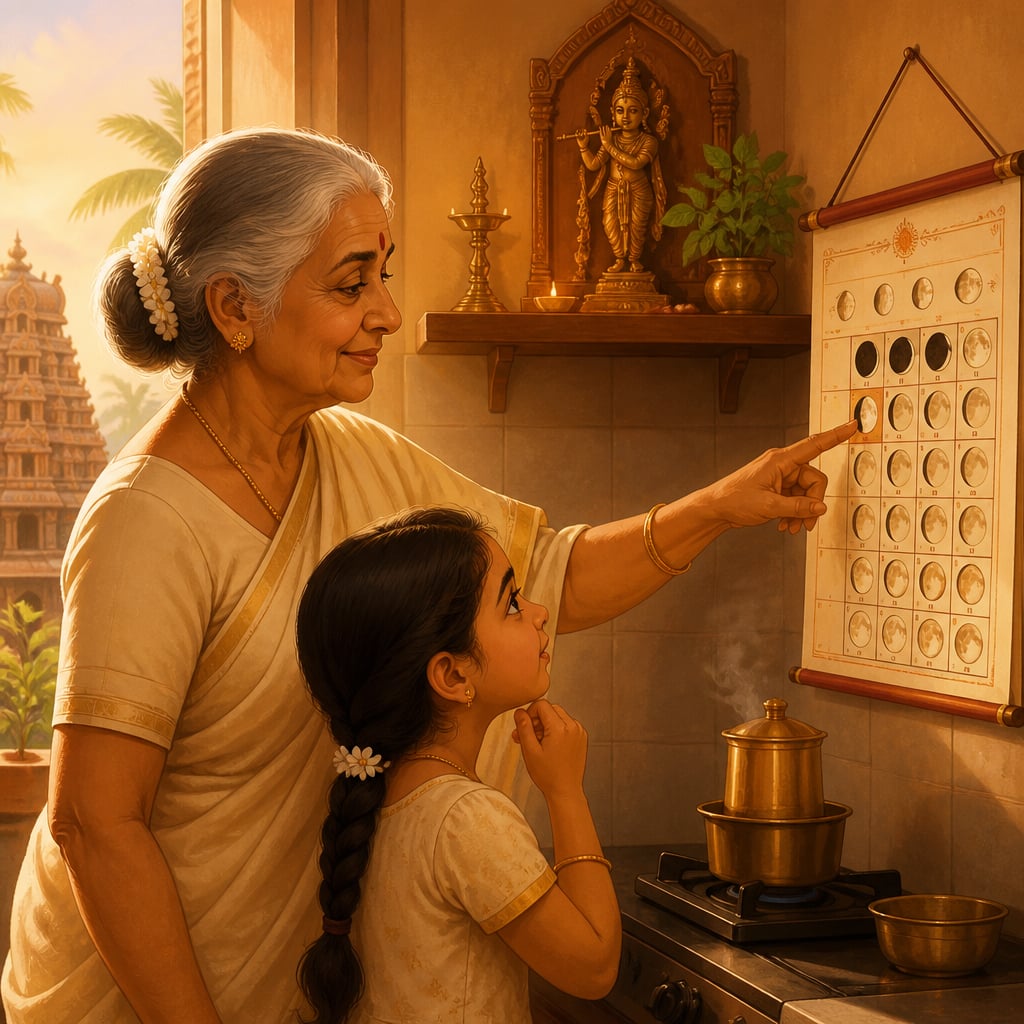
Tamil grandmother checking tomorrow's tithi on the kitchen wall calendar

In a flat in Mylapore, sometime in the early 2000s, a girl of nine is asked to fetch the calendar from the kitchen wall. Two calendars hang side by side on the same nail. The one in front is the corporate-printed Gregorian calendar, with January and February and the white spaces of office holidays. Behind it, half-hidden, is a smaller paper booklet. The pages are dense. Each page is a single month. Each day on the page has not one number but four: the English date in small print, the tithi in the largest type, the vasara (the day of the week, named for a planet), and the nakshatra (the lunar mansion). The corners of the page are marked with the names of festivals, fasts, and inauspicious windows. The girl's grandmother, her paati, looks at the back booklet first. The Gregorian calendar is for her granddaughter's school. The panchanga is for the household.

This morning the paati is checking whether tomorrow is Ekadashi. The booklet says it is. She runs through her plan for the day. She will not cook rice tomorrow. She will fast until the moon comes up the day after. She will read the Vishnu Sahasranama in the morning. She will not have onion or garlic in the house. The girl asks why. The paati does not answer with a reason. She answers with a sentence that the girl will hear ten thousand times before she finally understands it. "Tithi paartu pannardhu." You do it according to the tithi.

This lesson is about that sentence. The Hindu day is owned not by the Gregorian date but by the tithi, the lunar phase calculated from the precise angular separation of the sun and the moon. The household runs its monthly rhythm against three principal tithis. Ekadashi, the eleventh lunar day of each lunar half, is the fast that keeps the digestive system clean. Pournami (or Purnima), the full moon, is the night the body and the mind become unusually charged, and the household responds with reduced activity, fasting, and contemplation. Amavasya, the new moon, is the dark night the household turns inward, remembers the ancestors, and resets. The Surya Siddhanta, in the fourth or fifth century, codified the mathematical instrument that calculates these tithis to within a second per year of accuracy. The household has been running the resulting calendar for three thousand years. The lesson is the explanation the paati did not stop to give the nine-year-old at the kitchen wall.

What a Tithi Actually Is

The practice. The tithi is not the same as a day. The day, in Hindu time-reckoning, runs from sunrise to sunrise. The tithi is the lunar phase, defined as the time during which the angular separation between the sun and the moon increases by exactly twelve degrees. There are thirty tithis in a synodic lunar month: fifteen in the shukla paksha (the bright half, from new moon to full moon, when the moon waxes) and fifteen in the krishna paksha (the dark half, from full moon to new moon, when the moon wanes). Each half-month begins with the prathama tithi (the first), proceeds through dvitiya, tritiya, chaturthi, panchami, shashthi, saptami, ashtami, navami, dashami, ekadashi, dvadashi, trayodashi, chaturdashi, and closes with either purnima (full moon, ending the bright half) or amavasya (new moon, ending the dark half).

A tithi can be longer or shorter than a solar day, depending on the speeds of the sun and the moon along their orbits. A tithi can therefore overlap two solar days, can be entirely contained within one solar day, or can be skipped (a kshaya tithi). The household practice resolves this by reading the tithi at sunrise: the tithi prevailing at sunrise owns that day. Some practices, especially fasting and ancestor-rites, use a more precise reading at the ritual moment itself, which the family priest or the panchanga booklet identifies.

The panchanga is the household's daily reference. The word means literally the five-limbed: tithi (lunar day), vasara (day of the week), nakshatra (lunar mansion), yoga (sun-moon angular relationship), and karana (half-tithi). The panchanga is the most widely circulated annual reference book in the dharmic household. It is published in every regional script, calibrated to the local longitude, and consulted before any consequential act.

The scripture. The mathematical anchor is the Surya Siddhanta (the Sun-Treatise), composed in its surviving form approximately in the fourth or fifth century, with elements traceable to considerably earlier observation traditions. The text gives the algorithm for computing the tithi from the sun's and the moon's mean and true longitudes, with corrections for orbital eccentricity, lunar perturbation, and the obliquity of the ecliptic. The text's tithi calculation is accurate to approximately one second per year, a precision the European astronomical tradition reached only with the seventeenth-century work of Kepler and Newton. The earlier Vedanga Jyotisha (the astronomical limb of the Vedic corpus, composed approximately in the sixth century BCE) preserves the foundational observation tradition that the Surya Siddhanta later formalised into a fully mathematical instrument. The eleventh-century Persian polymath Al-Biruni, in his Kitab al-Hind, reports with astonishment that the Hindu calendar specialists at Varanasi could predict eclipses decades in advance and that their tithi system was the most precise time-reckoning instrument he had encountered.

तिथिर्द्वादशभागीयो रवीन्द्वोरन्तरांशकः।

tithir dvādaśa-bhāgīyo ravīndvor antarāṃśakaḥ

The tithi is the twelve-degree portion of the angular separation between the sun and the moon.

Surya Siddhanta, Tithi-adhyaya

The verse defines the tithi with mathematical exactness. Twelve degrees of angular separation between the sun and the moon constitute one tithi. Thirty tithis (twelve degrees times thirty equals three hundred and sixty degrees) constitute one full synodic lunar cycle. The grammar is the grammar of measurement, not of folk calendar. The dharmic tradition's tithi system is a precision astronomical instrument. The household has been running its monthly rhythm against this instrument for three thousand years.

The symbolism. The tithi system encodes a structural insight that the Western numerical-date calendar has lost: the day is owned by the sky, not by the number. The Western Tuesday is a Tuesday whether the moon is full or absent, whether the night is bright or dark, whether the body's nervous system is calibrated for activity or for rest. The tithi-based day is a different day depending on which tithi owns it. A Tuesday on Ekadashi is a different day from a Tuesday on Pournami, and the household's behaviour calibrates accordingly. The numerical date is a coordinate; the tithi is a quality. The household lives in qualities.

Ekadashi: The Eleventh-Day Fast

The practice. Ekadashi falls twice in every lunar month, on the eleventh tithi of each half. Across a year of twelve lunar months there are twenty-four Ekadashis, each with its own name, its own associated story, and its own particular efficacy in the textual tradition. The household practice is, broadly, to fast from grains for the duration of the tithi: no rice, no wheat, no millet, no pulses, no legumes. The dietary frame allows fruit, milk, certain root vegetables, sabudana (tapioca pearls), and water. The fast is broken on dvadashi (the twelfth tithi) at the prescribed hour, traditionally with a small amount of cooked rice or anna offered first to the deity and then taken as prasada.

The spiritual frame anchors the fast in the contemplation of Vishnu. The day is dedicated to Vishnu in his various forms (the Vishnu Sahasranama is recited, the household visits the Vishnu temple if one is accessible), and the fast is offered as a discipline whose merit is dedicated to him. The most institutionally significant Ekadashis include the Vaikuntha Ekadashi (the bright eleventh of the month of Margashirsha, in late December or early January, when the Vaikuntha gates of Tirumala and Srirangam are opened for darshan), the Nirjala Ekadashi (the bright eleventh of Jyeshtha, in May or June, on which the strictest practitioners fast even from water), and the Devshayani Ekadashi and Devuthani Ekadashi (the bright eleventh of Ashadha and Kartika respectively, marking the beginning and end of the four-month chaturmasa rest of Vishnu).

The scripture. The principal anchors are the Padma Purana, the Vishnu Purana, the Bhagavata Purana, and the Skanda Purana, each of which devotes substantial sections to the twenty-four Ekadashis, their names, and the canonical stories. Adi Shankaracharya, in his eighth-century commentary on the Vishnu Sahasranama, names the Ekadashi fast as dhatu-parishuddhana, the purification of the bodily tissues, and identifies the two-day rhythm (the fast on the eleventh and the breaking of the fast on the twelfth) as a complete cycle of intestinal rest and digestive renewal. The argument predates the modern autophagy science by approximately twelve hundred years.

एकादश्यां न भुञ्जीत पक्षयोरुभयोरपि।

ekādaśyāṃ na bhuñjīta pakṣayor ubhayor api

One should not eat on the eleventh tithi, in either of the two halves.

Padma Purana, Ekadashi-vidhi

The verse is direct and unambiguous. The eleventh tithi of both the bright and the dark halves is the fast day. The household has run the discipline twice a month for at least two and a half thousand years.

The symbolism. The Ekadashi fast is built around the dharmic insight that the body responds to lunar phase. The eleventh tithi is the moment at which the moon's gravitational influence on the body's fluid balance is at a particular phase, and the digestive system is, in the dharmic frame, structurally inclined toward rest rather than processing. The household's fasting on this day is therefore not an arbitrary discipline; it is the household's alignment of behaviour with the body's underlying lunar physiology. The Vishnu-dedication adds the contemplative layer: the day's discipline is offered to the deity who, in the chaturmasa frame, is himself in the cosmic rest period. The household fasts when Vishnu rests. The body rests when the moon's phase asks for rest.

Pournami: The Night of the Full Moon

The practice. Pournami (also called Purnima) is the full moon, the closing tithi of the bright half. The household practice across regions varies but converges on a few structural elements. Many households fast for the day, often partially (skipping one or two meals) rather than fully. The Satyanarayana Vrata, one of the most widely practised household pujas, is canonically performed on a Pournami. The temples are particularly active, with extended evening aartis. The practitioners of the Vaisakh Pournima (Buddha Purnima) commemorate the Buddha's birth, enlightenment, and parinirvana on this single day. The Sharad Pournima (the autumn full moon, in October) is the night the household places kheer in the moonlight, on the principle that the moon's rays, on this night, charge the food with amrita (the nectar of immortality). The Guru Purnima (the full moon of Ashadha, in July) is the day of the guru.

The scripture. The scriptural anchors are distributed across the Puranas (especially the Bhavishya Purana, the Skanda Purana, and the Brahma Vaivarta Purana for the various full-moon vratas), the Mahabharata (which preserves the Satyanarayana Katha in its later additions), and the Vedanga Jyotisha (which preserves the foundational observation that the full moon is a particular moment in the body's monthly rhythm).

Devotee performing Satyanarayana puja under the full Pournami moon

पौर्णमास्यां शुभं कृत्यं देवपूजा विशेषतः।

paurṇamāsyāṃ śubhaṃ kṛtyaṃ devapūjā viśeṣataḥ

On the full-moon day, auspicious acts are to be performed, especially the worship of the deity.

Bhavishya Purana, Vrata-khanda

The verse names the structural quality of the full-moon day: it is a day for auspicious acts, with the worship of the deity at its centre. The grammar of vrata (vow, observance) is the grammar of restraint and dedication, not of celebration alone.

The symbolism. The full moon is, in the dharmic frame, the moment of the moon's maximum charge of the body's nervous system. The Sanskrit term manas (the lower mind, the seat of restless thought and emotion) is etymologically connected to maas (the moon), and the dharmic tradition has long held that the moon governs the manas. The full moon is the moment at which the manas is at its most active, and the household responds with restraint, contemplation, and reduced ordinary activity. The night the modern world calls the night of madness (the etymological root of lunatic is luna, the moon) is the night the dharmic household calls the night of the deity.

Amavasya: The Dark Night and the Ancestors

The practice. Amavasya is the new moon, the closing tithi of the dark half. The household practice centres on three elements. The first is the monthly tarpana, the libation of water with sesame seeds offered to the ancestors, a smaller-scale version of the annual Pitru Paksha shraddha. The second is the darshan at the principal Shiva and Kali temples, where the dark-night theology is most explicit. The third is restraint: many households fast partially or wholly, avoid travel, and avoid initiating new ventures on Amavasya, on the principle that the dark night's energy is for closing rather than for opening. The Mahalaya Amavasya (the closing day of the Pitru Paksha fortnight, in September) is the most institutionally significant Amavasya, when the comprehensive shraddha for all ancestors is performed. The Diwali Amavasya (the closing of Karthika krishna paksha, in October or November) is the night of Lakshmi puja, when the moon's absence is filled by lamps in every household.

The scripture. The scriptural anchors are the Garuda Purana's Pretakhanda (for the ancestor-rites), the Manusmriti chapter three (for the monthly tarpana), the Skanda Purana (for the various Amavasya vratas), and the Devi Mahatmya (for the Kali-Amavasya theological frame).

Family at the Varanasi ghats offering tarpan to ancestors on Amavasya

अमावास्यां पितरस्तृप्यन्ति श्राद्धेन च तर्पणेन।

amāvāsyāṃ pitaras tṛpyanti śrāddhena ca tarpaṇena

On the new-moon day, the ancestors are satisfied by shraddha and by tarpana.

Manusmriti, Pitri-yajna chapter

The verse names the structural quality of the dark-moon day: it is the day on which the ancestors receive the household's offering. The dark night is not empty. It is the night the line of the dead is most accessible to the line of the living.

The symbolism. The Amavasya is the structural counterpart of the Pournami. Where the full moon is the body's maximum charge, the new moon is the body's minimum charge, and the household responds with reduced activity, contemplation, and the inward orientation of ancestor-remembrance. The dark night is also the night the shakti principle (the feminine, the formless, the infinite potential of the unmanifest) is at its most accessible; the Kali temples and the Tantric tradition place the principal observances on Amavasya. The dharmic frame treats darkness and light as two halves of a single rhythm, neither one good and the other bad, and the household calibrates its behaviour to the rhythm rather than fighting against it.

Why the Body Responds

The Habit Architecture of the tithi-calendar is one of the most carefully engineered behavioural systems in any continuous tradition. The cue is calendar-locked: the panchanga tells the household, every morning, which tithi owns the day. The routine is differentiated by tithi: the Ekadashi fast, the Pournami restraint and worship, the Amavasya tarpana and contemplation. The reward is the felt-sense of alignment: the body's behaviour is calibrated to the lunar cycle that, in the dharmic frame and the modern science, demonstrably affects the body. The household does not need to remember to do these things; the calendar does. The household does not need to decide whether tomorrow is a fasting day; the panchanga decides. The structure does the work that pure individual willpower cannot.

Wendy Wood, in Good Habits Bad Habits (2019), documents that the strongest habits are calendar-locked rather than mood-locked: the discipline that runs against a calendar regardless of how the practitioner feels is the discipline that survives. The Ekadashi-Pournami-Amavasya cycle is the canonical example of calendar-locked habit at the scale of a civilisation. Charles Duhigg, in The Power of Habit, identifies the cue-routine-reward structure; the panchanga is the cue, the tithi-specific behaviour is the routine, and the felt-sense of alignment is the reward. BJ Fogg, in Tiny Habits, identifies the value of small, frequent, calibrated discipline over occasional large effort; the Ekadashi twice a month, the Pournami once a month, and the Amavasya once a month constitute exactly such a small frequent calibrated discipline.

What the Labs Found

The modern research has, in the last twenty years, slowly approached what the tithi-calendar has held continuously. Yoshinori Ohsumi received the 2016 Nobel Prize in Physiology or Medicine for the discovery of the molecular mechanisms of autophagy, the cellular self-renewal process by which the body's cells digest and recycle damaged components. The autophagy mechanism is induced by fasting periods of approximately twenty-four to thirty-six hours, the precise window the Ekadashi fast occupies twice each lunar month. Mark Mattson, of the National Institute on Aging, in his comprehensive review in the New England Journal of Medicine (2019), summarised three decades of research on intermittent fasting, documenting autophagy induction, insulin sensitivity improvement, BDNF (brain-derived neurotrophic factor) increase, and a substantial reduction in markers of inflammation and oxidative stress. The findings are the modern instrumented confirmation of what Adi Shankaracharya named in the eighth century as dhatu-parishuddhana, the purification of the bodily tissues. The argument for the cellular mechanism behind Ekadashi was made in 750 CE, not in 2016.

Christian Cajochen and colleagues at the University of Basel, in a 2013 paper in Current Biology, conducted a controlled study in a windowless sleep laboratory across multiple lunar cycles and documented that, around the full moon, subjects showed approximately thirty percent less delta sleep, elevated cortisol, and approximately five-minute shorter sleep duration, with no visual or environmental cues to the moon's phase. The finding is the modern instrumented confirmation of the dharmic insight that the full moon affects the body and the nervous system independent of conscious awareness. The Pournami's behavioural prescriptions of fasting, reduced activity, and contemplative orientation are not folk superstition; they are calibrated responses to a biologically measurable lunar cycle.

The converging research is unambiguous. The tithi-based calendar's behavioural prescriptions are calibrated to lunar-physiological mechanisms that the modern science has, in the last twenty years, begun to measure with precision instruments. The dharmic tradition has been running the calibrated calendar for three thousand years.

What the World Calls It Now

The modern echoes are several. The principal echo is the intermittent fasting market. Mark Mattson's NEJM review and the broader research base have, since approximately 2016, generated one of the largest commercial wellness rediscoveries in this course's documentation. The Zero fasting app has over five million downloads. The Noom intermittent-fasting module is priced at approximately seventy dollars per month. Valter Longo's ProLon five-day fasting-mimicking-diet kit retails at approximately two hundred and fifty dollars per cycle. The 5:2 diet (Michael Mosley, 2012) and the 16:8 protocol (Martin Berkhan and others) are now mainstream wellness practices. The IF industry is estimated at over six hundred million dollars annually as of 2023. None of the principal IF curricula reference the Ekadashi, the Padma Purana, or Adi Shankaracharya's dhatu-parishuddhana exposition. Ekadashi's two-and-a-half-thousand-year head start is never cited. IF is the most lucrative commercial rediscovery in this course.

The second echo is the manifestation and full-moon ritual market. Full moon ritual kits and new moon manifesting kits became one of the bestselling wellness product categories on Amazon in 2020, with kits priced between twenty-five and seventy-five dollars. The #FullMoonRitual hashtag has over five million Instagram posts as of 2023. The #NewMoonManifesting hashtag has over three million. The Co-Star astrology app has reached approximately forty million users. The Pattern, Sanctuary, and The Numinous astrology platforms collectively serve a multibillion-dollar wellness category that markets the lunar cycle as a manifestation rhythm. The dharmic tradition's tithi-based calendar, with its precise mathematical foundation in the Surya Siddhanta and its three-thousand-year continuous household practice, is being commercialised as a manifesting window with no Vedic calendar attribution.

What to Call It Yourself

Tithi in Sanskrit. Ekadashi for the eleventh-day fast. Pournami (or Purnima) for the full moon, Amavasya for the new moon. Panchanga for the calendar. The Western intermittent fasting is Ekadashi with the Sanskrit name removed and the calendar lock replaced with an arbitrary clock window. The full moon ritual kit is Pournami with the deity removed. The new moon manifesting circle is Amavasya with the ancestors removed. When the conversation reaches for IF, lunar manifestation, or the moon-cycle wellness app, the response is one calm sentence. That is the tithi calendar. The Surya Siddhanta calculated it in the fourth century. The Padma Purana specified Ekadashi. The household has been running it for three thousand years. The naming is the lineage. The lineage is the receipt.

Key figures

Surya Siddhanta (text and tradition)

Composed in its surviving form approximately 4th to 5th century CE; with elements traceable to considerably earlier Vedanga Jyotisha observation traditions (6th century BCE)

Adi Shankaracharya

8th century CE (traditional dates 788 to 820 CE; some scholars place him slightly earlier)

Case studies

The Surya Siddhanta and Al-Biruni's Astonishment (4th to 11th century)

The Surya Siddhanta, composed in its surviving form approximately in the fourth or fifth century CE, gives the algorithm for computing the tithi as the time during which the angular separation between the sun and the moon increases by exactly twelve degrees. The text's tithi calculation is accurate to approximately one second per year, a precision the European astronomical tradition reached only with the seventeenth-century work of Kepler and Newton. The text became the foundation for the calendar work of Aryabhata (5th century), Varahamihira (6th century), Brahmagupta (7th century), and Bhaskara II (12th century), making the dharmic astronomical tradition one of the longest continuous mathematical lineages in any civilisation. In approximately 1030 CE, the eleventh-century Persian polymath Al-Biruni, who had travelled extensively in India and learned Sanskrit, completed his Kitab al-Hind. The work's chapters on Hindu astronomy report with astonishment that the calendar specialists at Varanasi could predict eclipses decades in advance, that their tithi-calculation instruments produced results accurate beyond anything the contemporary Arab or Persian astronomical traditions could match, and that the underlying lunar-cycle observations had been continuously preserved across centuries of household and temple use.

The household panchanga that the grandmother consults every morning is the household-scale instrument of one of the most precise astronomical traditions in the world. The Western framing of the tithi as folk calendar (the framing that the colonial-era ethnographic tradition imposed on Hindu practice) ignores the documented record of mathematical precision and continuous observational refinement across more than two and a half millennia. The Surya Siddhanta's twelve-degree definition of the tithi is the same definition the modern household panchanga implements; the mathematical instrument has been in continuous use, with refinements but without rupture, since the fourth century. The receipts for the calendar's status as a precision astronomical instrument, not a folk calendar, are in the Surya Siddhanta's surviving manuscripts, in Al-Biruni's eleventh-century report, in Bhaskara II's twelfth-century Siddhanta Shiromani, and in the household practice that continues to consult the panchanga every morning.

The Surya Siddhanta-anchored tithi system has been preserved continuously since the fourth century, with the tradition extended by Aryabhata, Varahamihira, Brahmagupta, and Bhaskara II across subsequent centuries. Al-Biruni's eleventh-century report is the principal early Islamic-world acknowledgement of the system's precision. The colonial period imposed the Gregorian numerical-date calendar through administration but did not displace the household panchanga. The twenty-first-century Indian household continues to consult the panchanga every morning, with regional editions in every Indian script and electronic panchanga apps with several million combined downloads as of 2023. The Surya Siddhanta-anchored calendar is one of the most stable scientific institutions in any continuous tradition.

The dharmic calendar is a precision astronomical instrument with a documented mathematical record across more than fifteen hundred years of formalisation and an underlying observational tradition of three millennia. The framing of the tithi as folk calendar is a colonial-era misreading. The Western framing of the Gregorian numerical date as the calendar and of the tithi system as a parallel cultural curiosity ignores the documented mathematical precision and the continuous observational refinement. The receipts for the tithi system's status are in the Surya Siddhanta, in Al-Biruni's Kitab al-Hind, and in the household panchanga the grandmother consults every morning.

When the conversation reaches for the Gregorian as the universal time-reckoning standard, the dharmic response is one calm sentence: The Surya Siddhanta calculated the tithi system to an accuracy of one second per year in the fourth century. Al-Biruni reported in 1030 CE that Hindu astronomers could predict eclipses decades in advance. The household panchanga is the daily instrument of that tradition. The Western numerical date is a coordinate; the tithi is a quality with a fifteen-hundred-year mathematical record.

The Surya Siddhanta, composed approximately 4th to 5th century CE, calculates the tithi to an accuracy of approximately one second per year. Al-Biruni's Kitab al-Hind (c. 1030 CE) confirms that Hindu calendar specialists at Varanasi could predict eclipses decades in advance, astonishing Arab scholars. The European astronomical tradition reached comparable precision only with the seventeenth-century work of Kepler and Newton, more than a thousand years after the Surya Siddhanta.

Intermittent Fasting and the Full-Moon Ritual Market: The $600M+ Tithi Echoes (2012 to present)

Two principal commercial echoes of the tithi-based calendar have emerged in the last decade. The first is the intermittent fasting market. Mark Mattson's 2019 New England Journal of Medicine review and the broader autophagy-research base, anchored in Yoshinori Ohsumi's 2016 Nobel Prize, have generated a multi-product wellness category. The Zero fasting app has over five million downloads. The Noom intermittent-fasting module is priced at approximately seventy dollars per month. Valter Longo's ProLon five-day fasting-mimicking-diet kit retails at approximately two hundred and fifty dollars per cycle. The 5:2 diet (Michael Mosley, 2012) and the 16:8 protocol have become mainstream wellness practices. The intermittent fasting industry is estimated at over six hundred million dollars annually as of 2023. None of the principal IF curricula reference the Ekadashi, the Padma Purana, or Adi Shankaracharya's eighth-century dhatu-parishuddhana exposition. The second echo is the full-moon and new-moon ritual market. Full moon ritual kits and new moon manifesting kits became one of the bestselling wellness product categories on Amazon in 2020, with kits priced between twenty-five and seventy-five dollars. The #FullMoonRitual hashtag has over five million Instagram posts and #NewMoonManifesting over three million as of 2023. The Co-Star astrology app has reached approximately forty million users. None of the principal full-moon and new-moon wellness products reference the Pournima, the Amavasya, the Bhavishya Purana, or the Manusmriti's chapter three Amavasya tarpana exposition.

The intermittent fasting market and the full-moon ritual market are the cleanest documented modern cases of the tithi-based calendar's individual elements being extracted from their integrated frame and rebranded as mass-market wellness products. The structural insight, that the body responds to the lunar cycle and that calendar-locked discipline produces better outcomes than mood-locked effort, is intact. The lineage is gone: no Surya Siddhanta, no Padma Purana, no Manusmriti, no panchanga. The commercialised IF window is decoupled from the lunar calendar entirely; the fasting day is whichever day the user chooses rather than the eleventh tithi. The commercialised full-moon ritual is decoupled from the deity-and-vrata frame entirely; the ritual is a self-directed manifestation rather than the worship of the divine. The dharmic household's job is not to argue with IF or with the manifestation industry; the structural advice is broadly aligned with the tradition. The job is to use the original names. Ekadashi, not 16:8. Pournima, not full-moon ritual kit. Amavasya, not new-moon manifesting circle.

The intermittent fasting market and the lunar-ritual wellness market have helped a generation of Western and global readers re-encounter the structural insight that calendar-locked behavioural discipline produces results that arbitrary effort does not. The Indian household that has always preserved the tithi-based calendar was not made worse by Mark Mattson or by Amazon's full-moon ritual category; it was, indirectly, validated by the global appetite for the structural insight. The six-hundred-million-dollar IF market, the multi-billion-dollar manifestation-and-astrology category, and the broader chronobiology consumer-product market are each downstream of the same recognition the Surya Siddhanta-anchored calendar codified more than fifteen hundred years ago.

The market rewards the rebrander, not the source. The dharmic household's job is not to sue the IF industry. The job is to use the original word. Ekadashi, not 16:8. Pournima, not full-moon ritual kit. Amavasya, not new-moon manifesting circle. When the conversation reaches for IF, lunar manifestation, or the moon-cycle wellness app, the response is one calm sentence: That is the tithi calendar. The Surya Siddhanta calculated it in the fourth century. The Padma Purana specified Ekadashi. The household has been running it for three thousand years. Talapatram's Sanatan Operating System course, in this lesson, is filing the receipt.

Use the original word in conversation. When the friend says she is doing 16:8, you say she is doing a partial Ekadashi. When the magazine cover names the full-moon manifestation kit, you name the Pournima. When the app prompts a new-moon ritual, you name the Amavasya. The market is selling the structural insight; the dharmic tradition is the source. The naming completes the loop.

The intermittent fasting market is estimated at over six hundred million dollars annually as of 2023. The Zero fasting app has over five million downloads. The Noom IF module is priced at approximately seventy dollars per month. Valter Longo's ProLon kit retails at approximately two hundred and fifty dollars per cycle. The full-moon ritual kit category became one of the bestselling wellness product categories on Amazon in 2020, with kits priced between twenty-five and seventy-five dollars. The Padma Purana specified Ekadashi approximately two thousand years earlier. The Manusmriti specified the Amavasya tarpana approximately two thousand years earlier. The Surya Siddhanta calculated the tithi system approximately fifteen hundred years earlier.

Ohsumi 2016, Mattson 2019, and Cajochen 2013: The Triple Vindication of the Tithi Calendar

The modern research has, in the last twenty years, produced a triple vindication of the tithi-based calendar's behavioural prescriptions. First, on the Ekadashi fast: Yoshinori Ohsumi received the 2016 Nobel Prize in Physiology or Medicine for the discovery of the molecular mechanisms of autophagy, the cellular self-renewal process by which the body's cells digest and recycle damaged components. The autophagy mechanism is induced by fasting periods of approximately twenty-four to thirty-six hours, the precise window the Ekadashi fast occupies twice each lunar month. Mark Mattson, of the National Institute on Aging, in his 2019 New England Journal of Medicine review, summarised three decades of research on intermittent fasting, documenting autophagy induction, insulin sensitivity improvement, BDNF increase, and substantial reduction in inflammation and oxidative stress. Second, on the Pournima and the lunar cycle: Christian Cajochen and colleagues at the University of Basel, in their 2013 Current Biology paper, conducted a controlled windowless-laboratory study across multiple lunar cycles and documented that around the full moon, subjects showed approximately thirty percent less delta sleep, elevated cortisol, and approximately five-minute shorter sleep duration, with no visual or environmental cues. Third, on the broader calendar-lock principle: Wendy Wood, in Good Habits Bad Habits (2019), documented that calendar-locked habits produce significantly better long-term adherence than mood-locked or intention-locked habits. Together, this body of work is the modern instrumented confirmation of what Adi Shankaracharya named in the eighth century as dhatu-parishuddhana, of what the Bhavishya Purana specified as the structural quality of the full-moon day, of what the Manusmriti specified as the structural quality of the new-moon day, and of what the Surya Siddhanta calculated as the precise mathematical foundation of the calendar.

The Shankara dhatu-parishuddhana exposition (8th century CE) is, in the language of modern molecular biology, the autophagy mechanism that won the Nobel Prize in 2016. The Bhavishya Purana's specification of the full-moon day as the structural occasion for restraint, fasting, and worship is, in the language of modern chronobiology, the Cajochen 2013 finding that the lunar cycle directly affects sleep architecture and cortisol regulation. The Manusmriti chapter three's specification of the new-moon day as the day of ancestor-rites and inward orientation is, in the language of modern habit science, the Wendy Wood 2019 finding that calendar-locked discipline produces stronger long-term adherence than mood-locked effort. The research vindication is total: the substance is correct, the structure is correct, the timing is correct, the mathematical foundation is correct. The dharmic tradition specified each of these by experience two thousand years before the experimental methods could measure them.

The intermittent fasting industry has grown into an estimated six-hundred-million-dollar annual market as of 2023. The lunar-rhythm wellness category is part of a multi-billion-dollar wellness market that includes astrology apps, manifestation publishing, and moon-cycle-tracking products. The chronobiology research base has expanded substantially since the 2017 Nobel Prize for circadian rhythm work (Hall, Rosbash, Young), with the lunar-cycle research as a parallel emerging field. The integrated tithi-based calendar has been running, in continuous family transmission, for the entire period during which the modern science was first dismissing the lunar cycle as folk superstition and then, in the last twenty years, beginning to measure its effects with precision instruments.

The case for the tradition does not need to wait for the lab. The lab, when it arrives, will confirm what the tradition recorded. The Vedanga Jyotisha specified the lunar-calendar foundation in the sixth century BCE. The Surya Siddhanta calculated the tithi system in the fourth or fifth century CE. The Padma Purana codified Ekadashi. The Bhavishya Purana codified the Pournima. The Manusmriti codified the Amavasya. Adi Shankaracharya named Ekadashi as dhatu-parishuddhana in the eighth century. Cajochen et al published the lunar-cycle sleep study in 2013. Yoshinori Ohsumi won the Nobel for autophagy in 2016. Mark Mattson published the NEJM review in 2019. Three independent research records, two thousand years apart, point to the same calendar-locked behavioural rhythm.

Three thousand years of practice, two thousand years of textual codification, and over twenty years of modern chronobiology and autophagy research all point to the same calendar-locked behavioural rhythm. The grandmother does not need to read Ohsumi or Cajochen. She has kept the panchanga on the kitchen wall. The chronobiology research and the tithi-based calendar are not in competition. They are the same insight, two thousand years apart, with one of them carrying the integrated whole the other is reassembling, piece by piece.

Yoshinori Ohsumi received the 2016 Nobel Prize in Physiology or Medicine for the discovery of autophagy mechanisms, with the Ekadashi twenty-four-to-thirty-six-hour fast window precisely matching the autophagy-induction window. Christian Cajochen et al's 2013 Current Biology paper documented approximately thirty percent less delta sleep, elevated cortisol, and shorter sleep duration around the full moon in a windowless laboratory. Mark Mattson's 2019 NEJM review summarised three decades of intermittent fasting research. Adi Shankaracharya specified the underlying dhatu-parishuddhana mechanism approximately twelve hundred years earlier. The Padma Purana, the Bhavishya Purana, and the Manusmriti specified the underlying calendar architecture approximately two thousand years earlier. The Surya Siddhanta calculated the underlying mathematical foundation approximately fifteen hundred years earlier.

Historical context

Vedic to present (the tithi-based calendar continuously documented from the Vedanga Jyotisha, 6th century BCE; mathematical formalisation in the Surya Siddhanta, 4th to 5th century CE; modern autophagy research, 1990s to present, with Ohsumi's Nobel Prize in 2016 and Mattson's NEJM review in 2019)

The tithi-based calendar is one of the most stable institutions in Indian civilisation. Across three thousand years, through Vedic, Mauryan, Gupta, Pala, Chola, Vijayanagara, Mughal, Maratha, and colonial periods, the household has consulted the panchanga every morning, run the Ekadashi fast twice a month, observed the Pournima with restraint and worship, and performed the Amavasya tarpana for the ancestors. The practice was preserved across regions, varnas, and economic classes through household and priestly transmission, with regional panchangas in every Indian script (Marathi, Tamil, Telugu, Kannada, Bengali, Hindi, Gujarati, Malayalam, Odia, and others) calibrated to the local longitude. The colonial period imposed the Gregorian numerical-date calendar through school and government administration but did not displace the household's panchanga, which continued in parallel use throughout the colonial period and remains in active use across India in the twenty-first century. The 2013-present Western rediscovery of the same architecture under the names intermittent fasting, lunar-cycle wellness, full-moon manifesting, and chronobiology is the documented modern case of an integrated indigenous calendar instrument being reassembled, piece by piece, with the Sanskrit names removed and the integrated whole unrecognised. The dharmic household's job is small and clear: keep running the calendar, every Ekadashi, every Pournima, every Amavasya, in every house that still keeps the panchanga on the kitchen wall.

Living traditions

The tithi-based calendar is no longer a Hindu tradition that the modern world is unaware of. The six-hundred-million-dollar intermittent fasting market is the Ekadashi fast with the lunar calendar lock removed and the dharmic name surgically removed. The full-moon ritual kit category on Amazon and the multi-billion-dollar lunar-rhythm wellness market are the Pournima and Amavasya observances with the deity-and-vrata frame removed. The chronobiology research base (Hall-Rosbash-Young 2017 Nobel, Cajochen 2013, and the broader lunar-cycle literature), the autophagy research base (Ohsumi 2016 Nobel, Mattson 2019 NEJM review), and the calendar-locked-habit literature (Wendy Wood, BJ Fogg) are each Western institutional re-recognitions of the architecture the tithi-based calendar has held continuously. The dharmic tradition's job is small and clear. When the conversation reaches for intermittent fasting, you say Ekadashi. When the conversation reaches for the full-moon ritual kit, you say Pournima. When the conversation reaches for the new-moon manifesting circle, you say Amavasya. When the conversation reaches for the Gregorian as the universal time-reckoning standard, you say the Surya Siddhanta calculated the tithi system to one-second-per-year accuracy in the fourth century. The Surya Siddhanta, the Padma Purana, the Bhavishya Purana, the Manusmriti chapter three, and Adi Shankaracharya's eighth-century commentary on the Vishnu Sahasranama are the textual anchors; the household panchanga is the daily instrument; the grandmother at the kitchen wall checking tomorrow's tithi is the institutional continuity. Use the names. The labs have arrived. Talapatram's Sanatan Operating System course, in this lesson and in the broader Gurukul, is the manual for the household and the lunar-calendar tradition the integrated tithi-based rhythm belongs to. Every Ekadashi, every Pournima, every Amavasya, every receipt.

Reflection

More in Kala: Time, Calendar, Cosmos

All lessons in Kala: Time, Calendar, Cosmos · Samskaras: The Sanatan Operating System course