The New Year Has Many Names
Ugadi, Vishu, Gudi Padwa, Puthandu, and Bihu: why the dharmic year begins five times across the subcontinent and why each beginning is astronomically exact
The English-speaking world celebrates one new year on the first of January. The dharmic world celebrates at least five regional new years across the spring weeks of March and April, each anchored to a different astronomical event and each carrying a different name. Ugadi opens the lunar year for the Telugu and Kannada speakers; Gudi Padwa opens the same lunar year in Maharashtra and Konkan; Puthandu opens the solar year for the Tamils; Vishu opens the solar year for the Malayalis; Bihu opens the agricultural year for the Assamese. The plurality is not confusion. Each new year is the precise astronomical signal of a different calendar system, and the dharmic householder lives inside multiple calendars at once. The Times Square ball drop draws a million attendees; Ugadi at the Hyderabad temples draws three million; the Western media has covered Times Square forever and Ugadi never. The fresh start effect that the Western behavioural science discovered in 2014 is the science of why having five new years is structurally superior to having one.
A Kitchen in Vijayawada, the Morning of Chaitra Shukla Pratipada
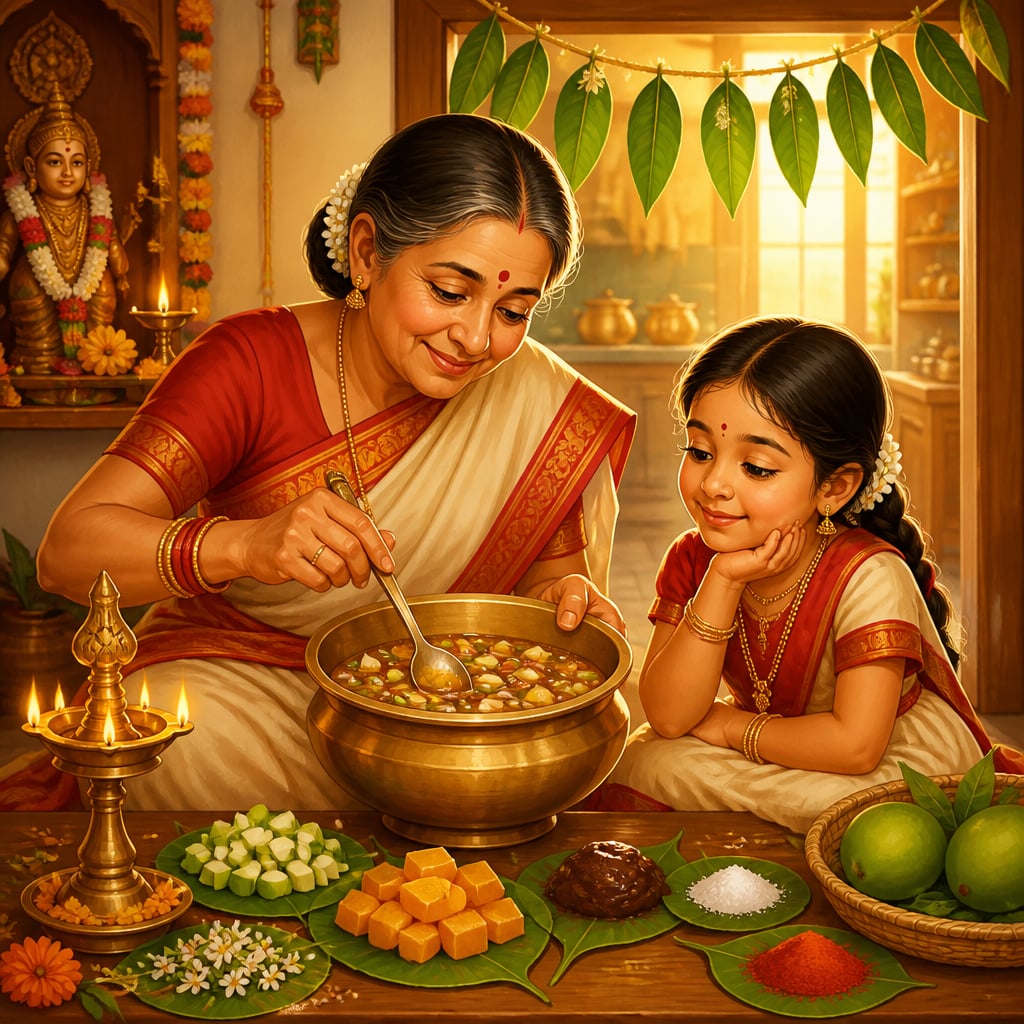
It is five in the morning in a small house in Vijayawada and the paati has already been awake for an hour. The mango leaves are already strung across the doorway. The fresh kolam is already drawn on the threshold with rice flour, the lines crossing and re-crossing into a star at the centre. The brass plate on the kitchen counter holds six small mounds of the Ugadi pachadi: a piece of raw mango, a sliver of neem flower, a small mound of jaggery, a pinch of salt, a wedge of green chilli, and a tablespoon of tamarind paste. The grandchild watches from the doorway and asks, in the tone of an eight-year-old who has been told this is important without being told why, "Paati, why neem? Neem is bitter."
The paati does not pause. "Adigirinchu," she says. Sit down. "Nuvvu konchem antha tinali. Ee samvatsaram lo intha andharu vunnaru." You have to taste a little of all six. This year contains all six tastes. The grandchild does not understand the sentence. The grandchild understands only that the morning is unlike any other morning, that the new calendar opens today, that the panchanga shravanam is at the temple at eleven, and that the rest of the year, on every consequential day, the grandmother will reach into the same kitchen for the same panchanga and ask, what is the tithi.
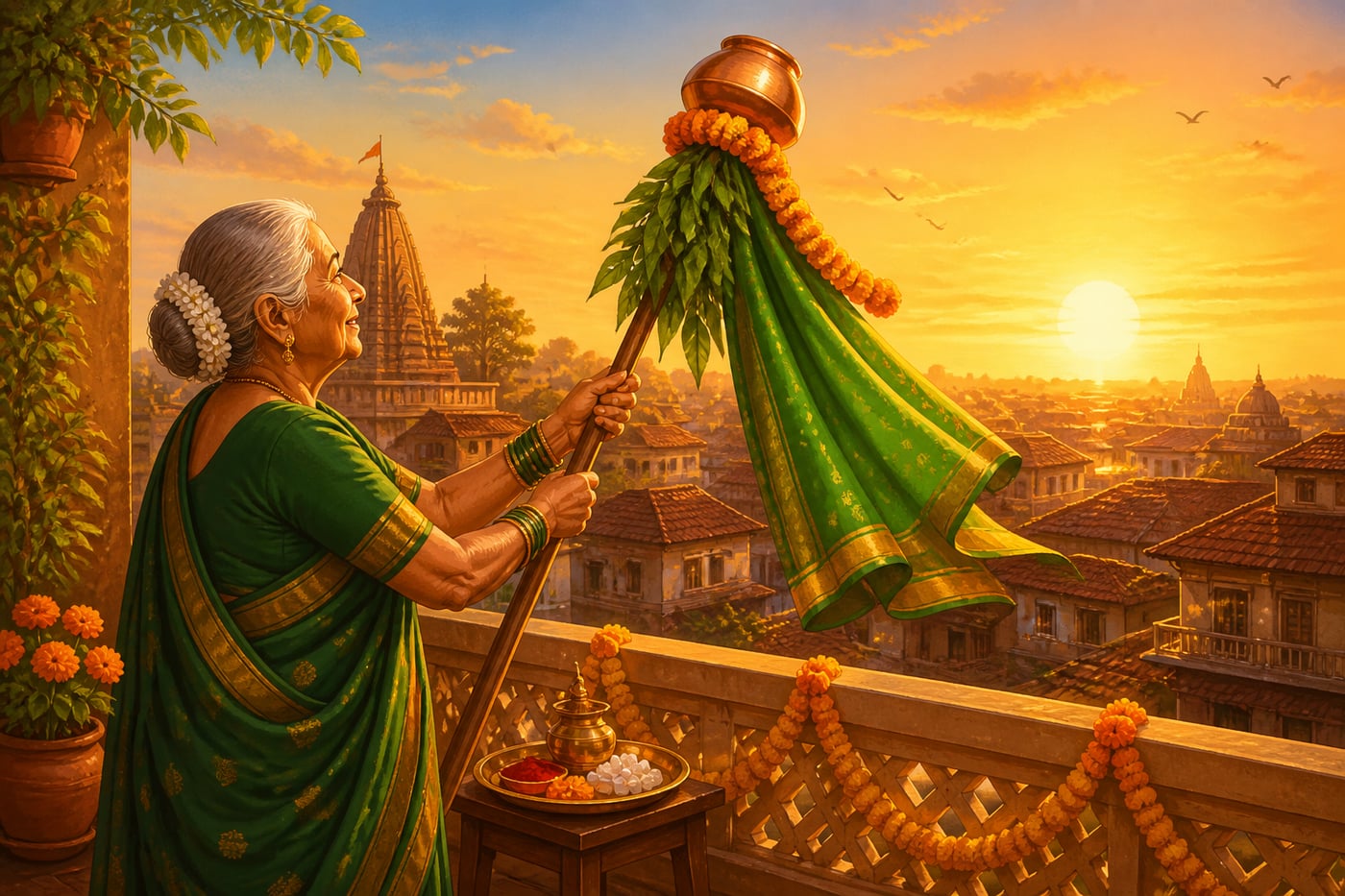
In the same hour, in a house in Pune, the aaji is hoisting the gudi onto the balcony pole: a fresh silk saree-cloth tied at the top of a long bamboo, a copper or silver pot inverted at the very tip, the entire pole lashed against the rail and decorated with mango leaves, marigold, and the batasha sweets. In a house in Coimbatore, the paati has already arranged the kanni tray for the morning: the brass mirror, the new gold ornaments, the betel leaves and areca nuts, the rice grains and a yellow cucumber. The first thing the family will see on opening their eyes is the kanni. In Thrissur, the same arrangement is being done in a house at exactly the same dawn moment, with the same logic but with the konna poo flower (the Cassia Fistula) added because Vishu's principal ritual sight is the konna in bloom. In a Brahmaputra-side household near Guwahati, the family is preparing the seven offerings of bohag bihu for the cow that has carried the family's milk and ploughing across the year that is closing.
The Western reader sees five different families in five different states doing five different rituals. The dharmic reader sees five families doing the same act of opening the new year by the calendar system their grandmothers' grandmothers have run, and sees that the calendar systems are five because the astronomy is five and the astronomy is precise.
This lesson is the explanation no grandmother in any of those five houses paused to give. The dharmic tradition has not one new year but at least five regional new years, each anchored to a different astronomical event, each documented continuously across more than two thousand years, and each carrying its own scripture, its own kitchen, and its own set of receipts.
Why the Year Has More Than One Name
The practice across India. The principal regional new years of the dharmic tradition fall in the spring weeks of March and April, with one (Bihu) extending into mid-April on the solar calendar. The principal observances are five.
Ugadi, the new year of the Telugu and Kannada-speaking world, falls on Chaitra Shukla Pratipada, the first day of the bright fortnight of the lunar month of Chaitra (typically late March or early April on the Gregorian calendar). The day opens the Vikram Samvat lunar year (in the Andhra and Karnataka regional adaptations) and the Salivahana Saka lunar year (more widely used in the Deccan tradition). The principal household ritual is the preparation and consumption of the Ugadi pachadi, the six-flavour mixture that names the year as containing all six emotional registers (the sweet of joy, the bitter of grief, the sour of disappointment, the salt of patience, the spicy of anger, the astringent of surprise). The principal community ritual is the panchanga shravanam, the priestly reading of the year's panchanga at the temple, in which the priest predicts the year's principal astronomical events and reads the new year's deity, regent, and lord.
Gudi Padwa, the new year of the Maharashtrian and Konkani world, falls on the same day as Ugadi: Chaitra Shukla Pratipada, the first day of the bright fortnight of Chaitra. The principal household ritual is the gudi itself: a long bamboo pole with a silk cloth tied at the top, an inverted copper or silver pot at the tip, and decorations of mango leaves and marigold and batasha sweets, hoisted on the household's balcony or veranda from before sunrise. The gudi commemorates Shalivahana's victory over the Sakas in the first century CE and the founding of the Shalivahana Saka era. The morning's first food is the shrikhand with puran poli, the basundi with bhakri, or the regional sweet associated with the household's family tradition.
Puthandu, the Tamil new year, falls on the first of Chithirai in the Tamil solar calendar (typically the fourteenth or fifteenth of April on the Gregorian). The day opens the Tamil solar year, anchored to the entry of the sun into Mesha rashi (Aries). The principal household ritual is the kanni, the auspicious first sight: a brass mirror, fresh fruits (especially the yellow plantain and the mango), gold ornaments, betel leaves and areca nuts, rice grains, and the new year's panchanga, arranged on a tray the night before so that the family's first sight on opening the eyes the next morning is the kanni. The first meal is the mango pachadi, structurally cousin to the Ugadi pachadi though typically with three or six flavours rather than the six-flavour Ugadi standard.
Vishu, the Malayali new year, falls on the same day as Puthandu (the first of Medam in the Malayalam solar calendar, mid-April on the Gregorian), with the same astronomical anchor: the entry of the sun into Mesha rashi. The principal household ritual is the vishukkani, the auspicious first sight, which differs from the Tamil kanni in one signature detail: the konna poo (the Cassia Fistula, the golden shower tree) is the principal floral addition, with its bright yellow blossoms arranged at the centre of the tray alongside the mirror, the gold ornaments, the rice, and the brass uruli holding the auspicious arrangement. The vishukkani is arranged the night before by the senior woman of the household, who covers the eyes of every family member as they enter the room and uncovers their eyes only when they stand directly before the kani. The morning's principal meal is the vishu sadya, the ceremonial banana-leaf feast with the day's specific dishes.
Bihu (specifically Bohag Bihu or Rongali Bihu), the Assamese new year, falls on the first of Bohag in the Assamese solar calendar (mid-April on the Gregorian), with the same astronomical anchor: the entry of the sun into Mesha rashi. Bihu's principal ritual focus is the agricultural year and the cow. The first day, Goru Bihu (literally cow Bihu), is dedicated to the household's cow: the cow is bathed, anointed with turmeric paste and oil, garlanded with fresh flowers, fed special offerings of dighloti and makhioti leaves, and ritually thanked for the year's milk and ploughing. The second day, Manuh Bihu, is the human's day: the family bathes in the maah halodhi (turmeric-and-black-gram paste), wears new gamosa towels, performs the bihu naam songs and the bihu nritya dance, and visits elders to offer the gamosa as a gift. The agricultural calendar of the Assamese year, anchored to the rice-cultivation cycle of the Brahmaputra basin, is encoded in the three Bihus across the year (Bohag Bihu in spring, Kati Bihu in autumn, Magh Bihu in winter); the spring Bihu is the new year proper.
The plurality is not redundancy. The dharmic tradition has not been arguing across two thousand years about which is the correct date for the new year. It has been running multiple precise calendars, each anchored to a different astronomical event, simultaneously. The lunisolar Vikram Samvat (with its own pratipada in Chaitra) and the lunisolar Shalivahana Saka (with its own pratipada also in Chaitra) coexist with the solar Tamil and Malayalam calendars (anchored to the Mesha sankranti) and the Assamese agricultural calendar (also anchored to Mesha sankranti). The Indian National Calendar adopted by the Government of India in 1957 uses the Saka era (78 CE) but with a March 22 (or 21 in leap years) opening date corresponding to the vernal equinox of the sayana system. The dharmic householder is, by structural definition, multilingual in calendars; the calendar's plurality is the calendar's strength.
The Astronomy Behind the Names
The regional new years cluster in the spring weeks because the astronomy clusters there. Two distinct astronomical events occur in this window, and each anchors a different family of calendars.
The first event is Mesha sankranti, the moment the sun enters the rashi (zodiacal sign) of Mesha (Aries) in the nirayana (sidereal) astronomical system. This event, calculated against the actual stars rather than the moving equinox, falls on the fourteenth or fifteenth of April on the Gregorian calendar. Mesha sankranti opens the solar year for Tamil Nadu (Puthandu), Kerala (Vishu), Assam (Bohag Bihu), Punjab (Vaisakhi), and West Bengal (Pohela Boishakh), as well as for several smaller regional calendars. The solar new year is a single sankranti moment, fixed by the sun's actual position against the stars.
The second event is the Chaitra Shukla Pratipada, the first day of the bright fortnight of the lunar month of Chaitra. This event, calculated against the moon's phase rather than the sun's position, falls in late March or early April depending on the year's lunisolar adjustments. Chaitra Shukla Pratipada opens the lunar year for the Andhra-Karnataka belt (Ugadi), the Maharashtrian and Konkani world (Gudi Padwa), the Sindhi tradition (Cheti Chand), and the broader Vikram Samvat tradition that prevails in much of North India for non-new-year purposes. The lunar new year moves by approximately ten or eleven days each Gregorian year, with periodic adhika maas (extra months) inserted to keep the lunar calendar synchronised with the solar year across longer periods.
The coexistence of solar and lunisolar calendars is not a confusion. It is the dharmic householder's standard equipment. The solar calendar anchors agricultural and seasonal practice (when to plant, when to harvest, when the rains arrive). The lunar calendar anchors ritual and festival practice (which tithi for shraddha, which day for ekadashi, which fortnight for Pitru Paksha). The dharmic year is run on both calendars at once, with the priest's panchanga as the daily reconciliation.
The Scripture Behind the Calendars
The Surya Siddhanta, composed in the late-classical period (with surviving recensions dating from approximately the fourth or fifth century CE), is the foundational classical text of the dharmic astronomical tradition. The Surya Siddhanta specifies the calculation of the tithi (the lunar day, defined as the 1/30 division of the synodic month), the nakshatra (the lunar mansion, the 1/27 division of the lunar zodiac), the yoga (the sun-moon angular sum), the karana (half-tithi), and the vara (the seven-day week). The text's calculations of the synodic month length, the sidereal year length, and the precession of the equinoxes are accurate to within seconds per year, with the synodic month given as 29 days, 12 hours, 44 minutes, 2.5 seconds (the modern value is 29 days, 12 hours, 44 minutes, 2.8 seconds: a discrepancy of three-tenths of a second).
The Aryabhatiya of Aryabhata (499 CE) provides the foundational mathematics of the dharmic astronomical tradition. Aryabhata's calculation of the value of pi (3.1416, given to four decimal places), his accurate determination of the sidereal year, his explicit recognition that the earth rotates on its axis (a heliocentric insight he reached approximately a thousand years before Copernicus), and his correct geometric explanation of solar and lunar eclipses as shadow events established the mathematical foundations on which the regional calendars are calculated. The Brihat Samhita of Varahamihira (sixth century CE) extends the application to the panchanga, the ritual calendar, and the muhurta tradition.
ज्योतिषं पञ्चमं वेदम्।
jyotiṣaṃ pañcamaṃ vedam
Astronomy is the fifth Veda.
Vedanga Jyotisha tradition, attributed to Lagadha (c. 1400 BCE)
The single phrase encodes the foundational dharmic claim: jyotisha, the science of light and time, is not an auxiliary discipline. It is the fifth Veda, integral to the practice of the four. The new year cannot be arbitrary; the new year is the calendar's signal, and the calendar's signal is the astronomy's signal. The grandmother in Vijayawada and the grandmother in Pune and the grandmother in Coimbatore and the grandmother in Thrissur and the grandmother in Guwahati are all running the same fifth-Veda discipline on five regional calendars at once.
The Symbolism of the Six Tastes and the Inverted Pot
The Ugadi pachadi's six tastes encode the dharmic teaching that the year contains all six emotional registers and that the householder consents to all six in advance. The six are: the sweet (jaggery, representing joy and prosperity), the bitter (neem flower, representing grief and disappointment), the sour (raw mango, representing surprise and disbelief), the salt (representing patience and equanimity), the spicy (green chilli, representing anger and difficulty), and the astringent (tamarind, representing irritation and the unexpected). The household consumes the pachadi as the year's first food, and the act of consumption is the act of consenting to the year's full spectrum. The year has not been promised to be sweet only. The year has been received as it will arrive.
The gudi of Maharashtra encodes a parallel symbolism through different materials. The bamboo pole is the dhwaja, the flag of victory; the silk cloth is the household's prosperity; the inverted copper or silver pot at the tip is the kalasha of abundance turned to pour; the mango leaves are the auspicious toranam; the marigold is the day's flower of welcome; the batasha sweets are the year's sweetness offered upward to the cosmos before the household consumes it. The gudi is hoisted before sunrise, stays up through the day, and is lowered with a brief prarthana at sunset.

The kanni of Tamil Nadu and the vishukkani of Kerala encode the same logic through a different medium. The first sight of the year must be auspicious, and auspiciousness is composed: gold for prosperity, mirror for self-recognition, fruits for abundance, betel and areca for hospitality, rice for sustenance, panchanga for the year's calendar, and (in Kerala) the konna poo for the season itself. The household covers the eyes of each family member as they enter the kani room and uncovers them only at the threshold of the kani. The first sight is structured. The year is opened with a prepared eye.
The bohag bihu of Assam encodes the agricultural and animal-relational dimension that the urban-Vaishnava-Brahminical calendars typically background. The first day belongs to the cow, who has carried the household's milk and ploughing across the year. The bath, the turmeric, the garland, the dighloti and makhioti offerings, and the explicit thanksgiving to the cow are not symbolic; they are the household's institutional acknowledgement that the year's prosperity has been the cow's labour. The second day belongs to the humans, with the new gamosa, the bihu songs, the bihu dance, and the elder visits. The order is exact: the cow is honoured before the family.
Why the Body Responds: The Habit Architecture of Multiple New Years
The Habit Architecture of having five regional new years across a six-week spring window is unusually well-engineered for the modern question of behavioural change. The cue is precise and astronomical: the moon's phase for the lunar new years, the sun's sankranti for the solar new years, the panchanga for the day's exact muhurta. The routine is the prepared kitchen, the strung mango leaves, the kolam at the threshold, the gudi on the balcony, the kani in the dawn-dark room. The reward is the felt-sense of beginning, the year that has been opened with the structured first food, the structured first sight, the structured first sound of the panchanga shravanam.
The dharmic householder has access to at least five structured behavioural-reset moments per year through the regional new years alone, plus the further reset moments of Sankranti (mid-January), Diwali (autumn, with Bestu Varas as the Gujarati new year), and the various sectarian new years. The Western single-new-year calendar offers one structured behavioural-reset moment per year. The dharmic calendar offers a structured behavioural-reset moment approximately once every six to eight weeks. The institutional architecture of the year is the architecture of repeated, calibrated, structured beginnings.
The behavioural science is exact. Hengchen Dai, Katherine Milkman, and Jason Riis (2014), in Psychological Science, published the foundational study on what they named the fresh start effect: the demonstration that the human nervous system increases commitment to behavioural change by a measurable factor of three to four when the change is initiated at a temporal landmark (a new year, a new month, a birthday, the first day of the week, the first day after a major life event) rather than at an arbitrary day. The 2014 study established that the fresh start effect operates on a cumulative basis: more landmarks produce more reset opportunities; more reset opportunities produce more sustained behavioural change. The dharmic calendar, with its multiple regional new years and its monthly tithi anchors, is the institutional embodiment of the fresh start effect on a calendar that has been running on the principle for two thousand years.
What the Labs Found
The modern psychology and behavioural-economics literature on calendar landmarks and behavioural change converges on what the dharmic calendar has institutionally delivered for two thousand years.
Roy Baumeister and John Tierney, in Willpower (2011), surveyed the broader behavioural-science literature on willpower depletion and behavioural change, establishing that structured external cues (calendar landmarks, social commitment devices, identity anchoring) are among the most reliable interventions for sustained behavioural modification.
Hengchen Dai, Katherine Milkman, and Jason Riis (2014), in Psychological Science (the foundational paper), demonstrated through a series of large-N studies that gym attendance, dietary commitment, and goal-pursuit behaviours all increased measurably (typically by three to four times) at temporal landmarks compared to arbitrary days. The 2014 paper established the term fresh start effect in the psychological literature.
Milkman, Minson, and Volpp (2014) in Management Science extended the framework with their work on temptation bundling, showing that pairing the desired behaviour with a specific calendar moment compounds the fresh start effect. Riis (2017) in Marketing Letters demonstrated that the fresh start effect operates across the lifespan and across cultures, with calendar plurality (multiple landmarks per year) producing measurably better long-term behavioural outcomes than calendar singularity.
Each of these papers is the modern instrumented confirmation of what the dharmic calendar has been institutionally delivering since the late classical period: that structured calendar landmarks, repeatedly across the year, are the architectural backbone of sustained behavioural and ritual practice, and that having more landmarks is structurally superior to having one.
What the World Calls It Now
The Times Square ball drop on the night of the thirty-first of December is the principal Western new year event, drawing approximately one million attendees in person, broadcast to approximately one billion viewers globally, and commanding an estimated five hundred million dollars in associated economic activity. The ball drop has been running annually since 1907. The Gregorian calendar's January 1 new year was, in India, imposed through colonial administration in the nineteenth century: school calendars, government office closures, and official correspondence were all aligned to the Gregorian year, while the regional new years were demoted to private holidays observed at the household level. The colonial calendar imposition is the principal mechanism by which the dharmic plurality of new years was made institutionally invisible to the global media.
Ugadi at the Hyderabad temple complex draws approximately three million temple visitors. Gudi Padwa in Mumbai and Pune draws several million household observances and major civic processions, including the shobha yatra in Girgaon, Mumbai, which alone draws hundreds of thousands. Puthandu in Tamil Nadu's temple cities (Madurai, Tiruchirapalli, Chennai's Mylapore) draws several million. Vishu in Kerala's temples (especially the principal Krishna and Devi temples) draws several million. Bohag Bihu's Guwahati and Brahmaputra-side observances draw further millions. Each of these regional new years independently exceeds the Times Square ball drop in attendance, in age, in scriptural anchoring, and in scale of household observance. None of them receives any significant international media coverage. The receipts are at the household altar.
The modern wellness and behavioural-coaching industry has, in the last decade, begun rediscovering the structural value of multiple calendar landmarks. The "new month, new goals" Instagram aesthetic, with its monthly journal templates and its first-of-the-month commitment posts, is the consumer-marketing version of the fresh start effect. The "birthday-as-reset" wellness coaching trend, with its annual personal new-year retreats priced from five hundred to five thousand dollars, is another. The "Monday morning reset" podcast and newsletter ecosystem, with its first-of-the-week behavioural-change framing, is a third. None of these acknowledges that the structural insight, that calendar plurality is structurally superior to calendar singularity for sustained behavioural change, is what the dharmic year has been institutionally running for two thousand years.
The "manifestation calendar" Instagram trend, with its monthly intention-setting posts tied to lunar and solar events, is the closest direct echo of the dharmic tithi-based ritual calendar. The market for new-year planning kits, paper journals tied to specific calendar landmarks, and goal-setting apps with calendar-landmark integration is estimated at over two billion dollars globally as of 2023. The dharmic householder receives the same architecture, free, on the panchanga that the priest reads at the temple every Ugadi morning.
What to Call It Yourself
Ugadi, Gudi Padwa, Puthandu, Vishu, Bohag Bihu in their Sanskrit and regional names. The lunar new year and the solar new year in unpacked English when the conversation needs the astronomical frame. The acts are not folkloric variants of January 1; they are precise astronomical openings of distinct calendar systems. When the friend says she has set her intentions for the new year on the first of January, the response is one calm sentence. "That is one calendar landmark. I have five."
When the colleague describes a wellness retreat's monthly intention-setting practice, the response names the source. "That is the dharmic tithi-based calendar architecture. The Surya Siddhanta specified the underlying mathematics in the late classical period. Aryabhata calculated the precession of the equinoxes in 499 CE. The fresh start effect that the Dai 2014 paper measured is the science of why having more landmarks works."
The paati's grandchild in Vijayawada, the aaji's grandchild in Pune, the paati's grandchild in Coimbatore, the amma's grandchild in Thrissur, and the aita's grandchild in Guwahati each grow up inside a calendar that opens five times a year by astronomical signal. Each grows up with a fluency the global single-calendar culture does not. The fluency is the point. The plurality is the strength. The receipts are at the threshold, on the gudi pole, in the kani tray, on the cow's garlanded neck, in the six-flavour pachadi the grandmother has prepared since before the grandchild was born.
Key figures
Aryabhata
476 - c. 550 CE
Varahamihira
c. 505 - 587 CE
Hengchen Dai (with Katherine Milkman and Jason Riis)
Born c. 1985; principal published work 2014-present
Case studies
The Saka Era and Kanishka's 78 CE Calendar Reform
In 78 CE, under the Kushan emperor Kanishka, an institutional calendar reform produced the Saka era, the dating system that became, over the subsequent millennium, the foundational anchor for the Salivahana Saka calendar of the Deccan and the broader Saka-tradition new years (Ugadi, Gudi Padwa). The Saka era's adoption was an institutional decision: the Kushan empire, ruling across Central Asia, the northwestern subcontinent, and parts of the Gangetic plain, adopted the era as the official imperial dating system; the era's institutional prestige carried across the subsequent dynasties. The Salivahana Saka tradition adds a layer: in the first or second century CE, the legendary king Shalivahana defeated the Sakas and established the Salivahana Saka era starting from approximately 78 CE; the Gudi of Gudi Padwa commemorates this victory specifically, with the bamboo-and-cloth dhwaja symbolising Shalivahana's flag of victory hoisted at the household level. The plurality of the dharmic regional new years (Ugadi, Gudi Padwa following the Saka tradition; Puthandu, Vishu, Bihu following the solar Mesha sankranti tradition; Vikram Samvat in northern India following a parallel lunar tradition; the Indian National Calendar's 1957 Saka adoption) reflects two thousand years of layered calendar institutionalisation, with each layer preserving its own astronomical anchor and its own household ritual sequence. The Indian National Calendar adopted by the Government of India in 1957 uses the Saka era explicitly, with March 22 (or 21 in leap years) as the year's opening date corresponding to the vernal equinox of the sayana system.
The plurality of the dharmic new years is not confusion or inconsistency. It is the layered institutional record of two thousand years of careful calendar science. The Saka era institutionalised in 78 CE coexists with the Vikram Samvat (with its own lunar Pratipada), with the regional solar calendars (anchored to the precise Mesha sankranti), with the Buddhist Vesak and Mahavir Jayanti calendars, and with the various sectarian and regional festival calendars. The dharmic householder is, by structural definition, multilingual in calendars; the calendar's plurality is the calendar's strength. The Surya Siddhanta and the Aryabhatiya provided the mathematical foundations on which all the regional calendars are calculated; the Brihat Samhita's panchanga chapters are the foundational textual source for the panchanga-makers' tradition that has continued unbroken across the subsequent fifteen centuries. The receipts for the calendar's astronomical precision are in the late-classical texts.
The Saka era's 78 CE foundation has been preserved continuously across two thousand years through institutional adoption (Kushan, Gupta, Pallava, Chola, Vijayanagara, Maratha, modern Government of India), through textual codification (the panchanga-makers' tradition deriving from the Surya Siddhanta and the Brihat Samhita), and through household and community practice (Ugadi, Gudi Padwa, the regional new year observances). The plurality of the dharmic regional new years is the institutional embodiment of two thousand years of layered calendar science. The 1957 Indian National Calendar adoption gave the Saka era a renewed civil status alongside the regional calendars and the Gregorian.
India has multiple new years because India has multiple precise astronomical traditions. The plurality is the documented record of two thousand years of careful calendar science, not the residue of regional disagreement. The Surya Siddhanta specified the synodic month length to within three-tenths of a second of the modern value. Aryabhata calculated the Mesha sankranti's astronomical anchor in 499 CE. Varahamihira's Brihat Samhita is the foundational text of the panchanga-makers' tradition that has continued unbroken across fifteen centuries. The receipts for the calendar's precision are in the late-classical texts. The receipts for the calendar's continuity are in the household kitchen on Ugadi morning, on the gudi pole on Gudi Padwa morning, on the kani tray on Vishu morning, on the cow's garlanded neck on Goru Bihu morning.
Every modern claim that India's regional new years reflect cultural confusion or geographic inconsistency can be answered with one citation. The plurality is the documented record of two thousand years of layered calendar science. The Saka era was institutionalised in 78 CE; the Aryabhatiya's calculations are 499 CE; the regional new years are precise astronomical signals of distinct calendar systems running simultaneously. The dharmic householder lives inside multiple calendars at once and reads them all on the panchanga. The colonial-administrative imposition of January 1 as the single new year is the recent intrusion, not the regional plurality.
The Saka era was institutionalised in 78 CE under the Kushan emperor Kanishka and adopted across the subsequent dynasties as the foundational dating system of the Deccan and broader subcontinental tradition. The Salivahana Saka tradition specifically commemorates Shalivahana's victory over the Sakas in the same period; the Gudi of Gudi Padwa is the household-level commemoration. The Indian National Calendar adopted by the Government of India in 1957 uses the Saka era as its official secular calendar. The era is approximately 1,948 years old as of 2026 CE.
The Times Square Ball Drop ($500M Annual Event) and the Invisible 3 Million at Ugadi
The Times Square ball drop on the night of the thirty-first of December has run annually in New York since 1907 and has become the principal Western new year event. The ceremony draws approximately one million attendees in person, is broadcast to approximately one billion viewers globally through major television networks (ABC, NBC, CBS, Fox), and commands an estimated five hundred million dollars in associated economic activity (television production, advertising, hospitality, tourism, retail, and security). The Gregorian January 1 new year was, in India, imposed through colonial administration in the nineteenth century: school calendars, government office closures, and official correspondence were all aligned to the Gregorian year, while the regional new years were demoted to private holidays observed at the household level. The post-independence Indian state's continued use of the Gregorian calendar for administrative purposes (alongside the 1957 adoption of the Indian National Saka Calendar for secular purposes) has preserved the colonial calendar imposition into the present. Meanwhile, Ugadi at the Hyderabad temple complex draws approximately three million temple visitors. Gudi Padwa in Mumbai and Pune draws several million household observances and major civic processions, including the Girgaon shobha yatra in Mumbai, which alone draws hundreds of thousands. Puthandu in Tamil Nadu's temple cities draws several million. Vishu in Kerala's temples draws several million. Bohag Bihu's Guwahati and Brahmaputra-side observances draw further millions. Each of these regional new years independently exceeds the Times Square ball drop in attendance. The combined dharmic regional new year observances exceed the Times Square ball drop by an order of magnitude. None of the regional new years receives any significant international media coverage.
The Times Square ball drop and the dharmic regional new years are not in competition. The ball drop is a one-day commercial-civic event of approximately a century's standing. The regional new years are precise astronomical openings of calendar systems documented continuously across two thousand years. The dharmic frame's response to the global media's overwhelming coverage of one and near-zero coverage of the other is not grievance; the response is naming. Use Ugadi, not 'Telugu and Kannada new year'. Use Gudi Padwa, not 'Maharashtrian new year'. Use Puthandu and Vishu and Bohag Bihu in their own names. Each regional new year is the institutional opening of a calendar that the panchanga-makers and the household priests and the grandmothers have run continuously since long before the Times Square ball drop existed as a category. The receipts are at the threshold.
The colonial calendar imposition succeeded in establishing the Gregorian January 1 as the official Indian administrative new year and in displacing the regional new years to the private and household sphere. The post-independence Indian state has partially reversed this through the 1957 Indian National Saka Calendar adoption and through the institutional recognition of the regional new years as state holidays in their respective states. The household and community practice has continued unbroken: Ugadi, Gudi Padwa, Puthandu, Vishu, Bohag Bihu have all been preserved in continuous household practice across the colonial and post-independence periods. The global media has overwhelmingly continued to cover the Times Square ball drop while ignoring the regional new years; the imbalance is the most documented modern case of the dharmic calendar's plurality being made institutionally invisible despite vastly exceeding the Western single-new-year event in attendance, age, and scriptural anchoring.
The market and the global media reward the rebrander, not the source. The dharmic household's job is not to argue with the Times Square ball drop. The job is to use the original names. Ugadi, Gudi Padwa, Puthandu, Vishu, Bohag Bihu in their own languages and their own astronomical systems. When the colleague at the office wishes you a happy new year on January 1, the response is one calm sentence: 'Thank you. My new year is Ugadi, in March or April depending on the lunar Chaitra Pratipada. We are running an older and more astronomically precise calendar.' Talapatram's Sanatan Operating System course, in this lesson, is filing the receipt.
Use the original names in conversation. When the friend wishes you happy new year on January 1, you note that your new year is Ugadi or Gudi Padwa or Puthandu or Vishu or Bohag Bihu, falling in March or April by the panchanga's calculation. When the corporate calendar at the office shows only Gregorian holidays, you note that the regional new year is the actual reset moment in your calendar architecture. When the global media covers the Times Square ball drop, you note that Ugadi at Hyderabad outdraws Times Square three to one and is approximately twenty times older. The receipts are at the threshold. The naming completes the loop.
The Times Square ball drop draws approximately one million in-person attendees, is broadcast to approximately one billion viewers globally, and commands approximately five hundred million dollars in associated economic activity. Ugadi at the Hyderabad temple complex alone draws approximately three million temple visitors. The combined regional new year observances across India draw an estimated several tens of millions in temple and household observances annually. The international media's coverage of the regional new years is approximately zero to two orders of magnitude smaller than its coverage of the Times Square ball drop, despite the regional events vastly exceeding the ball drop in attendance, age, and scriptural anchoring.
Dai et al 2014 and the Fresh Start Effect: The Behavioural Vindication of Calendar Plurality
In 2011, Roy Baumeister and John Tierney published Willpower, surveying the broader behavioural-science literature on willpower depletion and behavioural change and establishing that structured external cues (calendar landmarks, social commitment devices, identity anchoring) are among the most reliable interventions for sustained behavioural modification. In 2014, Hengchen Dai, Katherine Milkman, and Jason Riis published the foundational paper 'The Fresh Start Effect: Temporal Landmarks Motivate Aspirational Behavior' in Psychological Science, demonstrating through a series of large-N studies (gym attendance data from a major US university; Google search data for goal-related queries; experimental commitment data) that the human nervous system increases commitment to behavioural change by a measurable factor of three to four when the change is initiated at a temporal landmark (a new year, a new month, a birthday, the first day of the week, the first day after a major life event) rather than at an arbitrary day. The 2014 paper named the fresh start effect, established the term in the psychological literature, and provided the first systematic measurement of the phenomenon. The 2015 follow-up extended the framework with the demonstration that landmarks help people 'put imperfections behind' them by signalling the start of a new period; the 2017 Marketing Letters extension established that the fresh start effect operates across the lifespan and across cultures, and that calendar plurality (multiple landmarks per year) produces measurably better long-term behavioural outcomes than calendar singularity. Together, this body of work is the modern instrumented confirmation of what the dharmic calendar has held for two thousand years: that a calendar with five regional new years plus monthly tithi anchors plus bi-monthly Ekadashi reset moments plus the various sectarian and regional festival anchors is structurally superior to a calendar with one new year per year.
The dharmic calendar architecture, as articulated in the Vedanga Jyotisha tradition, codified in the Surya Siddhanta and the Aryabhatiya and the Brihat Samhita, and institutionalised in the regional new years and the panchanga-makers' tradition, treats calendar plurality as structurally superior to calendar singularity. The reasoning is exact and scientific. Each regional new year is anchored to a different astronomical event (the Mesha sankranti for the solar new years, the Chaitra Shukla Pratipada for the lunar new years), each new year offers a structurally distinct behavioural-reset opportunity (the agricultural reset of Bohag Bihu, the household reset of Gudi Padwa, the Vedic-Brahminical reset of Ugadi with the panchanga shravanam), and the household lives inside multiple calendars at once. The Dai 2014 paper is the modern laboratory measurement of why the architecture works. The receipts for the calendar plurality's behavioural effectiveness are the Surya Siddhanta and the Brihat Samhita; the modern instrumented confirmation is the Psychological Science 2014 paper. The two records, separated by two thousand years, point to the same underlying structure of human behavioural change.
The fresh start effect literature has, in the last decade, broadly confirmed the structural insight the dharmic calendar institutionalised since the Vedanga Jyotisha period. The Dai 2014 paper, the 2015 Psychological Science follow-up, the 2017 Marketing Letters extension, and the broader behavioural-economics and behavioural-coaching literature have established that calendar plurality is structurally superior to calendar singularity for sustained behavioural change. The modern wellness and behavioural-coaching industry has begun rediscovering this structural insight through the 'new month, new goals' Instagram aesthetic, the 'birthday-as-reset' wellness coaching trend, the 'Monday morning reset' podcast and newsletter ecosystem, and the 'manifestation calendar' Instagram trend. The market for new-year planning kits, paper journals tied to specific calendar landmarks, and goal-setting apps with calendar-landmark integration is estimated at over two billion dollars globally as of 2023. The dharmic householder receives the same architecture, free, on the panchanga that the priest reads at the temple every Ugadi morning and that the grandmother consults at the household altar across the year.
The case for the tradition does not need to wait for the lab. The lab, when it arrives, will confirm what the tradition recorded. The Vedanga Jyotisha specified the calendar's authority in approximately 1400 BCE. The Surya Siddhanta codified the panchanga's calculations in the late classical period. Aryabhata established the Mesha sankranti's astronomical anchor in 499 CE. Varahamihira's Brihat Samhita is the foundational text of the applied panchanga tradition. Hengchen Dai and Katherine Milkman published the foundational fresh start effect paper in Psychological Science in 2014. Three independent records, two thousand years apart, point to the same underlying structure: calendar plurality with multiple precise astronomical anchors produces measurably better behavioural outcomes than calendar singularity with one arbitrary administrative date. The behavioural-economics literature is doing serious good work. The dharmic calendar is the structural source.
Three thousand four hundred years of calendar science, two thousand years of textual codification, and over a decade of modern fresh start effect research all point to the same architecture. The grandmother in Vijayawada does not need to read Hengchen Dai. She has been running the architecture across the household calendar across her lifetime. The fresh start effect literature and the dharmic regional new year tradition are not in competition. They are the same insight, two thousand years apart, with one of them carrying the integrated architecture the other is reassembling, paper by paper. The plurality is the strength. The receipts are at the threshold.
Roy Baumeister and John Tierney published Willpower in 2011. Hengchen Dai, Katherine Milkman, and Jason Riis published 'The Fresh Start Effect' in Psychological Science in 2014, establishing the phenomenon's measurement at a factor of three to four times increased commitment at calendar landmarks. The 2015 Psychological Science follow-up and the 2017 Marketing Letters extension established that the effect operates across cultures and across the lifespan and that calendar plurality produces measurably better long-term outcomes than calendar singularity. The Vedanga Jyotisha specified the underlying calendar science in approximately 1400 BCE, approximately 3,400 years earlier. The Vedanga Jyotisha is mentioned in zero of the principal English-language fresh start effect, behavioural-economics, or wellness-coaching curricula.
Historical context
Vedic calendar foundations (c. 1400 BCE Vedanga Jyotisha) through the late-classical astronomical synthesis (Surya Siddhanta c. 4th-5th century CE, Aryabhata 499 CE, Varahamihira 6th century CE), the institutionalisation of the regional calendars (8th-15th centuries), the colonial imposition of the Gregorian calendar (19th century), the Indian National Calendar adoption (1957), and the modern fresh start effect research (2011-present)
The integrated regional new year tradition is one of the most stable and most plural institutions in Indian civilisation. Across two thousand years, through the late-classical, Pala, Chola, Vijayanagara, Mughal, Maratha, and modern periods, the regional calendars have been institutionally preserved in continuous household and temple practice. The Saka era's introduction in 78 CE under Kanishka and the Salivahana Saka's institutionalisation across the Deccan provided the foundational dating system for Ugadi and Gudi Padwa. The Tamil and Malayalam solar calendars, anchored to the Mesha sankranti, were institutionalised through the panchanga-makers' tradition of South India and the Madhava-of-Sangamagrama school's mathematical refinements in the fourteenth and fifteenth centuries. The Assamese Bohag Bihu, anchored to the same Mesha sankranti but woven into the agricultural cycle of the Brahmaputra basin's rice cultivation, was institutionalised through the Ahom-period state patronage and the household and village-festival traditions. The Indian National Calendar's 1957 adoption gave the Saka era a renewed civil status alongside the regional calendars and the Gregorian. The colonial imposition of the Gregorian January 1 new year demoted the regional new years to private holidays in the official sphere while the household and community traditions continued unbroken. The modern global media's overwhelming coverage of the Times Square ball drop and the Gregorian new year, alongside near-zero coverage of Ugadi (3 million temple visitors at Hyderabad alone), Puthandu (several million observances across Tamil Nadu), Vishu (several million across Kerala), Gudi Padwa (several million across Maharashtra), and Bohag Bihu (several million across Assam), is the most documented modern case of the dharmic calendar's plurality being made institutionally invisible despite vastly exceeding the Western single-new-year event in attendance, age, and scriptural anchoring. The dharmic householder's job is small and clear: keep running the regional calendar that the household has always run, keep teaching the grandchildren the kolam and the gudi and the kani and the goru bihu offerings, and keep the panchanga at the threshold so the year's first reading is fifth-Veda discipline rather than colonial-administrative habit.
Living traditions
The integrated regional new year tradition is no longer a Hindu tradition that the modern world is unaware of. The Times Square ball drop is the Western single-new-year benchmark, drawing approximately one million attendees and commanding approximately five hundred million dollars in associated economic activity, while Ugadi at Hyderabad alone draws approximately three million temple visitors with near-zero international media coverage. The modern wellness and behavioural-coaching industry's rediscovery of the structural value of multiple calendar landmarks, through the 'new month, new goals' Instagram aesthetic, the 'birthday-as-reset' wellness coaching trend, the 'Monday morning reset' podcast and newsletter ecosystem, the 'manifestation calendar' Instagram trend, and the over-two-billion-dollar global market for new-year planning kits and goal-setting apps with calendar-landmark integration, is the modern echo of what the dharmic calendar has been institutionally running for two thousand years. The Dai 2014 fresh start effect paper and the broader behavioural-economics literature is the modern instrumented confirmation. The dharmic tradition's job is small and clear. When the conversation reaches for January 1 as the new year, you say Ugadi or Gudi Padwa or Puthandu or Vishu or Bohag Bihu, depending on the regional tradition. When the conversation reaches for monthly-intention calendars and birthday-reset coaching, you say the dharmic panchanga has been delivering the multi-landmark architecture, free, on the daily temple calendar for two thousand years. The Surya Siddhanta, the Aryabhatiya, and the Brihat Samhita are the textual anchors; the panchanga-makers' tradition is the continuous priestly transmission; the household kitchen on Ugadi morning is the living embodiment. Use the names. The labs have arrived. Aryabhata calculated the Mesha sankranti's astronomical anchor in 499 CE, fifteen hundred years before Hengchen Dai measured the fresh start effect. The Saka era was institutionalised in 78 CE, almost two thousand years before the Times Square ball drop existed as a category. Talapatram's Sanatan Operating System course, in this lesson and in the broader Gurukul, is the manual for the integrated calendar architecture the dharmic household has always run. Every Ugadi, every Gudi Padwa, every Puthandu, every Vishu, every Bohag Bihu, every receipt.
- Ugadi and Gudi Padwa: The Lunar New Year Across the Saka Tradition: The integrated household and community practice of opening the lunar new year on Chaitra Shukla Pratipada in the Telugu, Kannada, Marathi, and Konkani worlds. In the Andhra-Telangana-Karnataka belt, the Ugadi observance includes the pre-dawn household awakening, the stringing of the mango leaf toranam at the doorway, the drawing of the Ugadi kolam at the threshold, the preparation and consumption of the six-flavour Ugadi pachadi (raw mango, neem flower, jaggery, salt, green chilli, tamarind), the household puja, and the community panchanga shravanam at the temple in mid-morning when the priest reads the year's panchanga and predicts the year's principal astronomical events and seasonal forecasts. In the Maharashtrian-Konkani belt, the Gudi Padwa observance includes the pre-dawn household awakening, the hoisting of the gudi (the bamboo pole with silk cloth and inverted copper or silver pot at the tip, decorated with mango leaves, marigold, and batasha sweets) on the household balcony or veranda, the household puja, the morning's first meal of shrikhand and puran poli or basundi and bhakri, and the community shobha yatra processions in the major Maharashtrian cities. The day commemorates Shalivahana's victory over the Sakas and the founding of the Salivahana Saka era.
- Puthandu and Vishu: The Solar New Year of Tamil Nadu and Kerala: The integrated household and community practice of opening the solar new year on the Mesha sankranti (the first of Chithirai in the Tamil solar calendar, the first of Medam in the Malayalam solar calendar, falling on the fourteenth or fifteenth of April on the Gregorian). In Tamil Nadu, the Puthandu observance includes the pre-dawn household awakening, the arrangement of the kanni tray (brass mirror, fresh fruits including the yellow plantain and the mango, gold ornaments, betel leaves and areca nuts, rice grains, the new year's panchanga, all on a brass plate or tray), the family's first sight of the kanni on opening their eyes, the household puja, the first meal of mango pachadi (the Tamil cousin of the Ugadi pachadi, typically with three or six flavours), and the community observances at the temple cities (Madurai's Meenakshi Temple, Tiruchirapalli's Srirangam, Chennai's Mylapore Kapaleeswarar). In Kerala, the Vishu observance includes the pre-dawn household awakening, the arrangement of the vishukkani on the brass uruli (the brass mirror, the gold ornaments, the rice, the fruits, the panchanga, and the konna poo at the centre), the family's first sight of the vishukkani with the senior woman covering and uncovering each family member's eyes, the kaineettam (the elder's gift of money to the younger family members), the morning's vishu sadya (the ceremonial banana-leaf feast), and the community observances at the principal Krishna and Devi temples (the Guruvayur Krishna Temple, the Padmanabhaswamy Temple at Thiruvananthapuram).
- Bohag Bihu: The Agricultural New Year of Assam: The integrated household, agricultural, and community practice of opening the new year on the Mesha sankranti in the Brahmaputra basin of Assam. The Bohag Bihu sequence runs across seven days, with the principal observances on the first two: Goru Bihu (the cow's day, on the last day of the closing year, the day before Mesha sankranti) and Manuh Bihu (the human's day, on the first day of the new year, the Mesha sankranti itself). On Goru Bihu, the household's cow is bathed in the river, anointed with turmeric paste and oil, garlanded with fresh flowers, fed special offerings of dighloti (Litsea monopetala) and makhioti (Flemingia strobilifera) leaves, and ritually thanked for the year's milk and ploughing; the cow is hit gently with the dighloti and makhioti branches in a symbolic act of removing the old year's accumulated misfortunes from her body. On Manuh Bihu, the family bathes in the maah halodhi (the turmeric-and-black-gram paste), wears new gamosa towels (the red-bordered cotton handwoven cloth that is the principal symbol of Assamese culture), performs the bihu naam songs and the bihu nritya dance (the celebrated Assamese folk dance with the dhol drum, the pepa horn, the gogona jaw harp, and the toka bamboo clapper), visits elders to offer the gamosa as a gift, and consumes the day's specific dishes (jolpan, pitha, laru, tilor laru). The week-long sequence continues with Gosain Bihu (the household altar's day), Taatar Bihu (the loom's day), Kutum Bihu (the relatives' day), and Senehi Bihu (the lovers' day, with the bihu naam songs traditionally exchanged between courting youth).
- The Ugadi Panchanga Shravanam at the Hyderabad and Vijayawada Temple Complexes: The principal urban observance centres of Ugadi in the Telugu-speaking world. The Bhagyanagar Mahankali Temple in Hyderabad, the Bhadrachalam Sri Sita Ramachandraswamy Temple's satellite observances across Hyderabad, and the Kanaka Durga Temple at Vijayawada are the principal sites for the community panchanga shravanam on Ugadi morning. The combined observance across the Hyderabad-Vijayawada-Tirupati corridor draws approximately three to five million temple visitors on Ugadi day, with the panchanga shravanam beginning at approximately ten in the morning and continuing through the early afternoon. The priest reads the year's full panchanga (the year's deity, regent, and lord; the predictions for the rains, the harvests, and the principal astronomical events; the eclipses, the principal sankrantis, and the auspicious muhurtas), with the recitation in Telugu or Sanskrit and the community gathering on the temple's outer courtyards to listen. The Vijayawada Kanaka Durga Temple's panchanga shravanam, conducted on the Indrakeeladri hill overlooking the Krishna river, is one of the most institutionally established panchanga readings in South India.
- The Gudi Padwa Shobha Yatra at Girgaon, Mumbai: The principal urban civic observance of Gudi Padwa in Maharashtra. The Girgaon shobha yatra is an annual procession through the historic Girgaon neighbourhood of South Mumbai on Gudi Padwa morning, drawing several hundred thousand participants and viewers. The procession opens at sunrise with the hoisting of the principal civic gudi at the Girgaon Chowpatty, proceeds through the historic streets of Girgaon (Khotachi Wadi, Mugbhat Lane, Kandewadi), and concludes at the Wilson College area in the late morning. The procession includes drumming by the dhol-tasha pathaks (the Maharashtrian percussion ensembles), the lezim dance traditions, traditional Maharashtrian dress (the nauvari saree for women, the dhoti and pheta for men), the symbolic display of household gudis, and the community distribution of shrikhand and puran poli sweets. The Girgaon shobha yatra has run annually since the 1990s as a community-led civic revival and has become the institutional flagship of the urban Gudi Padwa tradition.
- The Vishukkani at the Guruvayur Sri Krishna Temple, Kerala: The principal Vaishnava temple observance of Vishu in Kerala. The Guruvayur Sri Krishna Temple, dedicated to Krishna in the form of Vishnu's child manifestation, is the foremost Vaishnava temple of Kerala and one of the most important Krishna temples in India. The temple's vishukkani arrangement on Vishu morning is regarded as the institutional template for the household vishukkani across Kerala: the brass uruli with the konna poo at the centre, the brass mirror, the gold ornaments, the rice and the fruits, the panchanga, and the small Krishna murti as the central deity figure. The temple receives approximately one to two million darshan-seekers across the Vishu day, with the principal kani-darshan at sunrise drawing the longest queues. The temple's strict darshan rules (no photography, traditional Kerala dress for men, no shirt for males above the waist in the inner sanctum) are preserved on Vishu as on every other day. The temple's elephants, the famous Guruvayur Aanas, participate in the day's processional observances.
Reflection
- Of the dharmic regional new years (Ugadi, Gudi Padwa, Puthandu, Vishu, Bohag Bihu) and the further calendar landmarks (Sankranti, Bestu Varas, the monthly Sankashti and Ekadashi), which do you currently observe and which do you not? What would change in your year if you began treating each landmark as a structured behavioural-reset moment rather than as a folkloric or family observance?
- The Aryabhatiya was composed in 499 CE. The Hengchen Dai et al fresh start effect paper was published in 2014. Both records identify the same core architecture: that the year initiated at a precise temporal landmark with a structured first act produces measurably better behavioural outcomes than the year initiated at an arbitrary day. What does it mean that two cultures, separated by fifteen centuries and by entirely different methods (astronomical mathematics and behavioural-economics laboratory measurement), arrived at the same structural insight?
- The dharmic calendar is plural by design. The Western single-new-year calendar is singular by design. Each design encodes a different assumption about human nature: the dharmic assumption is that the year requires multiple structured resets across its duration; the Western assumption is that one structured reset at the year's start is sufficient. What does the plural design assume about the human that the singular design does not? What is gained by living inside multiple calendars at once?