Seasonal Vrats

Shravan, Kartik, Margashirsha, and Magh: how Hindu civilisation engineered four seasonal disciplines to align the body, the kitchen, and the calendar with the changing year

Four months across the Hindu year carry a particular weight. Shravan in the rains, Kartik in the autumn, Margashirsha in the early winter, and Magh in the deep winter. Each is held to be a sacred month. Each carries its own diet, its own discipline, its own deity, and its own behavioural reset. This lesson opens the four seasonal vrats: what is observed, where the practices live today, what the scripture says, why the body responds, and how the modern wellness industry is now selling Dry January and seasonal cleanses to a world that lost the names of months that were already doing the work.

A Pune Kitchen, the First Monday of Shravan
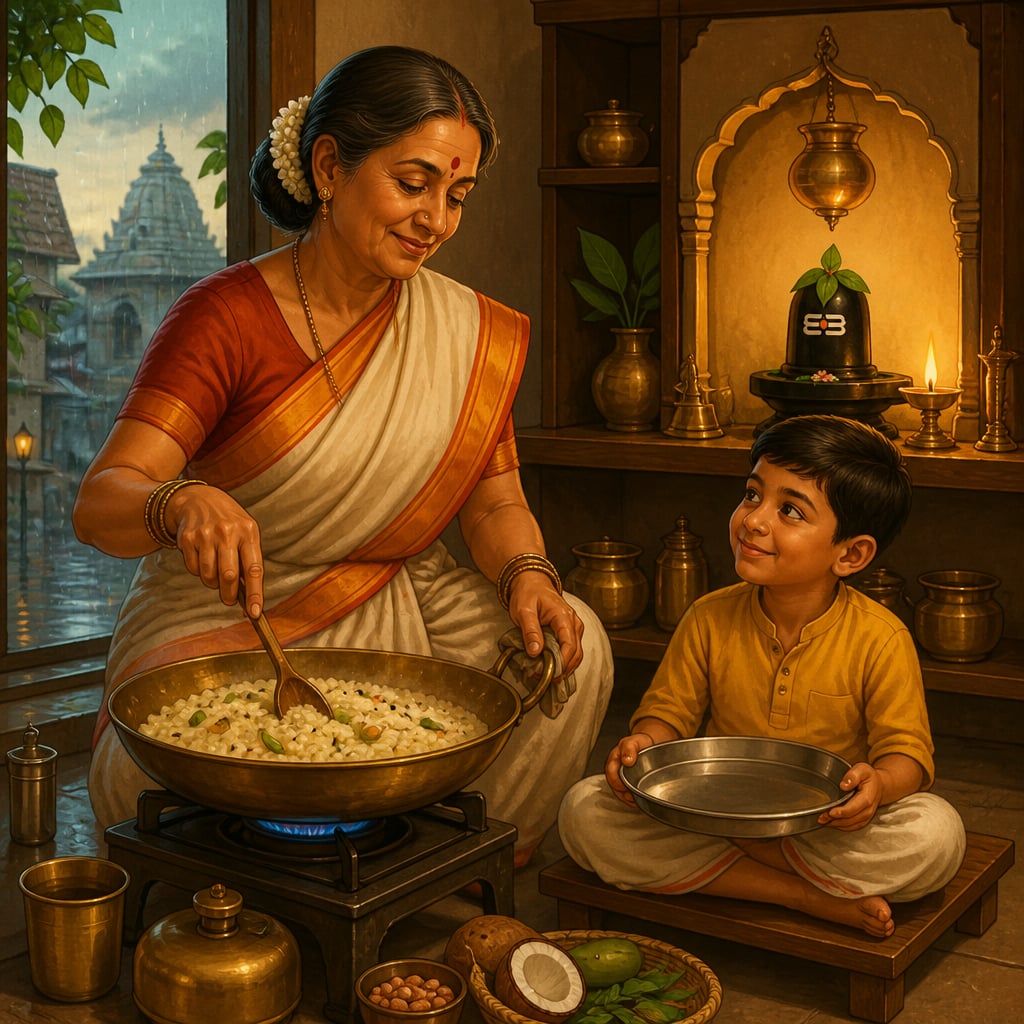
Pune grandmother cooking the first Monday Shravan breakfast

In a small house in Sadashiv Peth in Pune, the first Monday of Shravan begins before sunrise. The grandmother is up at five. The brass diya at the home altar is lit. The thali for the morning Shiva puga is set out: bel patra, white flowers, a small copper pot of Ganga water, a fresh rudraksha mala. The kitchen has been quietly reorganised overnight. The onion basket has been moved to the back of the pantry. The garlic has been wrapped in a cloth. The non-vegetarian shop down the lane has lost half of this household's custom for the next thirty days.

The grandson, eight years old, comes into the kitchen and asks why there is no egg for breakfast this Monday when there was one last Monday. The grandmother, without looking up from the stove, says one word. Shravan. She does not explain further. She offers him a banana and a glass of warm milk with a pinch of saffron. He accepts. He goes back to the front room where his grandfather, freshly bathed, is reciting the Mahamrityunjaya mantra at the small Shiva linga on the puja shelf. The boy joins. Outside, the monsoon rain has not stopped for three days. The street is half-flooded. The neem tree at the corner is dripping into the gutter.

For the next thirty days, this house will eat differently, sleep differently, count differently, and pray differently from the eleven months that bracket it. The grandson does not yet know that what he is watching is a four-thousand-year-old protocol for adapting a household to a season. He will learn the word for it later. Vrata. A vow. A discipline. A timed re-tuning of body and behaviour to the changing year.

The Practice, Across India

The Hindu calendar identifies four months as carrying special weight, each tied to a particular deity, a particular diet, and a particular behavioural code. The four together cover the back half of the year, from the heart of the monsoon to the depth of winter.

Shravan falls in July or August, the deepest stretch of the monsoon. It is the month of Shiva. Across Maharashtra, north and central India, devotees fast on Mondays, abstain from non-vegetarian food, onion, and garlic for the entire month, and visit Shiva temples for abhisheka with milk, water, and bel patra. The Kanwariya pilgrimages of north India, with their saffron-clad walkers carrying Ganga water on shoulder poles, fall inside Shravan. In Tamil Nadu and parts of the south, the parallel month of Aadi carries similar Devi-centred observances.

Kartik falls in October or November, the cool brightness after the rains. It is sacred to Vishnu and to Damodara, the bound child Krishna. The classical observance is Kartik snan, a daily pre-dawn dip in the Ganga or the local river, daily lighting of an akasha deepa, a sky lamp on a high pole at the home or the temple, and the recitation of the Vishnu Sahasranama. Tulsi vivaha, the ceremonial marriage of the tulasi plant to Krishna, marks the close of the chaturmas at the Prabodhini Ekadashi inside Kartik. Diwali sits in this month. So does the great Pushkar Mela in Rajasthan.

Margashirsha, also called Agrahayana, falls in November or December. Krishna identifies it in the Bhagavad Gita 10.35 as maso margashirsho aham, of the months I am Margashirsha. It is the month of new harvests. The classical observance includes daily Vishnu puja, the singing of the Tiruppavai by Andal across the Sri Vaishnava world, and the start of long pilgrimage journeys before the deeper cold sets in. In Tamil Nadu, the corresponding month of Margazhi is one of the most musically alive months in any culture, with the Madras Music Season anchored to it.

Magh Mela tent city at Prayagraj at first light

Magh falls in January or February, the depth of winter and the season of the Magh Mela at Prayagraj where the Ganga, Yamuna, and the unseen Saraswati meet. The classical observance is the Magh snan, the cold pre-dawn river bath at the Sangam, the daily recitation of the Surya stotras as the sun begins its return north, and dietary lightness as the body prepares to shed the heaviness of winter. The full Kalpavasa, the month-long encampment at the Sangam by tens of thousands of pilgrims who eat one meal a day and bathe daily in the cold river, is the most disciplined form of the Magh vrata.

Each of the four months has its own diet, its own deity, its own preferred mantra, and its own behavioural code. None is identical. None is incidental. Each lands at a specific point in the seasonal cycle, prescribes a specific reset, and is practised by tens of millions of households today.

The Scripture Says

The scriptural authorisation for the seasonal vrata begins with Krishna's own self-identification with one of the four months.

मासानां मार्गशीर्षोऽहम्

māsānāṃ mārgaśīrṣo'ham

Of all months, I am Margashirsha.

Bhagavad Gita 10.35

In the Vibhuti Yoga, where Krishna names himself among the highest exemplars across categories, he chooses Margashirsha among months. The verse is brief. Its consequences are not. To say that a month is Krishna is to say that the time itself is divine, that the calendar is not a neutral container of human activity, and that certain windows of the year carry, in their very temperature and light, a particular face of the divine.

The Padma Purana, in its Uttara Khanda, contains the Kartik mahatmya, an extended praise of Kartik as the most spiritually charged month of the year and the codification of the Kartik snan, the akasha deepa, and the Tulsi vivaha. The Skanda Purana carries parallel material on Shravan, naming it shiva-priya, the month dear to Shiva, and authorising the Monday fasts and the abhisheka.

The Bhagavata Purana, in the eighth canto, narrates the Margashirsha vrata observed by the gopis of Vrindavan, a practice of pre-dawn bathing in the Yamuna and singing of Krishna's name through the entire month, that the eighth-century Tamil saint Andal then condensed into the thirty hymns of the Tiruppavai. The Tiruppavai is recited every morning at every Sri Vaishnava temple from Srirangam to Tirumala through the entire month of Margazhi. It is one of the longest unbroken seasonal recitation lineages on earth.

The Magh observance traces to the Vedas themselves. The Atharva Veda contains hymns to the cold-month bath. The Rigveda's Sangam at Prayag, where the three rivers meet, has been a pilgrimage site since the late Vedic period. The Padma Purana's Magh mahatmya catalogues the daily disciplines of the Kalpavasa: one meal a day, daily snan, sleep on the ground, no anger, no harsh speech, no comfort beyond the strict minimum.

The four months together form the back half of the chaturmas, the four-month sacred period that begins with Devshayani Ekadashi in Ashadha and closes with Prabodhini Ekadashi in Kartik. The chaturmas as a unit is named in the Mahabharata, the Manusmriti, and the Grihya Sutras as the period of intensified discipline for sannyasis and householders alike.

The Symbolism

Why these four months and not others. Each lands at a hinge of the seasonal year. Shravan sits at the heart of the monsoon, when the rivers are highest, when the ground is softest, when the body is most prone to digestive disorder. The Shravan diet is built around easily digested vegetarian food and the abstention from heavier proteins is timed exactly to the season when the body's digestive fire, the agni, is at its weakest.

Kartik aarti at Pushkar lake with floating diyas at dawn

Kartik sits at the post-monsoon clearing of the air. The deepa, the lamp, is the central image because the rains have ended and the sky is clear enough to hold light again. The akasha deepa, the high lamp on a tall pole, is functionally a return of light to a household after months of cloud cover.

Margashirsha is the month of the new harvest in much of north and central India. The Margazhi observance in the south is anchored to the early morning bath and the pre-sunrise singing of the Tiruppavai because the cold has begun and the discipline of waking early is the first test of the householder's resolve.

Magh is the depth of winter in the north and the moment when the sun begins its return after Makar Sankranti. The cold river bath at Magh is the sharpest physical austerity in the year. The body that can submit to a pre-dawn dip in the Sangam in mid-January has already passed the test of the season.

The four are not redundant. Each is specific. Each is a reset for a different stress the year places on the body. Hindu civilisation, watching the year carefully across thousands of seasons, identified four windows where a small intentional discipline returned a large physiological dividend. The vrats encode the dividend.

Why the Body Responds

Layer four, habit architecture. Each seasonal vrata is a textbook example of a time-bounded behaviour change. The cue is the calendar. Shravan begins on the first day of the bright fortnight after Ashadha Purnima. Kartik begins after Sharad Purnima. Margashirsha begins after Kartik Purnima. Magh begins after Pausha Purnima. The cue is unmissable. The household knows by the moon when the month has started.

The routine is a fixed dietary and behavioural reset for thirty days. Wendy Wood, in Good Habits Bad Habits, calls this context-locked habit formation, and shows that a habit anchored to a calendar boundary outperforms a habit anchored to internal motivation by a wide margin. The Hindu seasonal vrata has been running this design for three thousand years, on the largest possible calendar boundary, the lunar month.

The stop is the closing day. Shravan ends at the next Amavasya. Kartik closes at Tulsi vivaha. Margashirsha ends at the close of Margazhi with the Vaikuntha Ekadashi. Magh closes at the Magh Purnima, often coinciding with the largest snan day of the Magh Mela. The discipline has a known last day. The mind that knows the discipline ends can hold the discipline more steadily than a mind that is asked to change forever.

The reward is identity. Every Shravan completed, every Kartik snan held, every Margazhi morning sung, every Magh dip taken, is a small piece of evidence that the practitioner is the kind of person who keeps the year. James Clear calls this identity-based habit formation. The grandfather who has done the Shravan abstention for fifty years is not a person who happens to fast. He is a Shravan-keeper. The discipline has fused with the person.

What the Labs Found

The most striking modern parallel is Dry January, the alcohol-free month launched in 2013 by the United Kingdom charity Alcohol Change UK. By 2023, the campaign had crossed six million participants globally. The published findings are clear. Johnson and colleagues, writing in the British Medical Journal in 2016, showed that one month of total alcohol abstention significantly improved liver enzymes, blood pressure, and insulin sensitivity, with measurable benefits persisting for six months after the month ended.

The finding is structurally identical to what the Shravan vrata has been doing for three millennia. A timed thirty-day abstention from a particular dietary category, anchored to a calendar boundary, produces measurable physiological reset. Shravan does it for non-vegetarian food, onion, garlic, and certain heavier preparations during the month when the digestive fire is weakest. Dry January does it for alcohol during the month after the heaviest drinking weeks of the year. The two practices share a structure. Hindu civilisation found it first.

The research on time-restricted eating by Mark Mattson at the National Institute on Aging, published across multiple New England Journal of Medicine papers between 2014 and 2019, vindicates the vrata logic at a deeper level. Cyclical periods of dietary restriction produce metabolic, cellular, and neurological benefits that continuous eating does not. The body needs the cycle. The seasonal vrata is the cycle, scaled to a month rather than a day.

Wansink and Sobal, writing in Environment and Behavior in 2007, established that dietary patterns held by an entire household, anchored to a shared calendar boundary, are sustained at far higher rates than individual diets. The Shravan kitchen is the proof of concept at civilisation scale. The whole household keeps Shravan. The whole household completes Shravan. The whole household carries the benefits into the rest of the year.

What the World Calls It Now

Dry January is the most prominent modern echo. By 2023, six million participants. By 2024, the model had spawned Sober October, Veganuary, No-Buy July, and an entire calendar of one-month behavioural resets marketed by wellness influencers, corporate HR departments, and lifestyle apps. Each is, structurally, a fragment of the chaturmas. None mentions the chaturmas.

The seasonal cleanse market in the United States crossed a billion dollars by 2022. Goop sells a fourteen-day G.Clean detox kit at one hundred and eighty five dollars. The Whole30 programme, founded in 2009, sells a thirty-day reset of dietary categories at premium price points. WW, the rebranded Weight Watchers, has shifted toward seasonal challenges. The functional template, in every case, is the same one Shravan has been running since the late Vedic period, with one difference. The Hindu version is free, household-based, deity-anchored, and embedded in a calendar already aligned to the seasons.

The fasting category has its own modern echo. Intermittent fasting protocols, made popular by Mark Mattson's research and subsequently by Andrew Huberman and other Stanford-adjacent communicators, prescribe periodic time-restricted eating. The classical Ekadashi fast, observed twice a month, is intermittent fasting in its original form. The Shravan Monday fast and the Kartik partial fast are seasonal scalings of the same logic. The lab confirmed in the 2010s what the Hindu year had already encoded by 1500 BCE.

The wellness retreat industry, with its seasonal detox programmes at six thousand to fifteen thousand dollars a week in Goa, Bali, and Tulum, sells the chaturmas back to those who can afford it. The chaturmas, kept at home, costs nothing.

What to Call It Yourself

From this lesson onward, the vocabulary changes. Call them vrats, not month-long challenges. Call Shravan by its name, not a wellness reset. Call Kartik by its name, not a seasonal cleanse. Call Margashirsha by its name, not a winter discipline. Call Magh by its name, not a January detox. The next time the office wellness coordinator launches a thirty-day challenge in October, smile and call the practice you are doing Kartik. The discipline does not require the wellness coordinator's permission. The receipts are on the older side.

The boy in the Pune kitchen is now grown. The grandmother is gone. He buys his own bel patra now, lights his own diya, keeps his own Shravan in a flat in Bengaluru. The neighbours think he is doing Dry January in July. He says nothing. He counts the rounds on his rudraksha mala. The lineage continues, in a different city, in a different decade, in a different language for the neighbours, in the same month for him.

Key figures

Andal

8th-century Tamil saint of Srivilliputhur; the only female Alvar in the Sri Vaishnava sampradaya; composer of the Tiruppavai, the thirty-hymn cycle recited every morning of Margazhi across the Sri Vaishnava world.

Fa-Hien

Chinese Buddhist pilgrim who travelled across India between 399 and 414 CE; author of the Record of Buddhist Kingdoms; one of the earliest external documentary witnesses to the seasonal vrata observance, including mass Kartik pilgrimage at Pataliputra.

Mark Mattson

Neuroscientist at the National Institute on Aging and Johns Hopkins; principal investigator of the foundational research programme on time-restricted eating and intermittent fasting; author of the 2019 New England Journal of Medicine review that put intermittent fasting on the global wellness map.

Case studies

Fa-Hien at Pataliputra: A Chinese Pilgrim Watches a Hindu Kartik in 410 CE

Sometime between 399 and 414 CE, the Chinese Buddhist monk Fa-Hien arrived in India on a pilgrimage to collect Buddhist scriptures. He spent fifteen years travelling from the northwest down through the Gangetic plain. His record of the journey, the Foguoji or Record of Buddhist Kingdoms, is one of the few non-Indian eyewitness sources for the Gupta-period subcontinent. In Pataliputra, the Mauryan and Gupta capital on the Ganga at modern Patna, Fa-Hien recorded that during the month of Kartik, hundreds of thousands of pilgrims arrived to bathe in the Ganga at the ghats, light lamps along the river, and circumambulate the city's temples. He noted that the practice was annual, that it followed a fixed lunar calendar, that whole households travelled together, and that the city's economy reorganised itself for the month to feed and house the pilgrims. The record is among the earliest external textual confirmations that the Kartik vrata was already a population-scale Indian practice fifteen hundred years ago.

In the Hindu reading, what Fa-Hien saw was not a one-off festival or an emerging practice. It was the Kartik mahatmya in operation at one of its largest centres. The Padma Purana's later codification of Kartik did not invent the practice. It documented one that was already deeply embedded. Fa-Hien is therefore evidence that the seasonal vrata system, with its calendar-anchored mass mobilisation of pilgrims, predated the Puranic textual record by centuries and that the texts we read as foundational were, in fact, descriptions of practices already in motion.

The Kartik pilgrimage at Pataliputra continued through the medieval period, survived the Turkic and Mughal conquests, and lives on today as the Kartik Purnima observance at the same ghats, now called the Patna ghats. The Pushkar Mela in Rajasthan and the Dev Diwali at Varanasi are sister observances of the same Kartik tradition. By 2024, the Kartik snan and Dev Diwali at Varanasi alone draws roughly one million pilgrims for the closing days of the month.

A practice that has population-scale eyewitness documentation in 410 CE and continues at population scale in 2024 is not a museum artefact. It is a living infrastructure. The Kartik vrata has outlasted the Roman Empire, the Gupta Empire, the Mughal Empire, the British Empire, and is still moving the calendar of every Vaishnava household on the Gangetic plain.

When the wellness industry markets a one-month autumn reset, recognise the shape of what is being sold. The Kartik vrata was a one-month autumn reset fifteen hundred years before the wellness industry was named. The receipts include Fa-Hien.

Fa-Hien, Foguoji or Record of Buddhist Kingdoms, written 414 CE; surviving in multiple Chinese manuscript traditions and translated into European languages from the nineteenth century onward. Modern Kartik snan and Dev Diwali at Varanasi: approximately one million pilgrims (2024 estimate).

Dry January and the BMJ: How a Six Million Person Movement Vindicated the Shravan Vrata

In 2013, the United Kingdom charity Alcohol Change UK launched Dry January, a public health campaign asking participants to abstain from alcohol for the entire month of January. By 2023, the campaign had crossed six million global participants. The British National Health Service ran controlled studies on participant outcomes. Johnson and colleagues, writing in the British Medical Journal in 2016, reported that one month of total alcohol abstention produced statistically significant improvements in liver function tests, blood pressure, and insulin sensitivity, with measurable benefits persisting six months after the month ended. The same studies showed reduced overall alcohol consumption for the rest of the year among Dry January participants. A second strand of research, building on Mark Mattson's work at the National Institute on Aging and published across multiple New England Journal of Medicine papers between 2014 and 2019, confirmed that cyclical periods of dietary restriction produce metabolic, cellular, and neurological benefits that continuous unrestricted eating does not. The body needs the cycle. A thirty-day window of restriction, anchored to a calendar boundary, produces a measurable physiological reset.

The Hindu seasonal vrata has been doing exactly what the BMJ has now confirmed since at least the late Vedic period. Shravan asks the household to abstain from non-vegetarian food, onion, garlic, and certain heavier preparations for the month when the digestive fire is at its weakest. The chaturmas as a unit asks for an extended four-month discipline. The Magh Kalpavasa asks for one meal a day for thirty days. Each of these is a calendar-anchored abstention. Each runs at the scale at which Wansink and Sobal in 2007 showed household-shared dietary discipline outperforms individual diets. The lab confirmed in the 2010s what the lineage has been operationalising in tens of millions of households since before the Christian era.

The Dry January model has spread to Sober October, Veganuary, No-Buy July, and an entire calendar of one-month resets. The corporate wellness industry has built the structure into employee benefit programmes. The functional template, in every case, is the chaturmas vrata. The science vindicates the structure. The Sanskrit names continue to be absent from the marketing materials.

A one-month abstention, anchored to a shared calendar boundary, produces measurable physiological benefit and high household compliance. The mechanism is the same whether the month is called Shravan or January, whether the abstention is from non-vegetarian food or from alcohol, and whether the framing is dharmic or wellness. The lineage chose the structure on the basis of what it produced in the body. The instruments confirm the choice.

When you next encounter a one-month wellness reset, name the older form. The chaturmas is the four-month original. Shravan is the thirty-day original. The body responds to the calendar boundary because the calendar boundary has been there longer than the body has been keeping it.

Johnson, A. et al, 2016, British Medical Journal, on liver enzyme and metabolic improvement from one-month alcohol abstention. Mattson, M. P., 2019, New England Journal of Medicine, Effects of intermittent fasting on health, ageing, and disease. Wansink, B. and Sobal, J., 2007, Environment and Behavior, on household-shared dietary patterns. Dry January participants: six million globally by 2023.

Veganuary and the One Billion Dollar Wellness Reset Industry

By 2022, the global one-month wellness reset industry crossed one billion United States dollars in annual revenue. The category includes Dry January, launched by Alcohol Change UK in 2013 and reaching six million participants by 2023. It includes Veganuary, founded in 2014, which by 2024 reported over seven hundred thousand official sign-ups in a single year and tens of millions more participating informally. It includes Sober October, No-Buy July, the Whole30 thirty-day dietary reset founded in 2009 and now sold through books, programmes, and corporate wellness packages. It includes Goop's G.Clean fourteen-day detox at one hundred and eighty five dollars and Goop's seasonal cleanse content marketed at premium subscribers. It includes the high-end seasonal detox retreat industry in Goa, Bali, and Tulum, with single-week stays at six thousand to fifteen thousand United States dollars. It includes corporate wellness platforms that build month-long behavioural challenges into employee benefit programmes. The functional template, in every case, is the chaturmas vrata. A defined calendar window. A specific dietary or behavioural restriction. A shared cohort. A known closing day. None of the products names the chaturmas. None of them names Shravan, Kartik, Margashirsha, or Magh. The structure is borrowed without acknowledgement. The vocabulary is the wellness industry's. The receipts, however, are older.

The course's response to this is the same as for japa. Not litigation. Not anger. Naming. Shravan is Shravan. Kartik is Kartik. Margashirsha is Margashirsha. Magh is Magh. The chaturmas is the four-month frame. When Veganuary launches in January, recognise the shape. The Hindu version is free, household-anchored, deity-connected, and tied to a calendar already aligned to the Indian climate. The wellness version is paid, individual-anchored, deity-stripped, and aligned to the Western fiscal year. The structures are the same. The frames are different. The user is allowed to choose which one to name.

The wellness reset industry continues to grow. The Sanskrit names continue to be absent from its marketing. The Hindu seasonal vrata continues, in tens of millions of households, in the same kitchens where the grandmothers are doing what the BMJ has now caught up to. The two trajectories run in parallel. The course is the receipt that says they were always the same practice.

The largest one-month behavioural reset industry in human history is a stripped-down rebrand of a four-month seasonal protocol that costs nothing in its original form. The Pune kitchen on the first Monday of Shravan is the original. The Goop checkout page is the rebrand. Both work. Only one of them had to be invented.

From this lesson onward, when an app, a podcast, a wellness brand, or an HR department launches a one-month reset, name the older form. Shravan. Kartik. Margashirsha. Magh. Chaturmas. The vocabulary is the discipline.

Dry January participants: six million globally (2023). Veganuary official sign-ups: seven hundred thousand-plus annually (2024). Goop G.Clean fourteen-day detox kit: one hundred and eighty five United States dollars. Whole30 thirty-day programme: founded 2009, multiple bestselling books. Global wellness reset industry: one billion United States dollars in annual revenue (2022).

Historical context

Late Vedic to modern: Atharva Veda hymns to the cold-month bath (c. 1000 BCE); chaturmas codification in the Mahabharata, Manusmriti, and Grihya Sutras (c. 500 BCE to 200 CE); Fa-Hien's eyewitness account of Kartik pilgrimage at Pataliputra (399 to 414 CE); Andal's Tiruppavai (8th century CE); Padma Purana Kartik Mahatmya (c. 8th to 11th century CE); Magh Mela and Kumbh codification at Prayagraj (medieval); Dry January launch by Alcohol Change UK (2013); Mattson NEJM intermittent fasting review (2019); global one-month wellness reset industry crossing one billion dollars (2022).

Living traditions

The four seasonal vrats are alive in tens of millions of Hindu households today. Shravan in the rains, Kartik in the autumn, Margashirsha in the early winter, and Magh in the deep cold. The kitchens reorganise. The temples fill. The ghats fill. The mantras change with the month. The lineage has not skipped a season since the late Vedic period.

Call the months by their names. Shravan, not Sober July. Kartik, not autumn cleanse. Margazhi, not winter morning challenge. Magh, not January detox. Chaturmas, not seasonal reset. The vocabulary is the discipline. From this lesson on, when an HR department or a wellness app announces a one-month reset, recognise the shape, smile, and use the older words. The Hindu year was already engineered to do what the wellness industry has rediscovered. The grandmother in the Pune kitchen kept Shravan when no app existed. The receipts are on the older side.

Reflection

More in Kala: Time, Calendar, Cosmos

All lessons in Kala: Time, Calendar, Cosmos · Samskaras: The Sanatan Operating System course