The Day Is Chosen, Not Found

Muhurta, the Panchanga, and the $36 Million Astrology App That Does Not Know What a Nakshatra Is

Why a Hindu wedding card carries a precise hour to the minute, why no Bharatiya family signs a property document at Rahu Kalam, and why the Brihat Parashara Hora Shastra dedicated one hundred chapters to the science of choosing the moment. Chandragupta II timed his military campaigns to Abhijit muhurta. Edward Lorenz confirmed in 1963 that small initial conditions produce large divergent outcomes. Co-Star, a New York astrology app, raised twenty million dollars selling muhurta-style timing advice in a system that does not know what a nakshatra is.

The Wedding Card and the Watch
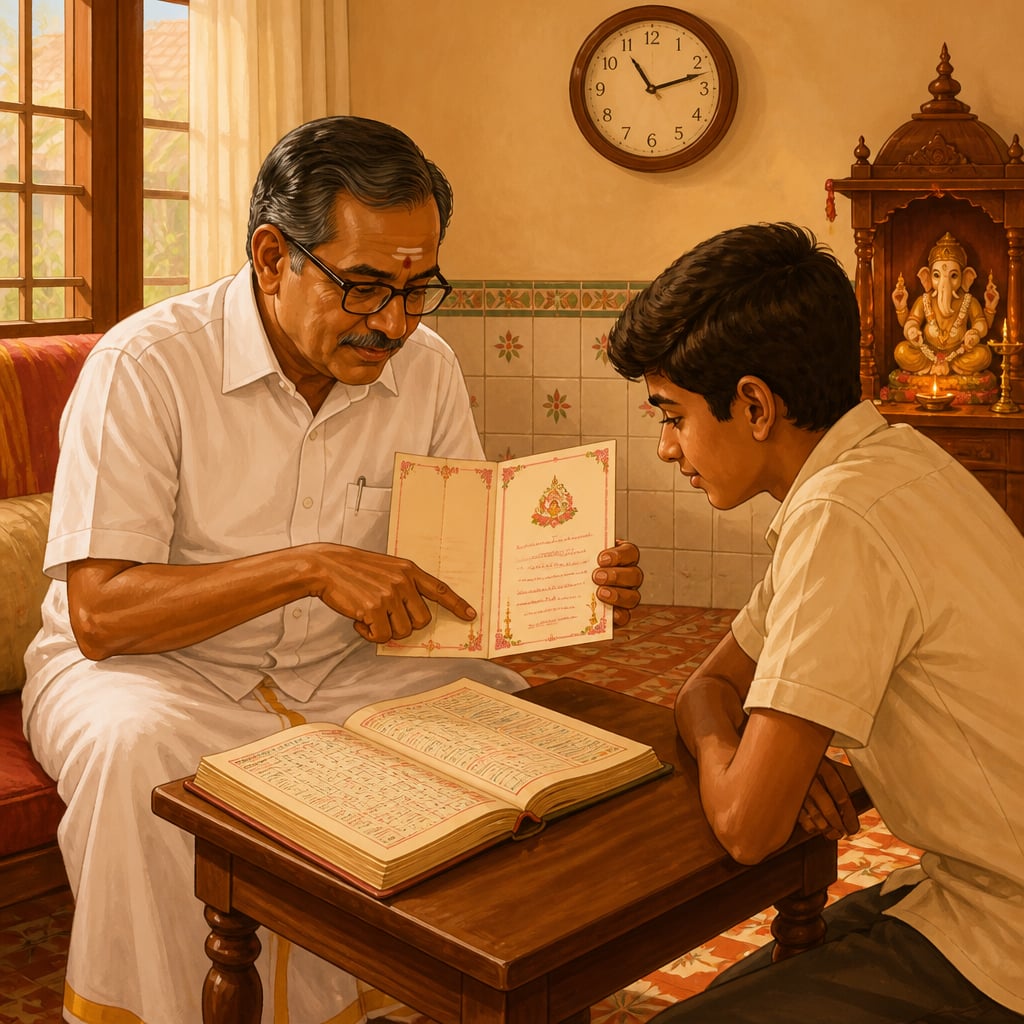
Retired bank officer showing his nephew the wedding muhurtam line

In a tiled drawing room in Mylapore, Chennai, on a Tuesday afternoon in February 2003, a retired bank officer named Subramanian is showing a freshly printed wedding card to his nephew. The card is for his daughter Lakshmi's marriage, scheduled for the third week of April. The nephew, a software engineer who has just flown in from Bangalore, glances at the front of the card and looks puzzled. The wedding date and time printed at the bottom reads: Sunday, 27 April 2003. Subha Lagnam: 7:48 AM to 8:11 AM.

The nephew asks why the auspicious window is twenty-three minutes wide and not the round half-hour the marriage hall has booked. Subramanian smiles and reaches for a small cloth-bound book on the side table. It is a panchanga, a printed Tamil almanac for the year 2003-2004, with one hundred and ninety pages of tables, planetary positions, and tithi calculations. He opens it to the entry for 27 April.

He shows his nephew the line. The window of 7:48 to 8:11 is a shubha muhurta in which Lakshmi's janma nakshatra of Hasta combines favourably with the moon's transit, with the lagna falling in Vrishabha, with no aspect of Saturn from the eighth house, and with Jupiter conjunct the ascendant for thirteen of those twenty-three minutes. The astrologer who calculated this, Subramanian's wife's first cousin in Kanchipuram, took two days over the chart and rejected three earlier dates the family had proposed.

The nephew asks, half-joking, what would happen if the wedding ran one minute late. Subramanian closes the panchanga and answers, without hurry, that the wedding will not run one minute late. The astrologer has chosen 7:48. The priest will start the muhurtam mantra at 7:47 and 30 seconds. The garland exchange will land between 7:55 and 8:05. The family has been doing this for at least fifteen hundred years and the watch is a recent convenience, not a constraint.

The lesson is what is in the panchanga, why the Brihat Parashara Hora Shastra dedicated one hundred chapters to the choice of the moment, why a 1963 paper by an MIT meteorologist named Edward Lorenz vindicates the underlying logic, and why a New York astrology app raised twenty million dollars selling muhurta-style timing advice in a system that does not know what a nakshatra is.

What Muhurta Actually Is

Muhurta is the Sanskrit word for an auspicious moment selected to begin any significant action. The classical Hindu day is divided into thirty muhurtas of forty-eight minutes each, fifteen of the day and fifteen of the night, with each muhurta carrying its own quality and presiding deity. Some muhurtas are universally favourable, like Abhijit, the eighth muhurta of the day, which falls roughly around solar noon. Some are universally inauspicious, like Rahu Kalam, the ninety-minute window that rotates daily by weekday. Most fall between, and their suitability depends on what is being initiated, by whom, and against which nakshatra.

The full muhurta calculation has five components, the panchanga or five-limbed almanac.

A proper muhurta selection cross-references all five of these against the chart of the person initiating the action and against the nature of the action itself. A wedding muhurta, a foundation-laying muhurta, a journey-beginning muhurta, a contract-signing muhurta, a surgery muhurta, and a child-naming muhurta are not the same calculation. The Brihat Parashara Hora Shastra, the foundational astrological text of the tradition, has separate chapters for each.

The Scripture Says

The muhurta tradition is one of the most heavily textualised branches of Hindu knowledge. The Vedanga Jyotisha, the astronomy limb of the Vedas, gives the earliest systematic timekeeping framework, datable to roughly 1400 BCE. The Brihat Parashara Hora Shastra, attributed to the sage Parashara and stabilised in its current form by around 600 to 700 CE, contains one hundred chapters on muhurta selection for every conceivable life event: marriage, travel, surgery, construction, battle, coronation, study, agriculture, trade.

शुभे मुहूर्ते कर्तव्यं सर्वं कर्म प्रयत्नतः। कालो हि बलवान् लोके कालः कर्मसु कारणम्॥

śubhe muhūrte kartavyaṃ sarvaṃ karma prayatnataḥ kālo hi balavān loke kālaḥ karmasu kāraṇam

Every action should be carefully begun in an auspicious muhurta. Time is the most powerful force in the world. Time itself is the cause behind every act.

Brihat Parashara Hora Shastra, Muhurta Adhyaya 1.1

The verse is the foundational claim of the entire system: kalo hi balavan loke. Time is the most powerful force. Action without attention to time is action against the strongest variable in the equation.

The Muhurta Chintamani, composed by Rama Daivajna in 1600 CE, is the most cited later reference. The Vivaha Muhurta Prakarana, a specialised wedding-muhurta text, is what Subramanian's astrologer in Kanchipuram is consulting in the opening scene. Kalidasa's Raghuvamsha, in canto seven, describes Rama choosing his muhurta of departure from Ayodhya for the campaign against Lanka. Banabhatta's Harshacharita, in the seventh century, records the muhurta selection for King Harsha's coronation. The textual record is dense, continuous, and politically embedded.

Muhurta as Statecraft

Chandragupta II timing his campaign to Abhijit muhurta at Ujjain

The single most consequential historical use of muhurta is governance. Chandragupta II of the Gupta dynasty, who ruled from 380 to 415 CE, timed every major military campaign to Abhijit muhurta, the universally auspicious window around solar noon. The court records preserved at the Allahabad Pillar inscription and in the Devichandraguptam play attributed to Vishakhadatta document this in detail. The campaigns against the Western Kshatrapas, the consolidation of Malwa, and the diplomatic mission to the Vakataka court were all initiated within Abhijit.

The Brihat Parashara Hora Shastra and Varahamihira's Brihat Samhita, composed in the sixth century at the court of Ujjain, both prescribe muhurta selection as a tool of statecraft. The Brihat Samhita has chapters on the muhurta for laying a fortification, the muhurta for declaring war, the muhurta for receiving a foreign envoy, the muhurta for crowning a king. Kautilya's Arthashastra, four centuries earlier, gave the political-economic frame in which the king's daily routine was itself a muhurta calculation: the king rises in Brahma muhurta because the cognitive window from one and a half hours before dawn to forty-five minutes before dawn is when his strategic thinking is sharpest.

The pattern across the textual record is clear: muhurta was a governance instrument before it was a wedding ritual. The household practice in Mylapore is the residue of a state technology that ran the largest empires in classical Bharat for two thousand years.

Why the Math Works

The muhurta system runs on two empirical claims that the modern scientific record has now substantially confirmed.

The first claim is about initial conditions. A complex system, once initiated, evolves along a trajectory determined by the conditions at the moment of its start. Small differences in starting conditions produce large differences in outcome. Edward Lorenz, a meteorologist at the Massachusetts Institute of Technology, formalised this in his 1963 paper Deterministic Nonperiodic Flow, the founding text of chaos theory. Lorenz's discovery, popularised as the butterfly effect, was that a weather model run with initial conditions different by one part in a thousand produced a completely different forecast within fourteen days.

Muhurta is the dharmic technology built on the same insight. A wedding initiated at 7:48 AM in a particular configuration of sun, moon, and lagna is, in the technical sense of nonlinear dynamics, a different system than the same wedding initiated ninety minutes later at Rahu Kalam. The muhurta tradition's claim is that the second wedding's trajectory will diverge measurably from the first's. Lorenz did not cite the Brihat Parashara Hora Shastra. The text had named the principle two thousand years earlier in a single line: kalo hi balavan loke.

The second claim is about human performance windows. The Hall, Rosbash, and Young Nobel Prize in Physiology or Medicine in 2017 confirmed that human cortisol, testosterone, and cognitive performance follow tightly regulated circadian and ultradian cycles. Cortisol peaks thirty to forty-five minutes after dawn, exactly the Brahma muhurta that Kautilya prescribed for kings. Testosterone peaks in late morning, exactly the Abhijit muhurta that Chandragupta II selected for battle. Cognitive vigilance shows a documented mid-afternoon trough, which the panchanga marks as Yamaganda Kala, the sub-auspicious window for important decisions.

The Whitehall Studies of British civil servants, the Karolinska Institute's chronobiology research, and the Roenneberg group at Ludwig Maximilian University in Munich have all independently mapped human performance to specific daily windows. The windows correlate, to a degree that is no longer dismissable, with the auspicious and inauspicious muhurtas of the panchanga.

What the Labs Found

Three empirical findings stand out from the convergence literature.

First, the chronobiology record on dawn cortisol is now uncontested. Multiple studies, including the work of Clow et al at the University of Westminster from 2004 onward, have measured the cortisol awakening response: a sharp rise in salivary cortisol within thirty to forty-five minutes of waking, peaking exactly in the Brahma muhurta window the Charaka Samhita and the Arthashastra both prescribed for the king's strategic study.

Second, the Karolinska work on alertness windows has documented a reliable mid-morning peak in vigilance and a corresponding mid-afternoon trough. The mid-morning peak corresponds to the muhurtas of Vijaya and Abhijit. The mid-afternoon trough corresponds to the panchanga's Yamaganda and Gulika windows, both flagged as inauspicious for new initiations.

Third, the chaos theory literature, from Lorenz 1963 forward through Mandelbrot, Strogatz, and the modern complex systems community at the Santa Fe Institute, has established that the timing of initiation in nonlinear systems is mathematically load-bearing. Small differences in starting conditions are not negligible. They are the dominant variable in long-run outcomes. The muhurta tradition's central claim is therefore mathematically defensible in a way the Western academic record now has to take seriously.

None of these papers cite the Brihat Parashara Hora Shastra. The astrologer in Kanchipuram does not need them to. The wedding will start at 7:48.

What the World Calls It Now

The Co-Star app, launched in New York in 2017 by Banu Guler, raised twenty million dollars in venture funding and reached fifteen million users by 2022 with annual recurring revenue of thirty-six million dollars. Co-Star uses real-time NASA planetary data to deliver daily timing recommendations to its users. The recommendations are functionally equivalent to muhurta advice: do this today, avoid that today, this is your alignment, this is your warning.

The Co-Star system runs entirely in the Western tropical zodiac, ignores the twenty-seven nakshatras of the lunar mansion system, has no concept of tithi, no concept of yoga, no concept of karana, and does not distinguish between the vara, the lagna, and the navamsa. It is, in the strict sense of the muhurta tradition, an incomplete one-out-of-five-limbed system selling itself as a complete daily-timing service.

The Pattern app, launched by Lisa Donovan in 2017, raised twenty million dollars on a similar premise. The Astro Twins, the Astrology Zone column, and roughly two hundred minor competitors collectively occupy a wellness-technology category that Forbes estimated at over two billion dollars in annual consumer spend by 2023. Every one of these products sells timing advice. None of them mention the panchanga, the Vedanga Jyotisha, or the Brihat Parashara Hora Shastra.

The asymmetry is striking. The full Hindu muhurta system is one of the most carefully engineered timing technologies in any civilization, with two thousand years of textual and political testing. The Co-Star app is a fragment of one limb, sold to fifteen million users at three to eight dollars a month, with the source tradition almost entirely deleted from the product layer.

What to Call It Yourself

The renaming is small and exact. When the Co-Star app says daily horoscope, you say panchanga. When the wellness column says cosmic timing, you say muhurta. When the astrology podcast says void of course moon, you say Rahu Kalam and Yamaganda. When the productivity coach says peak performance window, you say Brahma muhurta and Abhijit muhurta. When the New York Times trend piece says Mercury retrograde caution, you point at the Brihat Parashara Hora Shastra and the date 600 CE.

The practice itself is portable to any household with internet access. A printed or digital panchanga, of which the Drikpanchang website and the Mypanchang application are the two most reliable Vedic-sidereal options, gives the day's tithi, nakshatra, yoga, karana, vara, sunrise, sunset, Rahu Kalam, Yamaganda, and Abhijit muhurta. The Drikpanchang panchanga is free. The Mypanchang application is under five dollars annually. Both run the full five-limbed calculation that Co-Star does not.

The minimum household discipline is small. Avoid initiating significant actions in Rahu Kalam, the ninety-minute daily inauspicious window. Prefer Abhijit muhurta for important conversations or signings. Wake by Brahma muhurta for cognitively demanding work. Consult the panchanga for major decisions: weddings, foundation-laying, business launches, contract signings, surgery dates. The astrologer's role in life-event muhurta selection remains, but the daily-rhythm awareness is portable to any reader of this lesson.

The Watch on the Wall

Back in Mylapore, Subramanian has put the panchanga back on the side table. The wedding card is on the dining table, facing his nephew. The hour 7:48 to 8:11 is printed in clean Tamil and English. The marriage hall in Adyar has been booked. The astrologer has been paid two thousand rupees. The catering has been confirmed for sixty kilograms of vegetables.

Priest beginning the muhurtam mantra at exactly 7:47:30

Three months later, on Sunday 27 April 2003, the priest will indeed begin the muhurtam mantra at 7:47:30. The garland exchange will land at 7:58. Lakshmi will tie the mangalsutra around her husband's neck at 8:02. The watch on the wall of the marriage hall will read 8:11 when the priest closes the central rite, twenty-three minutes after he opened it. The day will not have been found by the family. It will have been chosen, two months earlier, by an astrologer in Kanchipuram with a panchanga and two days of arithmetic, against a tradition fifteen centuries old that still runs faster and more accurately than the New York app the family has never heard of.

Case studies

Chandragupta II and the Abhijit Muhurta Campaigns (380-415 CE)

Chandragupta II of the Gupta dynasty ruled from 380 to 415 CE over the largest empire of classical Bharat. Court records preserved at the Allahabad Pillar inscription, in the Devichandraguptam play attributed to Vishakhadatta, and in regional inscriptional traditions document that Chandragupta II timed every major military campaign and every significant diplomatic act to Abhijit muhurta, the universally auspicious window around solar noon. The campaigns against the Western Kshatrapas in Malwa and Saurashtra, the consolidation of central Bharat, the diplomatic mission to the Vakataka court that produced the Prabhavatigupta marriage alliance, and the establishment of the Navaratna court at Ujjain were all initiated within this window. The Brihat Parashara Hora Shastra and the Brihat Samhita of Varahamihira, the latter composed at Chandragupta II's own Ujjain court a century later, both prescribe muhurta selection as a tool of statecraft.

In the dharmic frame, the king is responsible for aligning state action with the cosmic order. The muhurta is the operational instrument of that alignment. A campaign initiated in Abhijit is not merely well-timed for tactical reasons. It is locked into a configuration of solar, lunar, and planetary positions that the tradition holds to maximise the probability of dharmic outcome. Chandragupta II's reign, remembered as the Golden Age of the Guptas, is the historical evidence the tradition cites for the muhurta's effectiveness at scale.

The Gupta empire under Chandragupta II reached its largest territorial extent, sustained the longest period of internal stability in classical Bharat, and produced the cultural achievements (Kalidasa's poetry, the navaratna court, the standardisation of Sanskrit literary forms, the Ajanta cave paintings) that the modern historical record now treats as the high water mark of pre-medieval Bharatiya civilization. The muhurta discipline is documented as one of the operational features of the regime, not as a peripheral devotional practice.

The historical record places muhurta in the operational kernel of statecraft at the precise moment classical Bharatiya power was at its peak. Whether one accepts the dharmic causal claim or treats it as a coincidence of disciplined timing, the institutional fact stands: the largest classical empire of Bharat ran on muhurta selection at the level of military and diplomatic strategy. The household muhurta in Mylapore is the surviving residue of that state technology. The dismissal of muhurta as folk astrology belongs to a colonial-era misreading. The right reading is that muhurta was a governance instrument before it became a wedding ritual, with documented operational success at the scale of the Gupta empire.

Chandragupta II of the Gupta dynasty, 380-415 CE: every major military campaign timed to Abhijit muhurta per the Allahabad Pillar inscription and the Devichandraguptam play. The largest classical empire of Bharat ran muhurta selection at the level of statecraft. The Brihat Parashara Hora Shastra (c. 600-700 CE) codified the textual basis.

Co-Star, Pattern, and the $2 Billion Astrology App Industry (2017-2023)

The Co-Star astrology app, launched in New York in 2017 by Banu Guler, raised twenty million dollars in venture funding and reached fifteen million users by 2022 with annual recurring revenue of thirty-six million dollars. The Pattern app, launched the same year by Lisa Donovan, raised twenty million dollars on a similar premise and reached comparable scale. The Astro Twins, the Astrology Zone column, and approximately two hundred minor competitors collectively occupy a wellness-technology category Forbes estimated at over two billion dollars in annual consumer spend by 2023. Every one of these products sells daily timing recommendations: do this today, avoid that today, this is your alignment, this is your warning. The Co-Star and Pattern systems run entirely in the Western tropical zodiac, ignore the twenty-seven nakshatras, have no concept of tithi, no concept of yoga, no concept of karana, do not distinguish between vara, lagna, and navamsa, and do not compute Abhijit muhurta or Rahu Kalam.

In the strict sense of the muhurta tradition, the Co-Star app is operating one limb of a five-limbed system and selling itself as a complete daily-timing service. The Western tropical zodiac is one input. The full muhurta calculation requires nakshatra (which Co-Star does not have), tithi (which Co-Star does not have), yoga (which Co-Star does not have), karana (which Co-Star does not have), and the cross-referencing of all five against the user's chart and the nature of the action. To sell timing advice on a one-out-of-five-limbed system is permitted in market terms. It is, in technical terms, a fragment marketed as a whole.

The astrology app industry continues to grow with new product launches, AI-driven personalisation, and integration with calendar applications. None of the major Western apps reference the panchanga, the Vedanga Jyotisha, the Brihat Parashara Hora Shastra, or the Muhurta Chintamani. The Drikpanchang website, the most reliable Vedic-sidereal panchanga available globally, runs the full five-limbed calculation for any city in the world, free of charge, and does not appear in any major Western media coverage of the astrology technology category.

इस असमानता का सही जवाब है स्पष्ट करना। अगर आप किसी एक अंग का टुकड़ा चाहते हैं, तो Co-Star का इस्तेमाल करो।

Co-Star ऐप: 36 करोड़ रुपये की सालाना आय, 1.5 करोड़ उपयोगकर्ता, 20 करोड़ रुपये जुटाए। Pattern ऐप: 20 करोड़ रुपये जुटाए। आधुनिक ज्योतिष का संयोजन।

लॉरेंज़, तितली प्रभाव, और कालबोध पुरस्कार: बृहत् परशर होरा शास्त्र के साथ तीन मेल खाते हुए।

1963 में, एडवर्ड लॉरेंज़ ने मैसाचुसेट्स टेक्नोलॉजी संस्थान में नियतात्मक अनियतकालीन प्रवाह पर एक शोधपत्र प्रकाशित किया।

हिंदू मुहूर्त परंपरा पंद्रह सदियों से दो अनुभवजन्य दावे कर रही है: कि कार्य का समय महत्वपूर्ण है और सही समय चुनना सफलता को प्रभावित करता है।

कैओस सिद्धांत को गणित, वायुमंडलीय विज्ञान और अन्य पचास हज़ार बाद के अध्ययनों में उद्धृत किया गया है।

When the labs and the Nobel committee converge on the same conclusions the Hindu tradition codified a thousand years earlier, the right response is not surprise. It is recognition. The muhurta is not folk astrology that happens to coincide with chronobiology. It is one of the longest-running, most carefully engineered timing technologies in any civilization, and the modern academic catch-up has only confirmed what the panchanga calculators have known for generations. The right reading is that muhurta is evidence-based dharmic engineering whose evidence base has been published in journals the engineers themselves never needed to read.

Lorenz 1963 Journal of the Atmospheric Sciences: Deterministic Nonperiodic Flow, founding paper of chaos theory, vindicates the muhurta claim about initial conditions. Hall, Rosbash, and Young 2017 Nobel Prize: molecular mechanisms of the circadian rhythm, vindicates Brahma muhurta and Abhijit muhurta. The Brihat Parashara Hora Shastra (c. 600-700 CE) named both insights in 'kalo hi balavan loke', a thousand and a half years earlier.

Historical context

From the Vedanga Jyotisha (c. 1400 BCE) and the Brihat Parashara Hora Shastra (c. 600-700 CE), through Chandragupta II's Abhijit muhurta campaigns (380-415 CE), Varahamihira's Brihat Samhita at Ujjain (c. 550 CE), Rama Daivajna's Muhurta Chintamani (1600 CE), Edward Lorenz's chaos theory paper (1963), the Hall, Rosbash, and Young Nobel Prize for circadian biology (2017), to the Co-Star app's $36M ARR and the $2 billion modern astrology-app industry (2022-2023).

The muhurta tradition is the operational kernel of Hindu time-discipline. Every Hindu wedding, every foundation-laying ceremony, every business launch, every coronation, and every major government project in classical, medieval, and modern Bharat has run a muhurta calculation against a panchanga before its initiation. The tradition has not been institutionally interrupted at any point in the last two thousand years. The Drikpanchang and Mypanchang digital panchangas now extend the same five-limbed calculation to the global Hindu diaspora. The household practice in Mylapore, the state-scale practice at the Allahabad Pillar inscription, and the digital practice on a smartphone in San Jose are the same calculation at three different scales.

Living traditions

The Co-Star app, the Pattern app, and the broader astrology-technology category collectively occupy a Forbes-estimated two-billion-dollar wellness market by 2023, with the source tradition of the panchanga and the Brihat Parashara Hora Shastra almost entirely deleted from the product layer. The Drikpanchang website and the Mypanchang application offer the full five-limbed Vedic-sidereal calculation free or under five dollars annually for any city in the world, with two thousand years of textual backing and the operational record of the Gupta empire behind them. Re-Sanskritize: when Co-Star says 'daily horoscope', you say panchanga. When the wellness column says 'cosmic timing', you say muhurta. When the astrology podcast says 'void of course moon', you say Rahu Kalam and Yamaganda. When the productivity coach says 'peak performance window', you say Brahma muhurta and Abhijit muhurta. Install Drikpanchang or Mypanchang on your phone. Check the day's tithi, nakshatra, Rahu Kalam, and Abhijit muhurta every morning. Avoid initiating significant actions in Rahu Kalam. Prefer Abhijit muhurta for important conversations or signings. Wake by Brahma muhurta for cognitively demanding work. Consult an astrologer for life-event muhurta selection: weddings, foundation-laying, business launches, contract signings, surgery dates. The discipline costs less than five dollars a year. The wellness app costs eight.

Reflection

More in Kala: Time, Calendar, Cosmos

All lessons in Kala: Time, Calendar, Cosmos · Samskaras: The Sanatan Operating System course