What the Floor Is Made Of
Cow Dung, Mud, and the Antimicrobial Floor That Predates Concrete by Five Thousand Years
Before the cement floor, before the marble tile, before the imported vinyl, the Hindu home stood on a floor of rammed earth and cow dung paste, freshly applied each week by the women of the household. Harappa built it in standardized brick. The Rig Veda named it gobar lipai. Modern microbiology has now confirmed the floor is antibacterial, antifungal, moisture-regulating, and seismically resilient. The American Earthship movement is selling the same design to Hollywood at a quarter-million dollars per home. The grandmother in Kutch is still smearing the threshold every Friday. The labs are catching up.
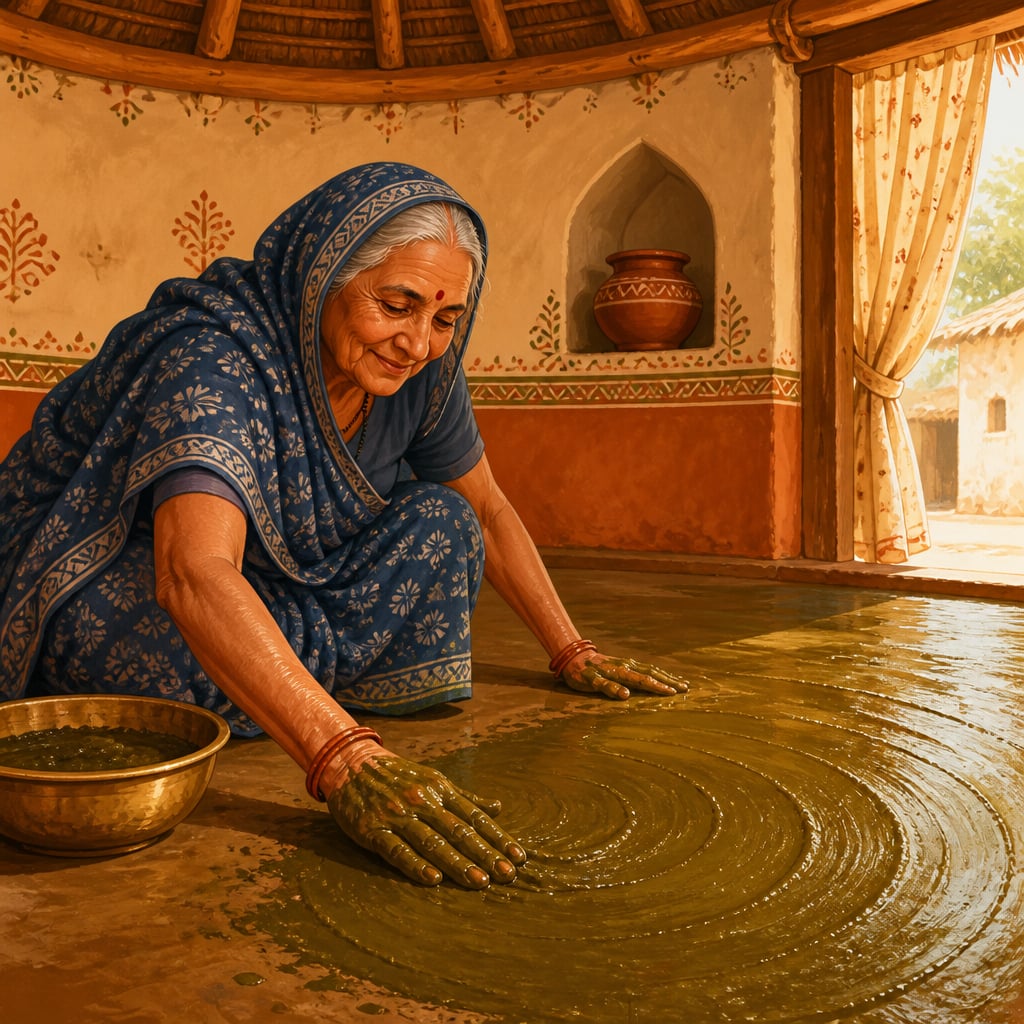
The Friday Floor
The paati in Bhuj is sixty-four years old. It is a Friday morning in the dry month of Phalguna. She is on her knees at the threshold of the small mud-walled house her father built in 1962, a fresh ball of gobar lipai in her right hand, a small lota of water beside her. The dung is from the family's own cow, collected before sunrise, mixed with a fistful of red Kutch soil and a few drops of water until it has the consistency of soft clay. She works in widening circles from the threshold inward, palm pressed flat, the paste spreading in a thin even film. By the time the sun is high, the floor will be dry, smooth, faintly green, and entirely free of the ant trail that crossed it yesterday. The grandchild watching from the doorway asks why the floor cannot be cement, like the neighbour's. The paati does not look up. She says, cement floor is cold. This floor breathes.
This lesson is the explanation she did not owe him. The Hindu home has stood on a floor of mud and dung for at least forty-six centuries of continuous, documented practice. Mohenjo-Daro built it in standardized brick. The Rig Veda named it. The Charaka Samhita prescribed it. Kalibangan's excavated houses preserve it. And in the last twenty years, microbiology and civil engineering have finally explained why the paati's instinct was right.
The Harappan Receipt
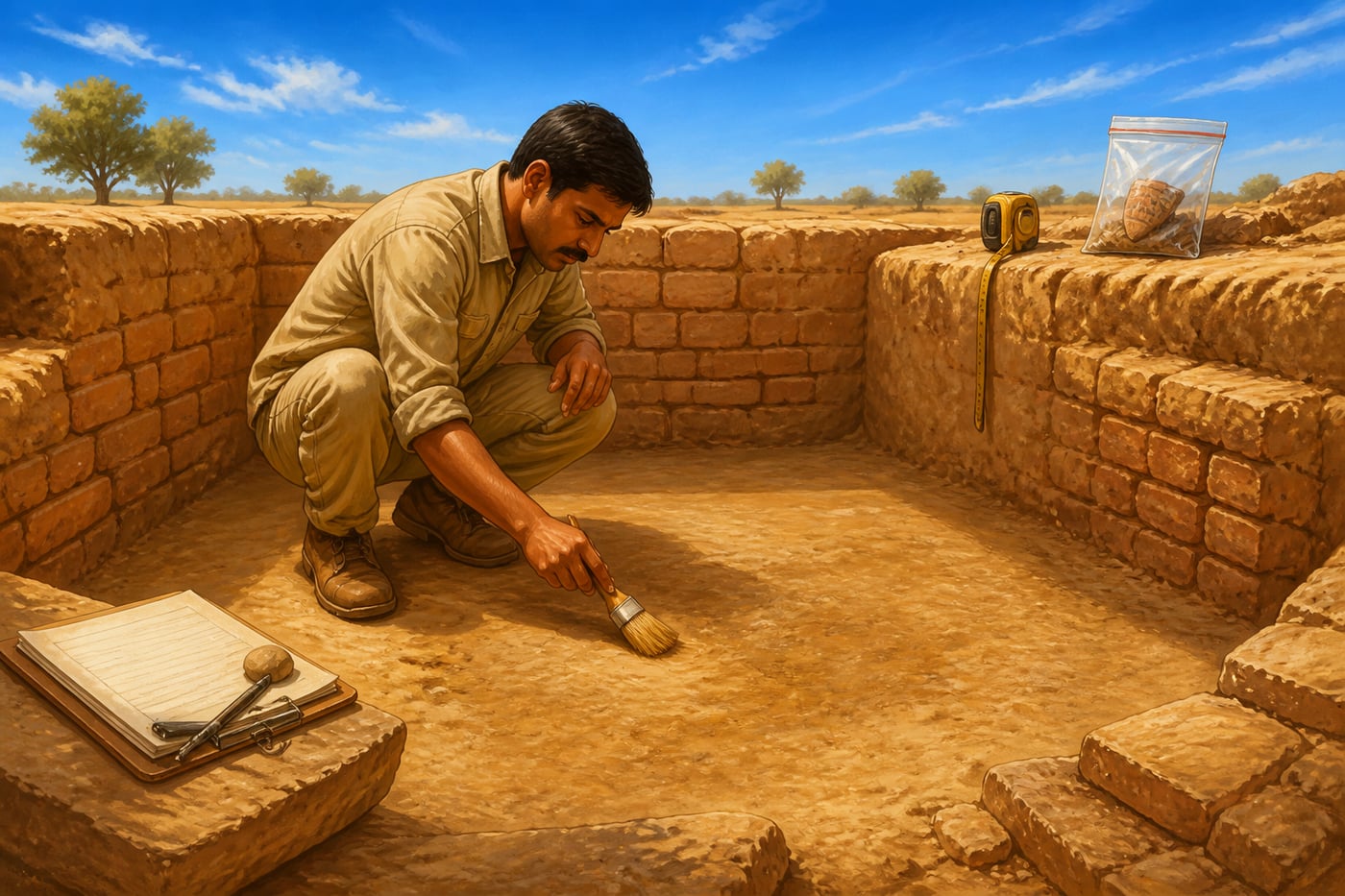
The oldest evidence sits in the brick. Mohenjo-Daro and Harappa, the great cities of the Indus-Saraswati civilization (c. 2600 to 1900 BCE), used a standardized fired-brick ratio of 1:2:4 (thickness to width to length). Modern civil engineers recognize this as the structurally optimal proportion for shear stability and load distribution. Every Harappan brick across hundreds of sites, from Dholavira in the south to Harappa in the north, conforms to the same ratio. This is engineering, repeatedly applied, at a scale unmatched in the contemporary world.
Beneath the brick walls, the floors tell the second half of the story. Excavations at Kalibangan in Rajasthan, conducted by B. B. Lal and B. K. Thapar for the Archaeological Survey of India between 1961 and 1969, uncovered residential houses with floors of compacted earth coated with a layer of plaster that chemical analysis identified as a mixture of clay, sand, and bovine dung. Every excavated household carried it. The floor was not a poor person's makeshift. It was the standard residential surface of the richest urban civilization of the Bronze Age.
The Rig Veda, composed in the same broad era, names the practice. The household ritual of plastering the floor with cow dung and mud paste, gobar lipai in the modern vernacular, is referred to as agnihotra-bhumi in the Vedic ritual texts: the ground prepared for the sacred fire. The fire could not be lit on bare earth or on stone. It had to rest on a floor freshly smeared with the pancha-gavya complex.
What the Floor Does
The floor is not decoration. The floor is functional engineering. Three properties, all named in the tradition and confirmed by modern research, make the gobar-mud floor superior to the cement slab it has been replaced by.
One: Antimicrobial Action
In 2015, Chauhan and colleagues published a study in Bioresource Technology (Volume 188, pages 18-26) on the antimicrobial properties of dried cow dung paste. They identified phenol, cresol, and indole compounds in measurable quantities, with documented activity against Escherichia coli, Salmonella enterica, and Staphylococcus aureus. The dried dung surface suppresses bacterial growth on contact. Independent research by the Central Building Research Institute at Roorkee has documented reduced fungal spore counts in dung-plastered floors compared with cement floors of the same humidity range.
The Charaka Samhita (Sutrasthana, chapter on dwelling-places) recommends the smearing of the floor with cow dung paste for the prevention of kushtha (skin disorders) and jvara (fevers) in the household. The Sanskrit term used is gomaya pralepana: anointing with the cow's gift. Two thousand years of clinical observation, vindicated in the 2015 paper by named compound.
Two: Moisture Regulation
A cement floor is hydrophobic. Water beads on it. Humidity sits on top of it. A clay-dung floor is hygroscopic: it draws moisture from the air during humid spells and releases it back during dry spells. The floor breathes. Civil engineers studying vernacular Indian housing in the Indian Institute of Technology Delhi's 2018 report on traditional materials found that homes with mud-dung floors maintained interior humidity within a 35% to 55% band even when ambient outdoor humidity swung from 20% to 90%. The cement-floored homes in the same study tracked the outdoor humidity directly.
This is what the paati meant by the floor breathes. It is a literal description.
Three: Seismic Resilience

In 2001, the Bhuj earthquake of magnitude 7.7 flattened concrete-frame buildings across Kutch. The traditional bhunga houses, the circular mud-walled, dung-floored, thatch-roofed homes of the Banni grasslands, survived almost universally. Post-earthquake surveys by the National Institute of Disaster Management found that bhunga structural failure rates were under 5%, while reinforced-concrete failure rates in the same epicentre zone exceeded 60%. The mud wall flexes. The dung floor absorbs vibration. The thatch roof falls light when it falls at all.
The paati's father built the house in 1962. The 2001 earthquake came and went. The house is still standing.
The Scripture Says
The Atharva Veda contains the household-protection mantra that anchors the floor in the symbolic order.
भूमिर्माता पुत्रोऽहं पृथिव्याः। पर्जन्यः पिता स उ नः पिपर्तु॥
bhūmir mātā putro'haṃ pṛthivyāḥ parjanyaḥ pitā sa u naḥ pipartu
The earth is my mother. I am a son of the earth. The rain is my father. May he nourish us.
Atharva Veda 12.1.12 (Prithvi Sukta)
The floor is not flooring. The floor is the body of the mother. The act of smearing it weekly with the cow's gift is the household renewing its contract with bhumi. The Sanskrit word for floor in the Grihya Sutras is the same word for the goddess: bhumi. There is no separate word for the surface you walk on. The surface you walk on is her body.
This is what the cement slab severed when it arrived in mass-housing programs in the 1970s. Not the antimicrobial action. Not the humidity regulation. The theological frame. The cement floor is a surface. The dung floor is the goddess.
Earthship, Taos, 1970
In 1970, an American architect named Michael Reynolds began building experimental homes in the desert north of Taos, New Mexico. He called them Earthships: structures of rammed earth, used tires, glass bottles, and adobe plaster, fully off-grid and thermally self-regulating. The walls were tamped earth. The floors were a mixture of clay, sand, straw, and animal dung, troweled in by hand.
Reynolds' 2007 documentary, Garbage Warrior, has been viewed over two million times. There are now over 3,000 Earthships built around the world, including high-end commissions for celebrities in Colorado and California at price points between $250,000 and $1.5 million. The Earthship Biotecture website cites Native American adobe traditions and Roman rammed-earth (pisé de terre) as inspirations. There is no mention of Mohenjo-Daro. There is no mention of Kalibangan. There is no mention of the Atharva Veda's Prithvi Sukta. There is no mention of the bhunga that survived the Bhuj earthquake.
What Hollywood is now buying at quarter-million-dollar price points, the Banni grandmother is still applying every Friday morning. Gobar lipai, not earth-plaster floor.
The Marie Kondo Layer
The Western rebrand has a second arm: the cleaning ritual itself. The Japanese organising consultant Marie Kondo built a $100 million empire (Netflix series 2019, books in 42 languages, KonMari Inc valued at over $80 million in 2020) on the proposition that the home should be cleaned with attention, with respect, and on a weekly cycle that the householder performs herself.
The Hindu household has run this cycle for at least three thousand years. The Friday gobar lipai. The pre-Diwali deep clean. The seasonal vastu shuddhi. The daily jhadu (sweeping) at sunrise and sunset. The KonMari method names none of this. The grandmother does not need it named to keep doing it. But the user, reading this lesson, can begin to see what was being copied.
What to Call It Yourself
The names matter. Gobar lipai, the cow-dung plastering. Bhumi, the floor as goddess. Agnihotra-bhumi, the ground prepared for fire. Vastu shuddhi, the seasonal purification of the dwelling. Bhunga, the circular mud-walled house of Kutch that beat the 2001 earthquake. The next time someone calls it earth-plaster flooring, smile and call it gobar lipai. The next time a luxury Earthship is featured in a design magazine, remember Mohenjo-Daro built it at city scale forty-six centuries earlier.
The Modern Echoes In One Frame
The receipts are dense in this lesson. The floor of the Hindu home, replaced in most urban housing by cement and tile in the second half of the twentieth century, is now the subject of a global revival sold at Western premium price points.
- Earthship Biotecture, Taos, 3,000+ homes globally, top-tier commissions at $1.5M.
- Adobe revival in California, Arizona, New Mexico, with the Adobe Association of the Southwest reporting a 200% growth in adobe permits between 2010 and 2020.
- Hempcrete and lime-plaster boutique builders in the UK and Australia, with the global natural building materials market projected at $36 billion by 2027.
- Cob construction workshops in Oregon and Vermont charging $2,500 per week.
- Marie Kondo / KonMari at $100M+, naming a weekly home-cleaning ritual the grandmother has run for three thousand years.
The Chauhan 2015 paper on dung antimicrobials. The IIT Delhi humidity study. The Bhuj earthquake bhunga survival data. The Kalibangan excavation reports. The Prithvi Sukta. Each is a fragment. The Hindu home is the whole.
Circle-Back
The paati in Bhuj has finished. The threshold is smooth, faintly green, drying in the morning sun. The grandchild has gone back to playing. He will not understand this lesson for thirty years. Then one morning, in some other city, on some other floor, he will remember the smell of the wet dung and the sound of his grandmother's palm pressing it flat. He will look up the antimicrobial paper. He will look up Mohenjo-Daro's brick ratio. He will look up the Earthship price tag. He will buy a small lota and a fistful of soil. And he will start again. Gobar lipai, not earth-plaster floor. The mother, not the surface.
Case studies
Kalibangan, 2600 BCE: The Mass-Built Mud-and-Dung Floor at City Scale
Between 1961 and 1969, the Archaeological Survey of India under B. B. Lal and B. K. Thapar excavated the Indus-Saraswati city of Kalibangan in Hanumangarh district of northern Rajasthan. The residential quarter, dating from approximately 2600 BCE, preserved hundreds of household floors. Chemical and microscopic analysis of the floor plaster revealed a consistent composition: clay, fine sand, and bovine dung in roughly the same proportions still used in rural Kutch and Marwar today. The brickwork conformed to the standardized 1:2:4 ratio that characterizes every Harappan site. Every household, from the modest two-room dwelling to the larger courtyard house, used the same floor.
The Atharva Veda's Prithvi Sukta names bhumi as mother. The Apastamba Grihya Sutra prescribes gomaya-lepana as the prerequisite for the agnihotra fire. The Vishnu Purana frames the daily floor-smear as a protection rite against bhuta-graha-bhaya. The Kalibangan floors, predating the Vedic textual layer in their composition by several centuries, are the material substrate of the practice the Vedas would later name in language.
Kalibangan's reports established that the gomaya-lepana floor is at minimum 4,600 years old as a continuous, documented, mass-deployed residential practice. The same floor is still being applied in rural Kutch every Friday morning. No other floor system in the world has comparable continuity of evidence.
Mud and dung construction in India is not a poverty makeshift. It is engineered building material, mass-deployed at city scale by the richest urban civilization of the Bronze Age, in the same composition still used in continuous rural practice five thousand years later. The continuity is the case.
When sustainable-construction startups in 2024 propose mud and dung as a frontier material, the answer is that it has been the residential standard of one Indian sub-continental civilization for over forty-six centuries. The frontier was settled in 2600 BCE.
Indus-Saraswati civilization, c. 2600-1900 BCE. Kalibangan excavations 1961-1969 by B. B. Lal and B. K. Thapar (Archaeological Survey of India). Standardized brick ratio 1:2:4. Bovine dung detected in residential floor plaster across all excavated households.
Chauhan et al, 2015: The Dung Floor Is Antibacterial
In 2015, a research team led by Chauhan published a study in Bioresource Technology (Volume 188, pages 18-26) on the antimicrobial properties of dried cow dung paste used in traditional Indian household plastering. The team identified phenol, cresol, and indole compounds in measurable concentrations and ran controlled microbial-challenge experiments against Escherichia coli, Salmonella enterica, and Staphylococcus aureus. The dried-dung surface suppressed bacterial growth in all three challenges. Independent work by the Central Building Research Institute at Roorkee documented reduced fungal spore counts and superior moisture regulation in dung-plastered floors compared with cement floors at matched humidity.
The Charaka Samhita prescribed gomaya pralepana for the prevention of kushtha (skin disorders) and jvara (fevers) in the household, naming the practice as a clinical preventive measure two thousand years before the molecular agents were identified. The Vishnu Purana 3.11 framed the daily sweep and weekly dung-smear as bhuta-graha-bhaya-apahā: as protection against unseen agents and afflictions. The 2015 paper named the unseen agents in Latin: E. coli, Salmonella, Staphylococcus.
The 2015 paper and its successors have shifted the academic framing of the gobar-lipai floor from cultural artefact to documented antimicrobial surface. Public-health researchers studying rural housing in low-resource settings now cite the practice as a low-cost, biodegradable, broad-spectrum antimicrobial floor coating, suitable for the prevention of household-acquired enteric infection.
The grandmother who insisted on the Friday gobar lipai was running a clinical preventive measure named in the Charaka two thousand years ago and confirmed in Bioresource Technology in 2015. The two-thousand-year clinical observation was right. The molecules were just unnamed.
Hospital infection-control research has begun to revisit traditional flooring materials in low-resource rural clinics. The dung floor, properly maintained, outperforms unmaintained cement on the metrics that matter for enteric pathogen control. The grandmother's protocol becomes a public-health intervention.
Chauhan et al, Bioresource Technology, Volume 188 (2015), pages 18-26. Phenol, cresol, indole identified in dried cow dung paste. Antimicrobial action documented against E. coli, S. enterica, S. aureus. Central Building Research Institute, Roorkee, 2018 humidity and fungal-spore study.
Earthship Biotecture, 1970-present: $1.5 Million for What the Banni Grandmother Does on Friday
In 1970, the American architect Michael Reynolds began building experimental homes in Taos, New Mexico, that he called Earthships. The walls were rammed earth and used tires. The floors were a mixture of clay, sand, straw, and animal dung, troweled in by hand. The 2007 documentary Garbage Warrior, chronicling Reynolds' work, has been viewed over two million times. By 2024, more than 3,000 Earthships have been built worldwide, with high-end commissions for celebrities priced between $250,000 and $1.5 million. The Earthship Biotecture website cites Native American adobe traditions and Roman pisé de terre as design inspirations. The global natural-building-materials market the Earthship sits within is projected to reach $36 billion by 2027. There is no mention of Mohenjo-Daro. There is no mention of Kalibangan. There is no mention of the Atharva Veda's Prithvi Sukta. There is no mention of the bhunga that survived the Bhuj earthquake.
Mohenjo-Daro, Harappa, Dholavira, and Kalibangan ran the same floor at city scale forty-six centuries earlier. The Atharva Veda named the goddess. The Apastamba Grihya Sutra named the protocol. The Charaka Samhita named the clinical benefit. The 2001 Bhuj earthquake named the seismic resilience. The 2015 Chauhan paper named the molecules. The Hindu home is the parent design. The Earthship is one fragment, sold at premium.
The Earthship and adjacent natural-building movements have become a celebrated arm of Western ecological architecture. The materials, the protocol, and the philosophy are extracted from the Hindu home's parent design and resold at Hollywood price points without attribution. The original system is still running, unbranded, in the courtyard houses of Banni, Marwar, and rural Tamil Nadu.
Forty-six centuries of continuous documented mass-deployment is not a frontier. The Western architecture industry's $36-billion natural-materials revival is a delayed encounter with the Hindu home. The user's work is not to be impressed by the Earthship. The user's work is to use the original name. Gobar lipai, not earth-plaster floor.
The next time a sustainable-architecture pitch deck or a glossy spread on adobe homes appears, ask one question: does it cite Kalibangan. If not, the design has been cropped from its source. Use the name. Gobar lipai.
Earthship Biotecture, founded 1970 in Taos, NM. 3,000+ structures built globally. Documentary Garbage Warrior (2007), 2M+ views. High-end commissions: $250K to $1.5M. Global natural-building-materials market: $36B projected by 2027 (Allied Market Research, 2022).
Historical context
From the Indus-Saraswati civilization (c. 2600-1900 BCE) and the Atharva Veda's Prithvi Sukta (c. 1500-1000 BCE), through the Apastamba and Baudhayana Grihya Sutras (c. 600-300 BCE) and the Vishnu Purana (c. 300-1000 CE), to the 2001 Bhuj earthquake bhunga survival data, to the 2015 Chauhan paper on dung antimicrobials, to the present-day Earthship and natural-building markets.
Living traditions
The names matter. Gobar lipai, not earth-plaster floor. Bhumi, not flooring. Agnihotra-bhumi, not sacred hearth area. Vastu-shuddhi, not deep clean. Bhunga, not vernacular hut. When a sustainable-construction movement proposes mud-and-dung as innovation, name the original system. When a wellness brand sells weekly home-cleansing as a self-care ritual, name the original protocol. The user's everyday practice can be small: smear the puja corner with a thin gomaya wash once a month, even in an apartment, using the small clay pots of dung sold at most temple shops; keep one room of the house on a weekly deep-clean cycle done by the household, not outsourced; mark the four festival junctures (Diwali, Pongal, Ugadi, Akshaya Tritiya) with a vastu-shuddhi cycle. The receipts are at Mohenjo-Daro, in the Chauhan 2015 paper, in the Banni bhungas, and in the paati's Friday hand. The user does not need to argue. The user only needs to keep the practice and use the name.
- Banni Grasslands and Bhunga Villages, Kutch: The traditional pastoralist villages of Banni preserve the bhunga: circular mud-walled, dung-floored, thatch-roofed houses that survived the 2001 earthquake at over 95% structural integrity. Hodka, Bhirandiyara, and Ludiya villages are accessible from Bhuj and many host visitors through community tourism programs. The interior walls carry mirror-and-mud (lippan kaam) embroidery work that is itself a regional art form.
- Kalibangan Archaeological Site: The Indus-Saraswati site excavated by B. B. Lal between 1961 and 1969. The lower town residential quarter preserves the household floors whose chemical analysis confirmed the bovine-dung composition. The site museum at Kalibangan and the Archaeological Survey of India's reports give the receipts for the 4,600-year continuity of gomaya-lepana.
- Hunnarshala Foundation, Bhuj: An architectural research and revival organization, founded after the 2001 Bhuj earthquake, that documents and rebuilds traditional vernacular construction including bhungas. Their workshops train architects and masons in earth-and-dung construction validated by post-earthquake structural data. Visit the campus, take a workshop, or commission an engineered traditional bhunga for an earthquake-prone region.
Reflection
- Walk through your home and notice every floor surface. Which surfaces breathe (mud, lime, terracotta, wood) and which do not (cement, vinyl, polished stone)? What is one room or one corner where you could install a breathing surface in the next year, and what would the smallest first step look like this month?
- Sit with the line from the Atharva Veda for two minutes before answering. Bhumir mata putro'ham prithivyah. The earth is my mother. I am a son of the earth. What changes about your relationship to the floor of your home, the soil of your city, and the ground you walk on, when you take that proposition seriously for the duration of one day?
- The Earthship is sold at $1.5 million. The Banni bhunga is built for the cost of local materials and the family's time. Both are mud-and-dung floored. What does the price gap reveal about how a society values originality versus continuity, and what is the work of the Hindu reader who knows the parent design but lives in a country where the fragment is sold at premium?