The House Is Cleaned for Lakshmi

Diwali deep clean, grain storage, and the seasonal resets the household runs around the festival of light

Two weeks before Diwali, every Hindu home in India enters a state of slow upheaval. Cupboards are emptied. Walls are washed. The grain bins are checked. The brass is polished. The cobwebs come down. The household is preparing for the goddess. The grandmother says Lakshmi only enters a clean house. The labs say household clutter measurably elevates cortisol. KonMari sold the Western world thirteen million copies of the same instruction in 2014. The Hindu calendar has been running this protocol for three thousand years.
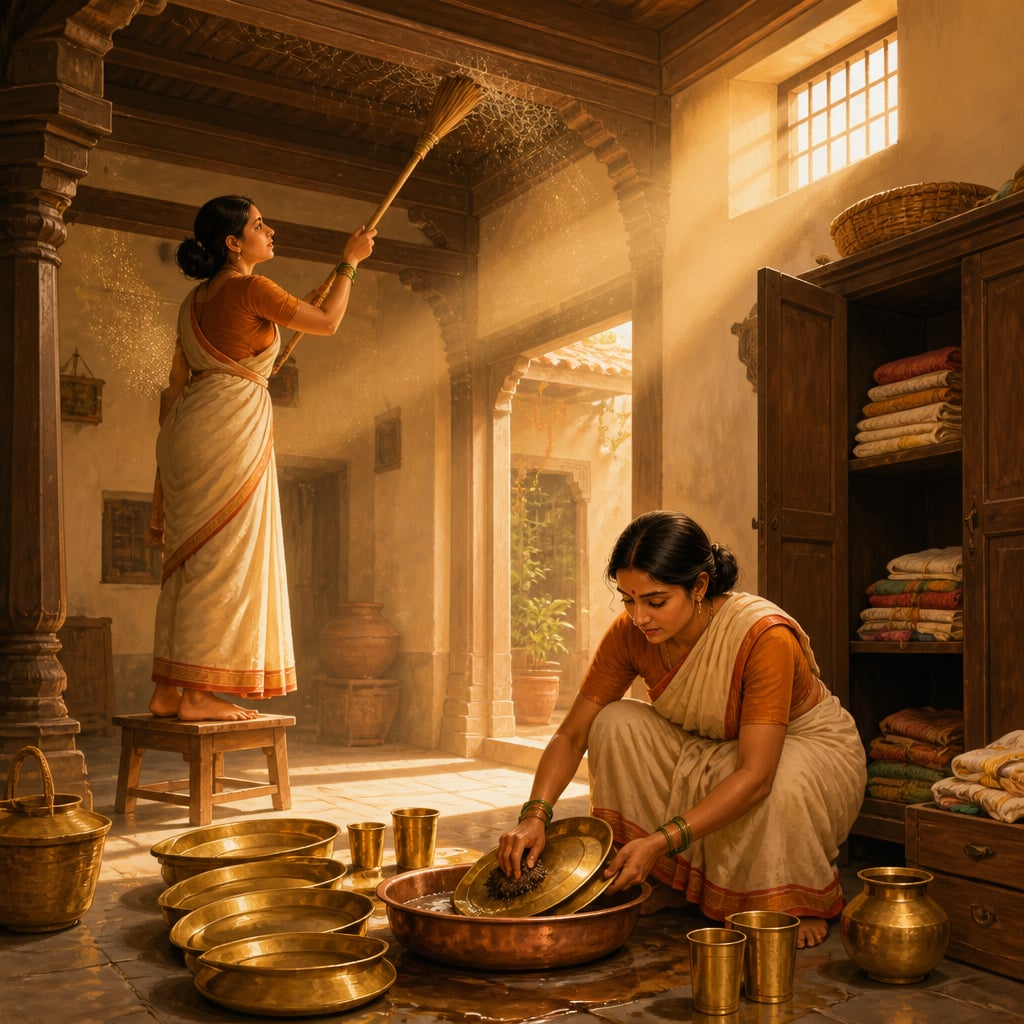
A Hindu household running the pre Diwali deep clean two weeks before the festival

Two Weeks Before Diwali, in a House in Nagpur

It is late October, sometime in the early 1990s. A boy of nine is sitting on the bottom step of the staircase in a two-storey house in Nagpur. From above, a steady percussion of activity is reaching him. His dadi is standing on a small wooden stool in the upstairs bedroom, a long bamboo broom tied with an old cotton cloth in her hand, sweeping the cobwebs out of the corner where the ceiling meets the wall. His mother is below, on the floor of the same room, every cupboard wide open, every saree, every steel tin, every old schoolbook of his stacked in piles around her. The radio is on in the kitchen. The pressure cooker has whistled four times.

The boy is in the way of every adult in the house, so he has been told to sit on the staircase and not move. From there, he can see, on the kitchen counter, the brass deepak that is brought out only once a year. Beside it, a small box of camphor and a sealed packet of new cotton wicks. Under the staircase, his uncle is hauling out the old tin trunks. "Throw, throw," the dadi keeps calling from upstairs. "Lakshmi nahi aati gandhe ghar mein." Lakshmi does not come to a dirty house. The boy will hear that sentence from October to mid-November every year of his childhood.

This lesson is about that fortnight. The Hindu household has, for three thousand years, been running an annual full-house deep clean as a ritual obligation, scheduled across approximately fourteen days, completed on Dhanteras, the second day of the five-day Diwali sequence. The cleaning is not optional. It is not a chore. It is the precondition for the goddess. The same household that washes the threshold daily and sweeps the courtyard at dawn does, once a year, take the entire house apart and put it back together. The deep clean is the largest shodhana in the calendar.

Most of the modern world has heard of Diwali as the festival of light. Almost none of the modern world has been told that the lights only go on in a house that has been physically rebuilt from the inside out for the previous fortnight. The candles are the result. The cleaning is the practice. This lesson is about the cleaning.

The Practice, Across India

The pre-Diwali deep clean has a recognisable shape across regions, with significant local variations.

In Maharashtra and the Konkan, the cleaning begins around two weeks before Diwali, often coinciding with the end of Pitru Paksha and the start of Navratri. The walls of the house are whitewashed (in older village homes) or wiped down with a cloth (in modern apartments). Every cupboard is emptied. Bedding, clothes, kitchen vessels, photo frames, and books are taken out, sorted, and either washed, polished, donated, or thrown. The brass and silver are polished with tamarind paste and ash (or in modern households, with Pitambari, the namesake Indian polish). On Dhanteras, fresh rangoli is drawn at every doorway, new diyas are placed at the threshold, the entrance is decorated with toranam of mango leaves and marigold, and the devara (home altar) receives the year's first new lamp.

In Tamil Nadu and Andhra Pradesh, the same fortnight is anchored to Naraka Chaturdashi rather than Dhanteras. The cleaning culminates in the abhyanga snanam, the pre-dawn oil bath taken on the morning of Naraka Chaturdashi, in a house that has been swept, mopped, and decorated through the previous week. The aravanai paadi (carpet of fresh kolam in front of the house) is laid daily for the seven days leading to the festival. The grain bins, the paanai of rice and dal, are emptied, the older grain is moved out, the new harvest grain is moved in, and the bin is washed with neem water before refilling.

In Bengal, where the dominant Diwali festival is Kali Puja, the cleaning is shorter but no less thorough, focused on the thakur dalan (the household shrine) and the central courtyard. In Punjab and Haryana, the cleaning runs in parallel to Karva Chauth preparations and culminates with the household Lakshmi Puja on the main Diwali night. In Gujarat, where the Diwali week ends with Bestu Varas (the Gujarati New Year on Kartik Shukla Pratipada), the deep clean is the closing of the old financial year and the opening of the new one. The merchants close their old account books (chopda) and open new ones in the Chopda Pujan ceremony; the household closes the old year of accumulation and opens a clean ledger for the next.

In every region, three sub-rituals run inside the deep clean.

The first is grain rotation. The bins of rice, dal, wheat, and millet are emptied entirely, the residue is swept out, the bins are washed and dried in the sun, and the new harvest grain (Diwali aligns with the post-monsoon Kharif harvest in most of India) is moved in. The old grain that has not been consumed is given as daana to the household helper or to the temple. The household begins the new year with a freshly stocked, freshly cleaned grain store.

The second is brass and silver polish. Every brass and silver vessel in the house, including the puja vessels, the daily kitchen pots, the lamp stands, and the family heirloom plates, is polished to mirror finish. The puja vessels especially are bathed in abhishekam quality, ready to receive the goddess on Lakshmi Puja night.

The third is textile renewal. New clothes are purchased, often on Dhanteras (which is also the day of new gold or silver purchase). Old clothes that are still serviceable are donated; old clothes that are not are thrown. The bedding is washed; the curtains are taken down and beaten and rehung. Fresh rangoli colours are bought. Fresh wicks are made or bought. The household, on Diwali night, is wearing its best, sitting on its cleanest floor, in its brightest room, with its newest lamp.

Emperor Akbar honouring Diwali at the Fatehpur Sikri palace with the akash deepa pole

The Scripture Says

The textual basis for the Diwali deep clean is layered. The Padma Purana, Skanda Purana, and Bhavishya Purana each contain detailed Diwali narratives. The Skanda Purana names Dhanteras as the day of Dhanvantari, the divine physician, who emerged from the samudra manthana (churning of the ocean) carrying the kalasha of amrita. The same churning produced Lakshmi, who emerged on Diwali Amavasya itself. The household cleans its space because the goddess of wealth is, on this night, choosing where to dwell.

गृहं स्वच्छं विधायाथ दीपान् प्रज्वालयेद् बहून्।

gṛhaṃ svacchaṃ vidhāyātha dīpān prajvālayed bahūn

Having made the house clean, one should then light many lamps.

Padma Purana, Uttara Khanda, Diwali-vrata-katha

The verse is exact in its sequencing. The cleaning precedes the lighting. The lighting is the consequence of the cleaning. A dirty house with bright lamps is not the practice; a clean house with even one lamp is. The Padma Purana repeats this in several places across the Diwali narrative, framing the cleaning as the adhikara, the qualifying act, that makes the household fit for the goddess to enter.

The Bhavishya Purana adds the Lakshmi-Alakshmi doctrine. Lakshmi, the goddess of fortune, has a sister, Alakshmi, the goddess of misfortune. Alakshmi dwells in dirt, in clutter, in disordered storage, in the corners that are never swept. Lakshmi will not enter a house in which Alakshmi already dwells. The pre-Diwali clean is, in the Puranic frame, a literal eviction of one sister to make room for the other. On the night of Naraka Chaturdashi, in many traditions, an effigy of Alakshmi is symbolically swept out of the house with the morning broom.

The Atharva Veda contains older fragments. Atharva Veda 12.1, the Bhumi Sukta, addresses the earth as the household's living substrate and asks that her surface be honoured by being kept clean. Atharva Veda 7.115 invokes the protective powers of a swept and ordered home against ill-fortune. The Vedic logic predates the Puranic Lakshmi-Alakshmi narrative by over a thousand years; the householder cleans the house because the household itself is a sacred space, not merely because Lakshmi is coming.

The Brihat Samhita of Varahamihira, the sixth-century encyclopedia of Vedic engineering, prescribes the annual full-house cleaning at the beginning of every season (rtu-shodhana) and especially before any major utsava. The text specifies the materials: cow dung paste for the floors, water mixed with turmeric for the walls, fresh kusha grass for the corners, and the smoke of dried herbs (loban, guggul, dhoop) for the air. Each material is named for both its symbolic and its empirical antimicrobial role.

The Symbolism

The deep clean carries a layered symbolism.

At the surface, it is preparation for the goddess. The household is the body in which Lakshmi will dwell for the next year. A clean body is the precondition for divine residence. The brass is polished because the goddess looks at her reflection in it; the floor is washed because she walks barefoot; the threshold is decorated because she crosses it.

A layer deeper, the cleaning is eviction. Alakshmi is named, located, and removed. The Hindu household does not pretend that misfortune is metaphor. It is treated as a presence that takes up residence in dust, clutter, broken vessels, hoarded objects, and unused textiles. The annual cleaning is the annual eviction. The house is told who is welcome and who is not.

A layer deeper still, the cleaning is calendar. Diwali falls on Kartik Amavasya, the new moon at the end of the harvest season, the structural pivot of the Hindu year. The deep clean is the calendar inscribing itself on the house. The household closes one annual cycle and opens the next. The merchant closes his old chopda and opens a new one. The grain bin is emptied of last year's stock and refilled with this year's harvest. The body itself is bathed at dawn on Naraka Chaturdashi as if to mark the same closure. The cleaning is the architecture of the calendar made physical.

The deepest layer is shodhana. Sanskrit treats cleaning, purification, and refinement as one operation. The same word shodhana is used for the cleansing of the house, the cleansing of the body in Panchakarma, the purification of metals in Ayurvedic and alchemical processes, and the refinement of the mind in meditation. The pre-Diwali deep clean is the household-scale instance of an operation the tradition runs at every scale. The same mind that cleans the corner of the room is the mind that cleans the corner of the heart.

Why the Body Responds

The Habit Architecture of the Diwali deep clean is unusually well-engineered.

The cue is unmistakeable. The festival date is fixed by the lunar calendar; the household cannot opt out without breaking with every neighbour, every relative, every shop and temple in the surrounding social field. The two-week run-up is signposted by everyone simultaneously: the markets fill with new vessels, the kolam shops display fresh colours, the sweet shops begin advertising their Diwali boxes, the relatives begin asking when the cleaning will start. The cue is environmental, social, and temporal at once. It is impossible to miss.

The routine is decomposed into manageable daily blocks across the fortnight. One day for the kitchen. One day for the living room. One day for each bedroom. One day for the puja altar. One day for the storage. The household never confronts the entire task at once; it confronts a small block per day. The decomposition is the same principle that BJ Fogg names in Tiny Habits: a behaviour is durable when it is broken into the smallest unit that can be performed without resistance.

The reward is layered. There is the immediate sensory reward of a clean room. There is the social reward of the relatives who visit during the festival and remark on the brightness of the home. There is the symbolic reward of placing the new lamp on the freshly washed altar on Diwali night. There is the calendar reward of beginning the new year with a clean ledger. There is the deep psychological reward Wendy Wood, in Good Habits, Bad Habits, names as environmental priming: the cleaned environment continues to reward the cleaner for the next several weeks every time they walk through it.

The practice also runs strong on identity anchoring. Charles Duhigg, in The Power of Habit, treats identity as the most durable substrate of habit: a person who identifies as a dharmic householder will run the deep clean every year because not running it would be a violation of self-image. The annual ritual is itself the anchor. Skipping it once produces a year of low-grade dissonance; running it produces the felt confirmation of being the kind of person who keeps the calendar. The Hindu household has, in the Diwali deep clean, designed an identity-anchored, environmentally cued, socially reinforced, calendar-locked, decomposed-into-blocks behaviour that runs reliably across generations with no top-down enforcement.

What the Labs Found

The modern research literature has, in the last twenty years, vindicated the deep clean from several angles.

The most cited single study is Roster, Ferrari, and Jurkat (2016), published in Personality and Social Psychology Bulletin, which measured the relationship between household clutter and cortisol in a sample of homeowners. The study found that household clutter significantly elevated cortisol in female homeowners and that regular clearing cycles reduced baseline stress markers; a separate controlled environment study at UCLA, led by Saxbe and Repetti (2010), in Personality and Social Psychology Bulletin, found that lower object-density in living spaces correlated with lower evening cortisol. The annual deep clean, on this evidence, functions as a measurable psychological hygiene intervention, not merely a symbolic ritual.

The Rogers and Hart (2021) study, published in Indoor Air, tied unwashed surfaces, accumulated dust, and clutter to elevated indoor mould-spore and dust-mite counts and correlated these with respiratory symptoms in residents. The annual deep clean reduces these counts substantially. The use of neem water for washing floors and bins (specified in the Brihat Samhita and still common in southern households) has independent antimicrobial validation in Subapriya and Nagini (2005) in Current Medicinal Chemistry, which catalogued neem's broad-spectrum antibacterial and antifungal activity.

The smoke purification layer of the cleaning, in which dried herbs (loban, guggul, sambrani) are burned to clear the air, has the same vindication that Nautiyal et al (2007) in the Journal of Ethnopharmacology documented for havan smoke: a measured ninety-four percent reduction in airborne bacterial colony counts in a closed room, with reductions sustained for thirty days. The Diwali deep clean ends, in most households, with the burning of dhoop in every room as the final purification before the lamps are lit.

The circadian and seasonal logic of scheduling the deep clean at Kartik Amavasya, the structural pivot of the Hindu year, aligns with the chronobiology literature that won the Hall, Rosbash, and Young Nobel Prize in 2017: human physiology runs on lunar and solar cycles, and major behavioural transitions are most effective when scheduled at calendar pivots that the body's own clocks recognise. The deep clean is the household scale of a circadian intervention.

What the World Calls It Now

In 2014, the Japanese consultant Marie Kondo published The Life-Changing Magic of Tidying Up. The book became a global phenomenon. By 2019 it had sold over thirteen million copies. Netflix released a Marie Kondo show in 2019. Kondo's brand, KonMari, generated tens of millions of dollars in licensed consulting, books, and certified-consultant fees. The KonMari method's core instructions are: empty every cupboard, hold every object, ask whether it sparks joy, discard what does not, return the rest to a freshly cleaned space. The framing references Japanese Shinto purification as the spiritual basis. The book, the show, and the brand do not mention Diwali, Lakshmi, the Padma Purana, or the three-thousand-year continuous tradition of the same operation in the Hindu household.

The parallel is structural. KonMari's whole-home audit is the Hindu deep clean. KonMari's release of unused items is the Hindu daana of old grain and old textiles. KonMari's restoration of order is the freshly polished brass and the new rangoli at the threshold. The Shinto reference is honest as far as it goes; Shinto cleaning rituals do exist. The omission is that the Hindu household has been running the same protocol annually, by Puranic prescription, for at least three thousand years, on a calendar locked to the lunar new moon at the end of the harvest, with a goddess named at the centre of the practice.

The receipts are sharper still. The global professional decluttering services industry is estimated at over one billion dollars annually as of 2023. Apartment Therapy, Real Simple, and Architectural Digest run an annual feature on the autumn deep clean, almost always in October or November, almost always without naming Diwali. The Home Edit, the Reese Witherspoon-backed organisation brand, runs a Netflix show and sells consulting at premium prices. The household practice that the Indian aunty has executed for free, every October, for the entirety of recorded history, is now a consultant-led service tier.

The Container Store ($1B+ annual revenue), IKEA's storage division, and the Western minimalism wellness movement are each downstream of the same underlying impulse: the household has accumulated more than it can hold, the accumulation has produced disorder, the disorder is producing felt cost, and the resolution requires the same annual operation the Hindu household has been running for millennia. The product the Hindu tradition packaged as a calendar-locked, goddess-anchored, family-executed, free-of-cost ritual, the modern wellness-organisation industry has unbundled and is selling back, one consultant session and one storage bin at a time.

None of this is a complaint. The receipts confirm the practice. The household that has always done the Diwali deep clean is not made worse by a thirteen-million-copy book or a Netflix show. The job of the dharmic householder is smaller and clearer: keep doing the practice, and use the original name.

What to Call It Yourself

The English phrase "Diwali cleaning" is acceptable. The Sanskrit frame is more precise: Diwali shodhana, or, with full ritual context, Lakshmi-prapti shodhana, the cleaning that prepares the house for Lakshmi to arrive. The Marathi household calls the fortnight Diwali-chi safai. The Tamil household calls the morning of Naraka Chaturdashi's bath Naraka Chaturdashi snanam and treats the seven preceding days as the cleaning window. The Gujarati merchant calls the closing of the books Chopda Pujan and the opening of the new ledger Bestu Varas.

When the conversation reaches for KonMari, the response is one calm sentence. "That is the Diwali shodhana. The Padma Purana specifies it. The Hindu household has been running it for three thousand years." The brass pot, the polished altar, the freshly drawn rangoli at the threshold, and the small lamp at the doorway are the receipts. The book is the receipt; the household is the original.

A single Diwali diya burning at a freshly cleaned home doorway at night

The Fortnight Closes With a Lamp

In the Nagpur house, on the morning of Diwali, the boy is woken at four in the morning. The whole household is up. His dadi is in the kitchen, running the abhyanga snanam with sesame oil for everyone. The brass is polished to mirror finish. The rangoli at the threshold is fresh. The cobwebs are gone. The cupboards are reorganised. The grain bins are full of new harvest. The silver puja plate is laid out on the altar with the silver Lakshmi murti at the centre. New clothes are folded on every bed. The house is, structurally, a different house from the one the boy lived in fourteen days ago.

The dadi lights the first lamp on the home altar. She closes her eyes and says one sentence in Marathi, "Aata Lakshmi yeu shakte." Now Lakshmi can come.

The lesson the household teaches the boy that morning is not that cleaning is virtuous. It is that the calendar requires it, that the scripture specifies it, that the goddess is the reason, that the body responds to it, and that, three thousand years and thirteen million KonMari copies later, the Indian aunty had the recipe before anyone began selling it. The lights, on Diwali night, are bright because the house was rebuilt for the previous fortnight to receive them. The cleaning is the practice. The lamps are the result.

The Hindu calendar will run this protocol again next year. The dadi, by then, may not be standing on the wooden stool with the bamboo broom. The protocol will be older than her, older than the house, older than the language she gives the instruction in. The boy, by then, will be the one explaining to his own children why Lakshmi does not come to a dirty house, and why the brass has to be polished, and why the grain bin has to be emptied. The lineage continues by being executed, fortnight by fortnight, lamp by lamp, broom by broom, every Kartik Amavasya, in every house that still keeps the calendar.

Key figures

Varahamihira

c. 505-587 CE

Abu'l-Fazl ibn Mubarak

1551-1602 CE

Catherine A. Roster

Active 2000-present; principal clutter-and-stress work published 2010-2020

Case studies

Akbar's Diwali at the Mughal Court (Ain-i-Akbari, 16th c CE)

In the late sixteenth century, Abu'l-Fazl ibn Mubarak, grand vizier and court chronicler of the Mughal emperor Akbar, completed the Ain-i-Akbari, the third volume of the Akbarnama and the administrative manual of the Mughal empire. Among its descriptions of Akbar's court ceremonial, the Ain-i-Akbari documents the imperial celebration of Diwali as a full state occasion. The account describes the cleaning and illumination of the imperial palace at Fatehpur Sikri and Agra, the lighting of the akash deepa (sky lamp) on a forty-cubit-tall pole in the central courtyard, and the elaborate household preparations preceding the festival. The text places Diwali alongside Nauroz and the Eid celebrations as one of the major calendar events of the Mughal imperial year. The clean was not a Hindu sectarian curiosity confined to merchant households; it was a recognised institutional event that the most powerful state of sixteenth-century South Asia found necessary to incorporate at the imperial scale.

The Diwali deep clean's institutional history is older and broader than the modern household scale alone suggests. The Ain-i-Akbari record places the practice in the Mughal imperial chronicle, with state-level resources committed to its execution. The cleaning was a public, ceremonial, calendar-locked operation that touched merchant households, common households, and the imperial palace alike. The modern KonMari book has a thirteen-million-copy print run and a Netflix show. The Diwali deep clean has a Mughal imperial chronicle, a Padma Purana citation, and an Atharva Veda anchor. The receipts are not contemporary.

The Ain-i-Akbari remains the principal sixteenth-century external chronicle of Mughal household and ceremonial practice, used by every modern historian of the period. The Diwali deep clean continued, after Akbar's reign, through the later Mughal period, the Maratha confederacy, the colonial era, and into post-independence India, transmitted by household custom rather than state mandate. The akash deepa tradition, the forty-cubit-pole-lamp Akbar installed at Fatehpur Sikri, is preserved in modified form in many western Indian households as the household pole-lamp lit on the first day of Diwali.

The dharmic household practice has chronicle history at the imperial scale. The framing of these rituals as folk custom, recovered or rediscovered by Western consultants, ignores the documented record of state-level institutional practice across centuries. The receipts for Diwali cleaning's institutional weight are in the sixteenth-century Mughal administrative manual, not in twenty-first-century wellness consulting.

Every modern claim that Diwali cleaning is a regional folk custom can be answered with one citation. The Mughal imperial chronicle had it documented in state-level detail four centuries ago. The Padma Purana had it specified a thousand years before that. The Atharva Veda's substrate is older still.

The Ain-i-Akbari (c. 1590 CE) documents Akbar's celebration of Diwali at the Mughal imperial court, including palace cleaning and illumination, the akash deepa on a forty-cubit pole, and full household preparations. The text was completed approximately four hundred and twenty years before Marie Kondo's first English-language book.

Marie Kondo's The Life-Changing Magic of Tidying Up (2014, 13M copies)

In 2014, the English-language edition of the Japanese consultant Marie Kondo's The Life-Changing Magic of Tidying Up was published. The book became a global phenomenon, selling over thirteen million copies by 2019. Netflix released the Marie Kondo show in 2019. The KonMari brand generated tens of millions of dollars in licensed consulting, books, and certified-consultant training fees. The KonMari method's prescribed annual home declutter parallels the Diwali deep clean in structure: empty every cupboard, hold every object, ask whether it sparks joy, discard what does not, return the rest to a freshly cleaned space. The book references Japanese Shinto purification as the spiritual basis. The book, the show, and the brand do not mention Diwali, Lakshmi, the Padma Purana, the Sri Sukta, the Brihat Samhita's rtu-shodhana, or the three-thousand-year continuous tradition of the same operation in the Hindu household. The global professional decluttering and home-organisation services industry, downstream of the KonMari wave, crossed an estimated one billion dollars annually by 2023.

The Marie Kondo book is the cleanest documented case in the modern record of an annual household reset ritual reaching mainstream Western shelves with the dharmic lineage surgically removed. The structure is intact: whole-home audit, release of unused items, restoration of order, calendar-anchored execution. The lineage is removed: no Diwali, no Lakshmi, no Padma Purana, no Sri Sukta, no Brihat Samhita. The KonMari method's Shinto reference is honest as far as it goes, but the omission of the larger and older Hindu tradition that has run the same protocol annually, by Puranic prescription, for three thousand years, is the receipt being filed. The dharmic household's job is small and clear: keep running the Diwali shodhana, and use the original name.

The KonMari brand and the Marie Kondo show normalised the annual home-reset practice for a Western audience that had largely lost it. The Indian household that has always done the Diwali deep clean was not made worse by the book; it was, indirectly, validated by the global appetite for the protocol. The professional decluttering industry, the storage products industry (The Container Store at over a billion dollars in annual revenue, IKEA's storage division, The Home Edit at premium consulting tiers), and the autumn deep-clean editorial cycle in Apartment Therapy, Real Simple, and Architectural Digest are each downstream of the same impulse. The receipts confirm the practice. The naming has been replaced.

The market rewards the rebrander, not the source. The dharmic household's job is not to sue Marie Kondo. The job is to use the original word. Diwali shodhana, not KonMari method. Lakshmi-prapti shodhana, not autumn deep clean. The naming is the lineage. The lineage is the receipt. The brass pot, the polished altar, the freshly drawn rangoli at the threshold, and the first lamp at the doorway, lit on Dhanteras evening, are the original. Talapatram's Sanatan Operating System course, in this lesson, is filing the receipt.

Use the original word in conversation. When the friend says she is going to KonMari her closet this weekend, you say you are running the Diwali shodhana. When the magazine cover says autumn deep clean, you say Lakshmi-prapti shodhana. The labs are catching up; the books are selling; the only thing that completes the loop is the name. Diwali shodhana, not KonMari method. The Padma Purana had the recipe before any consultant began charging for it.

Marie Kondo's The Life-Changing Magic of Tidying Up (2014) has sold over thirteen million copies. The Netflix show launched in 2019. The global professional decluttering and home-organisation services industry exceeds one billion dollars annually as of 2023. The Padma Purana's Diwali-vrata-katha specified the same protocol approximately one thousand five hundred years ago. The Padma Purana is mentioned on zero KonMari product labels.

Roster 2016 and Saxbe-Repetti 2010: The Cortisol Cost of Clutter

In 2010, Darby Saxbe and Rena Repetti published a landmark study in Personality and Social Psychology Bulletin titled 'No Place Like Home: Home Tours Correlate With Daily Patterns of Mood and Cortisol.' The study, conducted at UCLA, recorded saliva-cortisol levels in homeowners and matched them against guided audio descriptions the homeowners gave of their own homes. Homeowners who described their homes as cluttered or unfinished showed elevated evening cortisol; homeowners who described their homes as restful or restorative showed lower cortisol. In 2016, Catherine Roster, Joseph Ferrari, and Mark Jurkat published 'The Dark Side of Home: Assessing Possession Clutter on Subjective Well-Being' in Personality and Social Psychology Bulletin, establishing that household clutter measurably elevates baseline cortisol in female homeowners and reduces self-reported life satisfaction; regular clearing cycles reduced the baseline stress markers. A 2021 study by Rogers and Hart in Indoor Air tied unwashed surfaces and clutter to elevated indoor mould-spore and dust-mite counts, correlated with respiratory symptoms in residents. The full pharmacology of the deep clean: reduced cortisol (Saxbe-Repetti, Roster), reduced respiratory burden (Rogers-Hart), reduced airborne bacteria from the dhoop-smoke purification stage (Nautiyal et al, Journal of Ethnopharmacology 2007). Each layer of the Diwali deep clean has independent peer-reviewed vindication.

The Sri Sukta's doctrine that Alakshmi dwells in dirt and clutter, and that her eviction is the precondition for Lakshmi's arrival, is the dharmic frame for what the Roster and Saxbe-Repetti studies measured at the molecular level. The clutter was always producing the cortisol; the cortisol was always producing the felt-sense of misfortune the tradition named as Alakshmi; the eviction of clutter was always producing the felt-sense of arriving abundance the tradition named as Lakshmi. The research vindication is total: the Vedic and Puranic frame, instrumented and confirmed. The Bhavishya Purana specified the principle; Roster measured it.

Household clutter and cortisol is now a recognised research domain, with over fifty peer-reviewed studies in the decade since the Saxbe-Repetti paper. The professional decluttering industry's growth from negligible in 2010 to over one billion dollars annually in 2023 reflects, in part, the slow diffusion of these findings into popular consciousness. The Diwali deep clean achieves the same cortisol reduction as a paid decluttering consultant, in the same fortnight, with no consulting fee, anchored to a calendar that does not require the household to remember when to schedule the work. The recipe is intact; the lineage is missing from the consultant's invoice.

The case for the tradition does not need to wait for the lab. The lab, when it arrives, will confirm what the tradition recorded. The Sri Sukta named the Lakshmi-Alakshmi doctrine in the Vedic period. The Padma Purana specified the cleaning protocol approximately fifteen hundred years ago. The Brihat Samhita codified the materials in the sixth century. The Saxbe-Repetti paper measured the mechanism in 2010. The Roster paper documented the clinical effect in 2016. Three independent records, four hundred to three thousand years apart, point to the same fortnight before the Kartik Amavasya.

Three thousand years of practice, fifteen hundred years of Puranic recipe specification, and over fifty peer-reviewed studies all point to the same fortnight before Diwali. The grandmother does not need to read the papers. She has the protocol. The papers are the receipt.

Saxbe and Repetti (2010, Personality and Social Psychology Bulletin) established that home-clutter descriptions correlate with elevated evening cortisol. Roster, Ferrari, and Jurkat (2016, Personality and Social Psychology Bulletin) established that household clutter measurably elevates cortisol in female homeowners and reduces self-reported well-being. Rogers and Hart (2021, Indoor Air) tied clutter to elevated indoor mould-spore and dust-mite counts. The Sri Sukta named the same doctrine approximately three thousand years earlier.

Historical context

Vedic household practice (c. 1500 BCE) through Puranic Diwali codification (c. 4th-10th century CE), Mughal imperial documentation (16th century CE), and the modern wellness-organisation rediscovery (2014-present)

The pre-Diwali deep clean is one of the most stable household institutions in Indian civilisation. Across three thousand years, through Vedic, Mauryan, Gupta, Pala, Chola, Vijayanagara, Mughal, Maratha, and colonial periods, the household has emptied its cupboards, washed its walls, polished its brass, rotated its grain, and lit its first lamp at the freshly cleaned threshold every Kartik Amavasya. The practice was preserved across regions, varnas, and economic classes through household transmission, principally through the senior female line. The colonial-era reorganisation of urban households disrupted the practice in cantonment areas but did not penetrate the indigenous neighbourhoods. The 1990s-2000s urban shift to two-income apartment households compressed the schedule but preserved the structure. The 2014-2024 Western rediscovery of the same protocol under the KonMari brand, with thirteen million copies sold and a Netflix show, is the most documented modern case of an indigenous household institution being rebranded with the Sanskrit names removed and the goddess unmentioned. The dharmic household's job is small and clear: keep running the protocol, every Kartik Amavasya, in every house that still keeps the calendar.

Living traditions

The pre-Diwali deep clean is no longer a Hindu household secret. Marie Kondo's The Life-Changing Magic of Tidying Up, with its thirteen million copies and Netflix show, is its modern echo. The Container Store, IKEA storage, and The Home Edit are its retail echoes. The professional decluttering and home-organisation services industry, at over a billion dollars annually, is its consulting echo. Apartment Therapy, Real Simple, and Architectural Digest run the autumn deep-clean editorial cycle without naming Diwali. The dharmic tradition's job is small and clear. When the friend says she is going to KonMari her closet, you say you are running the Diwali shodhana. When the magazine cover says autumn deep clean, you say Lakshmi-prapti shodhana. When the consultant invoices for whole-home decluttering, you say the Padma Purana specified the protocol fifteen hundred years ago. The labs have arrived. The Saxbe-Repetti paper arrived in 2010. The Roster paper arrived in 2016. The Padma Purana had it specified before any of them. The grandmother is still winning the argument she never bothered to start. Use the names. The brass pot, the polished altar, the freshly drawn rangoli at the threshold, the new lamp on Dhanteras evening, are the receipts. Talapatram's Sanatan Operating System course, in the Griha chapter, is the manual for the household the brass pot belongs to. Every ritual, every receipt, every Kartik Amavasya.

Reflection

More in Griha: Home, Hearth, Earth

All lessons in Griha: Home, Hearth, Earth · Samskaras: The Sanatan Operating System course