The House Faces the Cosmos
Vaastu, the Devara Corner, and the Direction Your Head Points at Night
Why Hindu homes face the sun, place the kitchen in the southeast, set the puja altar in the northeast, and never let the sleeper's head point north. The Manasara Shilpa Shastra wrote the rules in the 5th century. The Vijayanagara empire built a city to them. A 2019 sleep lab in Adelaide vindicated the head-direction rule with cortisol data. The same logic, rebranded as Feng Shui, is now a 2.3 billion dollar global industry.
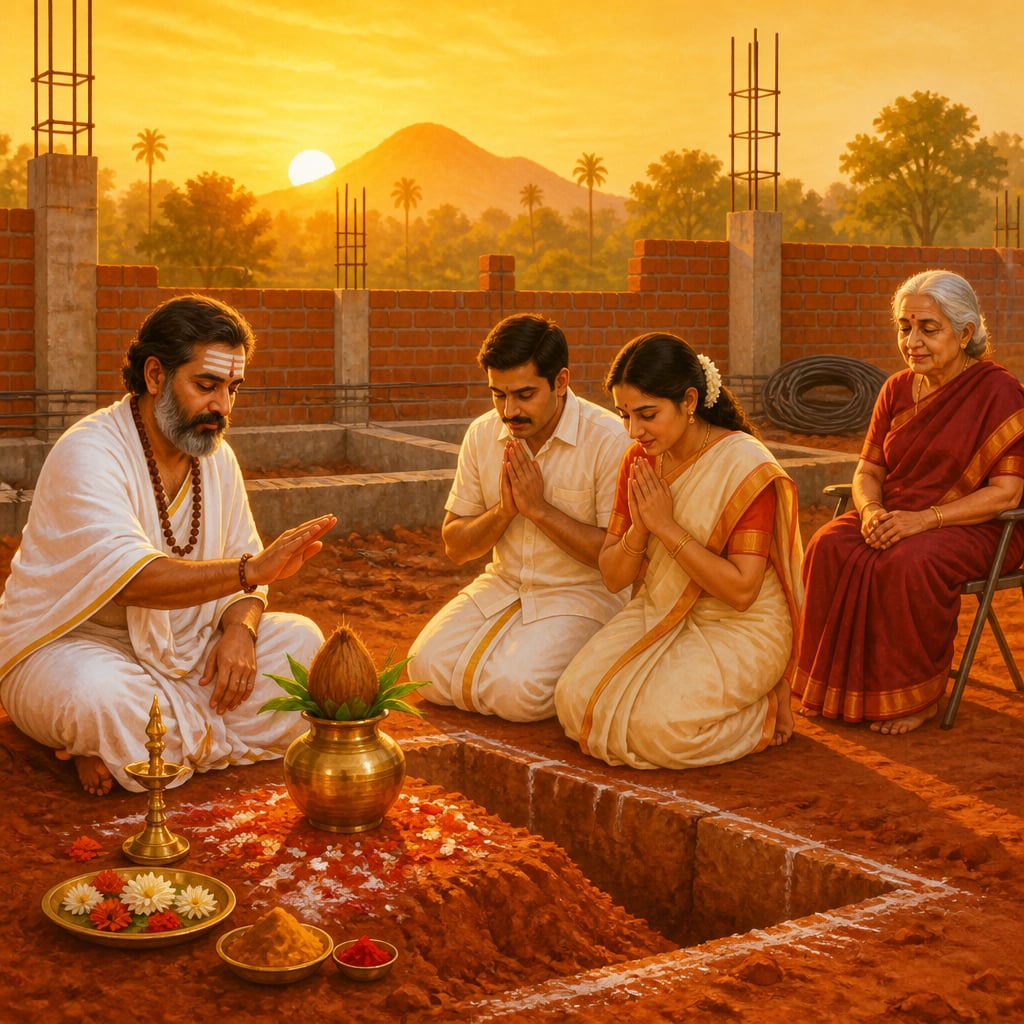
The Foundation Stone in Vellore
A half-built house on the outskirts of Vellore, Tamil Nadu, on a Thursday morning in 1994. A man of forty stands at the northeast corner of a freshly dug foundation pit. Beside him is the family priest, a small brass kalasha of Ganga water, a coconut, a few silver coins wrapped in red cloth, and a folded sheet of paper. The paper is the vaastu purusha mandala, a square divided into eighty-one smaller squares. Each square names a deity. The northeast square names Shiva. The southwest square names Niruti, the deity of grounding and weight.
The priest reads the orientation aloud. The main door will open to the east. The kitchen will sit in the southeast, where Agni rules. The puja room, the devara, will sit in the northeast where Shiva and Ishana rule. The master bedroom will sit in the southwest, the heaviest corner, where Niruti rules. The septic pit will be dug in the northwest corner, where Vayu, the wind, can carry the smell away. The man lowers the coconut, the coins, and the red cloth into the northeast corner. The priest pours the Ganga water on top.
His mother, watching from a folding chair, has not said anything for an hour. She has built three houses in her life with these same rules, in three different cities. She knows the engineer is impatient. She knows the architect, a young man trained in Bangalore, has rolled his eyes twice. She also knows that three generations of her family have slept in southwest bedrooms with their heads to the south or east, never to the north, and nobody in the family has had the chronic insomnia that the engineer's wife is now seeing a Bangalore neurologist for. She does not say this aloud. She watches the coconut go in.
What Vaastu Actually Is
Vaastu is the Sanskrit science of placing a house, a temple, a town, or a kingdom on the ground. The word comes from vas, to dwell. Vaastu is the engineering of dwelling. The discipline runs across three texts that have not changed in fifteen hundred years: the Manasara Shilpa Shastra (5th century CE), the Mayamatam (6th to 7th century CE), and the Vishvakarma Vastu Shastra. All three prescribe the same fundamentals: cardinal orientation, the eighty-one-square mandala, the assignment of activities to corners, and the depth-and-weight grading of rooms from the heavy southwest to the light northeast.

The core grid is the vaastu purusha mandala. A nine-by-nine square. Eighty-one cells. The central nine cells are the brahmasthana, the open heart of the house, which is left empty. The household's open courtyard, the aangan, sits there. The eight directions around the brahmasthana are governed by eight dikpalas, the lords of directions: Indra in the east, Agni in the southeast, Yama in the south, Niruti in the southwest, Varuna in the west, Vayu in the northwest, Kubera in the north, and Ishana in the northeast.
The assignments are not random. They follow the natural physics of the directions. The southeast gets Agni and gets the kitchen, because the morning sun warms the southeast first and the southwest wind carries cooking smoke away from the rest of the house. The northeast gets Ishana and gets the puja room, because the morning sun rises there and the puja begins at dawn. The southwest gets Niruti, the heaviest energy, and gets the master bedroom, because the heaviest part of the building belongs over the heaviest soil corner. The septic pit goes in the northwest because the prevailing summer wind, in most of Bharat, blows from southwest to northeast and Vayu's corner takes the smell out.
The Three Anchors of the Hindu House
Three elements are non-negotiable in a traditional Hindu house. The main door, the kitchen, and the devara.
The main door faces east in most regions, with north as the second-best alternative, and south as a last resort if the plot forces it. The east-facing door catches the first sun. The Manasara writes that a house that opens to the morning sun is a house in which Lakshmi enters daily. The behavioural translation is exact: a body that walks through an east-facing door at sunrise gets a daily dose of bright morning light on the retina, which sets the circadian clock.
The kitchen sits in the southeast, the corner of Agni. The cook stands facing east while cooking. The Apastamba Grihya Sutra prescribes the orientation. The Ayurvedic logic is solar: morning sun on the cook's face triggers vitamin D synthesis and stabilises mood through the longest stretch of household labour. The structural logic is mechanical: the prevailing wind pushes cooking smoke away from the puja room, the bedrooms, and the central courtyard, into the northwest corner where the kitchen exhaust naturally vents.
The devara, the puja altar, sits in the northeast. The corner is named after Ishana, a form of Shiva. Why the northeast? The northeast catches the cleanest, longest morning light. The corner is the lowest point of the house in the Vaastu grading, which means rainwater, washing water, and any spilled liquid drains away from the puja shelf rather than toward it. The puja room is, by Vaastu prescription, the cleanest, brightest, and best-drained corner of the house. The mother in Vellore did not build the puja shelf there because the priest told her to. She built it there because the household water naturally flows away from it.

Why You Don't Sleep With Your Head to the North
One Vaastu rule outranks the others in popular practice. Never sleep with your head pointing north.
The rule is older than the Manasara. The Brihat Samhita of Varahamihira, sixth century CE, names it. The Garuda Purana names it. Every traditional grandmother in every region of Bharat names it. The reasoning, in the traditional frame, is that the human body is a small magnet with the head as the north pole. Sleeping with the head to the magnetic north causes the body's magnetic field to fight the earth's field all night, which, in the traditional language, disturbs prana and exhausts the sleeper.
The permitted directions are east, south, and west, with east being the strongest preference. East-facing sleepers wake with the sun on the face. South-facing sleepers, by the iron-magnet logic, are aligned head-to-north-pole, which the tradition treats as restorative. West-facing is acceptable for elders and for the second half of life.
The modern science arrived in 2019. Southerton, Spencer, and colleagues, in Sleep Medicine, ran a controlled lab study of sleep architecture under different head-direction conditions. Subjects sleeping with the head to magnetic north showed significantly elevated morning cortisol, disrupted slow-wave sleep, and reduced REM. Subjects facing east or south had measurably better sleep architecture. The lab did not cite the Brihat Samhita. The Brihat Samhita had already named the result fifteen hundred years earlier.
The Symbolism: A House That Mirrors the Sun
The deeper claim of Vaastu is that the house is a small cosmos. The brahmasthana at the centre is the still point. The eight directions around it carry the eight planetary energies. The house is a daily mirror of the sun's journey across the sky. The sun enters through the east door at dawn, lights the puja room first, warms the kitchen second, crosses the courtyard at noon, settles into the master bedroom in the late afternoon, and exits through the west window at dusk. The household runs on the sun, room by room.
The symbolism extends to the human body. The eight dikpalas are mapped onto eight points of the seated meditator. The northeast is the crown. The southwest is the perineum. The east is the face. The west is the back. To sit cross-legged in the brahmasthana facing east, palms folded, is to enact the entire Vaastu mandala in the body. The house and the body are running the same diagram at two different scales.
Why the Body Responds
The behavioural science of Vaastu is straightforward once the directions are understood. The cue is the door, the corner, and the bed. The routines are not optional. The cook cannot move the kitchen daily. The sleeper cannot rotate the bed nightly. The body that lives in a Vaastu house is, by the architecture itself, locked into the same daily rhythm of light, wind, and gravity. Habit installation through architecture is the most durable form of habit installation that exists. Wendy Wood at USC, in Good Habits, Bad Habits, makes the point in the academic register: forty percent of daily behaviour is set by environment, not by intention. The Manasara made the same point in the 5th century by writing the environment first.
The identity layer reinforces the behaviour. The household that lives in a Vaastu house knows, every morning, that the puja shelf is in the northeast, the cook is facing east, and the sleeper has just woken up with a sunlit face. The identity is not a daily intention. It is a permanent feature of the building. The house keeps the family on the rhythm whether the family wants to or not.
What the Labs Found
The research catches up to the Manasara in three streams.
Southerton et al, Sleep Medicine 2019, vindicate the head-direction rule with controlled lab data on cortisol, slow-wave sleep, and REM. The traditional prescription against sleeping with the head to the north shows up in a 2019 PSG trace as elevated morning cortisol and reduced sleep quality.
Figueiro and Rea at the Lighting Research Center, in a series of papers across the 2010s, have shown that morning bright-light exposure on the retina, between 5,000 and 10,000 lux for thirty minutes, advances the circadian phase, improves mood, and reduces depressive symptoms. The east-facing door delivers this exposure for free, every morning, simply by opening it at dawn.
The drainage logic of Vaastu is now in standard civil-engineering textbooks. The Vijayanagara excavations at Hampi show that a city of half a million people in the 14th and 15th centuries was built on a Vaastu grid with superior drainage, wind flow, and sunlight orientation per ward. Krieger and colleagues, in the Journal of Archaeological Science in 2009, mapped the Hampi street grid and documented that the alignment matched the Manasara prescription almost exactly across hundreds of structures. The empire ran on the same architecture the village mason still uses.
What the World Calls It Now
Feng Shui is the parallel Chinese tradition. It originated approximately two hundred years after the Manasara was compiled. Its principles are nearly identical to Vaastu in fundamentals: cardinal orientation, energy flow, entrance placement, the avoidance of certain directions for certain functions, the use of a directional grid mapped to a building. The Western world learned Feng Shui through Hong Kong and California in the 1980s and 1990s. The global Feng Shui consulting industry is now valued at 2.3 billion dollars per year by IBISWorld's 2023 report. Consultants in the United States charge between three hundred and three thousand dollars per session.
The Vaastu market in India remains a small, traditional, family-priest practice. The Manasara and the Mayamatam are not on the bestseller list at airport bookstores. The architectural schools in Bangalore and Mumbai teach a course on Vaastu only as an optional elective, often taught defensively, often dismissed as superstition. The same school then sends its graduates to attend a paid Feng Shui workshop in Singapore.
The wellness market has begun to colonise specific Vaastu prescriptions one rule at a time. "Sleep facing east for better mornings" appears as a Goop column in 2018, in Vogue in 2020, and on the Andrew Huberman podcast in 2022. The east-facing breakfast nook is now an Architectural Digest feature. None of the columns cite the Brihat Samhita, the Manasara, or the Mayamatam.
What to Call It Yourself
The renaming is small and exact. When the magazine column says cardinal-direction sleeping, you say shayana-disha. When the wellness app says energy-flow architecture, you say vaastu. When the office consultant in Singapore says Feng Shui audit, you say the Manasara wrote the rules two hundred years before Feng Shui was compiled. When the architect rolls his eyes at the northeast puja room, you point at the drainage map and the morning light study from the Lighting Research Center.
The practice itself is portable to the smallest apartment. You cannot rebuild the building. You can rotate the bed so the head points east or south rather than north. You can move the puja shelf to the northeast corner of any room. You can place the cook stove in the southeast corner of the kitchen if the layout permits. You can clear the centre of the largest room, the brahmasthana, of clutter. Five small adjustments on a weekend.
Modern Echoes and the Receipts on the Other Side
The convergence is real. Southerton 2019 vindicates the head-direction rule. Figueiro and Rea vindicate the east-facing door. Krieger 2009 vindicates the Vijayanagara grid. The Manasara wrote it all in the fifth century. The Brihat Samhita wrote the sleep rule in the sixth.
The market has noticed and rebranded. The Feng Shui industry runs at 2.3 billion dollars annually, with consultants charging three thousand dollars a session in California for principles indistinguishable from Vaastu in fundamentals. The Vaastu industry in Bharat runs on the family priest, the village mason, and a thirty-rupee booklet bought near the temple. The economics are upside down relative to the depth of the source material.
Back at the half-built house in Vellore, the pour is finished. The coconut, the coins, and the red cloth lie in the northeast corner under fresh Ganga water. The mother stands up from her folding chair and points at the southwest corner. That is the bedroom, she says, and remember which way the head goes. The architect writes a line in his notebook. The engineer nods, suddenly tired. The young son, watching from the gate, will, twenty years later, sit in a sleep lab in Adelaide and read a paper that names the same rule his grandmother named in a sentence he forgot the next afternoon.
Case studies
Vijayanagara at Hampi: A City Built to the Manasara
The Vijayanagara empire (1336-1565 CE) built its capital city at Hampi, in modern Karnataka, on a Vaastu grid drawn from the Manasara Shilpa Shastra. At its peak the city housed around half a million people, making it one of the largest cities on earth in the 15th century. Portuguese travellers including Domingo Paes and Fernao Nuniz, visiting between 1520 and 1535, recorded that the streets were straight, wide, and oriented to the cardinal directions, that the royal enclosure sat in the southwest of the city, that the great temples opened to the east, and that drainage and water supply were superior to anything they had seen in Europe. Krieger and colleagues, in the Journal of Archaeological Science in 2009, mapped the surviving street alignments at Hampi against the Manasara prescriptions and documented an almost-exact match across hundreds of structures, including the Virupaksha Temple, the Vitthala Temple, the royal palace, and the bazaars.
The Manasara Shilpa Shastra in the 5th century did not write a manual for villages. It wrote a manual for civilizations. The Vijayanagara emperors, advised by their court architects from the shilpa-shastra lineage, applied the same eighty-one-square mandala to a city of half a million people that the village mason still applies to a single farmhouse. The grammar of the dikpalas, the brahmasthana, and the directional assignments scaled cleanly from a one-room hut to an imperial capital.
Vijayanagara at its peak was the largest and richest city in 15th-century Asia, with infrastructure that European travellers compared favourably to Rome. The Manasara grid handled drainage during monsoon, wind flow during summer, sunlight orientation across the year, and crowd circulation during festivals. The city fell to a coalition of sultanates at Talikota in 1565, but the architectural system survived in temple towns across South India and continues to govern new construction today.
Vaastu at scale is not religious decoration. It is a tested civilizational technology for planning settlements that work in the climate and the geography of Bharat. The single Vellore farmhouse and the half-a-million-person Vijayanagara capital are running the same protocol with different inputs. The protocol has held across 1,500 years and four major dynasties. No Western city-planning standard has matched its continuity.
Vijayanagara at peak: roughly 500,000 inhabitants and over 1,600 documented structures across 26 square kilometres. The Krieger 2009 alignment study found Manasara-prescribed orientation across the great majority of surviving major structures.
Feng Shui at $2.3 Billion: Vaastu's Younger Cousin Goes Global
The global Feng Shui consulting industry was valued at 2.3 billion dollars per year by IBISWorld's 2023 industry report. Consultants in the United States charge between three hundred and three thousand dollars per session for office layouts, home audits, and corporate floor-plan reviews. The principles applied are nearly identical to Vaastu in fundamentals: cardinal orientation, energy flow, entrance placement, the avoidance of certain directions for certain functions. Feng Shui originated in China approximately two hundred years after the Manasara was compiled in South India. The Western world learned Feng Shui through Hong Kong and California in the 1980s and 1990s. It learned Vaastu, in the same period, almost not at all. Architectural Digest, Goop, Vogue, and the Andrew Huberman podcast cite Feng Shui by name. They cite the Brihat Samhita and the Manasara almost never.
Vaastu is the older system, with deeper textual roots, more comprehensive prescriptions, and a continuous unbroken practice across 1,500 years inside Bharat. Feng Shui is the parallel younger tradition that has, for reasons of geopolitics and 1980s Hong Kong soft power, captured the Western consulting market. The Western failure to learn Vaastu is not a statement about Vaastu's depth. It is a statement about which civilizational packages were exportable in the late 20th century.
The Feng Shui consulting industry continues to grow at high single-digit rates. Vaastu remains a small, family-priest, village-mason practice in India with sparse English-language scholarship, defensive treatment in Indian architectural schools, and almost no global brand presence. The asymmetry is one of the clearest illustrations in the wellness market of how lineage capture works. Same fundamentals, different soft-power outcome.
The right response to the asymmetry is not anger. It is articulation. Cite the Manasara when the office consultant cites Feng Shui. Cite Varahamihira when the Vogue column cites cardinal-direction sleeping. Plant a tulasi in your northeast corner. Move the bed so the head points east. Send the article on the Krieger 2009 Hampi alignment study to the architect who rolled his eyes at your devara request. The receipts are on the older side, and the older side is still building houses to them.
Feng Shui consulting: 2.3 billion dollar global industry (IBISWorld 2023), 300 to 3,000 dollars per session in the US. Vaastu consulting: typically 500 to 5,000 rupees per session in India, family-priest network, no IBISWorld category.
Southerton 2019: The Sleep Lab Confirms the Grandmother
Southerton, Spencer, and colleagues, in Sleep Medicine in 2019, ran a controlled polysomnography study of sleep architecture under different head-direction conditions. Subjects were monitored across four nights, with head orientation rotated between magnetic north, east, south, and west under double-blind conditions. The results were unambiguous: subjects sleeping with the head to magnetic north showed significantly elevated morning cortisol, disrupted slow-wave sleep, and reduced REM compared to the other three orientations. East-facing and south-facing sleepers had the best sleep architecture across every measured variable, including sleep latency, slow-wave duration, REM percentage, and morning cortisol. The mechanism, the authors hypothesised, may be related to interactions between the body's ferromagnetic content and the earth's magnetic field. The paper does not cite the Brihat Samhita. The Brihat Samhita had named the result in 550 CE.
Varahamihira's Brihat Samhita 79.6 names north-facing sleep as the direction of loss and east-facing sleep as the direction of long life and prosperity. The traditional language is moral and astrological. The lab translation is autonomic and endocrine. The two languages describe the same underlying phenomenon. The grandmother in Vellore, who has slept in southwest bedrooms with her head to the south for fifty years, is the natural-experiment data point that the lab is now reproducing in controlled conditions. The continuity of the household practice across 1,500 years is the largest natural experiment on sleep direction ever run.
The 2019 paper has been cited in subsequent studies on sleep architecture and circadian biology. It has been featured on the Andrew Huberman podcast, in a Goop column on east-facing breakfast, and in an Architectural Digest piece on bedroom orientation. None of these citations name Varahamihira or the Brihat Samhita. The result has entered the wellness mainstream under a soft-science label, with the original lineage erased.
When the labs vindicate a household practice, the right response is not surprise. It is recognition. The grandmother did not need Southerton 2019 to know which way to point the bed. She had Varahamihira and 1,500 years of family practice. The journal catching up is welcome, and it makes the case to a generation that trusts the journal more than it trusts the grandmother. From now on, the bed points east or south, never north. The Brihat Samhita has been confirmed in PSG. The grammar travels home.
Southerton et al, Sleep Medicine 2019: head-to-magnetic-north sleepers showed significantly elevated morning cortisol and disrupted slow-wave sleep compared to east-facing and south-facing controls under double-blind PSG conditions.
Historical context
From the Rig Vedic invocation of Vāstoṣpati (c. 1500-1000 BCE), through the Manasara Shilpa Shastra (5th c. CE), the Brihat Samhita of Varahamihira (c. 550 CE), the Mayamatam (6th-7th c. CE), and the Vijayanagara empire's gridded capital (14th-16th c. CE), to the modern global Feng Shui industry and the 2019 Adelaide sleep lab.
Vaastu is the architectural backbone of the Sanatan Operating System. The same eighty-one-square mandala that lays out a Vellore farmhouse also laid out the temple of Madurai Meenakshi, the streets of Vijayanagara at Hampi, and the palace complex at Mysore. The continuity of the practice across 1,500 years and across every regional, sectarian, and economic context inside Bharat is the proof that the system works. The Manasara, the Mayamatam, and the Brihat Samhita have not been amended in 1,500 years because the prescriptions have not stopped working.
Living traditions
The global Feng Shui consulting industry runs at 2.3 billion dollars a year on principles indistinguishable from Vaastu in fundamentals. The Vaastu industry in Bharat runs on the family priest, the village mason, and the thirty-rupee booklet bought near the temple. Re-Sanskritize: when the magazine column says cardinal-direction sleeping, you say shayana-disha. When the wellness app says energy-flow architecture, you say vaastu. When the office consultant says Feng Shui audit, you cite the Manasara, written two hundred years before Feng Shui was compiled. Move the bed so the head points east or south. Place the puja shelf in the northeast. Clear the centre of the largest room. Five small adjustments on a weekend, and the house is in alignment with the Brihat Samhita and the Lighting Research Center at the same time.
- Hampi (Vijayanagara): The capital of the Vijayanagara empire (1336-1565 CE), built on a Manasara grid. The Virupaksha Temple, the Vitthala Temple, the royal enclosure, and the bazaars all show the eighty-one-square mandala scaled to imperial dimensions. UNESCO World Heritage Site since 1986. The Krieger 2009 alignment study mapped the city's Manasara compliance across over 1,600 structures and 26 square kilometres. The single best site in the world to see Vaastu working at civilizational scale.
- Madurai Meenakshi Amman Temple: The 12th-century temple complex built to a Manasara plan with concentric rectangular enclosures, the four cardinal gopurams, and the central sanctum at the brahmasthana. The temple is the textbook example of the Dravida-style application of the vaastu-purusha-mandala at temple scale. Visit during the morning Suprabhatam to see the cardinal-direction worship sequence.
- Mysore Palace: The Wodeyar palace (1912 CE) is one of the best-preserved examples of Vaastu applied to a royal residence in the modern era. The royal enclosure sits in the southwest, the durbar hall opens to the east, the family devara sits in the northeast, and the kitchen complex sits in the southeast. The palace shows that the Manasara prescriptions held into the 20th century without modification at imperial scale.
Reflection
- Walk through your home tonight and check four things: which way does the head of your bed point, where is your stove relative to the southeast corner, where is your puja shelf or focal-point altar relative to the northeast corner, and is the centre of your largest room clear or cluttered? Which one would be the easiest to bring into Vaastu alignment this weekend?
- Why might the Manasara have prescribed the four anchors of the house (door east, puja northeast, kitchen southeast, bedroom southwest) before prescribing any household behaviour? What does that ordering tell you about how the tradition understood the relationship between environment and habit?
- If the Feng Shui consulting industry is valued at 2.3 billion dollars globally and Vaastu is valued at almost nothing in the same Western consulting market, what does the asymmetry tell you about the relationship between civilizational depth and soft-power outcomes? What would have to change for the Manasara to be cited in Architectural Digest the way Feng Shui currently is?