Sacred Creatures, Sacred Witness

Bhuta-yajna and the Hindu Household's Daily Offering to All Beings

Why a Hindu household feeds the anthill, the crow, the stray dog, and the snake before the family eats. The bhuta-yajna, one of the five panchamahayajnas, is the original ecological ethic. The wellness industry rebranded it as 'spirit animals' and the emotional support animal industry. The grandmother kept the receipts.
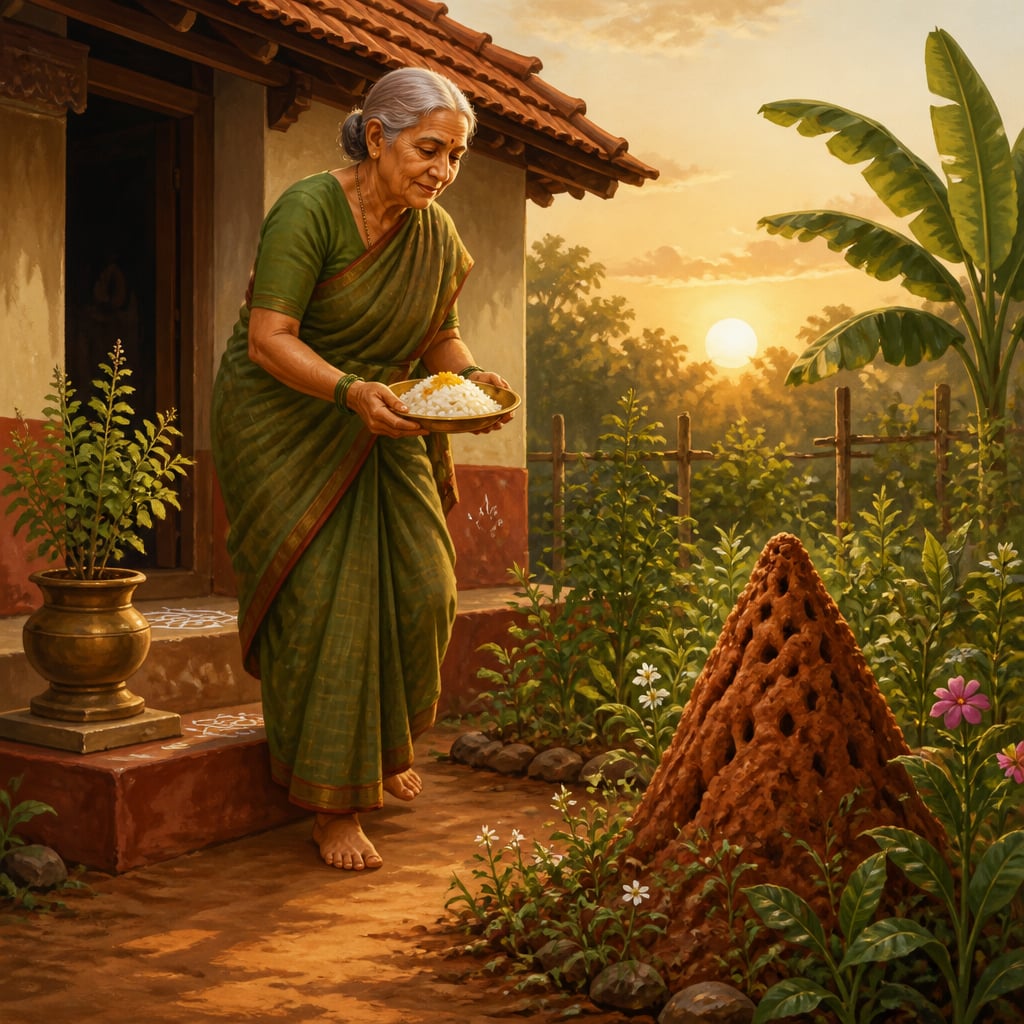
A Karnataka grandmother offering cooked rice at an anthill behind her house

The Anthill Behind the House

In a small house in Belgaum, in the Karnataka October of my eighth year, my Lakshmi ajji used to step out of the kitchen every morning carrying a steel tumbler of water and a piece of jowar roti. The first roti. The one any other household would have given to the man of the house. She walked to the back of the courtyard, where the rains had pushed up a small reddish anthill near the compound wall, and she poured the water in a thin circle around the mound. She crumbled the roti at its base. Then she stood for a moment with her eyes closed.

No one in the family had eaten yet. My grandfather was at the well. My uncle was still asleep. My mother was rolling out the next stack of rotis. The first food and the first water of the day went to the ants.

When I asked her once why we feed the ants before we feed ourselves, she said only this. They see. They witness. They remember.

She never explained the rest. She did not tell me that what she was performing was an ancient and codified rite called Bhuta-yajna, the daily offering to all creatures, named in the Manu Smriti as one of the five great sacrifices a householder owes every day. She did not tell me that the ants in front of her belonged to a global biomass of about twenty quadrillion individuals, more than every other land animal combined except humans. She did not tell me that an entire wing of the New Age wellness industry, worth several billion dollars, would in her lifetime sell a hollowed-out version of what she was doing and call it spirit animal work.

She just fed the ants.

This lesson is the explanation she did not give me.

The Householder's Five Daily Debts

Before we walk through the creatures, the frame matters.

The Manu Smriti, in chapter 3, lists five great daily sacrifices that every householder owes. Together they are called the panchamahayajna, the five great offerings.

Four of those five are well-known. The fifth, the bhuta-yajna, is the one this lesson is about. It is the duty to set aside, every single day, a portion of the household's food for non-human beings. Dogs. Crows. Cows. Ants. Snakes when they are seen. Fish in the temple tank. The word bhuta here is older and gentler than the modern Bombay-Hindi sense. It simply means creatures, beings. Every breathing thing the household shares the earth with.

This is not optional charity. The Manu Smriti is unambiguous. A householder who eats before he has fed the gods, the ancestors, the guests, and the creatures, eats only sin.

The ant at my Lakshmi ajji's anthill was not a hobby. It was one fifth of her daily duty as the senior woman of a Hindu home.

What the Family Sees, Through the Year

The bhuta-yajna takes different forms across Bharat through different seasons. Six anchor practices, the ones every reader will recognise.

A devotee pouring milk on a stone naga idol on Naga Panchami

The snake is honoured on Naga Panchami, the fifth tithi of the bright fortnight of Shravana (late July or early August). Across Maharashtra, Bengal, Karnataka, Andhra and Kerala, women clean the threshold, draw a snake on the floor in turmeric, and offer milk and lavalu (puffed rice). In Mannarasala, Kerala, this offering happens at the world's largest naga temple, more than thirty thousand stone snake images installed in a sacred grove that the priesthood, led traditionally by a woman called the Valiya Amma, has tended for centuries. In Karnataka, the same vow draws lakhs of pilgrims to Kukke Subramanya.

The elephant is honoured at temples and through everyday street blessings. The temple elephant of Kerala in gold caparison is the public form. The household form is the small coin and banana given to the trained elephant outside South Indian temples, who in return touches the donor's head with the trunk. The deity behind it is Ganesha.

Yudhishthira at the gate of heaven refusing to leave the dog

The dog is the vahana of Kala Bhairava, the fierce form of Shiva who guards Kashi. At the Kaal Bhairav temple in Varanasi, dogs are fed daily as part of the deity's worship. Across Karnataka and Tamil Nadu, Bhairava devotees feed a stray dog every Tuesday or Saturday. The Mahabharata deepens this. In the Mahaprasthanika Parva, Yudhishthira walks toward heaven with a dog who has followed him from Hastinapura. At the gate, Indra tells him to leave the dog behind. Yudhishthira refuses. The dog reveals himself as Dharma. The senior Pandava is the only one to enter heaven in his mortal body, and the dog is the test no one else passed.

The crow is the messenger of Yama. During Pitru Paksha, the dark fortnight of Bhadrapada (mid-September to early October), every household with departed elders sets out a small clean plate of cooked rice and a piece of pinda for the crow each afternoon. The Garuda Purana names this the kakabali. The grandmother who places the plate often calls the crow Mama without irony. For sixteen days the crows of the neighbourhood and the ancestors of the house are, in the household's reckoning, the same.

The ant is the smallest creature counted as kin. Across Maharashtra and Gujarat the practice is called chyontichoon or kidi-pe-aata, flour for the ants. A handful of fine wheat flour, sometimes with a pinch of sugar, is sprinkled at any anthill near the home, especially on Sundays, on Akshaya Tritiya, and through Pitru Paksha. Lakshmi ajji's morning practice was the village form of this.

The fish and turtle are honoured by feeding at temple tanks. Almost every old South Indian and Bengali temple has a kalyani, a stepped tank, with carp and turtles fed by visitors. The Matsya and Kurma avatars of Vishnu are remembered in this single small daily act.

In each, the same engine. A household offering. Before the offering, no eating. After the offering, the day begins.

What the Scripture Says, Across the Tiers

The scriptural backing is wide. The Atharva Veda contains an entire collection of mantras, the Sarpa Sukta, on the worship and propitiation of serpents. The Shukla Yajur Veda continues the same vocabulary.

The Manu Smriti in 3.70 states the five-yajna duty in a single famous line.

अध्यापनं ब्रह्मयज्ञः पितृयज्ञस्तु तर्पणम्। होमो दैवो बलिर्भौतो नृयज्ञोऽतिथिपूजनम्॥

adhyāpanaṃ brahma-yajñaḥ pitṛ-yajñas tu tarpaṇam homo daivo balir bhauto nṛ-yajño'tithi-pūjanam

Teaching is the offering to Brahman. Tarpana is the offering to the ancestors. Homa is the offering to the gods. Bali is the offering to all creatures. Honouring the guest is the offering to humans.

Manu Smriti 3.70

The word bali here is the same root as kakabali. It means the offering. Not the modern sense of sacrifice, but the older sense of the share set aside.

The Mahabharata Anushasana Parva elaborates the theme. To feed a hungry creature, the text says, is dharma even if the creature is the smallest of ants. The same parva devotes long passages to the protection of nagas, including the famous account of Janamejaya's snake-yajna and how the sage Astika halted it.

The Garuda Purana specifies the kakabali, the crow rite, in its account of Pitru Paksha procedure. The Shiva Purana establishes the dog as Bhairava's vahana and prescribes the household feeding of the dog as part of Bhairava worship.

Every part of the practice is named, dated, sourced.

Why the Body Responds

The daily bhuta-yajna does three things to the household at once.

It installs a cue. The morning kitchen has a fixed first action that is not about the family. The chapati water at the anthill, the rice for the crow, the biscuits in the pocket for the temple dog. The cue is physical. The hand reaches for the leaf or the steel plate before the brain has even decided. A daily hand-shaped cue is the sturdiest cue any habit science has measured.

It installs an identity. The grandmother who feeds the ants every morning for forty years is not an animal lover. She is a Bhuta-yajna keeper. The behaviour follows the name. James Clear's central argument in Atomic Habits, that durable change is built on identity rather than outcome, is the same engine the Manu Smriti named two thousand years ago.

And it installs a witness. The crow that lands on the wall at three in the afternoon during Pitru Paksha is being addressed by name. The dog at the temple gate is being received as Bhairava's darshan, not as charity. The household that knows it is being watched by the non-human eye behaves differently. The presence of a witness is the system. You do not rise to the level of your goals, you fall to the level of your systems.

The modern science of habit and ecology has caught up to most of this in the last forty years.

E.O. Wilson, the Harvard biologist, proposed the biophilia hypothesis in his 1984 book of the same name. His argument was that human psychological well-being is not fully reachable without regular contact with non-human life. Decades of research after him have confirmed measurable drops in cortisol, lower blood pressure, and improved mood in humans who keep daily contact with plants and animals. The bhuta-yajna is biophilia ritualised, made daily, made compulsory.

John Marzluff, an ornithologist at the University of Washington, ran a long series of experiments published in Animal Cognition in 2011 and 2012 showing that crows recognise individual human faces and remember them across years. A household that has fed crows on its balcony for three generations is being remembered, in measurable cross-generational memory, by the actual descendants of the crows the great-grandmother fed. The kakabali is not symbolism. It is verified cross-species memory.

Schultheiss and colleagues in 2022 published in PNAS the first global census of ant biomass. The estimate was twenty quadrillion ants. The wheat flour at the anthill is being received by a planetary network larger than every other terrestrial animal society combined.

Nagasawa and colleagues in 2015 published in Science the dog-human gaze study. Mutual gaze between a dog and a human releases oxytocin in both. The hormonal loop the bhuta-yajna installs at the temple gate has a name and a graph.

And Joshua Plotnik at the City University of New York has, in a series of studies through the 2010s, shown that elephants pass the mirror self-recognition test, console grieving herd-mates, and remember individual humans for decades. The temple elephant remembers the small coin and the banana.

Five labs. Five papers. The Manu Smriti got there first.

What the World Calls It Now

The wellness industry has been busy.

In 1968, Carlos Castaneda published The Teachings of Don Juan, a book later widely judged to be invented but read at the time as ethnography. It introduced the Western reader to the spirit animal, a vocabulary the New Age industry has been monetising ever since. By 2024, the US New Age and esoteric wellness market alone was estimated at more than five billion dollars a year. A meaningful slice sells spirit animal meditations, totem readings, and personality quizzes asking which animal you are most like. The Hindu sacred-creature framework reduced to a personality quiz on Instagram.

The emotional support animal industry is the second wave. The ESA framing presents the sacred bond as a one-way therapeutic transaction. The animal exists to soothe the human. The bhuta-yajna inverts the direction. The human exists to feed the animal. The witness sits with the creature.

PETA's annual budget runs around fifty million US dollars. Animal welfare in the West is a movement, an institution, a fund-raising cause. In Bharat, it has been a household duty, ritualised, named, scripted, since before the Vedas were put into writing.

None of this is a complaint. It is just the receipts.

The Practice (Sanatan) The Coopt (modern wellness) The Difference
Bhuta-yajna Spirit animal personality quiz Daily duty vs identity branding
Kakabali (crow) Backyard birdwatching Ancestor witness vs hobby
Bhairava's dog feeding Emotional support animal I feed it vs it serves me
Naga Panchami milk offering Snake conservation NGO Daily household vow vs annual donation
Anthill flour offering Insect ecology academic paper Pre-breakfast act vs research interest

What to Call It Yourself

The naming matters.

The crow on the balcony is not a backyard friend. It is a kakabali recipient and possibly an ancestor on visit during Pitru Paksha. Speak its name aloud before you place the plate.

The dog at the temple gate is not your spirit animal. It is Bhairava's witness. Carry biscuits in the pocket on Tuesdays and Saturdays. Feed at least one before you walk into the temple. The darshan begins at the gate.

The anthill behind the house is not a pest. It is the smallest creature counted as kin, and the daily flour is its share of the household.

The snake seen near the back wall during Shravana is not an emergency. It is a Naga, owed milk, owed lavalu, owed the small turmeric drawing at the threshold. Treat it as the Atharva Veda did.

The word spirit animal takes the practice and strips it of duty. The word emotional support takes the relationship and reverses it. The word pest takes the kin and turns it into a problem. The Sanskrit names carry the cosmology.

Modern Echoes

E.O. Wilson, in 1984, told the Western reader that humans need daily contact with the non-human to stay sane. The Manu Smriti, in 3.70, told the Hindu householder the same thing two thousand years earlier and made it a daily duty. John Marzluff confirmed in 2012 that crows remember the faces of the humans who feed them across years and generations. Nagasawa's 2015 Science paper found that dog-human gaze releases oxytocin in both. The Tuesday morning at the Kaal Bhairav gate has a hormonal signature now.

A five-billion-dollar wellness market has been busy translating one fifth of the panchamahayajna into something it can sell. The original is not for sale. It is in the kitchen, and the rotis are still warm.

Back to the Anthill

Lakshmi ajji is gone now. The house in Belgaum has new owners and they have probably plastered over the corner where the anthill used to come up after the rains. But somewhere in that corner of the courtyard, the great-great-great-granddaughters of the ants she fed are still farming the same red soil.

They see. They witness. They remember.

The lesson she did not owe me has been delivered, finally, by the labs.

Key figures

Kala Bhairava

Eternal; the Bhairava cult institutionalised across Bharat from at least the 7th century CE

Shesha Naga

Eternal; the eight-naga roster codified in the Atharva Veda and elaborated in the Puranas

Yudhishthira's Dog (Dharma)

Mahabharata period (traditional dating circa 3139 BCE)

Case studies

The Mohenjo-Daro Cobra Seals: Snake Worship Older Than the Vedas

In the excavations of Mohenjo-Daro and Harappa between 1922 and the 1960s, archaeologists recovered terracotta seals and small figurines depicting a seven-headed cobra. The iconography is unambiguous: the same multi-hooded serpent that the later Sanskrit tradition names Shesha. The seals are dated to the mature Harappan phase, between 2600 and 1900 BCE. They predate the textual codification of naga worship in the Atharva Veda by at least a millennium and a half.

The Hindu tradition has always held that the worship of the naga is older than any text. The seals at Mohenjo-Daro show the iconography already in place during the Harappan period. The Atharva Veda Sarpa Sukta later names the same form (Shesha, Vasuki, Takshaka and the rest) and gives it mantra. The Manu Smriti folds it into the panchamahayajna. The Puranas elaborate it. The pre-Vedic urban seal and the modern Naga Panchami threshold drawing belong to one continuous practice.

Sacred creature worship in Bharat is now documented as one of the oldest continuous religious practices on earth. The Mannarasala Sree Nagaraja Temple in Kerala alone holds more than thirty thousand stone naga images, and Naga Panchami is observed annually by hundreds of millions across South Asia.

When a modern frame describes a Hindu practice as folk superstition or a recent Puranic invention, check the archaeology. The receipts on the bhuta-yajna run from the Indus Valley seals through the Vedas through the Smritis through the temple in Alappuzha to the woman drawing turmeric at her threshold this Shravana.

Sacred creature worship in India is older than the Vedas. The household practice on Naga Panchami sits inside an unbroken iconographic lineage of more than four and a half thousand years.

The seven-headed cobra seals from Mohenjo-Daro are dated 2600 to 1900 BCE, predating the Atharva Veda's textual codification of naga worship by at least 1,500 years.

Marzluff and Wilson: The Labs Vindicate the Kakabali

In 1984, the Harvard biologist Edward O. Wilson published Biophilia, arguing that human psychological well-being is not fully reachable without regular contact with non-human life. In 2011 and 2012, John Marzluff and his team at the University of Washington published a series of papers in Animal Cognition showing that crows recognise individual human faces, remember them across years, and communicate that memory to other crows. In 2022, Schultheiss and colleagues published in PNAS the first global census of ant biomass: roughly twenty quadrillion individual ants, more than every other terrestrial animal society combined.

The Manu Smriti 3.70, two thousand years ago, made bhuta-yajna one of the five daily duties of every householder. The Garuda Purana fixed the kakabali, the crow rite, into the Pitru Paksha calendar. Across Maharashtra and Gujarat, the chyontichoon (flour at the anthill) has been kept at scale for as long as oral memory runs. The rituals were already calibrated to creatures the labs would only later confirm as cognitively rich, ecologically central, and capable of cross-generational human-recognition.

Biophilia is now a cited subfield of environmental psychology with controlled-trial evidence for cortisol reduction, blood-pressure improvement, and mood lift from regular contact with non-human life. Marzluff's crow studies are foundational reading in animal cognition. The ant census is the largest ever conducted. None of these labs cite the Manu Smriti, but their findings vindicate the practice it codified.

The bhuta-yajna is biophilia ritualised, made daily, made compulsory. The crow being fed on the balcony during Pitru Paksha is, by the Marzluff data, in measurable cross-generational memory of the household. The ecological duty the ritual encodes is biologically real.

The kakabali at the household's south-facing edge is not symbolism. It is verified cross-species memory. The flour at the anthill is being received by a planetary network larger than any other land-animal society.

Marzluff et al, 2012, Animal Cognition: crows recognise individual human faces and retain that recognition for at least five years, transmitting it to other crows. Schultheiss et al, 2022, PNAS: global ant biomass roughly 20 quadrillion individuals.

Spirit Animals and Emotional Support Pets: The Bhuta-Yajna, Rebranded

In 1968 Carlos Castaneda published The Teachings of Don Juan, a book later widely judged to be invented but read at the time as ethnography. It introduced the Western reader to the spirit animal and the power animal, a vocabulary the New Age industry has been monetising ever since. By 2024, the New Age and esoteric wellness market in the United States alone was estimated at more than five billion dollars annually, a meaningful slice of which sells spirit-animal personality quizzes, totem readings, and meditation packages. In parallel, the registered emotional support animal market crossed into the low billions of dollars a year, and the broader pet wellness industry passed two hundred and fifty billion dollars globally in the same year.

The Hindu sacred-creature framework already had a name, a scripture, a calendar, and a daily duty. Bhuta-yajna is one of the five panchamahayajnas in the Manu Smriti. The dog is Bhairava's vahana. The crow is Yama's messenger during Pitru Paksha. The cobra is a naga to be fed milk on Shravana Shukla Panchami. The relationship is not therapeutic; it is duty-shaped and witness-shaped. The human exists to feed the creature, not the other way round. The wellness industry's repackaging keeps the surface (the bond with the animal) and removes the cosmology (the deity, the calendar, the duty).

Several billion dollars a year now flow through Western wellness markets selling versions of the bond the bhuta-yajna codified. None of these industries cite the Manu Smriti or the Atharva Veda. The Hindu household, in the meantime, continues the practice unselfconsciously and at zero retail cost, in roughly two hundred million homes across South Asia.

When the world calls it spirit animal work, call it bhuta-yajna. When the world calls it an emotional support animal, call it Bhairava's witness. When the world calls the household snake a pest, call it the Naga the Atharva Veda already addressed. The Sanskrit names carry the deity, the calendar, and the duty that the English translations leave out.

The Hindu sacred-creature system has been reduced, in the largest wellness markets on earth, to a personality-type quiz and a paid service relationship. The original is older, larger, freer, and still running. The receipts are on the grandmother's side.

US New Age and esoteric wellness market: more than five billion dollars annually (2024). Global pet wellness industry: more than two hundred and fifty billion dollars annually (2024). Annual cost of one Hindu household's bhuta-yajna: roughly the price of a piece of jowar roti and a tumbler of water.

Historical context

Multi-layered: Harappan urban (c. 2600 to 1900 BCE) for naga iconography; Vedic and Atharva Vedic for codified mantra; Smriti period (c. 200 BCE to 200 CE) for the panchamahayajna codification in the Manu Smriti; 12th century CE for the institutional consolidation of Mannarasala in Kerala

Sacred creature worship in Bharat is older than the Vedas. The seven-headed cobra seals at Mohenjo-Daro show the iconography in place by 2600 BCE, which the Atharva Veda then names and systematises in the Sarpa Sukta. By the time the Manu Smriti consolidates the panchamahayajna, the practice of daily creature offering is no longer regional or sectarian; it is built into the householder's ethical rule book. Across the Mahabharata (Yudhishthira's dog, Janamejaya's snake yajna, the Anushasana Parva on feeding all beings) and through the Puranic period (Bhairava's vahana, Pitru Paksha kakabali, the Mannarasala lineage in Kerala), the same ethic flows continuously. The cross-creature ethical grammar of Bharat is older than any documented ethical system in the world.

Living traditions

The lesson here is to give the practice its right name. The crow on the balcony in Bhadrapada is not a bird visitor. It is a kakabali recipient and possibly an ancestor on visit. The dog at the temple gate on Tuesday is not your spirit animal. It is Bhairava's witness, owed Bhairava's biscuit. The anthill behind the house is not a pest problem. It is the smallest creature counted as kin under the bhuta-yajna, owed its share of the household's flour. The cobra seen near the back wall in Shravana is not an emergency. It is a Naga the Atharva Veda already addressed. The Sanskrit names carry the cosmology, the calendar, and the duty. Use the Sanskrit names. Tell your friends. The bhuta-yajna travels better when it carries its proper name.

Reflection

More in Griha: Home, Hearth, Earth

All lessons in Griha: Home, Hearth, Earth · Samskaras: The Sanatan Operating System course