The Threshold Is Sacred

Kolam, mango toranam, swastika, and the hanging bell: four objects that turn a doorway from a hole in the wall into a working membrane

Before sunrise, a woman in Mylapore squats outside her gate and pours rice flour through her fingers in a sixteen-dot grid. A few hundred kilometres north, fresh mango leaves are tied across a doorway in Pune for a housewarming. In Varanasi, a small swastika in turmeric paste sits beside the lintel. In Madurai, a brass bell hangs above the entrance, and every visitor's hand brushes it on the way in. Four objects, one threshold, one civilisation that knew the doorway is the membrane between the street and the household and built it accordingly. This lesson unpacks the kolam, the toranam, the swastika, and the bell, with scripture, symbolism, habit science, modern research, and a plastic-mango-leaf bestseller on Amazon.
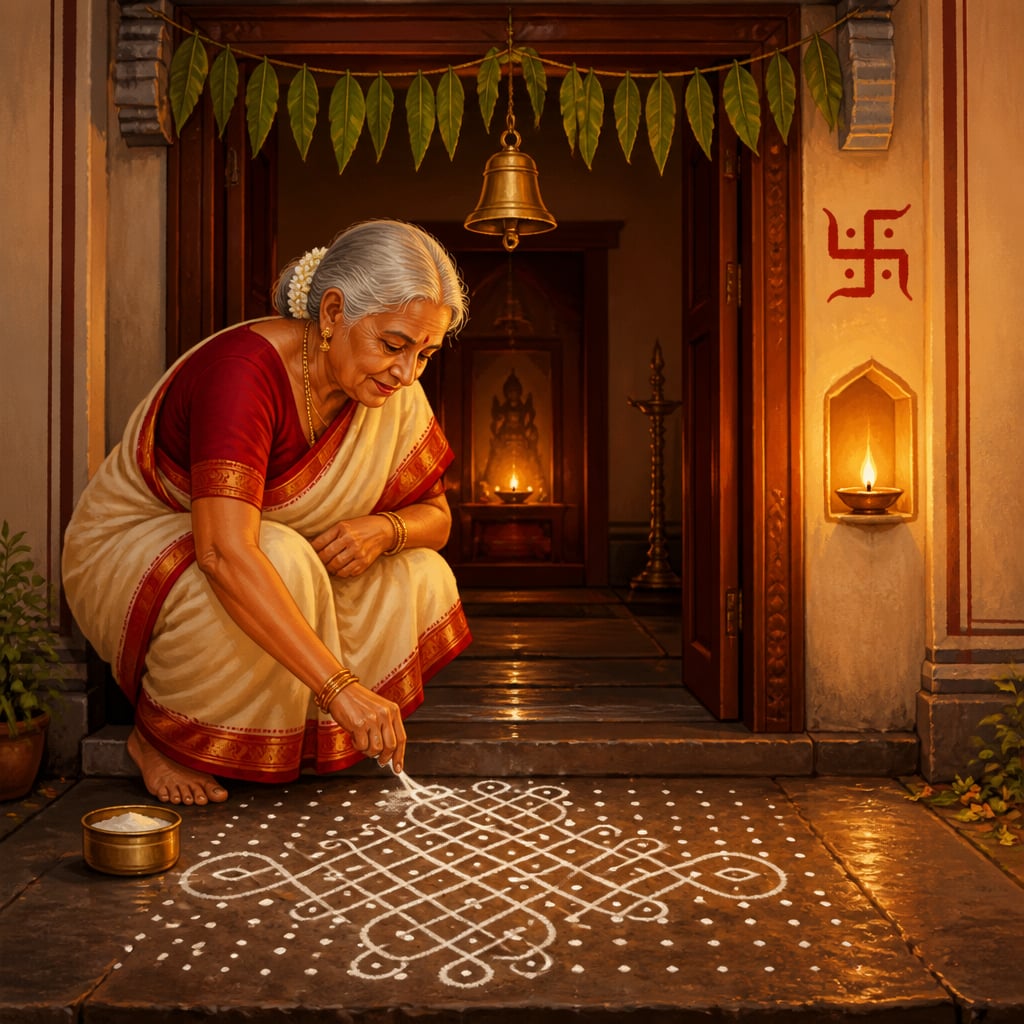
A Tamil grandmother in Mylapore drawing a sixteen dot kolam at dawn

A Grandmother at Four in the Morning, with Rice Flour

In a narrow street in Mylapore, Chennai, on a Friday morning in the month of Margazhi, a sixty seven year old woman called Lakshmi steps out of her front door at four fifteen in the morning. The street lamp at the corner is still on. Her neighbour's milk van has not yet arrived. She is carrying a small steel dabba of dry rice flour in her right hand and a copper kindi of water in her left.

She sets the dabba down on the doorstep. She squats. She sweeps a half-circle of the cement just outside her gate with the side of her palm, then sprinkles water in a fine arc to settle the dust. She picks up a pinch of the white flour between her thumb and her index finger, lowers her hand to the swept ground, and lets the flour fall in a thin steady stream as her wrist rotates. Sixteen dots, in four rows of four, appear in the half-light. Her fingers are quick. There is no pause to think.

Then she begins to draw. The flour falls in curving lines that loop the sixteen dots into a single unbroken pattern. No line crosses itself. No dot is left orphaned. The whole figure closes back on the point where it began. Within four minutes the kolam is finished. She straightens up, picks up the dabba, and goes back into the house to put the kettle on. She has done this every morning since she was eight. She will do it tomorrow.

In the doorway behind her, dried from the previous evening, hangs a string of fresh mango leaves tied to a yellow thread, the toranam her son brought back from the market two days ago for the family's housewarming. Above the lintel, just outside the threshold, a small brass bell on a worn red string. Beside the doorframe, in the gap between the wall and the door, a faint smear of turmeric paste in the shape of a swastika. Four objects. One threshold. The doorway is not a hole in the wall.

The Practice, Across India

The Hindu home does not begin at the door. It begins outside the door, at the threshold, with four working objects.

Kolam, rangoli, alpana, muggu. The drawn pattern at the entrance has different names in different regions. Kolam in Tamil Nadu and Kerala is drawn in dry rice flour without colour, on a swept and watered patch of street just outside the gate, before sunrise. Muggu is the Telugu equivalent. Rangoli in Maharashtra, Gujarat, and the north uses coloured powders, sometimes flower petals, sometimes coloured sand, and is drawn inside the doorway as well as outside. Alpana in Bengal uses a paste of rice flour and water painted with the fingers in flowing white lines. Mandana in Rajasthan uses chalk and ochre on the walls and floor. The grammar is shared. Dots first, then lines that loop the dots. The line must not cross itself. The pattern must close. The figure is fed by the dots and held together by the loops. It is geometry, drawn freehand, by women, before the rest of the household wakes.

Toranam, toran, bandanwar. A garland strung across the top of the main doorway. The classical material is fresh mango leaves tied to a string, with marigolds, ashoka leaves, or banana leaves added for festivals. Toranam in the south is renewed for housewarmings, weddings, festivals, and the start of the lunar new year. Toran in the north is the same object with the same function. Bandanwar in north India and Punjab adds beadwork and embroidered cloth to the leaves. The leaves are always fresh. A withered toranam is taken down and replaced. The doorway must not look as if the auspicious had been allowed to die.

The swastika, the kalasha, the foot. Beside the doorframe, a small mark in turmeric, vermilion, or sandalwood paste. The most common is the swastika, the four-armed solar symbol of auspiciousness, drawn at house entrances across India for at least four thousand years. Indus Valley seals at Mohenjo Daro and Harappa carry it. The Vedic altars carry it. The medieval Jain and Hindu temples carry it. It remains the threshold mark of choice for crores of Hindu households. Other thresholds carry Lakshmi padam, the painted footprints of the goddess walking inward, or a kalasha sketch.

The hanging bell, the ghanta. A small brass or bronze bell suspended above the threshold or at the home altar's entrance. Every visitor brushes the bell on the way in or rings it on the way to the puja room. The sound is clear, sharp, and lingering. The classical purpose is given in the Brahma Vaivarta Purana: the bell's sound consecrates entry. The functional effect is acoustic. The threshold is no longer silent. The body is no longer entering unannounced.

Margazhi morning girls walking to the Vatapatrasayi temple at dawn

The Scripture Says

The kolam's scriptural anchors are diffuse. The Tamil Sangam text Thirukkural does not name kolam, but the Sangam-era Manimekalai describes the daily drawing of patterns at the doorway as a household duty of the housewife. The medieval Tamil Andal, in the Thiruppavai, opens with girls rising in Margazhi to bathe, to draw kolam, and to go to the temple. The thirty pasurams of the Thiruppavai are recited in Tamil households across Margazhi, the same month Lakshmi is drawing her sixteen-dot kolam.

The toranam is named in the Garuda Purana and the Matsya Purana as a mandatory object at the house entrance during Griha Pravesha, the housewarming samskara. The mango leaf is specified by name. The leaves are tied with a yellow thread. The toranam stays up for the auspicious period and is renewed for festivals.

The swastika appears across the Hindu corpus, but its threshold use is canonised in the Vastu Shastra texts, particularly the Mayamatam and the Manasara, both of which prescribe the swastika as the auspicious mark at the dvara, the doorway, of any new construction. The medieval Mayura Chitraka, a treatise on auspicious painting, lists the swastika first among threshold motifs.

The ghanta has its own seed verse, recited at the start of every puja and applicable equally to the threshold bell.

आगमार्थं तु देवानां गमनार्थं तु रक्षसाम्। घण्टारवं प्रकुर्वीत देवताह्वान-लाञ्छनम्॥

āgamārthaṃ tu devānāṃ gamanārthaṃ tu rakṣasām ghaṇṭā-ravaṃ prakurvīta devatāhvāna-lāñchanam

For the coming of the devas and the going of the rakshasas, one should ring the bell, the sign that calls the deities.

Brahma Vaivarta Purana

A doorway with mango toranam, swastika, and brass ghanta bell

The Symbolism

The four objects together make a working membrane.

Object Position Function Symbol
Kolam Outside on the ground Welcome and feed Auspiciousness in geometry
Toranam Across the lintel Filter and cool Living vegetation as guard
Swastika Beside the doorframe Mark and bless Solar auspiciousness fixed in place
Ghanta Above the threshold Announce and consecrate Sound as boundary

The kolam is a feeding pattern as much as a welcome. The rice flour is eaten by ants, sparrows, and crows through the day. Hindu civilisation built the daily householder's first act around feeding the smaller creatures of the street. The pattern's unbroken loop is the symbol of life that does not break, of the household that opens but does not split. The dots are the seeds. The loops are the bonds that hold the seeds in a single living shape.

The mango toranam is the family of the home announced to the street. Mango is among the most auspicious trees in the Hindu canon, associated with Kamadeva, with Lakshmi, with fertility and abundance. To string fresh mango leaves across the doorway is to declare that this house is hosting auspiciousness. The leaves are also functional. Fresh mango leaves emit volatile organic compounds, monoterpenes including sabinene and beta-caryophyllene, continuously for three to seven days after cutting. The doorway is mildly antimicrobial. The body crossing the threshold breathes in a faint mango oil signature.

The swastika is the sun in geometry. The four arms turn clockwise in the auspicious form, the direction of the sun's daily motion across the Indian sky. The symbol has marked Hindu, Jain, and Buddhist thresholds for at least four thousand years, with Indus Valley examples at Mohenjo Daro and Harappa. The 1930s and 1940s saw the symbol's appropriation and inversion in Germany. The Hindu form is older, original, and unrelated. The threshold swastika is the household saying, every day, that the sun's auspiciousness has been fixed at this doorframe.

The ghanta is sound as boundary. The Brahma Vaivarta Purana names the bell's purpose plainly: the devas come, the rakshasas go. In acoustic terms, the bell's strike at one hundred and ten to one hundred and twenty hertz produces a brief, sharp pulse that interrupts whatever auditory state the body was in just before the threshold. The visitor enters announced. The body resets. The threshold has a sound.

Why the Body Responds

The four objects together build the most studied form of habit anywhere in cognitive science: the threshold-cued habit.

Cue. The doorway itself is the cue. The body never crosses a threshold by accident. The brain's spatial system, anchored in the hippocampus, registers each doorway as an event boundary. Gabriel Radvansky and colleagues at Notre Dame, in a famous 2011 paper in the Quarterly Journal of Experimental Psychology, showed that walking through a doorway clears short-term memory. The doorway is a hard reset for the working brain. Hindu civilisation chose this exact spot, the spot of the brain's natural reset, and stacked it with sensory cues.

Routine. The kolam is drawn every morning. The toranam is renewed at every festival. The swastika is touched up before every puja. The bell is rung at every entry. The objects rehearse the body across the threshold many times a day. The body learns the doorway not as a hole but as a stage with four cues.

Reward. Visual, tactile, social, and identity rewards stack. James Clear, in Atomic Habits, calls cue-rich environments the most powerful behaviour-change tool. The Hindu doorway is the densest cue-rich environment any civilisation has built.

Embodied cognition. Lakoff and Johnson argue that the body's physical movements shape its conceptual categories. Bowing under the toranam, brushing the bell, glancing at the swastika, stepping over the kolam, all teach the body that the threshold is a transition. The mind learns this through the doorway's choreography.

What the Labs Found

The mango toranam has its own research record. Limaye and Gosavi, writing in Industrial Crops and Products in 2018, documented that mango leaves emit monoterpenes (sabinene, beta-caryophyllene) continuously for several days after cutting, with measurable antimicrobial activity against airborne pathogens. The fresh mango toranam at a doorway emits these compounds for three to seven days. The doorway is, in functional terms, a passive aromatic diffuser.

The ghanta bell sits in the literature on auditory neuroscience. Bells in the one hundred and ten to one hundred and twenty hertz range, the standard pitch of a brass home bell, fall within the band documented by Enck and colleagues to affect the vagus nerve through auditory stimulation. The same frequency range engages the gut-brain axis. The body that brushes the bell on the way in is briefly nudged into a vagal response. The visitor is calmer by the time the foot touches the floor inside.

The kolam itself has begun to attract attention from mathematicians and computer scientists. Marcia Ascher, in Ethnomathematics in 2002, classified the kolam as a sophisticated example of a mathematical knot pattern, with strict rules of a single closed Eulerian path through a dot grid. Yanagisawa and Nagata at the University of Tokyo, in a 2007 paper in the Journal of Mathematics and the Arts, showed that traditional kolam patterns can be generated by formal grammar systems and have been used in early studies of cellular automata and pattern recognition. The grandmother in Mylapore is doing topology before sunrise.

The swastika's threshold position falls under a more general literature on symbolic doorway markers and boundary cognition. Bargh and Chartrand at Yale, on symbolic priming, have shown that environmental symbols at decision points subtly shape behaviour without conscious awareness. The threshold swastika is a symbol-prime active every time the body crosses the door.

What the World Calls It Now

In 2020, during the lockdown, plastic and polyester mango leaf garlands sold by Indian Amazon resellers reached bestseller status under the keyword "instant toranam." A pack of artificial leaves retails between two and five United States dollars. The product description leaves out the auspiciousness rationale and the monoterpene chemistry alike. The mango leaf, with its three to seven days of active aromatic emission, has been replaced by polyester that emits nothing. The reseller has sold the form and discarded the function.

Rangoli stencils are a five hundred million dollar global market, largely sold through Amazon, Etsy, and Indian craft retailers. The stencils reduce the kolam's freehand topology to a stamped pattern. The mathematical practice is gone. The decoration remains.

The wind chime market in the West, over four hundred million United States dollars globally in 2023, sells acoustic threshold objects on the same logic as the ghanta. The Feng Shui industry sells brass wind chimes specifically for entryways. The acoustic principle is identical to the Hindu home bell. The vocabulary has moved.

The swastika has the most painful modern echo of the four. The 1930s German appropriation cost the Hindu, Jain, and Buddhist threshold-mark its global readability. The original, four thousand years old, predates the German use by approximately three millennia. The doorway in Mylapore still carries it, in turmeric paste, every morning.

What to Call It Yourself

From this lesson onward, when an Etsy listing advertises a "sacred geometry stencil," call it kolam. When a Feng Shui shop sells an entryway wind chime, name the older protocol. When a craft-fair vendor sells "boho mandala doormats," use the older words. Kolam. Toranam. Ghanta. Four objects, one threshold.

Modern Echoes

Gabriel Radvansky at Notre Dame on the doorway as a cognitive event boundary, Limaye and Gosavi on mango leaf monoterpene emissions, Enck on bell-frequency vagal stimulation, Yanagisawa and Nagata on kolam topology. Four laboratories on three continents documenting what the woman in Mylapore is doing at four fifteen in the morning with a steel dabba of rice flour. The Mayamatam prescribed the swastika at the dvara in the eighth century. Mohenjo Daro carried it four thousand years ago. The plastic toranam on Amazon and the four hundred million dollar wind chime industry are catching up to a doorway that has been working at full sensory load since long before either had a price tag.

Back in Mylapore, the milk van has arrived. The kolam is whole. The mango toranam is fresh. The bell is steady on its red string. The threshold holds.

Key figures

Andal

circa 8th century CE

Gabriel Radvansky

born 1965

Marcia Ascher

1935 to 2013

Case studies

Rajput Wartime Rangoli at the Fort Gates

Rajput fort chronicles from the sixteenth to the eighteenth centuries document the drawing of swastika and chakra rangoli patterns at the great fortress gates before battle. The pattern as boundary-marker and protection symbol appears in Mughal miniature paintings depicting Rajput court ceremonies at Chittor, Mewar, and Jaipur. The threshold pattern was drawn at the scale of a fortress gate, by court priests and women of the household, before the gates were closed for the siege.

The threshold ensemble is not a domestic decoration. It is a defensive composition. The swastika at the doorframe of a house and the swastika at the gate of a fortress are the same object, scaled. Both consecrate the boundary. Both bind the auspicious to the threshold. The fort gate is the house's threshold made monumental.

The Rajput tradition of fortress-gate rangoli outlived the Rajput sieges. The same patterns continue to be drawn at the gates of Chittor, Mehrangarh, and Amber as living-tradition objects, even as the fortresses themselves have become world heritage sites.

The swastika's defensive use at the threshold predates its purely ceremonial use inside the home. The doorway is a boundary first.

The swastika in turmeric paste at a Mylapore doorframe and the swastika at the gate of Mehrangarh are the same object, at two scales, in continuous use across at least four hundred years.

Rajput fort chronicles, sixteenth to eighteenth centuries; Mughal miniature paintings of Rajput court ceremonies; living-tradition rangolis at Chittor, Mehrangarh, and Amber.

The Plastic Toranam on Amazon

In 2020, during the lockdown, plastic and polyester mango leaf garlands sold by Indian Amazon resellers reached bestseller status under the keyword "instant toranam." A pack of artificial leaves retails between two and five United States dollars. The product description leaves out the auspiciousness rationale entirely. The mango leaf, with its three to seven days of active monoterpene emission, has been replaced by polyester that emits nothing.

The fresh mango toranam at the doorway is, by the Garuda and Matsya Puranas, a living object that announces hospitality and emits a faint mango-oil signature into the air the body breathes as it enters. The plastic equivalent has the form and not the function. The household has been sold the silhouette.

The plastic toranam continues to outsell fresh mango leaves on Amazon India. Many urban Hindu households now keep a plastic toranam year-round as decoration. The fresh mango toranam survives in households with access to a market that still sells fresh leaves and in the Griha Pravesha rite, where the canonical text continues to specify the living object.

The threshold ritual reduced to a plastic product with the science stripped out. The form is sold. The function is lost.

Every Hindu household that replaces a living mango toranam with plastic has, without noticing, traded a working aromatic diffuser for a polyester silhouette.

Amazon India bestseller listings under "instant toranam," 2020 to present; product price band $2 to $5 per pack; product descriptions omit auspiciousness and chemistry.

Mango Leaf Monoterpenes and the Vagal Bell

Limaye and Gosavi, writing in Industrial Crops and Products in 2018, documented that mango leaves emit monoterpenes (sabinene, beta-caryophyllene) continuously for several days after cutting, with measurable antimicrobial activity against airborne pathogens. A fresh mango toranam at a doorway emits these compounds for three to seven days. Separately, Enck and colleagues, on bell-frequency vagal stimulation, have shown that bells in the one hundred and ten to one hundred and twenty hertz range, the standard pitch of a brass home bell, fall within the band that engages the vagus nerve and the gut-brain axis.

The Mayamatam and the Manasara prescribed the mango toranam at the dvara. The Brahma Vaivarta Purana prescribed the bell at the threshold. Both prescriptions were given in symbolic and devotional language. The lab work of 2018 has now restated the same prescriptions in the language of phytochemistry and auditory neuroscience.

The mango toranam and the hanging bell have moved from being treated as ceremonial decorations to being recognised, in at least the academic literature, as objects with active physiological mechanisms at the doorway.

The mango toranam and the hanging bell both have active physiological mechanisms. The doorway emits compounds. The bell engages the vagus nerve. The threshold is not symbolic only.

Three of the four threshold objects in this lesson, the toranam, the bell, and the doorway itself, now have peer-reviewed mechanisms. The fourth, the kolam, has been classified as a sophisticated knot pattern in ethnomathematics. The threshold is, in current academic terms, a working sensory composition.

Limaye SS and Gosavi GS, Industrial Crops and Products, 2018, on mango leaf monoterpene emissions; Enck P et al on bell-frequency auditory vagal stimulation; Radvansky GA et al, Quarterly Journal of Experimental Psychology, 2011, on the doorway effect.

Historical context

From the Indus Valley Civilisation (c. 3300 BCE to 1300 BCE) through the Vastu Shastra codification (c. 700 to 1100 CE) to the present day

Living traditions

Use the original names. Kolam for the Tamil pattern, rangoli for the broader north and west Indian form, alpana in Bengal, muggu in Telugu, mandana in Rajasthan. Toranam for the mango leaf garland. Swastika for the four-armed solar symbol, fully owned in its Hindu form. Ghanta for the bell. The Etsy stencil and the Feng Shui wind chime are selling fragments. The doorway in Mylapore is selling the whole composition for free.

Reflection

More in Griha: Home, Hearth, Earth

All lessons in Griha: Home, Hearth, Earth · Samskaras: The Sanatan Operating System course