Wake Before the World Does
Brahma Muhurta, Ushah-Paan, and the Silent First Hour
The Hindu day does not begin at sunrise. It begins ninety minutes earlier, in the silver window the tradition calls Brahma Muhurta. The grandmother wakes, sips room-temperature water from a copper vessel, and does not speak for the first hour. Two thousand years of scripture, Ayurvedic prescription, and modern circadian science say she is right.
The Copper Glass Beside the Bed
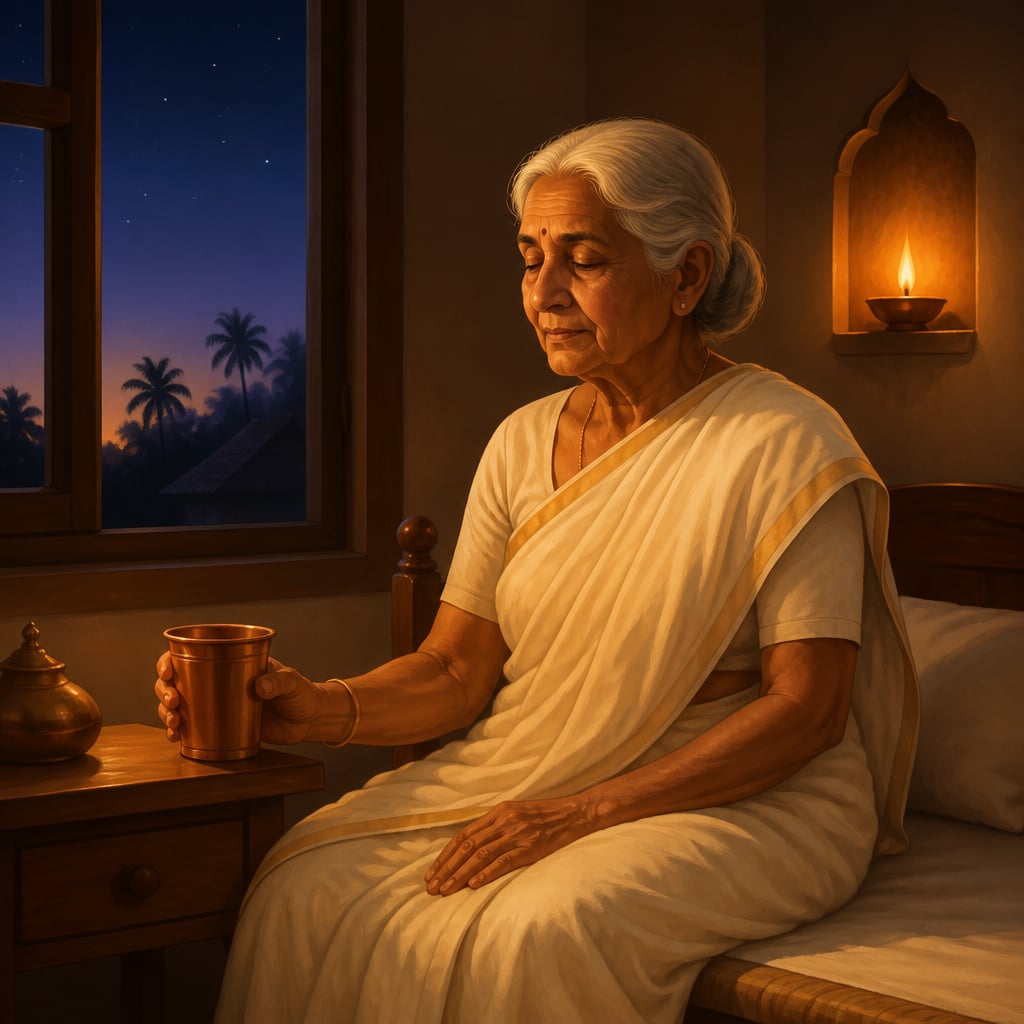
A composite Lakshmi paati in her bedroom in Madurai, sometime around 1998, four-fifteen in the morning. The street outside is silent. No autos, no koel, no loudspeaker from the Meenakshi temple yet. On her bedside stool sits a single object: a small tamra patra, a copper glass with two glasses of water that have been resting in it since the previous night.
She wakes without an alarm. She has woken at this time every day for forty-two years. She sits up on the cot. She does not pick up a phone, because there is no phone. She does not turn on a light. She lifts the copper glass, drinks both glasses slowly, in small sips, and sets the glass back down. She does not speak. Her grandson, asleep on the floor mat next to her, will not hear her voice for another hour.
This is the Brahma Muhurta, the muhurta of Brahma. It is the ninety-minute window before sunrise, the time the Charaka Samhita prescribes for waking, and the time the Arthashastra commands for kings. It is also the time the 2017 Nobel Prize in Physiology or Medicine vindicated as the precise circadian window when human cognition is sharpest. Lakshmi paati did not need the citation. She had a copper glass.
This lesson is the explanation for why the grandmother and the Nobel committee, twenty centuries apart, ended up at the same hour.
What Brahma Muhurta Actually Is
The Hindu day is divided into thirty muhurtas of forty-eight minutes each, fifteen for the day and fifteen for the night. The fourteenth muhurta of the night, the one that ends about ninety minutes before sunrise, is called Brahma Muhurta. In Tamil Nadu and most of South India, this falls between 4:00 and 5:30 AM. In the north, in the cooler months, it can begin as early as 3:30. It is the only muhurta in the entire day named after a deity.
The Yajnavalkya Smriti tells the householder to rise in this window, attend to nature, and sit for sandhya before the sun comes up. The Charaka Samhita says the same in the language of medicine: the kapha of the night has loosened by this hour, but has not yet thickened into morning lethargy. The mind is clearest. The world has not yet started talking.
Kautilya, the King, and the Pre-Dawn Court
The most surprising scriptural anchor for Brahma Muhurta is not in a yoga manual. It is in the Arthashastra, Kautilya's manual of statecraft, written in the fourth century BCE for the court of Chandragupta Maurya at Pataliputra.

In Book 1, Chapter 19, Kautilya prescribes the schedule of the king. The king's day is divided into eight nalikas of an hour and a half each, four for the day and four for the night. The very first nalika of the working schedule begins in Brahma Muhurta. Kautilya writes that in this window the king shall rise, study Vidya, and consult with his ministers in private before the public business of the day begins.
ब्राह्मे मुहूर्ते उत्थाय राजा कार्याणि चिन्तयेत्।
brāhme muhūrte utthāya rājā kāryāṇi cintayet
Rising in the Brahma Muhurta, the king shall reflect on the affairs of state.
Arthashastra, Book 1, Chapter 19
This is a political-economy argument, not a devotional one. Kautilya is telling his prince that the state runs better when the man at the top is awake and clear before the petitioners arrive. The earliest hour of cognition is reserved for the hardest decisions of the day. Two thousand years later, every CEO routine that prescribes a 5 AM wake-up before email is reciting this paragraph without knowing it.
Ushah-Paan: The First Food of the Day Is Water

The second ritual is in the copper glass. The Charaka Samhita, in Sutrasthana Chapter 5, prescribes ushah-paan, the morning drink. Ushah is the dawn. Paan is to drink. The sequence is exact: rise, rinse the mouth, drink between two and four glasses of water that have rested overnight in a vessel of pure copper.
The Ayurvedic logic is layered.
- The body has been fasting through the night for eight to ten hours. The first hydration of the day shocks the digestive channels (srotas) into motion. Peristalsis is triggered. The bowel that the Charaka Samhita says must be cleared every morning is cleared.
- Copper (tamra) is the metal of Surya, the sun. The Ayurvedic tradition holds that water rested in copper for six to eight hours absorbs trace ions of the metal and becomes itself a mild medicine.
- The water is room-temperature. Cold water at this hour disturbs the kapha-vata balance the body has just stabilised through sleep. Warm water is acceptable. Iced water is not.
The practice is one of the most widely-preserved samskaras of the Hindu body. In Maharashtra it is called tamrajal-paan. In Tamil households the same copper vessel sits beside the bed of the grandmother, the mother, and the unmarried daughter, and is refilled by the youngest member every night before the household goes to sleep. The vessel is washed once a week with tamarind paste, which prevents the green oxide from accumulating and keeps the inner surface bright.
The Silent First Hour
The third ritual is the one that is hardest to keep in the age of the smartphone. It is mauna, the silence of the first hour.
The Yoga Sutras of Patanjali, in 2.32, lists mauna among the tapas, the disciplines that purify. Manusmriti tells the householder that the first words of the day are heavier than the last words of the day, because they set the colour of the day. The tradition that taught Lakshmi paati to keep her tongue still until after her bath was not asking her to be quiet. It was asking her to choose carefully which thought she would let into the air first.
In the Brahma Muhurta the antah-karana (the inner instrument of mind, intellect, and ego) is at its calmest. The mind that has just emerged from sushupti, deep sleep, has not yet been colonised by the day's anxieties. To speak in this window is to spend the calmness on whatever first comes to mind. To not speak in this window is to bank the calmness for the harder moments later in the day.
The practical householder rule is simple. From waking until after the bath and the application of the tilak, the mouth is for water and mantra only, not for conversation, not for news, not for the phone.
Why the Body Responds
The routine of Brahma Muhurta, ushah-paan, and mauna is one of the most efficient cue-routine-reward stacks in any tradition.
The cue is the internal clock. After two weeks of the same wake time, the body wakes itself within a five-minute window. No alarm is needed. The bedside copper glass is the visual anchor. The first hand-movement of the day reaches for it.
The routine is sequenced. Sit up. Drink the water. Sit in silence. Rise to wash. The whole morning before the bath takes twenty minutes. Each step is a cue for the next.
The reward is twofold. First, an immediate physiological settling: the bowel clears, the body is hydrated, the prana rises with the light. Second, a cognitive reward: the first hour of the day is preserved from interruption, and the prefrontal cortex, which is sharpest in this window, gets the hardest work.
This is exactly the loop Charles Duhigg describes in The Power of Habit and James Clear in Atomic Habits. It is also the identity-anchor that Wendy Wood documents in Good Habits, Bad Habits. When a person can say "I am someone who wakes in Brahma Muhurta", the behaviour stops requiring willpower. The identity carries it.
What the Labs Found
In 2017, the Nobel Prize in Physiology or Medicine went to Jeffrey Hall, Michael Rosbash, and Michael Young for their work on the molecular mechanisms of the circadian rhythm. The PER and TIM proteins they identified rise and fall in a roughly twenty-four-hour cycle that is set by light exposure at the eyes. The cortisol awakening response peaks thirty to forty-five minutes after waking. Melatonin, the hormone of sleep, drops sharply once light enters the retina. The window from one hour before sunrise to two hours after sunrise is when the body is hormonally primed for focused cognition.
This is, almost to the minute, the window the Charaka Samhita and the Arthashastra prescribed.
For copper water, Sudha et al (Journal of Health, Population and Nutrition, 2012) confirmed that water stored in copper vessels for sixteen to twenty-four hours becomes antibacterial through the oligodynamic action of copper ions. The same study found that V. cholerae and E. coli populations were eliminated within twenty-four hours of contact with copper. Earlier work by Preethi Sudha at the National Institute of Cholera and Enteric Diseases reached parallel findings. The copper glass beside Lakshmi paati's bed is doing measurable work as a low-grade water purifier while she sleeps.
For mauna and the morning hour, Cal Newport's Deep Work and Gloria Mark's research at UC Irvine on attention residue both make the same case in non-Sanskrit vocabulary. The cognitive switching cost of one early-morning email is real. The recovery time from an interruption averages twenty-three minutes. The household that protects the first hour for silence is doing what the productivity literature now charges nine-hundred-dollar courses to teach.
What the World Calls It Now
Robin Sharma's The 5AM Club, published in 2018, has sold over three million copies. It prescribes the same wake hour as the Arthashastra and divides the morning into three twenty-minute blocks. It is one of the most commercially successful business books of the last decade. The acknowledgements do not mention Kautilya, Charaka, or Patanjali.
Andrew Huberman, the Stanford neuroscientist whose podcast crosses thirty million downloads a month, has built a recurring protocol around morning sunlight, fasted-state focused work, and screen-free time before 9 AM. Each component has a Sanskrit name two thousand years older than its English one.
The copper-vessel rediscovery is the most explicit. CopperH2O, an American direct-to-consumer brand, sells eighty-nine-dollar copper water bottles with marketing copy on "ancient Ayurvedic wisdom". Goop has run morning copper-water articles. The TikTok hashtag for morning water has crossed thirty million views. The vessel that costs three hundred rupees in any Tamil Nadu market is being sold as a wellness product at a thousand-percent markup, with the word ushah-paan missing from the packaging.
The extraction pattern has the same shape as every other ritual in this course. Mock as superstition. Then dismiss as primitive. Then have one Western researcher rediscover it. Then rebrand and sell. Then, sometimes, file a patent. The neem patent fight (1995) and the turmeric patent fight (1995, revoked 1997) are receipts already in the public record. The Brahma Muhurta has not yet been patented. Give it time.
What to Call It Yourself
The ninety minutes before sunrise are not the "5 AM hour." They are the Brahma Muhurta, named after the creator. The first water of the day is not "morning hydration". It is ushah-paan, prescribed by Charaka in the fourth century BCE. The silence of the first hour is not a "morning routine". It is mauna, listed among the tapas in the Yoga Sutras. The copper glass is not a wellness product. It is a tamra patra, the same vessel your great-grandmother kept by her bed.
When the productivity podcast next door says 5 AM Club, smile. You already know the names. Use them.
Modern Echoes
A growing body of clinical research now points back to this exact window. Matthew Walker, the Berkeley sleep researcher, frames the pre-dawn cortisol rise as the strongest cognitive window of the day. The military academies of every modern country wake their cadets between four-thirty and five. The Marine Corps, the Indian Army, and the Israeli Defence Forces are all running the Arthashastra without knowing it.
And Kautilya's argument was the simplest and the strongest. The state runs better when the man at the top is clear-headed before the petitioners arrive. The household runs better when the grandmother is settled before the children wake. The day runs better when its first hour belongs to the person who has to live it, not to the inbox.
Back in the bedroom in Madurai, the copper glass is empty. Lakshmi paati has not spoken. The first faint light is just touching the temple gopuram across the street. Her grandson stirs on the mat. She lights the small altar lamp. The day has not started for the world. It started for her ninety minutes ago.
The next lesson follows what comes next: the mouth, the tongue, the teeth, and the neem twig that has held its place in the Hindu morning for two thousand five hundred years.
Key figures
Kautilya (Chanakya)
4th century BCE (c. 350-275 BCE)
Charaka
c. 4th-2nd century BCE (traditional dating places the school much earlier)
Patanjali
c. 2nd century BCE - 4th century CE (dating disputed)
Case studies
The Royal Brahma Muhurta of Chandragupta Maurya
In the fourth century BCE at Pataliputra, the capital of the Mauryan Empire, Kautilya prescribed a daily schedule for the king Chandragupta Maurya. The schedule, recorded in Book 1 Chapter 19 of the Arthashastra, divides the king's day into eight nalikas of an hour and a half each. The very first nalika began in the Brahma Muhurta, ninety minutes before sunrise. The king woke, performed his ablutions, and consulted with his ministers in private session before the public business of the court began. The pre-dawn hour was reserved for the most demanding work of governance: reflection on dharma and artha, review of intelligence reports, and approval of the day's edicts.
The Arthashastra's prescription is not a religious instruction. Kautilya argues from cognitive efficiency: the mind in the Brahma Muhurta is undistracted by the day's petitioners, the body is rested, and the most consequential decisions of the state can be made before the noise begins. This is the same logic the Charaka Samhita applies to the body. Two different sciences, one window.
The Mauryan Empire under Chandragupta and his grandson Ashoka became the largest political entity ever assembled on the Indian subcontinent before the British. The schedule Kautilya prescribed was inherited by every subsequent dharmic kingdom, from the Guptas to the Vijayanagara emperors to Shivaji at Raigad. The morning council in Brahma Muhurta is documented in the court chronicles of all of them.
The hardest work of the day belongs to the clearest hour of the day. Kautilya's protocol scales: a king runs an empire from it, a household runs a family from it, a knowledge worker runs a career from it. The mistake is to spend the Brahma Muhurta on the inbox.
Every modern executive who blocks the first ninety minutes of the day for deep work is running Kautilya's nalika system without knowing it.
The Arthashastra divides the king's day into eight nalikas, each precisely ninety minutes long. The first nalika begins in Brahma Muhurta and is reserved for private state consultation, never for public audience.
Robin Sharma's 5AM Club and the Three-Million-Copy Echo
In 2018, the Canadian leadership coach Robin Sharma published 'The 5AM Club: Own Your Morning, Elevate Your Life'. The book prescribes a 5 AM wake-up time for high performers and divides the first hour into three twenty-minute blocks: movement, reflection, and growth. It became an international bestseller, with over three million copies sold in more than fifty languages. Sharma's prescription matches, almost exactly, the Brahma Muhurta protocol of the Arthashastra and the Charaka Samhita: rise in the pre-dawn window, attend to the body, then to the mind, before the day begins. The acknowledgements of the book do not cite Kautilya, Charaka, or any Sanskrit source. The 'ancient Stoic and warrior traditions' are mentioned. The Hindu and Ayurvedic origin is not.
The 5AM Club is the most commercially successful rediscovery of Brahma Muhurta in the English-language self-help market. The structure is identical to Kautilya's nalika schedule and Charaka's dinacharya. The naming has been changed. The receipts have been suppressed. This is the standard pattern: take the ritual, strip the lineage, sell the gesture.
Sharma's book has generated an estimated thirty million dollars in sales and spawned a multi-million-dollar coaching industry. The 5AM Club is now a global brand. Brahma Muhurta, which gave the world the practice in the first place, is unknown to most readers of the book.
The market rewards the rediscoverer, not the source. The dharmic householder's job is not to win a citation war. The job is to keep practising, name the practice in Sanskrit when the conversation comes up, and let the receipts speak over time.
Use the original word. Brahma Muhurta, not 5AM Club. Ushah-paan, not morning hydration. Mauna, not silent morning. The naming is the lineage.
Robin Sharma's '5AM Club' has sold over three million copies and been translated into more than fifty languages. The book mentions Kautilya, Charaka, and Brahma Muhurta zero times.
The 2017 Nobel Prize in Circadian Biology
On 2 October 2017, the Karolinska Institute awarded the Nobel Prize in Physiology or Medicine to Jeffrey Hall, Michael Rosbash, and Michael Young for their discoveries of the molecular mechanisms controlling the circadian rhythm. Their work, conducted over three decades on the fruit fly Drosophila and confirmed in mammals, identified the PER and TIM proteins whose oscillation drives the twenty-four-hour cycle of human cognition, hormone release, and metabolism. The Nobel committee's citation specifically mentioned that the cortisol awakening response peaks thirty to forty-five minutes after rising and that prefrontal-cortex performance is sharpest in the window from one hour before sunrise to two hours after sunrise.
The Nobel-winning window is the Brahma Muhurta, almost to the minute. The Charaka Samhita prescribed it as the optimal hour for cognition and the Arthashastra prescribed it as the optimal hour for governance. Both texts predate the Nobel research by at least two thousand three hundred years. The 2017 prize is not a discovery. It is a confirmation, in the vocabulary the modern world demands, of a window the dharmic tradition mapped without instruments.
The Nobel Prize gave Brahma Muhurta its first peer-reviewed Western citation. Andrew Huberman, Matthew Walker, and a generation of sleep scientists have since built protocols around the same window. The wellness industry has built a billion-dollar morning-routine market around it. The Charaka Samhita continues to be read in Ayurvedic colleges across India by students who already knew.
The labs are catching up. The grandmother does not need to wait for the citation, but she now has it for the next conversation. When the science arrives at the same hour the scripture named, the case for using the original Sanskrit becomes overwhelming.
Three thousand years of practice is now backed by three decades of Nobel-grade research. The two are saying the same thing in two different languages.
The 2017 Nobel-winning research identified the cortisol awakening response peak at thirty to forty-five minutes post-waking, precisely the window the Charaka Samhita reserves for medicinal cognition in Sutrasthana 5.13.
Historical context
Vedic origins (c. 1500 BCE) through Ayurvedic and Yogic codification (c. 4th century BCE - 4th century CE)
The morning routine of the Hindu householder is one of the most stable institutions in Indian civilisation. Across three thousand years and through Mauryan, Gupta, Pala, Chola, Vijayanagara, Mughal, Maratha, and colonial periods, the household kept waking before sunrise, drinking from a copper vessel, and observing morning silence. The practice was preserved across regions and varnas through household transmission, not through state mandate. When the British attempted to impose European-style office hours in the nineteenth century, the morning routine continued at home, untouched. It is the one samskara that no political authority has ever managed to interrupt.
Living traditions
The pre-dawn window is no longer a Hindu secret. Andrew Huberman, Robin Sharma, Matthew Walker, and the entire morning-routine industry have rediscovered it under different names. The dharmic tradition's job is small and clear: when the productivity podcast says 5AM Club, you say Brahma Muhurta. When the wellness brand sells you a copper bottle, you say tamra patra and ushah-paan. When the yoga studio teaches morning silence, you say mauna. Use the names. The labs are catching up. The Nobel committee already arrived in 2017. The grandmother is still winning the argument she never bothered to start.
- The Bedside Tamra Patra: The Hindu household tradition of keeping a small copper vessel, filled with two to three glasses of water, beside the bed every night. The youngest member of the household refills it at bedtime. The first act of the day, after waking, is to drink the contents of the vessel slowly, before any speech or action. The vessel is washed once a week with tamarind paste.
- Brahma Muhurta Sadhana: The pre-dawn personal practice window for japa, meditation, scripture study, and pranayama. Devotees rise between 4:00 and 5:30 AM, perform ushah-paan, complete morning ablutions, and sit for thirty to ninety minutes of silent practice before sunrise. The Iyengar yoga tradition, the Krishnamacharya lineage, and most Vedanta ashrams continue to teach the morning window as the primary time for sadhana.
- Mahakaleshwar Temple Bhasma Aarti: The only Jyotirlinga where the Bhasma Aarti is performed in the Brahma Muhurta with fresh cremation-ground vibhuti. The aarti begins at 4:00 AM, year-round, and is one of the most powerful examples of a Brahma Muhurta ritual that has continued unbroken for over a thousand years. Witnessing it is a foundational education in the muhurta of Brahma.
- Sringeri Sharada Peetham Morning Sadhana: One of the four Adi Shankaracharya mathas, where the morning sadhana of the Shankara tradition has continued unbroken since the 8th century CE. Visitors are welcome to observe the Brahma Muhurta sandhya and the morning Sharada puja. The Tunga river runs cold and silver at this hour. The matha distributes copper vessels for ushah-paan to long-stay visitors.
- Bihar School of Yoga (Munger): The institution founded by Swami Satyananda Saraswati in 1964 and now run by Swami Niranjanananda. The Bihar School preserves the most rigorous extant teaching of the morning sadhana of Brahma Muhurta and ushah-paan as a structured yogic discipline. Their published Sadhana programmes train practitioners worldwide in the exact protocol the Charaka Samhita prescribes.
Reflection
- What does your first hour after waking currently belong to? If you traced its ownership honestly, who would it be ceded to: the inbox, the news, social media, or yourself?
- Why might the dharmic tradition have placed water and silence, not food and speech, as the first acts of the day? What does it mean that the body's first hunger is not for nutrition?
- When a tradition's prescription (Brahma Muhurta) and a Nobel-winning research finding (circadian biology) point to the same window, what is the relationship between them? Is the science a confirmation, a translation, or a coincidence?