Twice a Day, the Sun Is Greeted
Sandhya Vandanam, Surya Namaskar, and the Gayatri: three rituals that turn sunrise and sunset into a discipline of the body, the breath, and the mind
Twice a day, at the seam where night meets day and day meets night, the Hindu householder pauses. Water is offered to the sun. The body bows through twelve postures. The Gayatri Mantra is counted on a hundred and eight beads. This lesson unpacks the three interlinked rituals that fill the sandhi window: Sandhya Vandanam as the container, Surya Namaskar as the body's offering, and the Gayatri as the heart-mantra inside both. Scripture, symbolism, habit science, modern research, and the eighty seven billion dollar yoga industry all meet at the same horizon.
A Grandfather at the River, Before the Crows Are Awake
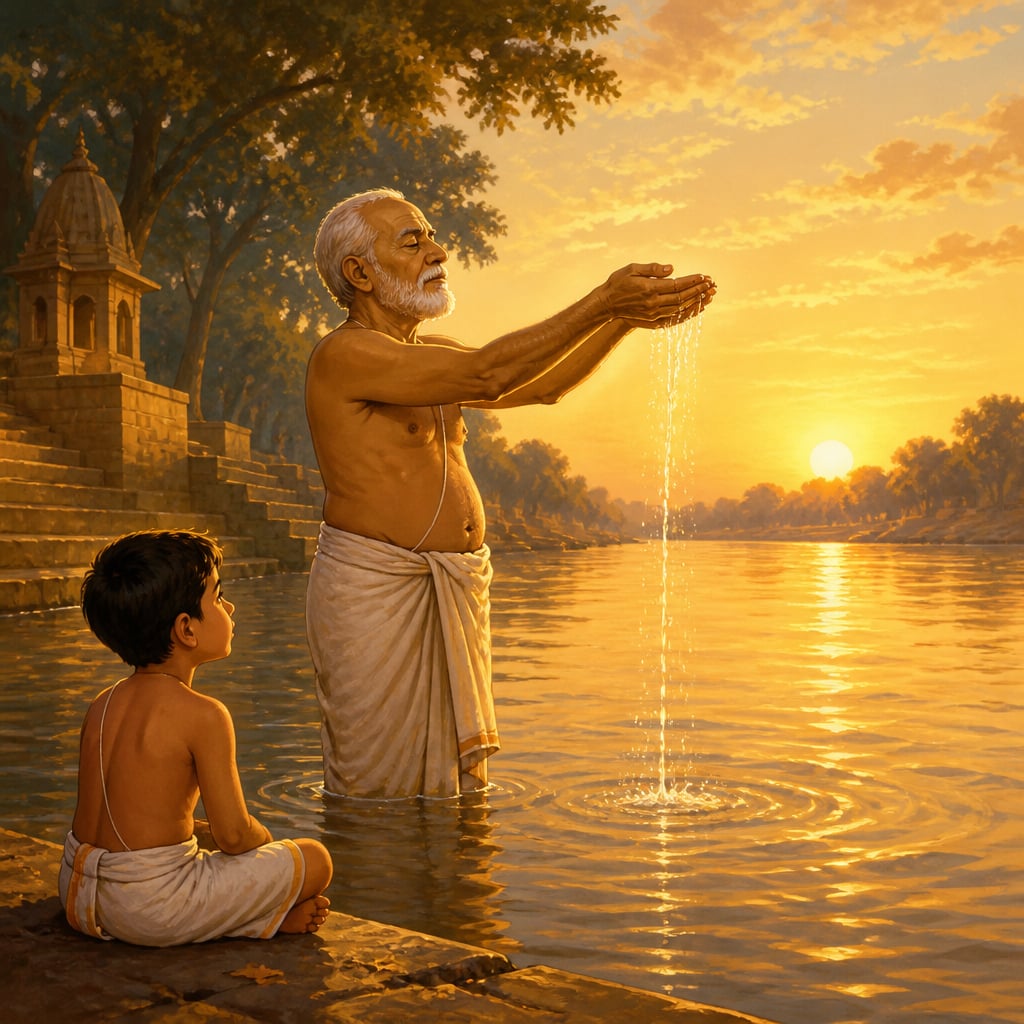
In a small house on the banks of the Krishna in Andhra, a grandson is woken at four thirty in the morning. The boy is ten years old, visiting from Hyderabad for the summer holidays. His tatayya is already up, dressed in a fresh white dhoti, the sacred thread visible across his bare chest. The old man hands him a copper kindi, a small spouted water pot, and walks him down to the steps of the river. The sky is the colour of a ripe pomegranate, the eastern edge just turning orange. The crows are still asleep. A single conch sounds from a temple somewhere upstream.
The grandfather steps into the water up to his knees. He sips a small amount three times from the cupped right hand, a gesture called achamana, naming three of the Lord's names with each sip. He breathes in and holds the breath, then breathes out, three rounds of pranayama. He scoops water in his joined palms, raises them above his head, and pours it back toward the rising sun. He does this three times. Then he stands very still, eyes half closed, the right hand counting on the joints of the fingers. The boy can hear, very faintly, the same words being whispered, again and again. Om bhur bhuvah svaha. Tat savitur varenyam. The mantra is so quiet it is almost a breath. The sun crosses the horizon. The grandfather opens his eyes, salutes the disc with both palms together, and turns to walk home.
The boy has just watched, without being told a word about it, the oldest unbroken daily ritual in human civilisation. It will be performed twice more that day. It will be performed every day until the old man dies. The boy will not understand what he saw for another twenty years. But he will remember the copper pot, the water arc against the morning, and the soft counted whisper, for the rest of his life.
This is Sandhya Vandanam. Inside it sits Surya Namaskar, the twelve posture salutation. Inside that, again, sits the Gayatri Mantra, the heart of the whole structure. Three layered rituals, each enclosing the next, each meeting the sun at the seam of the day.
The Practice, Across India
The junction worship is called Sandhya Vandanam. The word sandhya names the seam, the joint between night and day or day and night. Two of these joints are mandatory in classical practice, sunrise and sunset, called pratah sandhya and sayam sandhya. A third, madhyahna sandhya at solar noon, is observed by the more disciplined. At each junction the householder bathes, sits facing east in the morning and west in the evening, and walks through a fixed procedural sequence: achamana, the sipping of three small mouthfuls of water; pranayama, three rounds of regulated breath; sankalpa, the intention statement that names time, place, and self; arghya, the offering of water in joined palms toward the solar disc; Gayatri japa, the repeated counted recitation of the mantra; and upasthana, the closing salutation. The whole sequence takes between fifteen and forty minutes depending on lineage. It is performed by tens of millions of Hindus today, from Tirupati to Trinidad to New Jersey, in identical Sanskrit.

Inside the Sandhya, at the level of the body, sits Surya Namaskar. The salutation to the sun is a single flowing sequence of twelve postures performed in unbroken movement: pranamasana, hasta uttanasana, padahastasana, ashwa sanchalanasana, dandasana, ashtanga namaskara, bhujangasana, parvatasana, and the return through the same shapes. Each posture is paired with a mantra naming one of the twelve aspects of Surya: Om Mitraya Namah, Om Ravaye Namah, Om Suryaya Namah, Om Bhanave Namah, Om Khagaya Namah, Om Pushne Namah, Om Hiranyagarbhaya Namah, Om Marichaye Namah, Om Adityaya Namah, Om Savitre Namah, Om Arkaya Namah, Om Bhaskaraya Namah. Twelve names, twelve postures, twelve aspects of the sun. The full cycle is performed in odd numbered rounds, traditionally three, seven, or twelve, with the most committed students completing one hundred and eight repetitions on Ratha Saptami, the festival of the sun's chariot.
At the heart of both, named in the Sandhya at every junction and embedded in the breath of the Surya Namaskar, is the Gayatri Mantra. Twenty four syllables, gayatri meter, drawn from the third mandala of the Rigveda, verse 3.62.10, attributed to Brahmarishi Vishvamitra. The mantra is counted on a mala of one hundred and eight beads. Three rounds, one round, or one hundred and eight rounds, depending on the time available and the depth of the practice. It is the single most repeated verse in Hindu civilisation. Probably the single most repeated verse on earth.
The varna context of these practices must be named honestly. Classical Sandhya Vandanam was prescribed for the three twice born varnas after Upanayana. Surya Namaskar, especially in its modern systematised form, was always more open. The Gayatri itself was, in classical practice, restricted to dvija reciters at the formal Sandhya, but the verse and its meaning were widely sung in regional languages and devotional contexts beyond the formal ritual. From the nineteenth century onward, the Arya Samaj of Dayananda Saraswati, the universalist teaching of Swami Vivekananda, and the openly published yoga manuals of Swami Kuvalayananda and Swami Sivananda made the practices openly available. Today the Gayatri is chanted by Hindus of every background, Surya Namaskar is taught in every yoga studio on the planet, and Sandhya Vandanam itself is offered in lineage teaching to anyone who undertakes the discipline. The practice was once gated. Hindus opened it.
The Scripture Says

The Gayatri itself is Rigveda 3.62.10. The verse asks the radiant savitr, the sun as the impeller of all motion, to illuminate the intellects of those who chant it. The Krishna Yajurveda's Aruna Prashna and the Apastamba and Bodhayana Sutras prescribe the procedural code of Sandhya Vandanam in full: the timing, the direction, the materials, the postures, the breath count, the mantras for each step, and the closing dedication. These are not folklore. They are procedural manuals, transmitted unbroken, the reason a priest in Tanjavur and a priest in Varanasi will perform the same ritual in identical Sanskrit two thousand years apart.
The Surya Namaskar mantras are documented in the Aditya Hridayam of the Yuddha Kanda of the Ramayana, where Sage Agastya teaches the hymn to Sri Rama before the final battle with Ravana. The Aditya Hridayam is itself a hymn to the sun, and its opening verse is one of the Surya stotras still chanted at sunrise across India. The twelve namaskar mantras themselves, with the bija syllables and the postures, were systematised in the medieval Hatha Yoga texts and brought to their modern public form by Bhawanrao Pant Pratinidhi, the raja of Aundh in Maharashtra, whose 1928 book The Ten Point Way to Health published Surya Namaskar as a public health practice for the first time. The Aundh sequence is the direct ancestor of every Sun Salutation taught in every yoga studio in the world today.
The Symbolism
The sun is greeted at the joint of the day because the joint of the day is the joint of the self. Hindu civilisation reads sunrise as the moment when chaos becomes order, when the night's diffuse possibility crystallises into the day's directed work. The same is true at sunset in reverse. To stand at this seam, to offer water to the disc, and to chant a verse asking for illumination, is to align the self with the daily reorganisation of the cosmos.
The arghya, the offered water, is symbolic on two levels. The water curving from joined palms back toward the sun is a returning gift, an acknowledgement that everything the body has, including the water itself, has come from solar energy. The arc of falling water against the rising sun makes a small visible rainbow, a private prism. The wearer is making, for a moment, a personal sun.
The twelve postures of Surya Namaskar map the twelve houses of the zodiac, the twelve months of the year, and the twelve aspects of Surya named in the mantras. The body becomes a small calendar performed in five minutes. The Gayatri's twenty four syllables map onto the twenty four hours, twenty four pakshas of half the lunar year, and twenty four spinal vertebrae. Each syllable is anchored to a centre in the spine in the meditative tradition. The mantra is therefore not only a prayer. It is a body map.
Why the Body Responds
Layer four, habit architecture. Sandhya Vandanam is the most elegant example of an environmental cue based habit anywhere in the world. The cue is not internal willpower. The cue is the sun itself, an unmissable change in the visible sky, available to every human eye every day. The routine is the fixed sequence the body has rehearsed since Upanayana. The reward is the steady identity of one whose day has been opened by alignment with the cosmos. James Clear, in Atomic Habits, calls environmental cue habits the most durable kind. The Hindu civilisation has been running this design for three thousand years on the largest cue available, the rotation of the earth.
Surya Namaskar adds the dimension of breath. Each posture is paired with an inhalation or an exhalation, and the entire sequence flows on the breath. This is the textbook structure of a moving meditation. The vagal tone is raised. The parasympathetic nervous system is engaged. The body warms. The spine articulates through twelve coordinated angles. Modern strength and conditioning literature would describe Surya Namaskar as a complete dynamic warm up plus a full range of motion mobility flow plus a meditative breath protocol. It is all three. It was all three before any of the three were named in English.
The Gayatri is the deepest layer. The mantra is twenty four syllables. Chanted at a comfortable pace, it lasts six to eight seconds per repetition. That places the breath, naturally, at six to eight breaths per minute. This rate happens to be the resonance frequency of the human cardiovascular system, the rate at which heart rate variability is maximised and the baroreflex is most strongly engaged. Brown and Gerbarg of Columbia and Harvard documented this in 2005. The Gayatri's meter, set down by Vishvamitra at least three thousand years ago, is the exact tempo modern cardiology has identified as optimal for autonomic balance. The rishis chose the rhythm. The lab confirmed it.
What the Labs Found
Kalyani and colleagues, writing in the International Journal of Yoga in 2011, used functional MRI to map the brain's response to OM chanting, the seed sound at the head of the Gayatri. Compared to a control of pronouncing the syllable sssss for the same duration, OM chanting produced significant deactivation of the bilateral amygdala and the anterior cingulate, the same network deactivated by deep meditation. The vagus nerve was activated. The default mode network, the chatter of self referential thought, was quieted. The study has been replicated in multiple labs since.
Brown and Gerbarg, working at Columbia and Harvard, established that breathing at six breaths per minute, almost exactly the rate produced by counted Gayatri japa, maximises heart rate variability and engages the parasympathetic system. Their 2005 paper in the Journal of Alternative and Complementary Medicine remains a foundational reference in respiratory psychophysiology. The Gayatri has been doing what their machines now measure, by design, since the Rigveda.
The sun salutation has its own research record. Bhutkar and colleagues, writing in the Asian Journal of Sports Medicine in 2011, showed that twenty four weeks of daily Surya Namaskar produced cardiovascular fitness improvements equivalent to moderate aerobic training, with significant gains in upper body strength and flexibility. The world's most efficient five minute full body workout was already on the floor of every Brahmin household in 1500 BCE.
What the World Calls It Now
The global yoga industry was estimated by the Yoga Alliance in 2023 at eighty seven billion United States dollars. Lululemon, the Canadian athletic apparel company, posted nine point six billion dollars in revenue in 2023. Alo Yoga was valued at over ten billion dollars. The Sun Salutation, taught at the opening of every studio class from Manhattan to Munich, is the central technique of this entire industry. Almost none of the studios mention Sandhya Vandanam. Almost none mention the twelve mantras. Almost none mention the Aundh raja or the Hatha Yoga lineage. The salutation is taught as Sun Salutation, the postures are taught as poses with English names, and the technique is repackaged as wellness.
Robin Sharma's book The 5 AM Club, published in 2018, sold over two million copies and launched a global early rising movement. Andrew Huberman, the Stanford neuroscientist whose podcast reached more than four million subscribers by 2024, prescribes ten minutes of morning sunlight on the eyes and skin within the first hour of waking, citing circadian biology and dopaminergic regulation. The protocol is, beat for beat, a translation of pratah sandhya into the language of neuroscience. The sun, faced at sunrise, by a body that has just woken and washed, is the oldest dopaminergic protocol in the world. Hindu civilisation called it Sandhya Vandanam. Stanford calls it morning light exposure. The body knows them both as the same thing.
The golden hour photography tradition, the Mediterranean diet's reverence for sunrise meals, the Scandinavian practice of friluftsliv that prescribes daylight time even in winter, all converge on a discovery that Hindu grandmothers have been operationalising at five in the morning for three thousand years. The world is rediscovering the sun. The course names the older form.
What to Call It Yourself
From this lesson onward, when you see a yogi flow through the twelve postures, call it Surya Namaskar. When you hear an early rising book quoted, name the older protocol. When the wellness app prescribes morning light exposure, smile and use the older words. Pratah sandhya. Surya namaskar. Gayatri japa. Three names, one window, one sun. The window has been open every morning of human history. We are simply allowed to step through it.
Key figures
Vishvamitra
Brahmarishi; seer of the Gayatri Mantra; composer of the third mandala of the Rigveda · Late Rigvedic period, approximately 1500 to 1200 BCE
Vishvamitra was originally a kshatriya king who, according to the Mahabharata and the Puranas, undertook severe tapas to attain brahmarishi status, the highest rank of seer. The third mandala of the Rigveda is attributed to him and to his lineage of seers. The single verse Rigveda 3.62.10, the Gayatri, is his most enduring contribution to human civilisation. The verse is a prayer for the illumination of the intellect by the sun, set in the gayatri meter of twenty four syllables. It has been recited continuously for at least three thousand years and is the single most repeated mantra on earth.
Every Sandhya Vandanam centres on the Gayatri. Every Surya Namaskar is mantra accompanied by, in lineage practice, the Gayatri at the heart of the breath. The verse at the centre of all three rituals in this lesson is Vishvamitra's. To learn the Gayatri is to be in unbroken transmission with a seer who composed it before the founding of Rome, before the construction of the Parthenon, before the rise of the Han dynasty. The verse has outlasted every civilisation that was its contemporary.
Bhawanrao Pant Pratinidhi
Raja of Aundh in Maharashtra; author of The Ten Point Way to Health (1928); systematiser of modern Surya Namaskar · 1868 to 1951 CE
Bhawanrao Pant Pratinidhi, ruler of the small princely state of Aundh in Maharashtra, was a serious Hatha Yoga practitioner from a young age. In 1928, he published The Ten Point Way to Health, a Marathi and English manual that codified the twelve posture Surya Namaskar sequence, paired it with the twelve solar mantras, and prescribed it as a daily practice for every citizen of his state. He made it part of the school curriculum. He demonstrated the sequence personally well into his eighties. His book is the direct source from which modern global Surya Namaskar descends. T. Krishnamacharya, often called the father of modern yoga, drew on Aundh's work in shaping the Mysore palace yoga curriculum that produced B. K. S. Iyengar, K. Pattabhi Jois, and Indra Devi, who in turn carried the practice to the West.
Without Aundh, the Sun Salutation in a Brooklyn yoga studio in 2026 would not exist in its present form. The raja's 1928 codification is the procedural ancestor of the eighty seven billion dollar global yoga industry. The course names this lineage with care because the world's most coopted Hindu daily practice has a precise, datable, named modern source, and that source was an Indian raja who taught his subjects how to bow to the sun every morning.
Andrew Huberman
Stanford neuroscientist; podcaster; popular science communicator on circadian biology and sunrise light exposure · Born 1975, active 2010 to present
Andrew Huberman runs the Huberman Lab at Stanford, where he studies neural circuits underlying vision, stress, and circadian rhythm. His podcast, Huberman Lab, reached more than four million subscribers by 2024. His most widely shared protocol is the prescription of ten to thirty minutes of direct morning sunlight on the eyes and skin within the first hour of waking, citing dopamine release, cortisol regulation, and circadian entrainment. The protocol is, beat for beat, a translation of pratah sandhya into the language of contemporary neuroscience. Huberman cites the underlying biology with rigour. The Hindu lineage of the practice is, in his telling, absent.
Huberman is the modern echo. His lab has confirmed, with peer reviewed mechanism, what the rishis prescribed at the seam of the day. The course's job is not to dispute Huberman. The course's job is to name the older form. Sunrise light exposure is Sandhya Vandanam without the mantra. Adding the mantra is the difference between a protocol and a discipline.
Case studies
Vishvamitra and the First Recorded Utterance of the Gayatri
The third mandala of the Rigveda, attributed to the seer Vishvamitra and his lineage, contains in its sixty second hymn the tenth verse that has, for at least three millennia, been called simply the Gayatri. The Mahabharata and the Puranas record that Vishvamitra was originally a kshatriya king who, after being defeated in a contest of power by the brahmarishi Vasishtha, undertook severe tapas to attain the highest rank of seer himself. The composition of the Gayatri is the literary marker of his ascent. In the centuries that followed the Rigvedic period, the verse moved from being one mantra among many in a vast oral corpus to being the single mantra of mantras, the heart of every dvija's Sandhya Vandanam, the mantra that the priest whispers into the boy's ear at Upanayana, the mantra Krishna identifies in the Bhagavad Gita 10.35 as himself among meters. By the time of the Apastamba Grihya Sutra, around 700 BCE, the daily counted recitation of the Gayatri at sunrise, noon, and sunset was already procedural code. Three thousand years later, on a riverbank in Andhra at five in the morning, the same twenty four syllables, in the same Sanskrit, in the same meter, are whispered into the same wind.
In the Hindu reading, the Gayatri is not merely a verse Vishvamitra wrote. It is a verse he heard, in the technical sense the Veda uses for revelation. The seer is called rishi, the seer, not kavi, the poet. The verse arrived through him at a moment of perceptive clarity. His authorship is more like a radio operator's reception than a writer's invention. The continuity of the verse's recitation is therefore not a continuity of literary preference. It is a continuity of contact with the source from which the verse was received. Every modern chanter is, by tradition, dialling into the same frequency Vishvamitra opened.
The Gayatri became, and remains, the single most repeated verse in any tradition. Tens of millions of Hindus chant it daily. Hundreds of millions know at least its opening words. The verse has outlasted the civilisations that were its contemporaries: Sumer, Akkad, the Hittites, the Mycenaeans, the Achaemenids, and Rome. It has crossed every imperial and colonial boundary that tried to suppress it. The lineage of Sandhya Vandanam at the foot of which it sits is the longest continuously practised daily ritual lineage on earth.
A short verse, set at the right time of day, anchored to the right physiological moment, repeated by the right method, can outlast every empire of its century. The Gayatri is a proof of concept for what disciplined oral transmission can accomplish. There is no other artefact of human culture from 1500 BCE that is in active daily use today. The Gayatri is.
Every yoga teacher who opens class with Om has tapped, knowingly or not, the seed sound of the Gayatri. Every meditation app that prescribes a counted breath has approximated, knowingly or not, the cardiac coherence Brown and Gerbarg measured at the tempo of the Gayatri. The verse is not a museum artefact. It is the operating manual of a living tradition.
Rigveda 3.62.10, third mandala. Composition dated by mainstream Indology to between 1500 and 1200 BCE. Bhagavad Gita 10.35, Krishna's identification of the gayatri meter as himself. Apastamba Grihya Sutra, sandhya section, c. 700 BCE.
OM, the Vagus Nerve, and the Default Mode Network: What the fMRI Saw
In 2011, Kalyani and colleagues at the National Institute of Mental Health and Neurosciences in Bangalore published a study in the International Journal of Yoga titled Neurohemodynamic correlates of OM chanting. Using functional MRI, they imaged the brains of healthy adults during repeated chanting of OM, the seed sound at the head of the Gayatri, and compared the activation pattern to a control of pronouncing the syllable sssss for the same duration. The chanting condition produced significant deactivation of the bilateral amygdala, the anterior cingulate, the insula, and the parahippocampal regions, the same network associated with limbic activation, threat response, and self referential thought. Vagal nerve activation was inferred from the deactivation pattern, and was later confirmed by separate heart rate variability studies. The default mode network, the constellation of brain regions associated with mind wandering and rumination, was quieted. Separately, Brown and Gerbarg of Columbia University and Harvard Medical School had already shown, in their landmark 2005 paper in the Journal of Alternative and Complementary Medicine, that voluntary respiration at six breaths per minute, almost exactly the rate produced by counted Gayatri japa, maximises heart rate variability and engages the parasympathetic nervous system. Two threads of research, one neural and one cardiorespiratory, converged on the same finding. The Gayatri does, mechanistically, what Vishvamitra's tradition has always claimed it does.
The Vedic tradition has always treated the Gayatri as a tool of cognitive clarity. The verse itself is a prayer for the illumination of the intellect. The Upanishads describe its recitation as quieting the chitta vrittis, the modifications of the mind. The Hatha Yoga texts describe the breath rate produced by sustained japa as the rate at which the prana stabilises in the central channel. Every one of these claims is now imageable. The amygdala deactivation is the chitta vrittis quieting. The vagal activation is the prana stabilising. The default mode network suppression is the cognitive clarity the verse asks for. The lab's contribution is not to discover the effect but to render the effect visible to the reader who needs the picture before he believes the practice.
The Kalyani study has been cited more than three hundred times as of 2024 and has been replicated in several Indian and international labs. OM chanting is now a standard intervention in clinical mindfulness research. Insurance funded mindfulness programmes in the United States and the United Kingdom now include forms of mantra chanting that descend, directly and indirectly, from Vedic practice. The Brown and Gerbarg paper underpins almost every six breaths per minute coherent breathing protocol on the market today, including subscription apps such as Calm and Headspace and clinical devices marketed for hypertension management. The science is downstream of the practice.
The Gayatri's tempo, twenty four syllables paced over six to eight seconds per repetition, places the breath at the cardiac resonance frequency. The mantra's seed sound, OM, deactivates the limbic threat circuit and quiets the default mode network. These are mechanisms, not metaphors. The rishis chose the meter. The lab confirmed the choice. The lesson is that traditional ritual specifications are not aesthetic. They are physiological. When a tradition prescribes twenty four syllables, three rounds, at sandhya, the prescription is operating at the level of the brainstem.
When a meditation app prescribes coherent breathing at six breaths per minute, the user is being asked to approximate the tempo of the Gayatri without the mantra. Adding the mantra is the difference between a tempo and a discipline. The tradition gave both. The market sells the tempo and forgets the rest.
Kalyani et al, 2011, International Journal of Yoga, Neurohemodynamic correlates of OM chanting. Brown and Gerbarg, 2005, Journal of Alternative and Complementary Medicine, Sudarshan Kriya yogic breathing in the treatment of stress, anxiety, and depression. Bhutkar et al, 2011, Asian Journal of Sports Medicine, on twenty four weeks of Surya Namaskar and cardiovascular fitness.
The Eighty Seven Billion Dollar Sun Salutation: A Princely State Cooped by a Global Industry
In 1928, Bhawanrao Pant Pratinidhi, the raja of the small princely state of Aundh in Maharashtra, published The Ten Point Way to Health, a manual codifying a twelve posture salutation to the sun, paired with twelve mantras naming twelve aspects of Surya, to be performed daily by every citizen of his state. He made the practice part of the school curriculum. He demonstrated it personally well into his eighties. T. Krishnamacharya, working at the Mysore palace, drew on the Aundh work as he shaped the curriculum that would produce B. K. S. Iyengar, K. Pattabhi Jois, and Indra Devi, the three Indian teachers most responsible for carrying yoga to the West in the second half of the twentieth century. By the early 2000s, Surya Namaskar had become the central technique of every yoga studio class on earth. By 2023, the Yoga Alliance estimated the global yoga industry at eighty seven billion United States dollars annually. Lululemon, the Canadian athletic apparel company, posted nine point six billion dollars in revenue. Alo Yoga, the California athleisure brand, was valued at over ten billion dollars. The Sun Salutation, taught at the opening of millions of classes a week in dozens of languages, is the procedural backbone of this entire industry. Of the millions of teachers and students performing it daily, almost none mention Sandhya Vandanam. Almost none mention the twelve mantras. Almost none mention Aundh.
Surya Namaskar is not, in the Hindu tradition, a workout. It is the body's daily offering at the sandhya, paired with the breath, paired with the twelve mantras, performed inside the larger structure of arghya, japa, and upasthana. The salutation is not freestanding. It is a layer. To strip the mantras and the sandhya context and call it Sun Salutation is to keep the geometry and lose the meaning. The geometry is still useful. The body is still warmed. But the practice has been reduced from a discipline to an exercise.
The eighty seven billion dollar industry is not under threat from this naming. Lululemon will continue to sell yoga pants. Alo Yoga will continue to expand. The Sun Salutation will continue to open millions of studio classes. The course is not asking for a boycott. The course is asking for a name. When you flow through the twelve postures, knowing or not knowing the twelve mantras, knowing or not knowing the raja of Aundh, knowing or not knowing the Hindu sandhya context, you are participating in a tradition with a precise origin and a continuous lineage. Naming the lineage costs the industry nothing and gives the practitioner everything.
Cooption is not always malice. It is often market logic. A practice carried abroad by Indian teachers, simplified for studio use, branded for retail, and scaled by venture capital arrives at the customer with the lineage stripped not by hostility but by friction. The defence is naming. Use the older words. Surya Namaskar. Pratah sandhya. Mitraya, Ravaye, Suryaya. The world is allowed to bow. We are allowed to remember whose bow it is.
The next time you walk past a yoga studio, see the bodies flowing through the twelve postures, and hear the teacher say sun salutation, you will know two things the studio does not announce. The sequence has a 1928 codification by an Indian raja. The bow is to one of twelve named aspects of Surya, each posture its own salutation. The course is the receipt. Carry it lightly. Use it when needed.
Yoga Alliance Global Yoga Industry Report, 2023, eighty seven billion United States dollars estimated. Lululemon Athletica, fiscal year 2023 annual report, nine point six billion United States dollars revenue. Alo Yoga, valuation reported at over ten billion United States dollars in 2023 funding round coverage. Bhawanrao Pant Pratinidhi, The Ten Point Way to Health, 1928, original Marathi and English editions.
Historical context
Rigvedic to modern: c. 1500 to 1200 BCE composition of the Gayatri by Vishvamitra in the third mandala of the Rigveda; c. 700 BCE codification of Sandhya Vandanam in the Apastamba and Bodhayana Grihya Sutras; medieval Hatha Yoga systematisation of Surya Namaskar; 1928 CE Aundh publication; 2010s global yoga industry.
Living traditions
The sandhya, the salutation, and the Gayatri are alive in tens of millions of Hindu households today, performed daily at the seams of the day, taught from grandfather to grandson and, increasingly, opened by reform lineages to anyone who undertakes the discipline.
The sun is still greeted twice a day in tens of millions of Hindu households worldwide. Every pratah sandhya at a Bangalore flat at five thirty in the morning, every twelve round Surya Namaskar before a Mumbai office, every Gayatri counted on a mala on a Trinidad veranda, every Ratha Saptami sunrise abhisheka at Suryanar Kovil, is the system functioning exactly as designed. The vocabulary is the discipline. From this lesson onward, when you face the rising sun, name the practice. Pratah sandhya. Surya namaskar. Gayatri japa. The sun does not require the names. You do.
- Pratah Sandhya at the River, the Tank, and the Home Altar: Every morning before sunrise, traditional Hindu households across India perform pratah sandhya. The wearer of the sacred thread bathes, wears a fresh dhoti or veshti, sits facing east on a wooden plank or a small mat, sips three small mouthfuls of water in achamana, performs three rounds of regulated breath in pranayama, states the time, place, and self in sankalpa, offers three handfuls of water to the rising sun in arghya, recites the Gayatri Mantra one hundred and eight times on a mala in japa, and closes with upasthana, the standing salutation. The whole sequence takes between fifteen and forty minutes. Many South Indian families perform it on a small platform at the riverside. North Indian families perform it at the household tulasi vrindavana. Diaspora families perform it at a small puja shelf with a copper kindi and a brass mala.
- Surya Namaskar in Schools, Akharas, and Yoga Shalas: Surya Namaskar is performed daily in tens of thousands of Hindu schools, traditional akharas, yoga shalas, RSS shakhas, and households across India. The twelve posture sequence, paired with the twelve mantras, is repeated in odd numbered rounds, traditionally three, seven, twelve, twenty seven, fifty four, or one hundred and eight on Ratha Saptami. The Aundh sequence, codified by Bhawanrao Pant Pratinidhi in 1928, is the procedural backbone of most modern variations. The Mysore palace lineage of T. Krishnamacharya, transmitted through B. K. S. Iyengar, K. Pattabhi Jois, and Indra Devi, is the source of the global studio version.
- Suryanar Kovil: One of the very few continuously functioning Surya temples in South India, Suryanar Kovil is part of the Navagraha pilgrimage circuit and is the only one of the nine planetary temples dedicated to the sun himself. The presiding deity is Surya in his chariot drawn by seven horses, with shrines for the other eight grahas in concentric arrangement. The temple is the focal point of Ratha Saptami observance in Tamil Nadu, with hundreds of devotees performing one hundred and eight Surya Namaskars at sunrise.
- Konark Sun Temple: Built in the thirteenth century by King Narasimhadeva I of the Eastern Ganga dynasty, the Konark Sun Temple is the most magnificent surviving solar temple in India. Designed as a gigantic stone chariot of Surya, with twelve pairs of intricately carved wheels marking the twelve months and seven horses marking the days of the week, the temple was a public statement of the central place of solar worship in Hindu civilisation. The main sanctum is no longer in active worship after partial collapse, but the surrounding structures and the Surya idol now housed in the National Museum in Delhi continue to draw pilgrims who chant the Aditya Hridayam at sunrise on Ratha Saptami every year.
Reflection
- What is the strongest environmental cue available to you every day, the one event you cannot miss? If you anchored a single five minute discipline to that cue, what discipline would it be, and what would change in your life over a year of unbroken repetition?
- The Gayatri is a prayer for the illumination of the intellect, not for material favour. If you could request only one quality from the cosmos to be increased in you every day, what would it be? Why did Hindu civilisation choose clarity of thought as the single most repeated request in its history?
- When you next see a yoga class flowing through the Sun Salutation, what does the practice mean to you now? Has the older form become more visible, less visible, or simply more present alongside the studio version?