The Body's Daily Sacrament
Abhyangam, Snanam, and Nasya: The Hindu Body Treated as a Temple
Why a Hindu pours warm oil on the body before the bath, takes the bath before the prayer, and lifts a few drops of oil into the nostril before the day. Three small acts that make the body a sacrament. Most of which the wellness industry is now selling at four hundred dollars a session, with no mention of Charaka.
The Brass Bowl, the Warm Oil
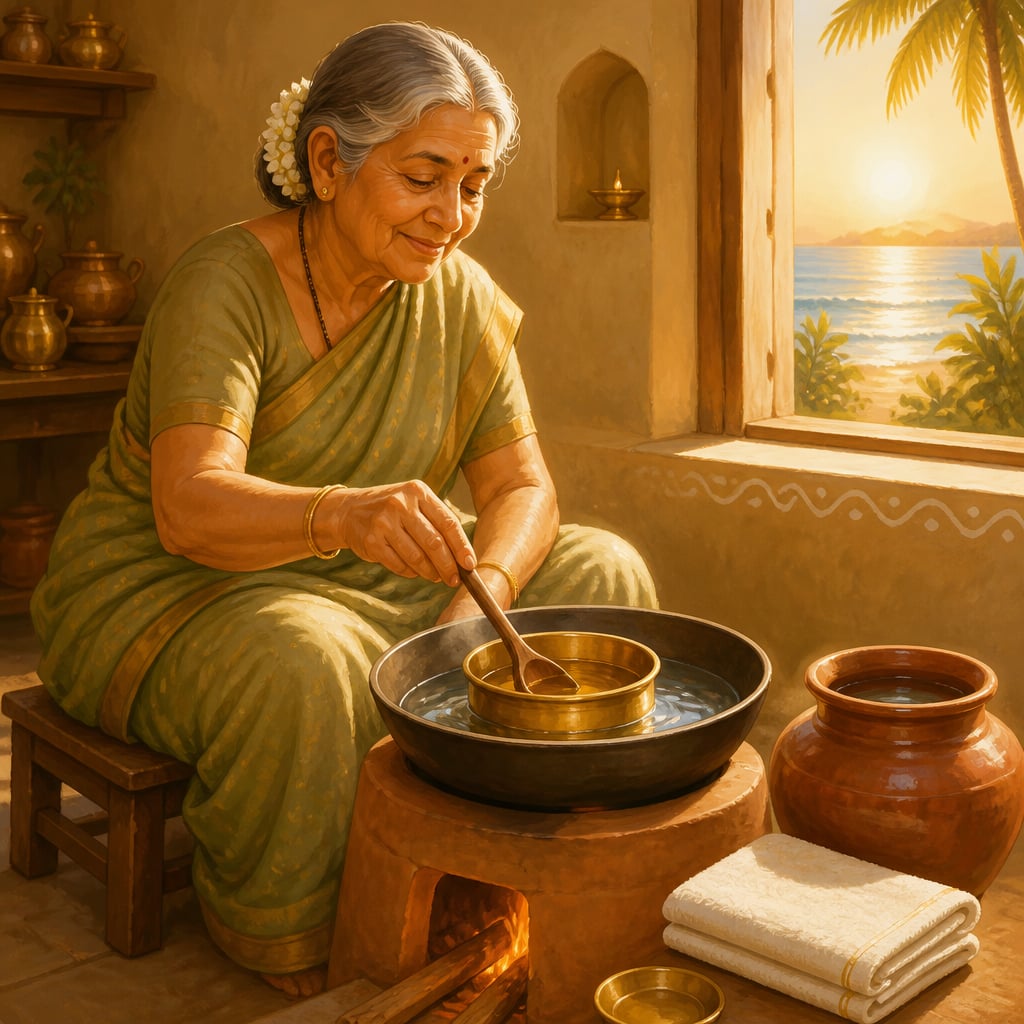
My paternal grandmother, on a Saturday morning in coastal Andhra, would warm sesame oil in a small brass bowl set inside a larger pan of hot water. She did not boil it. She let the oil draw the heat in slowly, the way a body draws warmth from a sunlit floor. Then she would call the youngest grandchild first. The child would sit on a low wooden peetha in the corner of the courtyard. She would dip her right hand into the oil, rub it between both palms once, and begin. The crown of the head. The temples. The sides of the neck. Each ear, the inside fold of each ear, the small hollow behind the lobe. The shoulders. The arms, long strokes outward, then the joints, circular. By the time she reached the soles of the feet, the child was usually half asleep. The whole process took about twenty minutes. Then a hot snanam, a quick prayer, and the child was returned to the world.
She did not call this abhyangam. She did not call it anything. It was Saturday. The oil was sesame. The bowl was brass. The hand was warm.
The Practice, Across Bharat
The oil bath is one of the oldest continuously practiced rituals in the Indic world, and the regional accents are sharp.
- In Tamil Nadu, ennai kuliyal is fixed to Saturdays for boys and Tuesdays and Fridays for girls. Sesame oil for adults, coconut oil for children. The oil is followed by a paste of shikakai, reetha, and avarampoo for the bath.
- In Kerala, abhyangam is closer to its Charaka original. The full-body warm oil massage is a clinical procedure offered at every Ayurveda kendra and inside most traditional households on at least one fixed day a week. Dhanvantari Jayanti, Diwali morning, and Onam are the big abhyangam days.
- In Maharashtra, the abhyang snan at four in the morning on Naraka Chaturdashi is the formal opening of Diwali. The whole household oils, bathes, and lights the lamp before the sun rises.
- In Punjab, mustard oil for the head and the joints, especially in winter, sits inside almost every grandmother's morning routine for grandchildren.
- In Bengal, the tel maakha before the bath is part of the wedding gaye holud and a weekly household practice.
Four regions, four oils, one logic. Warm oil first. Bath after. Prayer follows. The body is prepared for the day before the day arrives.
Nasya, the third part of this lesson, is quieter. A few drops of warm oil, anu taila or plain sesame, lifted into each nostril with the small finger, often after the abhyangam, often on its own. Most North Indian households call it naas lena. Most South Indian households call it mookku enna. The dose is small. The discipline is daily.
What the Scripture Says
The Charaka Samhita, in Sutrasthana chapter 5, gives the most quoted line in the entire Ayurvedic corpus on this subject.
अभ्यङ्गमाचरेन्नित्यं स जरा-श्रम-वातहा। दृष्टि-प्रसाद-पुष्टि-आयुः-स्वप्न-सुत्वक्-त्व-दार्ढ्यकृत्॥
abhyaṅgam-ācaren-nityaṃ sa jarā-śrama-vāta-hā | dṛṣṭi-prasāda-puṣṭi-āyuḥ-svapna-sutvak-tva-dārḍhya-kṛt ||
Practice oil application daily. It removes old age, fatigue, and the disorders of vata. It clears the eyes, nourishes the body, lengthens life, brings sound sleep, and gives the skin its strength.
Charaka Samhita, Sutrasthana 5.88-89
Charaka does not stop at the instruction. He maps the oil to the body type. Sesame for vata, coconut for pitta, mustard for kapha. He prescribes a sequence, the head and the soles of the feet first, then the rest. He fixes the duration. He distinguishes the morning abhyangam from the evening one. The Charaka chapter on swasthavritta, the daily routine for the healthy person, treats the oil bath not as a luxury but as a daily medical protocol that prevents the body from breaking down.

Nasya gets its own Charaka chapter. Sutrasthana 5.57 to 5.62 describes the procedure, the daily quantity, the contraindications, and the named oil, anu taila, formulated specifically for the channels of the head. The Sushruta Samhita and the Ashtanga Hridaya repeat the protocol with small refinements.

The Manusmriti, less clinical and more devotional, places the bath squarely before the prayer. The householder is instructed to bathe before sandhya, before any reading of the Vedas, before any offering at the home altar. The Apastamba Grihya Sutra repeats the rule. Snanam before dhyanam. The body is the first instrument; if the instrument is unclean, the music will not carry.
The Symbolism
Warm oil on the body, before the bath, is the first sacrament of the day for a reason. It is the household's way of saying that the body is not a stub of flesh on the way to a soul. It is the soul's working interface with the world. Charaka calls this body the annamaya kosha, the food sheath, and treats it with the same respect a Vedic priest treats the havan kund. You do not bring an unprepared instrument into a sacred work.
The oil itself is the symbol. Taila, in Sanskrit, is etymologically related to tila, the sesame seed, and tila is one of the most sattvic substances in the Indic kitchen and ritual. Sesame is offered at the shraadh to the ancestors. Sesame is poured on the head of the bridegroom at certain Tamil weddings. Sesame is the substance Charaka prescribes for the body. The same seed that feeds the dead, blesses the living, and rebuilds the tissue.
The bath that follows the oil is also symbolic. Snanam is one of the shaucha rituals, alongside achamana (the sipping of water) and prokshanam (the sprinkling). The Hindu tradition treats water not as a cleaning agent but as a witness. To enter water with deliberate intent, especially after the body has been oiled and the mind has been settled, is to step out of one state and into another. This is why the bath at Kashi is called a snanam and not just a wash. The same word covers the Saturday morning bath at home and the Mahasnana at the Kumbh.
Nasya extends the same logic to the breath. The Ayurveda treats the nose as the gateway to the head, shiraso dvara. What enters the nose conditions what reaches the manas and the buddhi. Warm oil drawn into the nostril each morning lubricates the channel, conditions the breath, and prepares the head for the day.
Why the Body Responds
The habit architecture is the part the modern mind rediscovers last and pays for first.
The oil bath is a near-perfect cue-routine-reward loop in the BJ Fogg sense. The cue is the day, Saturday or Tuesday or the morning of Diwali. The routine is twenty to forty minutes of warm oil and bath. The reward is immediate, the soft-tissue relaxation that follows a slow oil massage, and long-term, the cumulative tissue and joint repair Charaka described two and a half thousand years ago.
The identity-anchoring function is even stronger. A child who has had her ennai kuliyal every Saturday from the age of two does not, at thirty, need willpower to oil herself. The Saturday is the cue. The body is the routine. The discipline runs without conscious effort.
The nasya is a Pavlovian micro-cue. Two warm drops in the nostril, every morning, become the body's signal that the day is beginning. The same neural shortcut a coffee drinker uses with the first sip. The cue is the oil; the response is the wakeful clarity.
The bath after the oil and before the prayer is the threshold reset that Lesson 1.4 named. The street self ends in the bath water. The praying self begins on the wet feet of the way out.
What the Labs Found
The research layer is, at this point, large.
Buttagat and colleagues at Khon Kaen University, in a 2011 paper in the Journal of Bodywork and Movement Therapies, ran a five-day clinical trial of traditional oil massage on patients with chronic shoulder and neck pain. They measured a statistically significant reduction in pain scores, in salivary cortisol, and in muscle tightness compared to the control group. Five days. Sesame oil. The same protocol Charaka prescribes.
Nasya has its own file. Trager and colleagues, in a 2014 paper in the Journal of Alternative and Complementary Medicine, compared anu taila nasya to a saline nasal spray in patients with chronic allergic rhinitis. The anu taila group showed improved olfactory acuity and reduced symptom scores at the four-week mark. The saline group did not. The Indian Council of Medical Research has run smaller follow-up trials at the All India Institute of Ayurveda since 2018, with consistent direction.
The scientific framing now exists for what the Charaka Samhita already named in Sutrasthana 5. The skin is the body's largest organ; warm oil applied with friction increases peripheral circulation and parasympathetic tone. The nasal mucosa is one of the body's fastest absorptive surfaces; medicated oil reaches the cranial channels in minutes. None of this is news to the Ayurveda. It is news to the journals.
Modern Echoes
The American Ayurvedic massage market, by the National Ayurvedic Medical Association estimate, crossed one billion dollars in 2022. Miraval Resorts in Tucson sells a single abhyangam session for between two hundred and five hundred dollars. The Four Seasons in Bengaluru runs a similar package at the same dollar range. Dr. Oz ran an episode on abhyangam in 2012; Google Trends recorded a roughly two thousand four hundred percent spike in the search term within seventy-two hours.
Gwyneth Paltrow's Goop has, since 2017, sold a daily-self-massage protocol at a hundred and twenty dollars a kit, branded The Morning Body Brush Ritual. The brush is dry; the oil is sold separately. Charaka's chapter five is not cited.
The wellness language has rebranded the constituent acts. Self-care morning routine, dosha-balancing massage, nasal oil drops for stress, ear seeding, face yoga oil ritual, Ayurvedic body brushing. Each phrase is the English translation of a one-line instruction in the Charaka. The instructions still run free in any traditional Indian household. The English translations run at three hundred dollars an hour.
| What the Wellness Industry Calls It | What Our System Has Called It for 2,500 Years |
|---|---|
| Self-massage with warm oil | Abhyangam |
| Daily nasal oil drops | Nasya, anu taila |
| Ritual bath, sound bath, soak | Snanam |
| Detox routine | Shaucha |
| Skin-barrier oil | Tila taila |
| Lymphatic drainage massage | Mardana, the second phase of abhyangam |
What to Call It Yourself
The vocabulary carries the system. Abhyangam before bath, not self-massage. Snanam before prayer, not shower. Nasya for the nostril drops, not nasal hydration. Tila taila for the sesame oil, narikela taila for the coconut, sarshapa taila for the mustard. Anu taila for the medicated oil for the nose. The names anchor the practice. Once you say abhyangam, you cannot quietly downgrade it to a moisturiser.
A Last Pass at the Modern Echoes
A Mumbai aunty oils her grandchildren on Saturday morning with sesame oil from a brass bowl, bathes them, and feeds them lemon rasam. The whole protocol costs about thirty rupees of oil. A Manhattan wellness studio, four hundred dollars a session, performs abhyangam on a heated Korean stone bed and calls it Royal Indian Healing. The aunty has the Saturday rhythm. The studio has the price tag. The instruction is the same instruction.
Closing
The brass bowl is still on my grandmother's shelf. She is gone, but the bowl has come down. On a Saturday morning, the right thing to do with a young child is to warm a little oil, sit her on a low peetha, and start at the crown of the head. The aunties already know. The journals are catching up. The instruction has not changed.
Key figures
Charaka
Compiler of the Charaka Samhita (c. 600 BCE to 200 CE in its received form); the foundational physician of Ayurveda.
Vagbhata
Author of the Ashtanga Hridaya and the Ashtanga Sangraha (c. 6th to 7th century CE); synthesiser of Charaka and Sushruta.
Dhanvantari
The deity of Ayurveda; emerged from the samudra manthana holding the kalasha of amrita; canonical patron of healers.
Case studies
Charaka Samhita, Sutrasthana 5: The World's Oldest Dosha-Mapped Massage Protocol
Around 600 BCE, in the school tradition that produced the received Charaka Samhita, the chapter on swasthavritta laid out a body-care protocol of unusual specificity. Apply oil to the body daily. Begin at the head. Move to the soles of the feet. Then take the rest. Use sesame for the vata constitution, coconut for pitta, mustard for kapha. Distinguish the morning practice from the evening. Map the duration to the season. The chapter named the procedure abhyangam, fixed the oils to the doshas, and prescribed it as a clinical protocol, not a luxury.
Charaka's framing is the dharmic position on the body. The annamaya kosha is the soul's working interface. You do not bring an unprepared instrument into a sacred work. The daily oil bath is the maintenance of the instrument, the same way a Vedic priest cleans the havan kund before the fire is kindled. The dosha mapping is a recognition that bodies differ; the same oil does not serve every body. This is the original personalised medicine, three thousand years before the term.
The Charaka protocol survived intact through Sushruta, Ashtanga Hridaya, the medieval nighantus, and into the Kerala Ayurveda kendras of the modern era. The Tamil ennai kuliyal, the Maharashtrian abhyang snan, the Bengali tel maakha, and the Punjabi tel malish are all surface variations of the Sutrasthana 5 instruction. Two thousand five hundred years of unbroken household practice, across regions, languages, and political boundaries.
Every body is not the same body. The Ayurveda's dosha-mapped instruction is older than personalised medicine and more honest than the wellness industry's one-size protocols.
The Charaka Samhita, in its received form of Sutrasthana with thirty chapters and roughly twelve thousand verses, devotes more than half of its preventive-medicine section to daily routines like abhyangam; no contemporaneous Greek, Egyptian, or Chinese medical text matches its detail on body-oil protocols.
Buttagat 2011 and Trager 2014: What the Lab Found About Oil and the Nostril
Buttagat and colleagues, at Khon Kaen University in Thailand, in a 2011 paper in the Journal of Bodywork and Movement Therapies, ran a controlled trial of traditional sesame-oil massage on patients with chronic shoulder and neck pain. After five days of standardised abhyangam, the treatment group showed statistically significant reductions in pain scores, in muscle stiffness, and in salivary cortisol compared to a no-massage control. Three years later, in 2014, Trager and a team from the All India Institute of Medical Sciences and Bastyr University ran a randomised trial of anu taila nasya against saline nasal spray in chronic allergic rhinitis. The anu taila group showed improved olfactory acuity and reduced symptom scores at four weeks. The saline group did not.
The Charaka Samhita named the outcomes the labs measured. Sutrasthana 5.88 says abhyangam removes srama, fatigue, and lengthens ayuh, life. The cortisol drop in the Buttagat trial is a modern instrument's reading of srama-hara. Vagbhata in Ashtanga Hridaya 2.8 says nasya brings clarity to the throat, head, nose, and ears. The olfactory-acuity improvement in the Trager trial is the modern instrument's reading of ghrana-prasannata. The instruments are new. The result is old.
Both papers seeded a wave of follow-up trials at the All India Institute of Ayurveda, the Banaras Hindu University Ayurveda department, and several Western universities. By 2024 there were more than forty published clinical trials on abhyangam and nasya, with consistent direction. The Indian Council of Medical Research now funds Ayurveda RCTs as a standard category. The Ministry of AYUSH has cited these papers in policy documents on integrative medicine.
The Charaka chapter and the journal article are reading the same body. The journal is just slower and more expensive.
By 2024, more than forty peer-reviewed clinical trials had been published on abhyangam and nasya; the Indian National Ayurvedic Medical Association estimates that Ayurvedic body-oil protocols are now the second-most-studied non-pharmaceutical preventive intervention in Indian biomedical literature, after yoga.
The 200-Dollar Abhyangam: Miraval, Goop, and the Wellness Re-Sale
In 2012, Dr. Mehmet Oz aired a television segment on abhyangam; Google Trends recorded a spike of roughly two thousand four hundred percent in the search term within seventy-two hours. By 2022, Miraval Resorts in Tucson was selling a single abhyangam session for between two hundred and five hundred dollars. The Four Seasons in Bengaluru, the Aman in New Delhi, and the Ananda spa in Rishikesh ran similar packages at the same dollar range. Goop, since 2017, has sold a daily-self-massage protocol called The Morning Body Brush Ritual at a hundred and twenty dollars a kit. None of these properties cite Charaka Samhita, Sutrasthana 5, on the box. The National Ayurvedic Medical Association estimates that the American Ayurvedic massage market crossed one billion dollars in 2022.
The wellness industry sells the surface of the practice and skips the system. Charaka's instruction is dosha-mapped, sequenced, oil-specific, and embedded in a daily-routine chapter that includes diet, sleep, sandhya, and ethical conduct. A three-hundred-dollar resort session reproduces the surface, sometimes well, but it does not transmit the constitutional knowledge that makes the practice work over a lifetime. The aunty in Chennai with a brass bowl of warm sesame oil, on a Saturday morning, is operating the full system at thirty rupees of oil. The studio in Manhattan is operating one piece of it at four hundred dollars.
By 2024, the Indian government had begun to push back through the Ministry of AYUSH's licensing regime, the Geographical Indication system, and a series of patent-fight precedents traced to the 1995 turmeric case and the 1997 basmati case. The Ayurvedic body-oil market continues to grow; the question of attribution has not been settled.
The wellness industry is selling fragments at retail. The system is still free in any traditional Indian household. Use the names. Use the sequence. Use the oil for your constitution. The Charaka chapter is in the public domain.
The U.S. Ayurvedic massage market reached one billion dollars in 2022; a single Goop dry-brush kit sells for one hundred and twenty dollars; a daily abhyangam at home, with sesame oil from the local kirana, costs roughly four to ten rupees.
Historical context
Vedic and classical period (c. 1500 BCE to 700 CE)
The codification of abhyangam, snanam, and nasya as a daily protocol runs from the late Vedic chapters on the householder's conduct, through the Charaka Samhita (c. 600 BCE to 200 CE in received form), the Sushruta Samhita (c. 500 BCE to 400 CE), and the Ashtanga Hridaya of Vagbhata (c. 6th to 7th century CE). The daily-routine chapter, swasthavritta, is the longest single treatment of preventive medicine in any premodern medical literature.
Living traditions
The Ministry of AYUSH's National Ayurveda Day (since 2016), the All India Institute of Ayurveda's clinical research programme, and the Kerala kendras' continuing chikitsa lineages keep the Charaka Sutrasthana 5 protocol alive against the global wellness industry's one-billion-dollar simplification. Use the names: abhyangam before bath, not self-massage; snanam before prayer, not shower; nasya for the nostril drops, not nasal hydration; tila taila for sesame, narikela taila for coconut, sarshapa taila for mustard, anu taila for the medicated nasal oil. The wellness world is selling Goop dry-brush kits at one hundred and twenty dollars and Miraval abhyangam sessions at five hundred dollars; the Charaka chapter is in the public domain and the brass bowl is on the kitchen shelf.
- Saturday Ennai Kuliyal: The fixed-day oil bath of Tamil households. Sesame oil for adults, coconut oil for children, applied warm in a clockwise sequence from crown to soles. Followed by a hot bath with shikakai, reetha, and avarampoo paste. Saturday for boys; Tuesday and Friday for girls in many traditional homes.
- Maharashtrian Abhyang Snan on Naraka Chaturdashi: At four in the morning on Naraka Chaturdashi, the second day of Diwali, the entire household oils the body with utne paste and warm oil, bathes, and lights the first lamp before sunrise. The bath marks the killing of Narakasura by Krishna and the body's preparation for the new lunar year.
- Kerala Ayurveda Kendra Abhyangam: The Kerala Ayurvedic clinical lineage continues to deliver abhyangam as a full medical procedure. The Vaidya prescribes the oil based on the patient's prakriti; trained therapists deliver the seven-position massage; the bath is hot, herbal, and timed. Sessions run forty-five to ninety minutes.
- Arya Vaidya Sala, Kottakkal: One of the oldest continuously running Ayurvedic clinics and pharmacies in the world; the Charaka Samhita Sutrasthana 5 protocols are delivered daily as in-patient and out-patient procedures. Founded by P.S. Varier in 1902 and now in its fifth generational lineage.
- All India Institute of Ayurveda, New Delhi: The flagship Ayurvedic teaching, research, and clinical hospital under the Ministry of AYUSH; runs daily abhyangam, nasya, and panchakarma procedures, and publishes the largest Indian RCT programme on Ayurvedic preventive medicine.
- Dhanvantari Temple, Nelluvai: One of the most important Dhanvantari temples in Bharat; the deity is worshipped specifically as the patron of Ayurveda. Vaidyas across Kerala visit before opening a new clinic or beginning a new chikitsa cycle. Dhanvantari Jayanti draws large crowds.
Reflection
- What is one daily or weekly act of body-care that already runs in your life without effort? And what is one Charaka prescription, abhyangam, snanam, or nasya, that you could fold into your week with the smallest possible cue?
- Why do you think Charaka placed the chapter on daily routines, swasthavritta, before the chapters on disease in the Charaka Samhita? What does the order reveal about his understanding of medicine?
- What is the dharmic position on the body, given that abhyangam treats it as worthy of daily sacrament and the bhakti tradition sometimes treats it as a vehicle to be transcended? How do these two views sit together?