The Threshold and the Lamp

Why the Hindu day begins on the doorstep, with a wet broom, a fistful of rice flour, and a single flame

Sweeping the entrance, drawing the kolam, and lighting the morning lamp are not three small chores. They are one engineered sequence that consecrates the threshold, feeds the ants, and tells the body the day has begun. The wellness market sells fragments of this. The grandmother has been running the whole stack for centuries.

The Wet Broom Before Sunrise
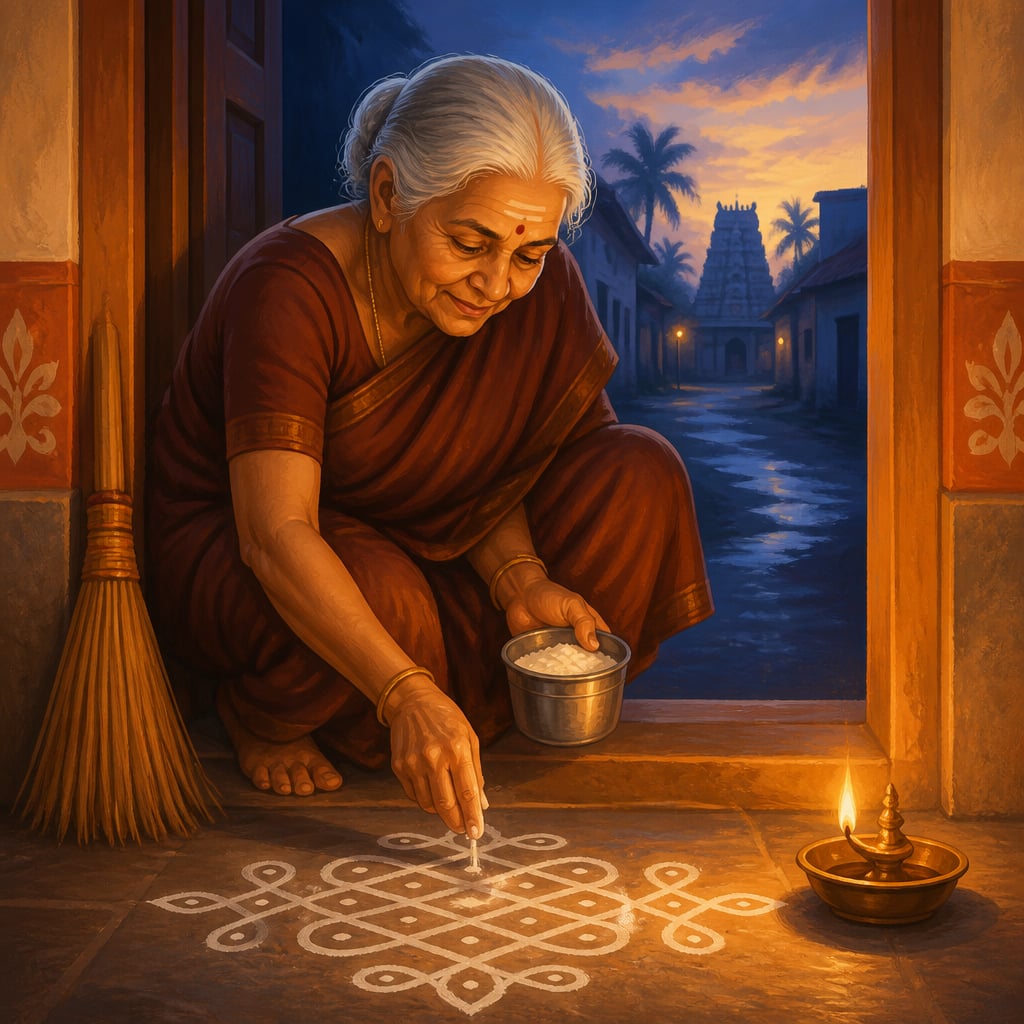
A paati drawing a kolam at her threshold before sunrise

Four-thirty in the morning in a small house off North Mada Street in Madurai, the year somewhere in the early 1990s. A paati in a dark cotton saree opens the front door. The street outside is still cold and quiet. She bends, sweeps the porch with a short coconut-frond broom, sprinkles a half-tumbler of water from a brass lota onto the swept stone, and waits a moment for the dust to settle. From a small steel tin she takes a fistful of pure rice flour. She squats. She begins to draw.

Her fingers work fast. A grid of dots first, twelve by twelve, set with a precision no architect could match without a ruler. Then long curves looping around the dots, never crossing, never breaking. Three minutes later there is a kolam on the porch, a closed pattern wide enough for two people to step through. She stands, wipes her fingers on the corner of her saree, and goes back inside. From the puja shelf she lifts a small brass lamp, deepa, fills it with sesame oil, twists a cotton wick, and lights it with a wooden matchstick. She places the lit lamp on the threshold.

She has not yet had coffee. She has not yet bathed. She has not yet greeted anyone in the house. The day has not begun. And yet, in three small acts, she has already done the most important thing the day required of her.

She will not explain why. The explanation is the lesson she did not owe you.

What Happens at the Door, Across Bharat

What the paati did has three names that work as one. The sweeping is prabhata-marjana, the dawn cleansing of the threshold. The drawing is kolam in Tamil and Telugu, muggu in older Telugu, rangoli in Marathi and Hindi, alpana in Bengali, mandana in Rajasthani, chowk-purna in the eastern Hindi belt. The lighting is deepa-prajvalana, the kindling of the morning lamp.

The regional dialects are the lesson. In Tamil Nadu and Andhra, the kolam is drawn freehand in plain rice flour, and the daily pattern is small and quick. On festival days a pulli kolam, a dot-grid kolam, can fill the entire street in front of a house. In Karnataka, the rangoli at the doorstep is often colored, with red brick powder, yellow turmeric, and lime white, and it stays through the day. In Maharashtra, rangoli uses dry color powders pressed into the stone with the side of the palm. In Rajasthan, mandana is drawn on washed-clay walls and floors with a paste of chalk and milk, in geometric forms that match the embroidery of local textiles. In Bengal, alpana is painted with a thick rice paste, often the night before puja, in flowing organic forms that look like vines and lotuses.

A small brass lamp burning at the doorway at dawn

Along with the kolam comes the lamp. In a Tamil household it is the small kuthu vilakku, a brass standing lamp with one wick. In a Maharashtrian Brahmin home it is the samai, often five-wick. In Kerala, the tall nilavilakku stands taller than a child. In a Punjabi home, a single diya of clay is enough. In a Bihari home, the deeya is placed at the chaukhat, the threshold itself, where the wood meets the floor. The vessel changes. The act does not.

One ritual, twenty regional dialects of practice. The dialects mean the practice is alive.

What the Scripture Says

The paati's silence has a long paper trail. The morning sequence is named in the Apastamba Grihya Sutra, which lists prabhata-marjana among the daily duties of the householder, before the morning Sandhya. The Atharva Veda carries the older protective layer.

या ते अग्ने सूर्ये रुचो दिवमातन्वन्ति रश्मिभिः। ताभिर्नो अद्य सर्वाभिः समिद्धो दीदिहीह नः॥

yā te agne sūrye ruco divam ātanvanti raśmibhiḥ tābhir no adya sarvābhiḥ samiddho dīdihīha naḥ

O Agni, with all the rays of yours that spread across the sky in the form of the sun, kindled and bright, shine here for us today.

Atharva Veda, 4.10.5

This is the verse the morning lamp is lit under. The lamp is not a substitute for the sun. It is the sun's emissary, kindled at the door before the sun has crossed the horizon, calling the same Agni into the household.

The Vishnu Smriti, Manusmriti chapter four, and Yajnavalkya Smriti all list cleaning the entrance and decorating the threshold among the daily duties of the householder. The Markandeya Purana chapter twenty-eight describes the ideal Hindu home as one whose front door is washed before dawn and whose threshold carries an auspicious figure each day. The Tamil Tirukkural in chapter forty-one, on the householder's life, names the lit lamp at the door as the visible sign that the family is in dharma.

Most striking, the Sri Rangam temple inscriptions of the ninth and tenth centuries CE record professional kolam artists, called Pon peyar, as salaried temple staff paid in measured grain. The same employment category appears in the Thiruvananthapuram palace records through the seventeenth century. Kolam was not a domestic chore. It was a recognized professional skill, paid in rice, with a job title and a place in the temple's economic register.

The Symbolism

The Hindu house is built on a single architectural premise. The threshold, the dehali, is not a mere edge. It is the membrane through which the outer world enters the inner. The deity sits inside, in the devara, the household altar. The ancestors sit inside, in the lineage. The family members sleep, eat, and pray inside. Everything that crosses in must be welcomed, sorted, and consecrated at the door.

The sweeping says, what entered yesterday is gone now.

The water says, the dust is settled, the air is clean.

The kolam says, this is a household in dharma; a guest is welcome here, a deity is welcome here, an ancestor is welcome here, even an ant is welcome here.

The lamp says, Agni is here; the day is consecrated; nothing inauspicious may cross this line without being seen.

The ant matters. In the Tamil tradition, the rice flour of the kolam is deliberately uncooked and edible. The day's first ritual is anna-daana, food-giving, performed silently to the smallest beings before any human in the house has eaten. A household that begins the day by feeding ants cannot easily forget that food is a debt, not a possession.

Why the Body Responds

Look at the morning sequence through the lens of habit architecture and the design becomes plain.

The cue. The first light at the eastern window. A sound from the street. The body, after a few months of practice, wakes within the brahma muhurta without an alarm. The wet stone of the porch is the second cue, sensory and unmistakable. The kolam grid is the third.

The routine. A short, embodied, pre-cognitive sequence. Sweep, sprinkle, draw, kindle. None of it requires decision-making. The body knows it.

The reward. The completed kolam at the door. The lit lamp. A specific, visible, finished product, every single morning. BJ Fogg at Stanford writes that the most under-rated component of a habit is its tiny celebration, the felt sense of having done the thing. The kolam is the celebration built into the morning.

The identity anchor. A woman who has drawn the kolam every morning for thirty years is not someone who does kolam. She is someone for whom the day does not begin without it. Wendy Wood at USC calls this context-dependent identity. The Hindu morning has been encoding it for centuries.

The social-accountability layer. The kolam is visible from the street. A neighbor who passes at six in the morning sees whose porch is swept and whose is not. The accountability is not punitive. It is woven. A household whose porch is dark and dirty is a household something is wrong in, and someone, eventually, will quietly knock.

What the Labs Found

The rice-flour kolam has two independent vindication arcs, in two completely different fields.

A finished rice-flour kolam with an ant approaching

The first is ecological. Sharma and Desai, in a 2001 ethnobotany paper, observed that traditional rice-flour kolams function as deliberate ant-feeding stations. Ants approaching the house find food at the threshold and return without entering. The practice provides controlled outdoor food provision that reduces indoor pest entry, all while satisfying the ritual injunction of feeding the smallest creatures. The household's ant-management is solved before the kitchen door has opened.

The second is mathematical. Lapointe and colleagues, in a 2020 paper in Leonardo, MIT Press, classified the most complex pulli kolams as Eulerian path drawings, single closed curves that pass through every dot exactly once and return to origin. The same family of patterns anticipates cellular automata and the formal grammar of modern computer graphics. Tamil grandmothers had been drawing freehand what computer scientists would later need a four-year degree to describe.

The morning lamp has a third arc. Brown and Gerbarg at Harvard, in a long line of work on slow rhythmic breathing, documented that gazing at a single steady flame for three to five minutes lowers heart-rate variability into the parasympathetic range and produces a measurable anxiolytic effect. The same team's work on slow chant and HRV is the foundation of the modern trataka literature. The grandmother does not call it trataka. She just stands in front of the lamp with her hands folded for a minute before she goes to make coffee.

Three practices. Three independent vindication arcs. One morning sequence.

What the World Calls It Now

In April 2020, the second month of the global lockdown, Anthropologie released a line of Mandala Doorstep Kits, retailing at forty-five dollars per kit, marketed as "Indian-inspired geometric art" for stoop and doormat decoration. Amazon's home and decor category briefly carried "Rangoli Sets" at the number-three bestseller position in the same window. None of the product descriptions cited the rice-flour tradition. None mentioned the ant-feeding rationale. None named Sri Rangam. None used the word kolam.

The Container Store carries a line of "welcome chalk stencils" for porches that imitate Mandana grid patterns. Goop ran a 2021 feature on "the morning ritual" recommending lighting a single beeswax candle at the entrance, sold as part of a "sacred space starter kit" at one hundred and twenty dollars. The Mindbodygreen podcast in 2022 ran a long episode on "liminal thresholds" in domestic feng shui, drawing on what it called "Eastern wisdom traditions," without once using the word dehali.

None of this is hostile. It is what happens to a fragment of an old, integrated practice when it is lifted out of its scriptural and household frame. The substance survives. The names do not.

What to Call It Yourself

From now on, the porch in Madurai had a kolam, not a doorstep mandala. The Bengali aunt's painted threshold is alpana, not a stoop sticker. The Marwari girl's painted floor is mandana, not a chalk stencil. The morning brass lamp is the deepa, not a meditation candle. The doorway itself is the dehali, not a foyer.

Use the original names. They are older than the rebrands. They will outlast them.

Modern Echoes

The vindication arc is on the record. The Sharma and Desai 2001 ant-management study confirms the ecological logic. The Lapointe 2020 Leonardo MIT Press paper places kolam in the formal lineage of cellular automata. Brown and Gerbarg's Harvard work on flame-gaze and slow breathing places the morning lamp inside the parasympathetic literature. The Sri Rangam inscriptions of the ninth and tenth centuries record kolam as paid temple staff work, an economic category that survived in the Thiruvananthapuram palace into the seventeenth century. Anthropologie, Goop, Amazon, and the lockdown craft economy have moved fragments of this stack onto Western porches at retail markup. Nothing in any of those product descriptions cites the Atharva Veda 4.10.5, the Apastamba Grihya Sutra, or the Pon peyar of medieval Tamil Nadu.

In the small house in Madurai, the paati has finished. The kolam is closed. The lamp is steady. A line of small black ants has just reached the rice flour and is doing the work the household quietly funds. The porch is now ready for the day. So is the household. So, in a way no Anthropologie kit will reproduce, is the dharma of the place.

The paati did not need the receipts. We do.

Key figures

Apastamba

Apastamba's Grihya Sutra is one of the three canonical household ritual manuals of the Vedic tradition. He gives the morning sequence in a single procedural sutra: sweep, sprinkle, draw. The discipline of compressing the entire dawn architecture of the home into one line is what made the practice transmissible across generations of non-specialists.

Tiruvalluvar

Tiruvalluvar's Tirukkural, in its long section on ilvazhkai (the householder's life), names the lit lamp at the door as the visible sign that a family lives by dharma. He links the morning deepa to the integrity of the family's livelihood and the discipline of the woman who lights it. The Kural is the bridge between Vedic Sanskrit instruction and the Tamil household's lived form.

Marcia Ascher

Ascher, an ethnomathematician at Ithaca College, was among the first Western scholars to formally analyze the kolam as advanced mathematics. Her 2002 paper in Mathematics Magazine classified pulli kolams as Eulerian path drawings, single closed curves through a dot grid, and traced their relationship to graph theory and combinatorics. Lapointe and colleagues built on her work in the 2020 Leonardo MIT Press paper on cellular automata.

Case studies

Sri Rangam's Pon Peyar: When Kolam Was a Salaried Profession

Inscriptions on the temple walls at Sri Rangam, dated to the ninth and tenth centuries CE under the later Chola administration, record a class of temple staff called the Pon peyar, the kolam-drawers. The Pon peyar were not volunteers. They were paid in measured grain, kalam-counted, alongside priests, musicians, and garland-makers. Their salary line appears in the temple's daily expenditure register. Their job was to draw the kolam at the eastern gate of the temple every dawn before the first puja. The same employment category appears in Vaishnava temple complexes across the Tamil country and continued in the Thiruvananthapuram palace administrative records into the seventeenth century. Kolam was not a domestic chore that women performed in their spare time. It was a recognized professional skill with a salary, a job title, and a place in the temple's economic register.

The medieval Hindu temple ran on the same logic as the medieval Hindu home, only at scale. The temple gate is the dehali of the deity. The kolam there is the same act the householder performs at her door. The temple economy understood that the act required skill, and it paid for that skill in grain. The Pon peyar entry is the receipt that what the paati does freely at four-thirty in the morning was, at the institutional level, valuable enough to fund. The household and the temple are running the same software at different scales.

The Pon peyar employment line survived nearly nine centuries through multiple political transitions, including the Vijayanagara and Nayaka periods, before fading in the colonial era. Its existence is the durable evidence that kolam was a recognized economic category, not a leisure activity.

When a tradition pays for a practice in grain across nine centuries and three dynasties, the practice is not folklore. It is institutional infrastructure. The household is running a smaller copy of what the temple is running at scale.

Sri Rangam temple inscriptions list at least three named Pon peyar with their grain allotment in kalams, alongside the priests and musicians of the same period.

Anthropologie's Forty-Five Dollar Mandala Doorstep Kit

In April 2020, the second month of the global lockdown, Anthropologie launched a line of Mandala Doorstep Kits, retailing at forty-five dollars per kit. The kits contained chalk in geometric stencil patterns, marketed as a way to bring intentional ornament to the homeowner's stoop during a period when the front door had become unusually emotionally salient. Amazon's home and decor category briefly carried Rangoli Sets that reached the number-three bestseller position in the same window. The product copy on both used phrases like Indian-inspired geometric art, sacred geometry for the threshold, and morning intention practice. None of the descriptions cited the rice-flour tradition. None mentioned the ant-feeding rationale. None named Sri Rangam, the Pon peyar, or the Apastamba Grihya Sutra. Customer reviews on the Anthropologie product page were uniformly positive. Almost none of them used the word kolam.

The Anthropologie kit is the kolam stripped of every layer except the visual. The substance is replaced (rice flour with chalk), the ant-management function is removed, the consecration mantra is gone, the household's daily anna-dana is unwoven. What remains is the geometric pattern alone, sold as a styling object. The course's response is not grievance. It is to use the original names. Kolam. Alpana. Mandana. The pattern is portable. The names are not, unless we keep saying them.

The lockdown craft economy briefly made variants of kolam visible on porches across North America and Europe. The cultural attribution did not travel. Within eighteen months, most of the kits were quietly discontinued or rebranded as generic chalk art. The names did not stick because the names were never offered.

When a fragment of a daily ritual is sold back to the world without its original names, the practice survives for a season and then dissolves. Naming the practice is what makes it durable. The grandmother knew the name. The kit did not.

Anthropologie's Mandala Doorstep Kit retailed at forty-five dollars in 2020. The traditional rice flour for one Tamil household's morning kolam costs roughly three rupees per day.

Eulerian Paths and Ant Management: Two Vindication Arcs in One Pattern

Two completely independent lines of late-twentieth and early-twenty-first century research have revisited the kolam from opposite ends of the academic spectrum. Sharma and Desai, in a 2001 ethnobotany paper, observed that traditional rice-flour kolams function as deliberate ant-feeding stations at the house threshold. Their data showed that ants that found food at the doorway returned to the colony without entering the kitchen, providing measurable indoor pest reduction without insecticide use. From a different building entirely, Marcia Ascher's 2002 Mathematics Magazine paper, expanded by Lapointe and colleagues in a 2020 Leonardo MIT Press paper, classified the most complex pulli kolams as Eulerian path drawings, single closed curves passing through every dot exactly once and returning to origin. The same family of patterns sits in the formal lineage of cellular automata and the procedural-grammar work that underlies modern computer graphics. The Sri Rangam Pon peyar of the tenth century were freehanding what the late twentieth century would need graph theory and ethnobotany to describe.

The kolam was always doing several things at once. The Sharma and Desai paper validates the ecological function. The Ascher and Lapointe papers validate the mathematical function. Neither piece of research originated the practice. Both confirm what the tradition had been quietly running for at least a thousand years. The grandmother is not waiting on the lab. The lab is catching up to the morning.

The kolam now appears in mathematical curricula as a worked example of Eulerian-path drawing and in ecological-design literature as a low-cost, high-efficacy non-toxic pest management practice. Neither field credits the Sri Rangam inscriptions. Neither field uses the original Tamil name in its citations. The vindications are real. The naming is still missing.

When two independent research streams converge on the same ancient practice from opposite directions, the practice is not arbitrary tradition. It is over-engineered infrastructure that the modern world is now reconstructing piecemeal.

The Lapointe 2020 Leonardo MIT Press paper places kolam patterns in the same combinatorial family as Conway's Game of Life and Wolfram's elementary cellular automata.

Historical context

Sutra to Early Medieval Period (c. 500 BCE to 1200 CE)

The threshold practice has the longest unbroken institutional record of any daily ritual in the Hindu household. The Vedic and Sutra tradition codified it. The Tamil bhakti tradition gave it a poetic moral architecture. The early medieval temple economy professionalized it, paying kolam artists in grain alongside priests and musicians. By the time the Vijayanagara, Chola, and Hoysala temple complexes were running at full institutional scale, the morning kolam was already a recognized economic category, not a private domestic chore. The Thiruvananthapuram palace records carried this employment line forward into the seventeenth century, almost untouched.

Living traditions

The lockdown craft economy briefly moved the kolam onto Anthropologie shelves and Amazon listings under names like Mandala Doorstep Kit and Rangoli Set, with Goop and Mindbodygreen carrying parallel features on liminal thresholds and morning candle rituals. Goop's 2021 sacred space starter kit retailed at one hundred and twenty dollars. The course's response is to use the original names. Kolam in Tamil. Muggu in Telugu. Rangoli in Marathi and Hindi. Alpana in Bengali. Mandana in Rajasthani. Chowk-purna in the eastern Hindi belt. Deepa for the lamp. Dehali for the threshold itself. The wellness market is selling fragments of the morning sutra at retail markup. The names belong to the tradition that codified it under Apastamba and ran it as paid temple labor at Sri Rangam for nine centuries.

Reflection

More in Dinacharya: The Hindu Day

All lessons in Dinacharya: The Hindu Day · Samskaras: The Sanatan Operating System course