The Mouth Comes Awake
Tongue scraping, oil pulling, and the neem twig before the toothbrush
Charaka, in the sixth century BCE, named three things a Hindu does to the mouth before the day begins. Scrape the tongue. Hold oil between the teeth. Chew a bitter twig. Twenty-five centuries later, an American daytime TV show in 2013 announced one of these practices as a new wellness trend, and the global oil-pulling market crossed fifty million dollars. This lesson takes the three protocols apart, layer by layer, and shows what was always in the morning routine.
The Copper Scraper on the Bathroom Shelf
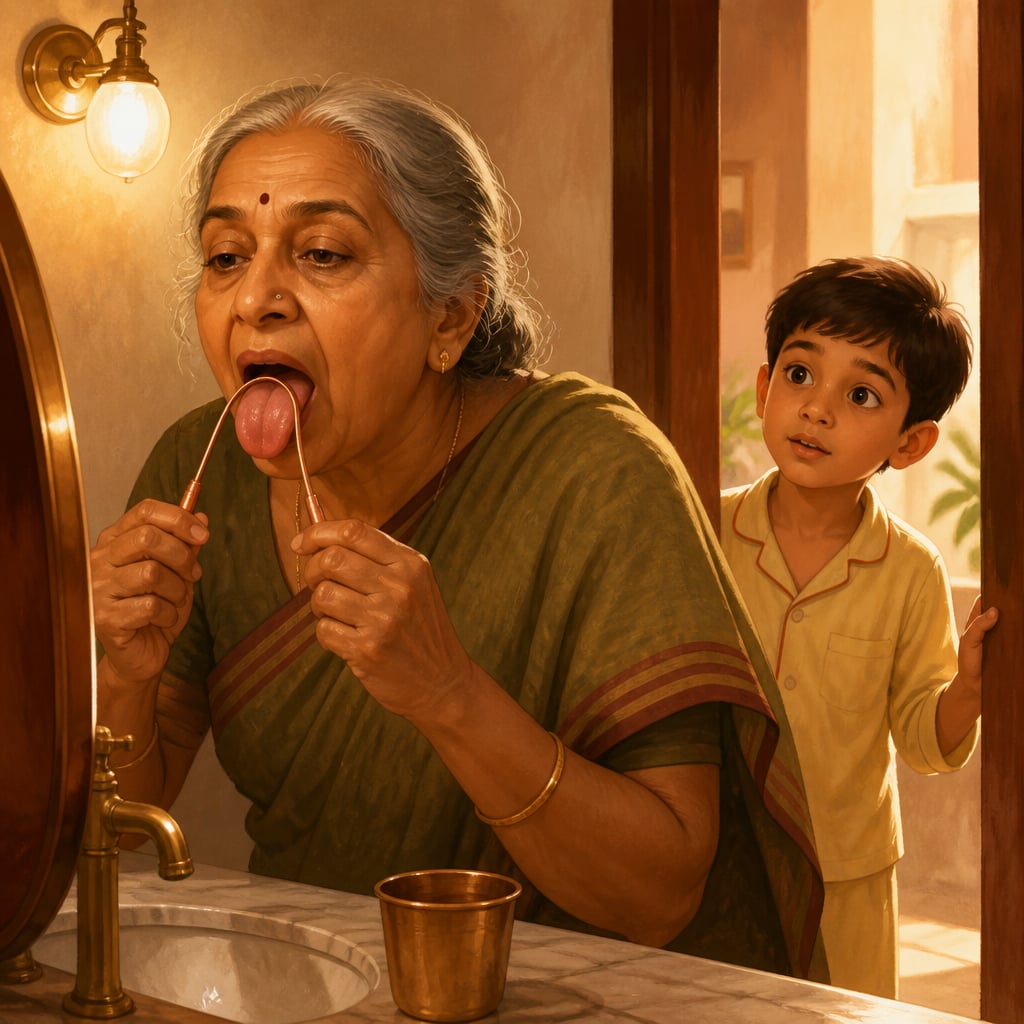
In a small flat in Coimbatore, sometime around 2005, a seven-year-old boy is standing on a stool, staring at his patti's reflection in the bathroom mirror. The patti is in a faded cotton saree. In her right hand is a thin curved strip of copper, slightly tarnished at the edges. She holds it at both ends, lowers her tongue gently, and draws the strip from the back of the mouth toward the front. A faint white residue comes off on the metal. She taps it once on the rim of the basin and draws again.
"Jihva," she says in Tamil, pointing to her own tongue. Then she points at his.
The boy makes a face. The copper looks cold. The patti is patient. She does this every morning, before tea, before pooja, before saying a single word to anyone in the house. She does not say it is Ayurveda. She does not say it is from Charaka. She says only, "It will keep your breath clean and your stomach quiet." The boy submits. The copper scrapes the back of his tongue. A faint ammonia smell rises and disappears. The patti smiles.
Twenty years later, the same boy will see a five-dollar "Tongue Sleek" copper scraper on Goop, and a twenty-dollar "Tonguebath" at a Bangalore Whole Foods, and an eighteen-dollar GuruNanda "Coconut Pulling Oil" at a Walmart in Texas. The packaging will speak of Ayurveda gently, the way one nods to an old neighbour without using their name. The boy will recognise the protocol immediately. His patti was on it before any of them.
This lesson is about the three things Charaka asks the mouth to do before the day begins. Jihva nirlekhana, the tongue scrape. Gandusha, the oil hold. Dantadhavana, the bitter-twig chew. Each was specified, by name, in the Charaka Samhita roughly twenty-five centuries ago. Each is back, under a new name, in the wellness aisle today.
Jihva Nirlekhana: The Tongue Scrape
The practice. First action of the morning, before water, before tea. A thin curved strip of copper, brass, or in older households silver, is held at both ends. The tongue is lowered. The strip is drawn from the back of the tongue toward the front, with light pressure, six to eight times. After each pass the residue (Sanskrit mala) is rinsed off. The mouth is then rinsed with warm water.
The practice is regional in its texture. In Tamil Nadu and Kerala, the scraper is usually copper, kept in a small brass cup near the basin. In Maharashtra, brass is more common; in Punjab, the older households still produce stainless steel curved strips at family weddings. In coastal Karnataka, a scraping edge is sometimes formed by folding the spine of a fresh tender mango leaf.
The scripture. The Charaka Samhita, Sutrasthana, Chapter 5, calls this jihva nirlekhana and lists it as the second action after dantadhavana in the daily morning routine. It specifies that the scraper be taijasa, that is, made of metal, and that it be smooth, slightly curved, and free of sharp edges. Sushruta's Chikitsasthana adds that the scraping must be light enough not to bruise the tongue and firm enough to remove the night's accumulation.
जिह्वा निर्लेखनं कार्यं प्रातः उत्थाय सर्वदा।
jihvā nirlekhanaṃ kāryaṃ prātaḥ utthāya sarvadā
Tongue scraping is to be done, on rising, every single day.
Charaka Samhita, Sutrasthana 5.75
The symbolism. The mouth is the gate of the body. Speech leaves through it; food enters through it. To begin the day with the cleansing of the gate is to take responsibility for both halves of that traffic. The tongue holds the residue of the night, both literal (mala) and metaphorical. The first act of the day is its removal.
Why the body responds. The cue is location: the scraper sits next to the toothbrush, impossible to miss. The routine is short and physical, six to eight passes, complete in under a minute. The reward is immediate, the metallic taste of the morning vanishes after the first stroke. The classical Ayurvedic claim is that the scraping awakens the deeper digestive fire (agni) by clearing the upper end of the channel.
What the labs found. A 2017 review by the American Dental Association found that tongue cleaning reduces volatile sulfur compounds, the molecules behind morning breath, by roughly seventy-five percent compared to brushing alone. Quirynen et al, Journal of Clinical Periodontology 2004, recorded measurable drops in tongue-coating bacterial load after a single scraping session. The biofilm that brushing leaves behind on the tongue is what the copper has been removing in Tamil Nadu kitchens for centuries.
What the world calls it now. Goop's "Tongue Sleek" copper tongue scraper retails at thirteen dollars. The Aapri "Tongue Cleaner" at Sephora retails at fifteen. Amazon's wellness aisle lists thousands of "copper tongue scrapers," rising in search volume after a 2023 New York Times wellness feature. The North American tongue-cleaner market crossed an estimated thirty million dollars in 2024, almost none of it crediting Charaka.
What to call it yourself. Jihva nirlekhana if you are speaking precisely. Jihva safai in everyday Hindi. The English "tongue cleaning" works; "tongue gua sha," which a 2024 wellness influencer briefly tried to rebrand it as, does not.
Gandusha: The Oil Hold

The practice. A spoonful of unrefined sesame oil, or coconut oil in southern coastal homes, is placed in the mouth on rising. The oil is held still in the mouth, or moved gently between the teeth, for between five and twenty minutes. It is not gargled. It is not swallowed. It is held until it turns thin and milky, then spat out into a bin (never the sink, since the saturated fat clogs drains). The mouth is rinsed with warm water.
In northern India, sesame oil (til tel) is the classical choice. In Kerala and coastal Karnataka, coconut oil is more common, since both grow at the doorstep. The Charaka Samhita prescribes the oil according to the wearer's constitution, recommending sesame oil for vata and pitta, and lighter oils for kapha.
The scripture. Charaka, Chikitsasthana 5, names the practice gandusha (the held mouthful) and kavala graha (the agitated mouthful). The text gives indications: cleansing of teeth and gums, prevention of dental caries, reduction of kapha in the head channels, sharpening of the voice. Sushruta adds the daily indication, distinct from the therapeutic one. Vagbhata's Ashtanga Hridaya, Sutrasthana 22, restates the practice with regional refinements.
कवलैस्तु मुखाभ्यासात् दन्ता दृढाः शुद्धि-कराः।
kavalais tu mukha-abhyāsāt dantā dṛḍhāḥ śuddhi-karāḥ
By the regular practice of oil-holding in the mouth, the teeth become firm and the mouth is cleansed.
Charaka Samhita, Chikitsasthana 5.81
The symbolism. The mouth, in Hindu thought, is one of the navadwaras, the nine gates of the body. Holding oil in the mouth is a small daily disciplining of one of these gates. It also embodies a household philosophy: the smallest acts protect the largest organs. Tooth and gum, breath and tongue, all sit in front of the throat (kantha) and the heart.
Why the body responds. The cue is the oil bottle on the kitchen shelf, the same one used for cooking. The routine takes time, ten to fifteen minutes, but it is parallel time: it can be done while bathing, while sweeping the front threshold, while lighting the morning lamp. The reward is the after-feeling, a clean and slightly slippery freshness in the gums that lasts for hours.
What the labs found. Asokan et al, Indian Society of Periodontology Journal 2008, ran a randomized controlled trial of sesame oil pulling against chlorhexidine, the chemical mouthwash gold standard. The oil group showed an equivalent reduction in Streptococcus mutans count. A 2014 study by the same group, in the Journal of Indian Society of Pedodontics and Preventive Dentistry, recorded a measurable drop in plaque index after two weeks. A 2017 systematic review in the Journal of Traditional and Complementary Medicine concluded that oil pulling has comparable effects to chemical mouthwash on gingival inflammation, with no recorded adverse events.
What the world calls it now. In March 2014, Dr Oz devoted a daytime TV segment to oil pulling and called it a wellness breakthrough. Within twelve months, the U.S. oil-pulling market grew from negligible to fifteen million dollars, reaching fifty million by 2020. GuruNanda's coconut pulling oil at fifteen to twenty dollars a bottle became a Walmart staple. Goop launched a pulling-oil kit at thirty dollars. Neither label cited the Charaka Samhita. This is the cleanest documented case of an Ayurvedic protocol going mainstream in the West without attribution.
What to call it yourself. Gandusha for the held form, kavala for the moved form. Til tel se kuli karna, in everyday Hindi, is the household phrase. "Oil pulling," if used, should at least be paired with the original term in writing.
Dantadhavana: The Bitter-Twig Chew

The practice. A fresh fibrous twig, traditionally from the neem tree (Azadirachta indica), is broken to the length of the index finger. One end is chewed for a minute until the fibres separate into a small natural brush. The frayed end is then rubbed across the teeth and gums. The twig is discarded after one use. In some regions, the choice tree is babool (acacia), in others khadira (catechu) or karanja.
This was the daily oral hygiene of most of South Asia until commercial toothpaste replaced it in the second half of the twentieth century. Even today, in many villages of Bihar, Uttar Pradesh, Madhya Pradesh, Gujarat, and across rural Pakistan and Bangladesh, the datun still appears at the morning threshold, sold for one or two rupees by passing vendors.
The scripture. Charaka, Sutrasthana 5, calls the practice dantadhavana (tooth cleansing) and lists permitted woods: nyagrodha (banyan), khadira (catechu), karanja, arka, and nimba (neem). The text specifies length (twelve fingerwidths), thickness (the tip of the little finger), and behaviour (the twig must be fresh, not dried).
The symbolism. A bitter mouth at the start of the day is a small renunciation. The Hindu tradition treats kashaya (astringent) and tikta (bitter) tastes as cleansing for the body. To begin the day with a bitter twig is to put the body in a state where sweet things, when they arrive, register more clearly. It is also a daily reminder that what is medicinal is rarely also delicious.
Why the body responds. The cue is the morning vendor or the home stock of fresh twigs. The routine takes three to five minutes; a single twig completes a full cycle of brushing, gum massage, and disposal. The reward is a clean tooth surface and a measurably reduced bacterial load.
What the labs found. A 2014 review in the Journal of Pharmacy and Bioallied Sciences found that the miswak and neem twig families show measurable antimicrobial activity against major dental pathogens. A 2007 study from the College of Dentistry, King Saud University, recorded that miswak users showed lower plaque index scores than toothbrush users in matched cohorts. The World Health Organization, in 2000, formally recommended chewing-stick use as an effective oral hygiene aid in regions where commercial alternatives are unavailable.
What the world calls it now. In 2018, a London startup called "The Humble Co." launched a charcoal-and-bamboo "natural toothbrush" priced at six dollars, drawing on the chewing-stick tradition. Boka and Davids ran similar campaigns. Neem-extract toothpastes became a wellness category, with brands like Auromere and Vicco occupying the shelf next to the imported vendors. The global "natural toothbrush" market crossed three hundred million dollars in 2024. Most of these products mention Ayurveda only obliquely.
What to call it yourself. Datun for the twig itself. Dantadhavana for the formal Sanskrit name. Neem datun if you want to specify.
Why All Three, and Why Together
Charaka does not list these three as alternatives. He lists them as a sequence. Dantadhavana (twig), then jihva nirlekhana (tongue scrape), then gandusha (oil hold). The three together address the full upper digestive gateway: tooth surface, soft palate and tongue, and the inner mucosa. The dentist, the gastroenterologist, and the ENT specialist split this work today; the morning routine of a sixth-century BCE Hindu household integrated it.
The wellness market, since 2013, has rediscovered all three. The British Medical Journal in 2018 ran a feature on oil pulling. The New York Times in 2023 ran a feature on tongue scraping. Forbes in 2024 ran a feature on miswak. None of these features cited Charaka's name. The patient research underneath, however, does. The Asokan studies, the ADA reviews, and the Saudi miswak cohort studies all locate the practice in its source.
The modern echoes are receipts, not threats. Goop's tongue scraper at thirteen dollars and GuruNanda's pulling oil at eighteen dollars do not endanger the tradition. They confirm it. The substance is correct. The science is real. The brand is selling you what your patti was doing for free in 2005.
In the Coimbatore bathroom, the patti finishes the scrape, rinses the copper strip, and dries it on a small cotton cloth. The boy gets down from the stool. The bitter twig and the oil come next. By the time the morning lamp is lit at the threshold, the gate of the body is clean. Forty years later, in another country, he will keep a copper scraper on his own bathroom shelf and a small bottle of unrefined sesame oil next to it. The mouth has been waking up like this for a long time.
Case studies
Charaka Samhita, Sutrasthana 5: The World's Oldest Codified Oral-Hygiene Protocol
Around the sixth century BCE, the Charaka Samhita codifies a daily oral-hygiene protocol that Indian households were already practising. Sutrasthana Chapter 5 specifies the sequence: chew the twig (dantadhavana), scrape the tongue (jihva nirlekhana), hold the oil (gandusha or kavala graha). The text gives constitutional mappings: sesame oil for vata and pitta, lighter oils for kapha. It names permitted twig woods: banyan, catechu, calotropis, neem, karanja. It specifies tools (a metal scraper, a fresh fibrous twig). It locates each step in a fixed time of day. The resulting protocol is the oldest codified daily oral-hygiene system in any literature anywhere in the world.
This is the textbook case of the six-layer template running at full strength. Practice, in three named procedures. Scripture, in Charaka Sutrasthana 5 and Chikitsasthana 5, restated by Sushruta Chikitsasthana 24 and Vagbhata Sutrasthana 22. Symbolism, in the mouth as the gate of the body. Habit architecture, in the locked sequence and time. Research, in twenty-five centuries of unrecorded household trials and twenty years of randomised trials. Modern echo, in the wellness aisle. The system was complete before Hippocrates was born.
The Charaka protocol has run, with regional variation, in tens of millions of Indian households for roughly two thousand five hundred years. It has produced the prior art that defeated multiple Western patent attempts on neem-based oral care and on sesame-based mouthwashes. It also stands behind every modern Ayurvedic oral-care brand that markets itself as traditional.
When a system has been written down, prescribed by name, refined across a thousand years, and continuously practised in millions of households, it does not need the wellness market's permission to be called effective. The receipts are the manuscripts and the household practice.
The Charaka Samhita's morning oral-hygiene chapter predates the earliest Western dental treatise, the medieval Latin texts of Guy de Chauliac, by roughly nineteen centuries.
Asokan 2008 and the ADA 2017 Review: The Labs Confirm Two Charaka Protocols
In 2008, Asokan and colleagues at the Meenakshi Ammal Dental College in Chennai published a randomized controlled trial in the Journal of the Indian Society of Periodontology. They compared sesame oil pulling (gandusha) against chlorhexidine, the chemical mouthwash gold standard, on Streptococcus mutans counts in adolescents. The oil group showed an equivalent reduction. Almost a decade later, in 2017, the American Dental Association published a review of tongue cleaning. The review concluded that tongue scraping reduces volatile sulfur compounds, the molecules behind morning breath, by approximately seventy-five percent compared to brushing alone.
Two independent clinical validations, separated by nine years and an ocean, for two practices in the same Charaka chapter. The Charaka Samhita named the outcomes (firm teeth, cleansed mouth, clarified voice, removal of oral disease) twenty-five centuries before either study. The labs are not discovering anything new. They are testing an existing protocol against a chemical alternative and confirming that the protocol holds. The 2008 study is what every Ayurvedic oral-care brand cites when challenged on efficacy. The 2017 review is what every English-language wellness feature on tongue scraping points to.
The Asokan study has been cited hundreds of times in dental literature and is now a standard reference in any review of non-chemical oral hygiene. The ADA review formalised tongue cleaning as an evidence-based practice. Together, they form the modern citation backbone for two Charaka protocols. They have not, on their own, slowed the wellness market's tendency to rebrand the practices as novel discoveries.
Modern clinical research is welcome confirmation, but it is not the source of the claim. The claim is the Charaka shloka. The lab is the youngest member of the family, useful and respected, but not the elder. When sharing the practice with a sceptical friend, name both the verse and the study. The two together are unanswerable.
ADA 2017 review: tongue cleaning reduces volatile sulfur compounds (the source of morning breath) by approximately seventy-five percent versus brushing alone.
GuruNanda, Goop, and the 2014 Oil-Pulling Boom
In March 2014, the Dr Oz daytime television show in the United States ran a segment on oil pulling, framing it as a natural wellness breakthrough. Within twelve months, two American brands launched dedicated oil-pulling products. GuruNanda introduced its coconut pulling oil at fifteen to twenty dollars a bottle, eventually becoming a Walmart staple. Goop launched a pulling-oil kit at thirty dollars. Neither label cited the Charaka Samhita. Neither carried the words gandusha or kavala graha. The US oil-pulling market grew from negligible in 2013 to fifteen million dollars in 2015 and crossed fifty million by 2020. Today the practice is embedded in mainstream American wellness routines, with no awareness of its source.
GuruNanda and Goop are the cleanest case in this chapter for the named modern echo. The substance is correct: sesame and coconut oils are exactly what Charaka prescribed. The protocol is correct: hold or move the oil between the teeth for ten to fifteen minutes. Layer one (the practice) is intact. Layer five (the research) is gestured at via the Asokan studies. Layers two, three, four, and six (the scripture, the symbolism, the habit architecture, and the original naming) are stripped. The market has discovered that customers pay for confidence in a protocol; it has not yet discovered that the confidence comes from the lineage.
The North American oil-pulling category crossed an estimated fifty million dollars in retail value by 2020. Indian sesame and coconut farmers see a small fraction of the retail margin. Most American buyers do not know they are practising gandusha. Indian-American households, ironically, often learnt about oil pulling from Dr Oz before learning it from their own grandparents.
The wellness market's preferred move is to keep the substance and erase the source. The defence is not anger; it is the use of the original names. Gandusha for the held mouthful. Kavala for the moved one. Charaka Samhita Chikitsasthana 5.81 for the citation. Once these words enter the conversation, the rebrand collapses on its own.
US oil-pulling market: under one million dollars in 2013; over fifty million dollars by 2020; growth driven by a single 2014 daytime-TV segment.
Historical context
Classical Ayurvedic period (c. 6th century BCE through 7th century CE), with continuous household practice from then to the present
The morning oral-hygiene protocol is one of the oldest continuously running personal-care systems in the world. Charaka's sixth-century BCE codification was already drawing on a household practice older than the text. The protocol survived through the Mauryan and Gupta periods, the medieval temple economy, the Mughal era, the colonial period, and the arrival of Colgate in the twentieth century. Even today, in villages across Bihar, Uttar Pradesh, and Madhya Pradesh, the datun and the copper scraper coexist with the toothbrush.
Living traditions
Multiple Western patent claims on neem-based oral care, sesame-oil mouth preparations, and turmeric-based dental formulations have been defeated since the late 1990s by Indian prior-art submissions citing Charaka, Sushruta, and Vagbhata. The Traditional Knowledge Digital Library, set up by CSIR and the Ministry of AYUSH, now blocks similar claims at the patent-office stage. When you scrape your tongue with a copper strip, hold sesame oil in your mouth, or chew a neem twig, you are practising a protocol whose institutional defence apparatus is in place. Use the original names: jihva nirlekhana, gandusha, dantadhavana.
- Daily morning datun in rural North India: In thousands of villages across Bihar, Uttar Pradesh, Madhya Pradesh, and Gujarat, the morning still begins with a fresh neem or babool twig, sold at the village threshold by passing vendors for one or two rupees. The twig is chewed at one end into a fibre brush and used across the teeth and gums.
- Copper jihva nirlekhana in South Indian and Maharashtrian households: A thin curved copper or brass strip lives next to the basin. Each morning, before tea or water, the head of the household scrapes the tongue from back to front, six to eight times, and rinses the mouth with warm water. Children are introduced to the practice between ages five and seven.
- Daily gandusha with sesame or coconut oil: A spoonful of unrefined sesame oil in northern households, or coconut oil in coastal southern ones, held in the mouth on rising for ten to fifteen minutes. The oil is then spat out and the mouth rinsed with warm water. The practice runs in parallel with bathing, sweeping the threshold, or lighting the morning lamp.
- Arya Vaidya Sala, Kottakkal: One of India's most established Ayurvedic institutions, founded in 1902, treating the Charaka and Sushruta protocols as living clinical practice. Visitors can attend the daily morning routine demonstrations and observe the in-house production of sesame and coconut oils used for gandusha.
- Banaras Hindu University, Faculty of Ayurveda: One of the oldest modern Ayurvedic teaching faculties in India. The faculty holds rare manuscript copies of the Charaka Samhita and the Sushruta Samhita and conducts current clinical studies on dantadhavana, jihva nirlekhana, and gandusha.
Reflection
- Of the three Charaka protocols (jihva nirlekhana, gandusha, dantadhavana), which one would actually fit into your current morning, and what is honestly stopping you from starting tomorrow?
- Why did Charaka treat the mouth as the first organ to be cleansed each day, before the eyes, the skin, or the gut?
- When a clinical trial in 2008 confirms what a verse from 600 BCE already states, what is the relationship between the verse and the trial?