Utsavam: When the Deity Comes Out
Rathotsavam, ratha yatras, brahmotsavam, deity processions, padayatras, and the dharmic engineering of community catharsis at landscape scale
For most of the year the deity in the temple is held inside the garbha griha behind closed doors. On Utsavam days the deity is brought out. The processional bronze (utsava murti) is bathed, dressed, garlanded, placed on a vahana or a ratha, and carried by the community through the streets of the town for hours or days. Tens of thousands walk with him. Songs are sung, lamps are lit, food is shared, and the body that was alone in its house is suddenly inside a moving crowd that is moving for the same reason. Tiruvannamalai's Karthigai Deepam draws three to four million people in a single night. The Puri Rathotsav has run continuously since the twelfth century. Burning Man rebuilt the structure in the Nevada desert in 1990 without naming it. Dunbar's research and the Harvard School of Public Health Kumbh study confirmed what every village priest already knew: collective ritual movement encodes the endorphin-and-oxytocin biology of human bonding. The chapter on devotional practice closes with the deity stepping out of the temple and into the street.
A Street in Tiruvannamalai, the Night of Karthigai Deepam
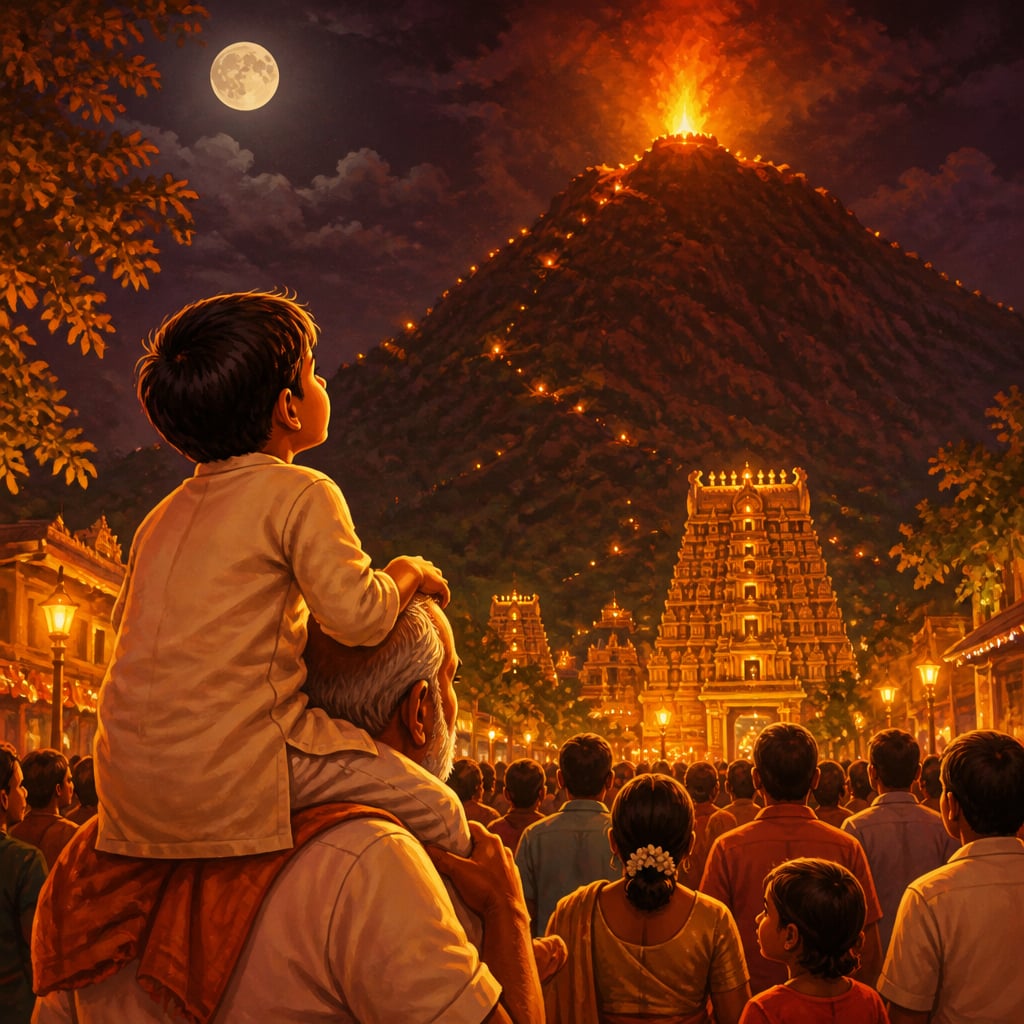
It is the full moon night of the Tamil month of Karthigai. A boy of nine is sitting on his grandfather's shoulders, somewhere in the dense river of people moving slowly down the four-mada streets that ring the Annamalaiyar temple at Tiruvannamalai. The streets, normally quiet enough at night, have disappeared beneath a single continuous human surface. There are three million people in the town tonight. Possibly four. The official count has stopped trying. Above the boy, on the summit of Arunachala hill, a giant copper cauldron of ghee and camphor has been lit at sunset. The flame is the size of a small house. It will burn for ten days. Every face in the streets below is turned, at least once each minute, toward the flame on the hill.
The boy's paati is somewhere ahead in the crowd, holding the small brass lamp she lit in the courtyard of the family home before they walked out. His grandfather is humming, very quietly, the Arunachala Akshara Mana Malai of Ramana Maharshi. The procession of the deity passes nearby, the bronze utsava murti of Annamalaiyar swaying on the shoulders of bare-chested bhattars, garlanded in jasmine, lit by a circle of camphor torches and a circle of nadaswaram players whose long mournful notes cut through the noise of the crowd. The grandfather points at the moving deity and at the flame on the hill in a single gesture. "Ondre," he says quietly to the boy. They are one. The boy does not understand the sentence. He understands only that he is on his grandfather's shoulders, that the entire town has come out, and that something very large and very old is happening underneath him.
This lesson is about what is happening underneath him. The dharmic tradition does not keep its deity locked behind the garbha griha door for the whole year. On specific calendar windows the deity is brought out. The utsava murti, the smaller processional bronze that doubles for the immobile stone mula vigraha in the inner sanctum, is bathed, dressed, garlanded, placed on a vahana (mount) or a ratha (chariot) or a palaki (palanquin), and carried by the community through the streets of the town. The Sanskrit word for the festival is utsavam, literally the lifting up. The Tamil and Telugu speakers say utsavam. The Marathi and Hindi speakers say yatra for the procession and utsav for the festival. The institution is one. The deity comes out. The community walks with him.
The forms vary by region and tradition. The South Indian temple runs an annual brahmotsavam that lasts ten days, with the deity processed each night on a different vahana (the Garuda, the Hanuman, the Sesha, the Hamsa, the elephant, the horse, the lion, the bull). The Eastern tradition runs the rathotsav, the chariot festival, in which the deity is placed on a hand-pulled wooden chariot and drawn through the streets by ropes that thousands of devotees grip together. The Western tradition runs the palaki yatra, the palanquin processions of Pandharpur and Vitthala. The Northern tradition runs the padayatra, the foot-pilgrimage that carries deity, devotee, and song over hundreds of kilometres. The Karthigai Deepam at Tiruvannamalai is the landscape-scale form: not the deity in a procession but the entire mountain transformed into the deity, the giant flame on its summit visible for fifty kilometres, three to four million pilgrims walking the fourteen-kilometre giri pradakshina through the night. Each form is a regional dialect of one underlying institution. The deity comes out. The community walks with him.
The Practice, Across India
The technical name in the Agama literature is utsavam, with subcategories specifying duration, occasion, and form. The Pancha Maha Utsavas, the five great festivals, are: Brahmotsavam (the ten-day annual festival of the temple), Theerthavari (the annual ritual bathing of the deity at a sacred tank or river), Rathotsavam (the chariot festival), Pavitrotsavam (the annual purification festival, typically in Shravana), and Damanotsavam (the spring festival of new flowers). Different temples emphasise different festivals; the Tirumala Tirupati Devasthanam runs the world's most institutionally elaborate brahmotsavam each Navaratri, with the deity processed on nine successive vahanas across nine successive nights, drawing two to three million pilgrims annually.

The Puri Jagannath Rathotsav is the most documented and most institutionally continuous. The festival has run, in continuous record, since the twelfth century, with the chariot construction beginning each year on Akshaya Tritiya (the third lunar day of the bright half of Vaisakha), the chariots completed by Ashadha Shukla Pratipada, and the rathotsav itself running on Ashadha Shukla Dwitiya. Three chariots are built fresh each year: Nandighosha (Jagannath, forty-five feet high), Taladhwaja (Balabhadra, forty-four feet high), and Darpadalana (Subhadra, forty-three feet high). The deities are processed nine days from the Jagannath temple to the Gundicha temple, two and a half kilometres distant, by ropes pulled by the devotees themselves. The Western word juggernaut is a corruption of Jagannath, deriving directly from the British colonial observation of the chariot's irresistible communal momentum.
The South Indian brahmotsavam at the great temples (Tirupati, Madurai, Srirangam, Chidambaram, Tiruvannamalai) runs the deity on a different vahana each night for ten nights. The vahanas vary by deity but typically include Garuda (the eagle, mount of Vishnu), Hanuman (the monkey, devotee of Rama), Sesha (the cosmic serpent), Hamsa (the swan, mount of Brahma), Simha (the lion), Vrishabha (the bull, mount of Shiva), Gaja (the elephant), Ashva (the horse), and on the closing night the Tirumanjanam, the great bath of the deity in the temple tank. Each vahana procession circumambulates the four mada streets of the temple, with thousands of devotees walking alongside, with the temple's nadaswaram and tavil players leading, with priests and elephants in the formation, with devotees prostrating as the deity passes, and with the entire town's economy and rhythm shaped around the procession's nightly schedule.

The Pandharpur palaki yatra of the Warkari tradition is the western Indian form. Twice each year, on Ashadhi Ekadashi (June or July) and Kartiki Ekadashi (October or November), hundreds of thousands of warkari pilgrims walk to Pandharpur from Alandi, Dehu, Tryambakeshwar, and other Vitthal-bhakti centres, carrying the paduka (footprints) of Sant Dnyaneshwar and Sant Tukaram on palanquins. The walk takes between fifteen and twenty-one days. The pilgrim sleeps in roadside tents and host villages, eats simple meals, sings the abhangas of the bhakti saints, and joins, by the time of arrival, a single mass of seven to eight hundred thousand devotees. The institution has run continuously since the thirteenth century.
The Karthigai Deepam at Tiruvannamalai is the landscape-scale Tamil form. On the full moon of Karthigai (November or December), at sunset, a giant cauldron of ghee and camphor is lit on the summit of Arunachala hill. The flame, the mahadeepam, burns for ten days. Three to four million pilgrims gather in the town across the festival, with the principal night drawing the largest crowd. The full giri pradakshina, the fourteen-kilometre walk around the base of Arunachala, is performed by a continuous river of pilgrims through the night. The institution traces, in inscriptional record, to Chola-period inscriptions of approximately 820 CE. The flame on the summit has been lit, in documented continuous record, for more than twelve hundred years. It is one of the world's largest outdoor religious gatherings on a single night.
The scripture. The Agamas are the principal classical anchors. The Pancharatra Agamas (Vaishnava) and the Shaiva Agamas specify the utsavam protocols in detail: the timing, the vahana sequence, the priestly duties, the music, the procession route, the closing tirumanjanam. The Vaikhanasa Agama is the principal text for the Tirumala tradition; the Pancharatra texts are the principal texts for the Sri Vaishnava temple tradition; the Shaiva Siddhanta and Kashmir Shaiva Agamas govern the Shaiva temples. The Skanda Purana and the Linga Purana preserve the Karthigai Deepam tradition. The Brahma Purana and the Skanda Purana preserve the Puri Rathotsav tradition. The Bhagavata Purana preserves the Vrindavan and Mathura procession traditions.
रथे च वामनं दृष्ट्वा पुनर्जन्म न विद्यते।
rathe ca vāmanaṃ dṛṣṭvā punar-janma na vidyate
Having seen the deity on the chariot, there is no further birth.
Skanda Purana, Utkala Khanda
The verse anchors the Puri Rathotsav tradition's central doctrinal claim: the rathotsav darshan is liberating in itself. The deity, normally accessible only inside the temple to those permitted to enter, comes out to the street where any human being, of any background, of any varna, of any community, of any access status, can have darshan. The procession is the institutional answer to the question of inclusivity in temple practice. The streets are the temple for the day.
The symbolism. The utsavam encodes a doctrine of cosmic mobility. The deity is not bound to the inner sanctum. The deity moves. The bronze utsava murti is the moving body of the same divine principle whose still form is the stone mula vigraha; the procession is the divine principle in motion through the human community. The vahana sequence is itself a doctrinal teaching: the deity rides Garuda one night and Hanuman the next and Sesha the third, displaying the multiple aspects of the deity's manifestations and the multiple modes of devotion the community can offer. Each vahana is a meditation. The Garuda night is the devotee's flight. The Hanuman night is the devotee's service. The Sesha night is the devotee's surrender. The festival is a ten-day immersive teaching in the modes of bhakti.
The ratha itself, the chariot, is one of the most layered symbols in the dharmic tradition. The Bhagavad Gita's opening scene is the chariot of Arjuna with Krishna as the charioteer; the Katha Upanishad's image of the body as the chariot, the senses as the horses, the mind as the reins, and the buddhi as the charioteer is the foundational psychology of yoga. The Puri Rathotsav literalises the Upanishadic image. The deity is the rider. The community is the horse. The rope pulled by ten thousand hands is the rein. The chariot moves because the community moves. The devotee who pulls the rope is, in the doctrinal frame, the buddhi disciplining the senses through service. The festival is a metaphysics in motion.
The giri pradakshina of Tiruvannamalai is the landscape-scale form of the same doctrine. The mountain is the deity. The walk around the mountain is the pradakshina that any devotee performs around any deity in any temple, scaled from a stone vigraha to a fourteen-kilometre hill. The flame on the summit is the agni that any devotee lights at any household altar at any sandhya. The festival is the household lamp scaled to mountain size. The grandfather pointing at the deity in the procession and at the flame on the hill in a single gesture is teaching a one-line doctrine. Ondre. They are one. The deity in the bronze, the flame on the summit, the lamp on the household altar, the agni in the human body: one substance, four scales.
Why the body responds. The Habit Architecture of the utsavam is, in the strict behavioural sense, the most powerful single ritual technology in the entire dharmic toolkit. Every other ritual we have studied in this chapter is a small daily or weekly act. The utsavam is a calendar-locked, multi-day, full-community immersion. The cue is the calendar: the brahmotsavam falls on the same lunar window each year, the rathotsav falls on Ashadha Shukla Dwitiya, Karthigai Deepam falls on Karthigai Pournami, and the entire region's social and economic life adjusts to the date. The routine is collective: the devotee does not perform the utsavam alone in the household; the devotee joins a procession of thousands and walks for hours or days inside a single coordinated mass. The reward is the felt-sense of dissolution, the bhakti-rasa in which the boundary between the individual devotee and the surrounding community softens, with the deity at the centre and the devotee inside a body much larger than his own.
The behavioural science here is striking. Mass-coordinated movement, mass-coordinated singing, and mass-coordinated breathing produce, in the human nervous system, what the research literature calls collective effervescence, a term Émile Durkheim coined in 1912. Robin Dunbar's evolutionary psychology research at Oxford (Proceedings of the Royal Society B, 2012) demonstrated that synchronised group movement, synchronised group singing, and synchronised group dancing trigger endorphin release significantly above the level produced by the same movement performed individually. The endorphin release is the substrate of the felt bond. The walker in the giri pradakshina is not having a private experience; the walker is having the experience the surrounding three million walkers are simultaneously having, and the surrounding three million are amplifying his experience as he is amplifying theirs.
What the labs found. The modern research on collective ritual has, in the last twenty years, broadly confirmed what the utsavam tradition has held for two millennia. Robin Dunbar et al (2012), Proceedings of the Royal Society B, demonstrated that synchronised group movement and singing trigger endorphin release significantly beyond individual performance, and that the endorphin spike is the substrate of group bonding across human societies. The paper documented the same neurochemical signature in religious processions, military marching, sports crowds, and traditional dance circles. Khan et al (2013), the Harvard School of Public Health study of the Allahabad Kumbh Mela, measured significantly elevated bonding-hormone profiles in pilgrims attending the Kumbh compared with control populations, with the participants reporting durable post-pilgrimage psychological benefits across measurable subjective well-being scales. The Kumbh is the Indian utsavam at the largest scale; the Karthigai Deepam, the Pandharpur palaki yatra, and the Puri Rathotsav are the regional institutional siblings. Konvalinka et al (2011), Proceedings of the National Academy of Sciences, documented synchronised heart-rate patterns between fire-walkers and observing relatives at a Spanish ritual, demonstrating that mass ritual produces measurable physiological coupling across participants. The neurochemical and physiological substrate of the utsavam-effect is no longer a matter of folk belief; it is documented in the principal peer-reviewed literature.
What the world calls it now. Burning Man (founded 1986 in San Francisco, relocated to Black Rock Desert, Nevada in 1990, current attendance approximately eighty thousand annually, total economic activity approximately one hundred million dollars annually) is the most documented Western parallel. The festival's central institution is the Temple, a large wooden structure built each year, decorated with offerings, names of deceased loved ones, written grievances, and personal objects, and burned on the final night before a quiet, processional, communal gathering. The structure is, point for point, the brahmotsavam architecture: a fixed deity-equivalent (the Temple), a calendar-locked annual cycle, a procession with music and offerings, a closing communal catharsis (the burn). The Burning Man Project has not, in any of its documentation, named the Hindu utsavam tradition as a structural source. The Project cites a generic neo-spiritual openness. The structure is the structure.
The EDM festival ecosystem more broadly (Tomorrowland in Belgium with four hundred thousand annual attendees, Coachella in California with two hundred and fifty thousand, Glastonbury in the UK with two hundred thousand, total global EDM festival economy approximately ten billion dollars annually) is the secularised commercial form of the same architecture: a calendar-locked annual gathering, a multi-day immersion, a synchronised collective movement to amplified rhythm, a felt-sense of dissolution into the surrounding crowd. The festivals each report what the academic literature describes as transformative experience outcomes among attendees, a category that, when described in full clinical detail, is the bhakti-rasa of the utsavam in commercial mass form. The festivals do not name the Hindu source. The architecture is, structurally, the architecture.
The modern parade industry (the Macy's Thanksgiving Day Parade with over three million attendees in New York annually, the Rose Parade in Pasadena, the Mardi Gras in New Orleans, the Notting Hill Carnival in London) preserves the utsavam's outer form (a calendar-locked annual procession with a community walking together) while removing the deity at the centre. The procession is the institution; the deity is missing. The Indian utsavam keeps the deity in the bronze on the chariot. The Western parade keeps the procession and removes the deity. The Pancha Maha Utsavas of the Agama literature have been the architectural source of the integrated form continuously across the period during which the secular Western forms have been the partial echo.
What to call it yourself. Utsavam in Sanskrit, Tamil, Telugu, and Kannada. Yatra in Marathi, Hindi, and Bengali for the procession; utsav for the festival. Brahmotsavam for the great ten-day annual temple festival; rathotsav for the chariot festival; palaki yatra for the palanquin procession; padayatra for the foot-pilgrimage; giri pradakshina for the mountain-circumambulation form. Procession covers the loose Western frame but loses the deity. When the conversation reaches for Burning Man, Tomorrowland, the Macy's parade, or Mardi Gras, the response is one calm sentence. "That is the utsavam form. The Pancha Maha Utsavas of the Agama literature have been the architectural source for the form continuously since long before any of the modern festivals had names of their own."
The Chapter Closes With the Deity in the Street
This lesson closes the chapter on devotional and temple practice. The chapter began with the invocation of Vighna-harta at the start of every undertaking, walked through the sacred geometry of pradakshina, the two-way act of darshan, the anointing of the deity in abhishekam, the final offering of the lamp in aarti, the bead-and-breath of japa-dhyana, and arrived, at the seventh lesson, at the deity stepping out of the temple and into the street. The arc is intentional. The chapter began inside the household altar with sankalpa. The chapter ends in the streets of Tiruvannamalai with three million pilgrims walking the giri pradakshina under a flame the size of a small house on the summit of a hill that, in the doctrinal frame, is the deity itself.
The boy on his grandfather's shoulders did not understand the sentence at nine. He understood at nineteen, walking the giri pradakshina himself for the first time without his grandfather. He understood again at thirty-four, reading Dunbar's paper in a magazine and recognising what the lab had found in the language of endorphins is what the grandfather had pointed at in the language of ondre. He understood again at forty-eight, watching the crowd at Tomorrowland on a documentary and recognising the brahmotsavam architecture inside the EDM festival without the deity, and recognising what was missing.
The utsavam tradition has been running, in continuous institutional record, for at least twelve hundred years on the summit of Arunachala, for at least eight hundred years at Puri, for at least seven hundred years at Pandharpur, and for at least one thousand five hundred years across the great South Indian temples of the Pallava and Chola periods. The labs have arrived. The festivals have arrived. The deity, in the bronze, on the chariot, on the shoulders of the bhattars, on the summit of Arunachala, has been arriving every year on the same calendar window, in the same form, with the same rope pulled by the same ten thousand hands, for as long as the records can reach.
When the conversation reaches for Burning Man, Tomorrowland, Mardi Gras, or the Macy's parade, the response is three calm sentences. The Pancha Maha Utsavas of the Agama literature are the architectural source. The deity at the centre is the difference. The Indian utsavam keeps the deity in the bronze on the chariot, and the deity is the reason the rope pulls and the music plays and the three million walk. Use the names. Utsavam. Brahmotsavam. Rathotsav. Padayatra. Giri pradakshina. The deity comes out. The community walks with him. The chapter, on this lesson, closes.
Key figures
The Chola Patrons of Tiruvannamalai (c. 850-1280 CE)
c. 850-1280 CE (the principal Chola period of temple endowment and inscription)
Sant Dnyaneshwar (1275-1296 CE)
1275-1296 CE
Robin Dunbar
Born 1947; principal research period 1990-present
Case studies
The Tiruvannamalai Karthigai Brahmotsavam (820 CE Chola Inscriptions to Present)
The Karthigai Deepam at Tiruvannamalai is one of the world's largest outdoor religious gatherings on a single night, drawing three to four million pilgrims annually on the full moon of the Tamil month of Karthigai (November or December). The festival has run, in continuous inscriptional record, since approximately 820 CE under early Chola patronage. The institutional substrate was built across the high Chola period (Rajaraja I, Rajendra I, and Kulottunga I, c. 985-1135 CE), with land grants, priestly establishments, maintenance grants for the mahadeepam (the giant copper cauldron of ghee and camphor on the summit of Arunachala hill), and inscriptionally codified festival schedules preserved in the Annamalaiyar temple's stone records. The festival's central institution is the lighting of the mahadeepam on the summit of Arunachala at sunset on Karthigai Pournami; the flame, the size of a small house, burns for ten days, visible for fifty kilometres in every direction. The festival's principal devotional act is the giri-pradakshina, the fourteen-kilometre clockwise circumambulation of the base of Arunachala, walked by hundreds of thousands of pilgrims through the night. The brahmotsavam runs the annual ten-day vahana procession sequence in parallel. The festival is one of the most institutionally documented continuing religious gatherings in the world, with the Chola-period inscriptions providing the archaeological substrate for the claim that the festival has been observed continuously, with the same flame on the same summit, for more than twelve hundred years.
The dharmic frame treats the mahadeepam as the deity itself at landscape scale. The mountain is Arunachala, which is Shiva. The flame on the mountain is the agni of Shiva manifest. The fourteen-kilometre walk around the base is the pradakshina that any devotee performs around any deity in any temple, scaled from a stone vigraha to a hill that is held to be the deity in cosmic form. The flame is not symbolic of the deity; the flame is the deity in its scale-shifted form. The doctrinal claim of the Skanda Purana's Maheshvara Khanda is exact: the darshan of the mahadeepam on Karthigai Pournami is itself the closing of the cycle of birth and rebirth for the devotee who sees it with the appropriate orientation. The Western framing of religious gatherings as occasional collective effervescence misses the dharmic architecture entirely. The festival is not a community gathering with a religious justification. The festival is the deity stepping out of the inner sanctum and becoming visible at landscape scale to the entire community.
The Karthigai Deepam has been run continuously across more than twelve hundred years of regional and political change, with the Chola, Pandya, Vijayanagara, Mughal, Maratha, colonial, and modern Indian republic periods all preserving the institutional core. The festival's modern attendance has grown to three to four million pilgrims on the principal night, with the Tamil Nadu state government providing logistical support (water, sanitation, traffic management, medical services) on the scale of the Kumbh Mela coordination. The flame on the summit has been lit, in continuous documented record, every Karthigai Pournami across this period, with the priestly families of the Annamalaiyar temple maintaining the institutional continuity. The festival is the world's longest-running annual outdoor religious gathering on the basis of continuous inscriptional record.
Indian temple institutions had landscape-scale annual procession festivals running, in continuous documented record, for more than a millennium before the modern Western festival ecosystem and the academic study of mass ritual. The Karthigai Deepam's twelve-hundred-year continuous record is documented in the Annamalaiyar temple's Chola-period inscriptions, in the Skanda Purana's Maheshvara Khanda, in the continuous priestly transmission of the festival protocols, and in the modern attendance records of three to four million pilgrims on the principal night. The receipts for the institutional architecture are in the stone, not in the Western press.
When the conversation reaches for the world's oldest continuing annual religious gathering, the answer is on the summit of Arunachala. The festival predates the Cathedral of Notre-Dame de Paris by four centuries, predates the founding of the Holy Roman Empire by a generation, and predates the modern Western festival ecosystem by more than a millennium. The Chola-period inscriptions are the archaeological receipt. The flame on the summit is the institutional continuity.
The Karthigai Deepam at Tiruvannamalai has run, in continuous inscriptional record at the Annamalaiyar temple, since approximately 820 CE, more than twelve hundred years. The festival draws three to four million pilgrims on the principal night, making it one of the world's largest outdoor religious gatherings. The mahadeepam, the giant flame on the summit of Arunachala, has been lit on every Karthigai Pournami across this period in continuous documented record. The fourteen-kilometre giri-pradakshina is walked by hundreds of thousands of pilgrims through the night.
Burning Man's Temple Burn and the Hundred-Million-Dollar Brahmotsavam Echo (1990-Present)
Burning Man, founded in 1986 by Larry Harvey on Baker Beach in San Francisco and relocated to the Black Rock Desert in Nevada in 1990, is the most documented Western parallel of the brahmotsavam architecture. The festival's central institution is the Temple, a large wooden structure built each year by a designated artist or collective, decorated across the festival week with offerings, names of deceased loved ones, written grievances, photographs, and personal objects, and burned on the final Sunday night before a quiet, processional, communal gathering of approximately eighty thousand attendees. The festival's annual attendance has grown from twenty in 1986 to approximately eighty thousand by the late 2010s; the total economic activity associated with the festival is estimated at approximately one hundred million dollars annually as of 2023. The Temple's structural design varies each year (the David Best Temples of 2000-2008, the Galaxia of 2018, the Templo de Tiempo of 2014, the Temple of Whollyness of 2013), but the institutional architecture is constant: a calendar-locked annual cycle, a deity-equivalent fixed point at the centre, a week of pilgrim arrival and offering, a procession with music, a closing communal catharsis. The structure is, point for point, the brahmotsavam architecture: a fixed deity-equivalent (the Temple, replacing the bronze utsava murti of the dharmic festival), a calendar-locked annual cycle (the week before Labor Day, replacing the Karthigai Pournami of the dharmic calendar), a procession with music and offerings (the festival's daily rituals, replacing the nine-vahana sequence of the dharmic brahmotsavam), and a closing communal catharsis (the burn, replacing the closing tirumanjanam or the closing of the rathotsav at the Gundicha temple). The Burning Man Project has not, in any of its principal documentation, named the Hindu utsavam tradition as a structural source. The Project cites a generic neo-spiritual openness, a 'radical inclusion' framing, and a 'temporary autonomous zone' theoretical lineage. The structure is the structure.
The Burning Man Temple is the cleanest documented modern Western case of the brahmotsavam architecture reaching mainstream attention with the dharmic lineage surgically removed and the deity at the centre missing. The structural insight is intact: a calendar-locked annual gathering with a built fixed point at the centre, a week of pilgrim arrival and offering, a procession with music, a closing communal catharsis. The lineage is gone: no Pancharatra Agama, no utsava murti, no priestly transmission, no Chola inscriptional record, no Karthigai Pournami calendar. The deity is gone: the Temple is decorated with offerings, but the central absence at the heart of the structure is, doctrinally, the absence of the deity. The Indian utsavam keeps the deity in the bronze on the chariot. Burning Man keeps the procession and the burn and removes the deity. The dharmic household's job is not to argue with Burning Man; the festival's structural architecture is broadly aligned with the tradition. The job is to use the original word. Brahmotsavam, not Burning Man. Utsavam, not 'transformative festival experience'. The naming is the lineage. The lineage is the receipt.
The Burning Man Project has grown from twenty attendees in 1986 to approximately eighty thousand by the late 2010s, with associated annual economic activity of approximately one hundred million dollars and a global subculture of 'Burner' communities running parallel events on five continents. The wider EDM festival ecosystem (Tomorrowland in Belgium with four hundred thousand annual attendees, Coachella in California with two hundred and fifty thousand, Glastonbury in the UK with two hundred thousand, total global EDM festival economy approximately ten billion dollars annually as of 2023) is the secularised commercial form of the same architecture. The festivals report what the academic literature describes as 'transformative experience' outcomes among attendees, a category that, when described in full clinical detail, is the bhakti-rasa of the utsavam in commercial mass form. None of the festivals name the Hindu source.
The market rewards the rebrander, not the source. The dharmic household's job is not to sue the Burning Man Project. The job is to use the original word. Brahmotsavam, not Burning Man. Utsavam, not 'transformative festival experience'. When the conversation reaches for Burning Man, Tomorrowland, or Coachella, the response is one calm sentence: 'That is the brahmotsavam architecture without the deity at the centre. The Pancharatra Agama specified the protocol two thousand years ago, and the Chola inscriptions document the institution running continuously since the ninth century.' Talapatram's Sanatan Operating System course, in this lesson, is filing the receipt.
Use the original word in conversation. When the friend says she went to Burning Man, you say she attended a contemporary brahmotsavam without the deity. When the magazine cover names Tomorrowland, you name the Karthigai Deepam. The festival is selling the structural insight; the dharmic tradition is the source of the structural insight. The naming completes the loop.
Burning Man, founded 1986 and relocated to Black Rock Desert 1990, has grown to approximately eighty thousand annual attendees with associated annual economic activity of approximately one hundred million dollars by 2023. The Tirumala Tirupati brahmotsavam draws two to three million pilgrims annually each Navaratri and has run, in continuous record, since the Vijayanagara period; the Karthigai Deepam at Tiruvannamalai draws three to four million pilgrims on a single night and has run, in continuous inscriptional record, since approximately 820 CE. The Pancharatra Agama is mentioned in zero of the principal Burning Man Project documentation, communications, or theoretical literature.
Dunbar 2012 and Khan 2013: The Endorphin-and-Oxytocin Vindication of the Utsavam
In 2012, Robin Dunbar and his research collaborators at Oxford (Cohen, Ejsmond-Frey, Knight, and Zlatev) published 'Rowers' high: behavioural synchrony is correlated with elevated pain thresholds' in Proceedings of the Royal Society B. The paper documented, in a controlled experimental setting, that synchronised group movement and singing trigger endorphin release significantly above the level produced by the same movement performed individually, with measured pain-threshold elevation as the principal physiological proxy. The paper's broader programme, summarised in Dunbar's subsequent writings on the social brain hypothesis, established that synchronised collective behaviour (procession, song, dance, marching) is one of the most reliable triggers of the human bonding-hormone profile across cultures. In 2013, Khan, Tewari, Srinivasan, and Hopkins published the Harvard School of Public Health study of the Allahabad Kumbh Mela, measuring significantly elevated bonding-hormone profiles in pilgrims attending the Kumbh compared with control populations, and documenting durable post-pilgrimage psychological benefits across measurable subjective well-being scales over the months following return. In 2011, Konvalinka et al published in Proceedings of the National Academy of Sciences a study of synchronised heart-rate patterns between fire-walkers and observing relatives at a Spanish ritual, demonstrating that mass ritual produces measurable physiological coupling across participants. Together, this body of work is the modern instrumented confirmation of what the brahmotsavam, the rathotsav, the palaki yatra, the Karthigai Deepam, and the Kumbh Mela have institutionalised continuously across more than a millennium: the substrate of the utsavam-effect is the human nervous system's response to synchronised collective movement, song, and shared focused attention. The neurochemical and physiological architecture is no longer a matter of folk belief; it is documented in the principal peer-reviewed literature.
The Pancharatra Agama specified the brahmotsavam protocol in classical times, including the precise sequence of the nine vahanas, the music of the nadaswaram and tavil, the procession route around the four mada streets of the temple, the role of the priestly establishments, and the closing tirumanjanam. The Skanda Purana specified the Karthigai Deepam protocol at Tiruvannamalai by the medieval period, including the lighting of the mahadeepam, the giri-pradakshina, and the doctrinal frame of the mountain-as-deity. The Chola patronage built the festival's institutional substrate from the ninth century onward; the continuous priestly transmission across the Pallava, Chola, Vijayanagara, and modern periods preserved the integrated form. Dunbar's 2012 paper documented the neurochemistry of the felt experience the procession produces. Khan et al's 2013 Kumbh study documented the bonding-hormone substrate at the largest institutional scale. The research vindication is total: the substance is correct, the structure is correct, the music is correct, the synchronisation is correct, the duration is correct, the scale is correct. The dharmic tradition has been running the integrated experience for more than a millennium; the modern lab has, in the last twenty years, instrumented the underlying biology.
The principal modern peer-reviewed literature on the cognitive science of religion (Boyer, Atran, McCauley, Whitehouse, Norenzayan, Dunbar, and parallel research programmes) has, in the last two decades, broadly converged on the recognition that synchronised collective ritual produces a specific neurochemical and behavioural bonding substrate, and that this substrate is the proximate mechanism of the felt-bond across human societies. The Indian utsavam tradition has, across the same period, continued to run the institutional form continuously, with the Karthigai Deepam, the Tirumala brahmotsavam, the Puri Rathotsav, the Pandharpur palaki yatra, and the Kumbh Mela each preserving the integrated architecture at scales the modern Western festival ecosystem has only partially approached. The modern Western festival economy of approximately ten billion dollars annually is the partial commercial form of the same architecture, with the deity at the centre missing. The integrated dharmic form is, structurally, the architectural source the modern industry is reassembling without acknowledgment.
The case for the tradition does not need to wait for the lab. The lab, when it arrives, will confirm what the tradition recorded. The Pancharatra Agama specified the brahmotsavam protocol in classical times. The Skanda Purana specified the Karthigai Deepam protocol by the medieval period. The Chola inscriptions document the institution running continuously since the ninth century. Dunbar published in Proceedings of the Royal Society B in 2012. Khan et al published the Kumbh study in 2013. Three independent records, more than a millennium apart, point to the same institution. The research vindication is doing serious work. The dharmic tradition is the structural source.
More than a millennium of continuous institutional practice, two thousand years of textual codification in the Pancharatra and Shaiva Agamas, and twenty years of modern instrumented research in the cognitive science of religion all point to the same architecture of synchronised collective ritual. The grandfather pointing at the deity in the procession and at the flame on the hill in a single gesture does not need to read Dunbar. He has walked the giri-pradakshina. The lab and the giri-pradakshina are the same insight, more than a millennium apart, with one of them carrying the integrated whole the other is reassembling, paper by paper.
Robin Dunbar et al published 'Rowers' high: behavioural synchrony is correlated with elevated pain thresholds' in Proceedings of the Royal Society B in 2012, documenting endorphin release in synchronised group movement. Khan et al published the Harvard School of Public Health study of the Allahabad Kumbh Mela in 2013, documenting elevated bonding-hormone profiles in pilgrims and durable post-pilgrimage psychological benefits. The Pancharatra Agama specified the underlying protocol in classical times; the Chola inscriptions document the Karthigai Deepam running continuously since approximately 820 CE; the Tirumala brahmotsavam, the Puri Rathotsav, the Pandharpur palaki yatra, and the Kumbh Mela preserve the integrated form continuously across more than a millennium.
Historical context
Vedic and Agamic foundations (c. 1500 BCE - 500 CE) through Pallava, Pandya, and Chola institutionalisation (c. 600-1280 CE), continuous medieval and modern practice (c. 1280-present), and the modern instrumented confirmation in the cognitive science of religion (1992-present)
The utsavam institution is one of the most stable continuing institutions in Indian civilisation. Across more than a millennium, through Pallava, Pandya, Chola, Hoysala, Vijayanagara, Mughal, Maratha, colonial, and modern Indian republic periods, the Karthigai Deepam at Tiruvannamalai has been lit each year on the summit of Arunachala, the Puri Rathotsav has been run each year on Ashadha Shukla Dwitiya, the Tirumala brahmotsavam has been run each Navaratri, and the Pandharpur palaki yatra has been walked each Ashadhi and Kartiki Ekadashi. The institutional preservation across regional and political shifts is documented in inscriptions, in the Sthala Puranas of the major temples, in the Mahatmya texts of the principal pilgrimage sites, and in the continuous priestly transmission of the Pancha Maha Utsavas protocol across the Pancharatra, Vaikhanasa, and Shaiva Agama traditions. The Western rediscovery of the integrated form, in the Burning Man Project (1990 onward), the EDM festival ecosystem (the ten-billion-dollar global industry of Tomorrowland, Coachella, Glastonbury, and parallel events), and the secular parade industry (the Macy's parade, the Rose Parade, the Mardi Gras, the Notting Hill Carnival), is the most documented modern case of a structural architecture being independently reassembled in fragments without recognition of the institutional source. The Indian utsavam keeps the deity at the centre. The Western parallel forms preserve the procession and remove the deity. The dharmic household's job is small and clear: keep walking the procession, keep pulling the rope, keep lighting the mahadeepam, every year on the same calendar window, in every town that still keeps the institution.
Living traditions
The integrated utsavam form of the Indian temple tradition is no longer a Hindu tradition that the modern world is unaware of. The Burning Man Project's annual Temple structure and the broader EDM festival ecosystem (Tomorrowland, Coachella, Glastonbury, total global festival economy approximately ten billion dollars annually) are the brahmotsavam architecture in commercial mass form with the deity at the centre missing. The modern parade industry (the Macy's Thanksgiving Day Parade, the Rose Parade, the Mardi Gras, the Notting Hill Carnival) preserves the procession and removes the deity. The pilgrimage tourism industry (the Camino de Santiago, the Hajj for non-Hindu traditions, the Buddhist circuits in Sri Lanka and Southeast Asia) is the closest cousin and preserves the structural form most completely. The dharmic tradition's job is small and clear. When the conversation reaches for Burning Man, you say brahmotsavam. When the conversation reaches for Tomorrowland or Coachella, you say utsavam. When the conversation reaches for the modern parade, you say rathotsav or palaki yatra or padayatra. The Pancharatra Agama, the Skanda Purana's Utkala Khanda and Maheshvara Khanda, the Chola inscriptions at the Annamalaiyar temple, and the continuous priestly transmission across more than a millennium are the textual and institutional anchors; the household practice of attending the brahmotsavam, walking the giri-pradakshina, pulling the rathotsav rope, or joining the palaki yatra is the living tradition. Use the names. The labs have arrived. The festivals have arrived. The Pancharatra Agama specified the brahmotsavam protocol two thousand years before Burning Man. The Chola inscriptions document the Karthigai Deepam running continuously since approximately 820 CE. Dunbar published in Proceedings of the Royal Society B in 2012. Khan et al published the Kumbh study in 2013. The dharmic tradition has been holding the integrated whole the modern world is reassembling, piece by piece, paper by paper, festival by festival, for as long as the inscriptional record can reach. Talapatram's Sanatan Operating System course, in this lesson and in the broader chapter on devotional practice, is the manual for the household and the temple community the integrated tradition belongs to. Every Karthigai Deepam, every Rathotsav, every Pandharpur Ekadashi, every brahmotsavam, every receipt.
- The South Indian Brahmotsavam at the Great Temples: The annual ten-day brahmotsavam at the great South Indian temples of Tirumala, Madurai, Srirangam, Chidambaram, Tiruvannamalai, and the parallel Vaishnava and Shaiva centres. The deity is processed each night on a different vahana around the four mada streets of the temple, with the priestly establishments leading, the nadaswaram and tavil players providing the music, the temple elephants in the formation, and thousands of devotees walking alongside. The vahana sequence typically includes Garuda, Hanuman, Sesha, Hamsa, Simha, Vrishabha, Gaja, and Ashva across the first eight nights, with the closing Tirumanjanam or the closing rathotsav on the ninth or tenth night. The institutional protocols are codified in the Pancharatra and Vaikhanasa Agamas (for the Vaishnava temples) and in the Shaiva Agamas (for the Shaiva temples).
- The Puri Jagannath Rathotsav and the Eastern Indian Chariot Tradition: The annual rathotsav at the Jagannath temple in Puri, Odisha, on Ashadha Shukla Dwitiya (June or July). Three chariots are built fresh each year between Akshaya Tritiya (early May) and Ashadha Shukla Pratipada (late June): Nandighosha (Jagannath, forty-five feet high, with sixteen wheels), Taladhwaja (Balabhadra, forty-four feet high, with fourteen wheels), and Darpadalana (Subhadra, forty-three feet high, with twelve wheels). The deities are processed nine days from the Jagannath temple to the Gundicha temple, two and a half kilometres distant, by ropes pulled by the devotees themselves, with hundreds of thousands of pilgrims gripping the ropes in shifts. The festival is the principal continuing institution of the Eastern Indian chariot tradition and one of the most documented continuing religious gatherings in the world.
- The Pandharpur Palaki Yatra of the Warkari Tradition: The twice-yearly palaki yatra of the Warkari sect, walked from Alandi (the samadhi of Sant Dnyaneshwar) and Dehu (the home of Sant Tukaram) to Pandharpur (the principal Vitthal temple) on Ashadhi Ekadashi (June or July) and Kartiki Ekadashi (October or November). The walk takes between fifteen and twenty-one days. The pilgrims, the warkaris, carry the paduka (footprints) of Dnyaneshwar and Tukaram on palanquins, sleep in roadside tents and host villages, eat simple meals offered by villages along the route, sing the abhangas of the bhakti saints, and join, by the time of arrival, a single mass of seven to eight hundred thousand devotees. The institution has run continuously since the thirteenth century. The yatra is one of the largest continuing pilgrim-procession institutions in continuous record anywhere on earth.
- Annamalaiyar Temple and the Giri Pradakshina, Tiruvannamalai: The principal site of the Karthigai Deepam and one of the five Pancha Bhuta Sthalams of the Shaiva tradition (the Agni Sthalam, with Arunachala held to be the linga of fire). The temple complex is one of the largest in South India, with the four mada streets surrounding the inner sanctum, the principal gopuram (temple tower) rising to two hundred and seventeen feet, and the temple tank. The fourteen-kilometre giri-pradakshina route runs around the base of Arunachala hill, with eight smaller shrines (the Ashta Lingams) marking the cardinal and intercardinal directions along the route. The Ramana Maharshi ashram, on the lower slopes of Arunachala, is one of the principal modern Advaita Vedanta sites and is closely associated with the giri-pradakshina tradition.
- Jagannath Temple and the Rathotsav Route, Puri: The principal site of the Puri Jagannath Rathotsav and one of the four mainland Char Dham. The temple complex is one of the largest and most institutionally elaborate in Eastern India, with the principal gopuram rising to two hundred and fourteen feet, the kitchen complex serving daily mahaprasad to one hundred thousand pilgrims (the largest temple kitchen in continuous operation in the world), and the Daitapati and Pandita priestly communities preserving the institutional protocols. The two-and-a-half-kilometre rathotsav route runs from the Jagannath temple to the Gundicha temple, with the chariots constructed on the Bada Danda (the principal road leading to the temple) each year and the deities processed during the festival. The Puri tradition, including the rathotsav, the daily mahaprasad, the snana yatra (the bathing festival on Jyestha Pournima), and the navakalevara (the periodic renewal of the deity images, performed every twelve to nineteen years), is one of the most institutionally complete continuing temple traditions anywhere in the world.
- Vitthal Temple and the Pandharpur Palaki Yatra Route: The principal site of the Pandharpur palaki yatra and the institutional centre of the Marathi Warkari tradition. The Vitthal temple, on the banks of the Bhima river (locally called the Chandrabhaga), is the principal Vitthal-bhakti shrine in the dharmic geography. The temple complex preserves the deity of Vitthal (a form of Krishna) and Rakhumai (Rukmini), with the priestly establishments of the Badva and Sevadhari communities preserving the institutional protocols across more than seven centuries. The Pandharpur yatra route runs from Alandi (the samadhi of Sant Dnyaneshwar, near Pune) and Dehu (the home of Sant Tukaram, also near Pune) through fifteen to twenty-one days of walking to Pandharpur, with the principal arrival on Ashadhi Ekadashi (June or July) and the parallel arrival on Kartiki Ekadashi (October or November). The institution is one of the largest continuing pilgrim-procession institutions in continuous record.
Reflection
- What is the principal annual procession festival in your region or family tradition (the Karthigai Deepam, the Rathotsav, the Ganesh visarjan, the Durga visarjan, the Murugan kavadi, the Pandharpur Ekadashi, or the parallel local utsavam)? When did you last walk the procession yourself, rather than watching it from a distance or skipping it because the calendar was busy? What would change in your year if you walked the procession in full this year?
- Robin Dunbar's 2012 paper in Proceedings of the Royal Society B documented that synchronised group movement triggers endorphin release significantly above individual baseline. The Pancharatra Agama specified the brahmotsavam protocol two thousand years earlier. The Chola inscriptions document the Karthigai Deepam running continuously since approximately 820 CE. What does it mean that the modern lab and the classical Agama and the medieval inscription are all describing the same institution from different angles?
- The Indian utsavam keeps the deity in the bronze on the chariot. Burning Man keeps the procession and removes the deity. Tomorrowland keeps the synchronised movement and removes the deity. The Macy's parade keeps the community walking together and removes the deity. What is the deity at the centre doing, structurally, that the modern parallel forms are missing? What does the absence of the deity change about what the procession is and what it does?