Darshan Is a Two-Way Act
Darshan, Archana, and Pushpanjali: how a Hindu sees the deity, names the deity, and offers the flower
The English word for what happens at the threshold of the temple sanctum is 'viewing'. The Sanskrit word is darshan, and the two are not the same. Viewing is a one-way act of the eye on an object. Darshan is a mutual act in which the devotee sees the deity and the deity sees the devotee, with the priest's lamp lifted to the eyes of the murti last so that the gaze is finally exchanged. Around the darshan, two further acts complete the puja: archana, the recitation of the deity's names with each name accompanied by a flower or grain of rice, and pushpanjali, the closing offering of cupped hands full of flowers placed at the feet. Nammalvar's Tiruvoimoli specified darshan as a two-way act in the ninth century. The wellness retreats charging three hundred dollars a weekend for eye-gazing meditation are selling the same gaze technology, with the murti, the priest, and the temple removed.
A Threshold in Tirumala
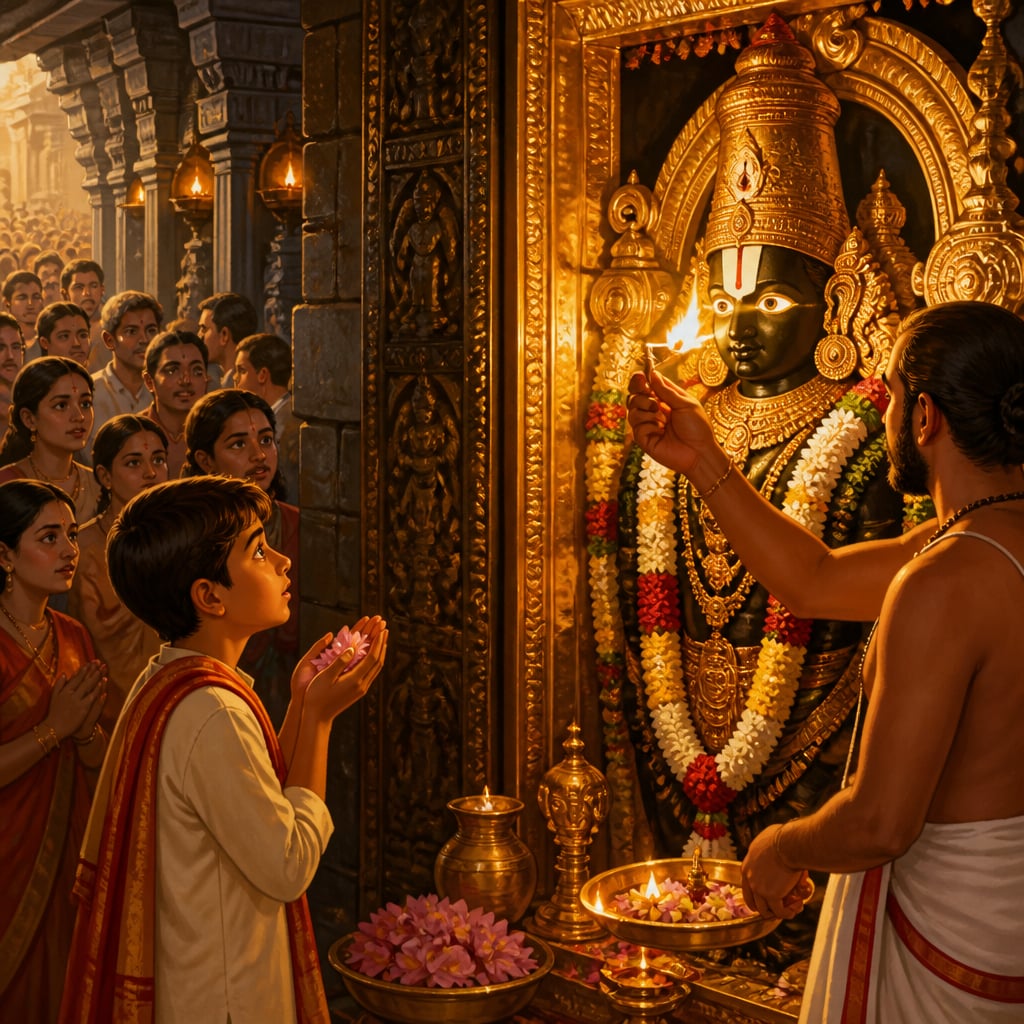
There is a moment that every devotee who has stood in the queue at Tirumala remembers. The line has moved for hours. The body is exhausted, the head is shaved, the air inside the garbhagriha corridor smells of camphor and damp granite, and the temple bells are ringing somewhere above. Then the line turns the last corner and the priest, in front of the mulavar of Sri Venkateshwara, lifts the lamp. The flame moves once across the deity's feet, once across the chest, once across the hands. And then, at the end, the lamp is lifted to the eyes. For a single second the paati behind you grips your arm and whispers, "Bhagavan kandaaru." The Lord has seen.
She does not say "You have seen the Lord." The English word she would have to use, viewing, is a one-way word. The Tamil and Sanskrit word she actually uses is darshan, and darshan is a two-way word. The devotee sees the deity. The deity sees the devotee. The priest's job is to choreograph the moment of mutual recognition. The grandmother grips your arm at exactly the moment the lamp moves to the eyes because the moment is the entire reason the queue exists.
This lesson is about that two-second exchange and the two ritual acts that surround it. Darshan is the central act of temple worship in the dharmic tradition. Archana is the recitation of the deity's names that prepares the gaze. Pushpanjali is the closing flower-offering that releases the worshipper from the encounter with the request the encounter generated. Together the three form the most sophisticated gaze-and-naming technology any continuous tradition has documented. The grandmother who whispers Bhagavan kandaaru knows the technology by its outcome. The lesson is the structure she has not paused to explain.
A Note on the Sanctum
The garbhagriha is the inner sanctum, literally the womb-house, the smallest and oldest part of every Hindu temple. Around it the mandapa halls, the gopuram towers, and the perimeter walls have grown over centuries. The garbhagriha itself is dim by design: the only light is the deepa, the oil lamp the priest holds, and the camphor flame at the moment of deeparadhana. The priest moves; the lamp moves; the deity is revealed in stages. The structure is the structure of darshan.
Darshan: The Mutual Gaze
The practice. The Sanskrit verb drish means to see, but the noun darshan is exact in a way the English word viewing never reaches. Darshan is the act of standing before a consecrated murti and exchanging a deliberate gaze with the deity. The gaze is structured: the devotee approaches with palms joined in anjali mudra, the eyes are first cast down at the feet of the murti, then raised in a slow sweep across the chest, the hands, the ornaments, and finally to the eyes. The priest, at the corresponding moment, lifts the deeparadhana lamp in the same sequence: feet, chest, hands, face, and last to the eyes of the deity. The two gazes meet at the eyes of the murti, and the moment of meeting is the darshan.
The sequence is preserved across regional and sectarian traditions with remarkable consistency. At Tirumala, the priest lifts the lamp to the eyes of Sri Venkateshwara at the close of the suprabhatam and the principal seva windows. At the Jagannath temple at Puri, the mahasnan, bhoga, and alati all close with the lifting of the lamp to the eyes of Jagannath, Balabhadra, and Subhadra. At Vaishno Devi, the priest's deeparadhana at the pindi moves identically. At a small gram-devata temple in any village in the Godavari delta, the priest's lamp moves in the same sweep: feet, hands, eyes. The gesture is universal across the dharmic temple tradition, from the largest Vaishnava and Shaiva pilgrimage temples down to the household altar where the householder herself performs the deeparadhana morning and evening.
The regional variations are substantial in their devotional register but constant in their gaze structure. The Vaishnava sampradaya of South India treats the darshan of the mulavar (the immovable principal deity) and the utsava murti (the processional deity) as distinct acts with their own priestly choreography. The Shaiva tradition at the jyotirlingas offers darshan of the linga form, where the deity has no eyes in the conventional sense and the gaze is exchanged at the avimukta point of the abhishekam vessel. The Shakta tradition at the fifty-two shakti peethas offers darshan of the goddess in the form she takes at each peetha. In each tradition, the underlying act is the same: a mutual gaze, choreographed by the priest, at a consecrated form.
The scripture. The earliest sustained theological treatment of darshan as a two-way act is in the Tiruvoimoli of Nammalvar, the foremost of the twelve Alvars of Tamil Vaishnavism, composed in the ninth century. Nammalvar's central insight, articulated across a thousand verses, is that the deity's gaze is what completes the worshipper, and that the worshipper's gaze is what the deity has been waiting for. Darshan is mutual. The Pancharatra Agama texts, which codify the principal Vaishnava temple ritual procedure, specify the priest's choreography of the gaze with the precision of a stage direction. The Shaiva Agamas preserve the same structure for the linga and the mukhalinga. The Brihadaranyaka Upanishad anchors the cosmology: the atman is what sees through every eye, and the encounter at the temple is the atman recognising itself across the priest's lamp.
கண்டேன் கமலமலர்ப்பாதம் கண்டேன்
kaṇṭēṉ kamala-malar-pātam kaṇṭēṉ
I have seen, I have seen the lotus-flower feet.
Tiruvoimoli, opening of decade ten of the first centum (Nammalvar, 9th century)
The verse is short and twice repeats the verb kanden, I have seen. The repetition is the point. The first kanden is the worshipper's act of seeing. The second kanden is the worshipper's recognition that he has been seen. The grammar of Tamil bhakti poetry, in Nammalvar's hands, encodes the mutuality without needing the grammatical second person. The deity's response is in the repetition itself.
The symbolism. The dharmic theology of darshan is built on a precise cosmology. The murti is not a representation of the deity; it is the deity, made present through the prana pratishtha consecration that the acharya performs at the moment of installation. The eyes of the murti are themselves carved, then opened in a separate ritual called the netronmilana or chakshu unmilana, in which the sculptor strikes the eyes open with a small chisel and a drop of honey or ghee is placed on the eyelids. From that moment, the deity's eyes are open. The gaze the worshipper meets is not symbolic. The tradition holds that the gaze is real, and the priest's lamp is the instrument that makes the real meeting visible.
The deity's gaze is also doctrinally kripa-drishti, the gaze of grace. The encounter is asymmetric in one direction (the deity's gaze precedes and constitutes the worshipper) and symmetric in the act of meeting (the worshipper sees what is seeing him). The Vaishnava acharyas, especially Ramanuja and the post-Ramanuja sampradayas, articulate kripa-drishti as the central theological category: the worshipper does not earn the gaze, the gaze is freely given, and the worshipper's job is to be present at the threshold so that the gaze can land. The grandmother's grip on the arm at the moment the lamp lifts to the eyes is the grip of a person who has been at this threshold many times and knows that the moment is not under the worshipper's control.
Why the body responds. The Habit Architecture of darshan is unusually well-engineered. The cue is sensory and unmistakable: the queue, the bell, the camphor, the priest's lamp, the choreographed sweep from feet to eyes. The routine is the gaze itself, held for the few seconds that the priest's lamp remains at the eyes of the murti. The reward is a felt-sense of recognition, the body's physiological response to sustained mutual gaze that is, in the modern psychology literature, one of the most reliable triggers of prosocial neurochemistry available to the human nervous system.
The behavioural scientist Daniel Stern, in The Interpersonal World of the Infant, established that mutual gaze is the foundational social act through which the infant's nervous system learns the structure of relationship itself. The structure of darshan is the same structure operating in the adult worshipper: a brief, deliberate, mutually held gaze that anchors the worshipper to a presence outside the self. The temple's choreography (the priest, the lamp, the bell, the queue) is the institutional scaffolding that makes the moment available on a calendar rather than waiting for it to occur by chance. Most of modern adult life has very few moments of sustained mutual gaze; the temple manufactures them on a schedule.
What the labs found. The modern psychology and neuroscience research on mutual gaze converges on what the dharmic tradition has held for thirteen centuries. Eckland-Flores and Volkmar (1990), in Developmental Psychology, established that sustained mutual gaze between adults triggers measurable physiological synchronisation: heart rate variability moves toward a shared rhythm, pupillary diameter coordinates, and the parasympathetic nervous system activates in both parties. Paul Zak (2012), in The Moral Molecule and supporting laboratory work, demonstrated that sustained gaze (along with related social-bond cues) is among the most reliable triggers of oxytocin release, the neuropeptide associated with prosocial motivation, trust, and bonding. Andrew Newberg's SPECT imaging studies (Why God Won't Go Away, 2001) of devotees during temple-style meditation showed increased prefrontal lobe activation and decreased parietal lobe activation, the same neural signature that the felt-sense of self-dissolution produces. The Kalyani et al fMRI study of OM chant (NIMHANS, Int J Yoga 2011), while focused on auditory rather than visual practice, established the same default-mode-network shift the visual darshan produces. Each of these is the modern instrumented confirmation of what the priest's lamp at the eyes of the murti has been delivering on a calendar for thirteen centuries.
What the world calls it now. In the American wellness retreat circuit, the practice of sustained mutual gaze between two practitioners has been packaged as eye-gazing meditation. The Spirit Weavers Gathering, a women-only retreat held annually in California, offers eye-gazing as one of its principal workshop formats at approximately three hundred dollars per weekend. Tara Judelle's Embodied Flow trainings, sold across the United States and Europe, include extended eye-gazing modules. The Tantra Festival circuit in Berlin, Lisbon, and Goa offers eye-gazing as a paired practice in week-long retreats priced from eight hundred to two thousand euros. The conscious-relating community, including the Authentic Relating Games and the Circling practices marketed by Circling Europe and The Circling Institute, place sustained mutual gaze at the centre of their methodology. None of these acknowledge a Hindu source. Each of them is selling the gaze technology that the priest's lamp at the eyes of the murti has been delivering on a calendar for thirteen centuries.
The mutual gaze has also been ported into the clinical attachment-therapy literature and the somatic experiencing modalities of trauma therapy, where it appears under names such as co-regulation and interpersonal neurobiology (the field associated with Daniel Siegel and the Mindsight Institute). These uses are clinically grounded and do not claim a wellness lineage; they are nonetheless downstream of the same recognition that the dharmic tradition has held continuously: that a mutually held gaze, structured by an external choreography, is among the most powerful nervous-system interventions available to a human community.
What to call it yourself. Darshan in Sanskrit. The mutual gaze at the deity in English when the conversation needs an unpacked frame. The act is not viewing. The act is not looking. The act is darshan. When the friend returns from a Spirit Weavers eye-gazing weekend and describes the felt-sense of being seen, the response is one calm sentence. "That is darshan. Nammalvar specified the protocol in the ninth century and the priest at Tirumala has been running it on a daily calendar for as long."
Archana: The Naming Before the Gaze

The practice. The act that prepares the worshipper for the gaze is archana, the priestly recitation of a chosen sequence of the deity's names with each name accompanied by the offering of a flower, a grain of rice, a leaf of bilva or tulsi, or a sprinkling of akshata (turmeric-coloured rice). The principal sequences are the ashtottara shata namavali (108 names) and the sahasranama (1,008 names), each preserved across the major sampradayas with deity-specific variants: the Vishnu Sahasranama of the Bhishma Parva for Vaishnava temples, the Shiva Sahasranama of the Linga Purana and the Mahabharata for Shaiva temples, the Lalita Sahasranama of the Brahmanda Purana for the Sri Vidya Shakta tradition, and dozens of other sahasranamas for Ganapati, Subramanya, Hanuman, Durga, and the principal regional deities.
The procedural sequence is exact. The worshipper or the priest acting on the worshipper's behalf states the sankalpa (the intention, with name, gotra, lunar day, and place), then begins the recitation. Each name is enunciated, the namaskara prefix Om is added, the dative case ending -aya or -yai is added (Om Vishnave Namaha, Om Shivaya Namaha, Om Lalitayai Namaha), and the flower or grain is placed at the feet of the murti. The full ashtottara is completed in ten to fifteen minutes; the full sahasranama in forty-five to ninety minutes depending on the tempo. At the close of the recitation, the priest performs the mantra pushpa (the verse-flower) and the deeparadhana that opens the darshan window.
The scripture. The principal scriptural anchor for the namavali tradition is the Vishnu Sahasranama as preserved in the Anushasana Parva of the Mahabharata, where Bhishma, on his bed of arrows, recites the thousand names of Vishnu to Yudhishthira at Krishna's instruction. The Shiva Sahasranama has multiple recensions, the principal being the Linga Purana version and the Anushasana Parva version recited by Krishna himself to Yudhishthira. The Lalita Sahasranama, embedded in the Brahmanda Purana's Lalitopakhyana, is the central text of the Sri Vidya Shakta tradition. The Pancharatra Agama specifies the procedural integration of the namavali recitation with the puja sequence.
The symbolism. The act of naming has a precise dharmic logic. The deity is not exhaustible by any single name; the thousand-name recitation is the worshipper's acknowledgement that the deity exceeds language and that language can only approach by accumulation. Each name is a mantra, a sound-form of the deity, and the cumulative recitation is the worshipper's offering of a thousand sound-forms in sequence. The flower placed at each name is the material counterpart of the sound: the deity is offered the name and the petal together. By the time the recitation closes, the murti's feet are buried in flowers and the worshipper's mind has been steadied across a thousand discrete acts of attention.
Why the body responds. The Habit Architecture of archana is the architecture of structured repetition. The cue is the priest's opening sankalpa. The routine is the disciplined recitation, name after name, flower after flower, for the minutes or the hour the namavali requires. The reward is the steadied mind that approaches the darshan window in a different state from the one in which it joined the queue. The recitation is not, in the dharmic frame, a performance for the deity's benefit; the deity is not in need of being told its names. The recitation is the worshipper's instrument for arriving at the gaze in the right condition.
The behavioural science here is the science of focused-attention meditation. Cahn and Polich (2006), in Psychological Bulletin, surveyed the EEG and fMRI literature on mantra-style focused-attention practice and documented the convergent finding that disciplined repetition produces measurable theta and alpha activity, increased prefrontal coherence, and the default-mode-network deactivation associated with the felt-sense of self-quieting. The archana namavali, by structure, is precisely a focused-attention practice with an external object (the murti, the flower, the name), a disciplined cadence, and a defined endpoint. The science is the same.
What the labs found. The Cahn and Polich review remains the standard summary. Newberg et al (2003), in Psychiatry Research Neuroimaging, imaged Tibetan Buddhist and Franciscan practitioners during focused mantra and prayer meditation and documented the prefrontal-up parietal-down pattern. Brown and Gerbarg (Harvard, 2009), in their work on slow chanting and HRV, established that recitation at the cadence of the typical sahasranama (forty-five to ninety minutes at sixty to eighty bpm) produces vagal-tone activation comparable to formal pranayama practice. The thousand-name recitation, in modern instrument terms, is a structured pranayama-cum-focused-attention session with a devotional object.
What the world calls it now. The closest modern Western parallel is the Catholic rosary, which the post-Vatican II Catholic Church has revived in popularity through the Rosary Apostolate and various lay movements; the rosary's structure (158 Hail Marys plus the Our Fathers and the Glory Be, recited with a 59-bead string) is functionally an archana with a single name. The Eastern Orthodox Jesus Prayer (the Hesychast tradition's recitation of the prayer with a knotted prayer rope) is a closer structural cousin, with the seven thousand repetitions of the Athonite tradition mapping almost exactly onto the multi-sahasranama practice of the Sri Vidya tradition. The wellness echo is Transcendental Meditation with its single-mantra repetition and the mantra-based meditation apps including Insight Timer and the various TM-derived offerings (priced from free for the apps to fifteen hundred dollars for TM initiation). None of these acknowledges that the structural insight, that the disciplined repetition of names of the divine produces a steadied mind ready for encounter, is the archana the priest at the temple has been performing for two thousand years.
What to call it yourself. Archana in Sanskrit. The thousand-name recitation or the namavali in unpacked English. The act is not chanting in the loose sense; it is archana, with the mudra, the flower, the cadence, and the gaze toward the murti. When the friend describes a meditation app's mantra programme, the response names the source. "That is archana, in the simplified single-name form. The Vishnu Sahasranama is the full version. Bhishma recited it to Yudhishthira on his bed of arrows."
Pushpanjali: The Closing Flower-Offering

The practice. The act that closes the puja is pushpanjali, the offering of cupped hands full of flowers placed at the feet of the murti while the worshipper recites the mantra pushpa verse and states the closing prarthana, the prayer that names what the worshipper is asking for or the gratitude the worshipper is offering. The flowers are gathered in the anjali (the cupped hands joined into a small bowl) and held above the head before being released over the murti's feet. The mantra pushpa, the "yopam pushpam veda" verse from the Taittiriya Aranyaka, is the canonical closing recitation; in regional traditions, additional verses (the Vishnu Pushpanjali in Vaishnava sampradayas, the Shiva Pushpanjali in Shaiva traditions) are added.
The symbolism is exact. The flower is the worshipper's offering of the most beautiful and most fragile of household possessions; the gesture of releasing the flowers is the gesture of releasing the request itself; the act of holding the anjali above the head before the release acknowledges that the deity is the higher witness; the closing prarthana names what the worshipper has come to ask for or to offer. The puja is not complete without the pushpanjali; the request, however inwardly felt, must be outwardly stated and outwardly released.
The scripture. The Taittiriya Aranyaka's mantra pushpa verse (yopam pushpam veda, pushpavan prajavan pashuman bhavati) is the principal Vedic anchor: he who knows the flower of the waters becomes endowed with flowers, with progeny, with cattle. The Garuda Purana, the Vishnu Purana, and the Skanda Purana specify the regional pushpanjali sequences for the major Vaishnava and Shaiva traditions. The Pancharatra Agama and the Shaiva Agama procedural texts integrate the pushpanjali with the deeparadhana and the closing mangala arati.
The symbolism and the body's response. The pushpanjali is the worshipper's structured release. The puja has gathered the worshipper's attention through the queue, the archana, and the darshan; the pushpanjali releases the gathered attention in a single deliberate gesture. The Habit Architecture is the architecture of the closing ritual: the cue is the priest's signal that the deeparadhana is complete; the routine is the gathering of the flowers, the mantra pushpa recitation, and the release of the anjali; the reward is the felt completion of the encounter and the worshipper's freedom to step back from the threshold.
What the labs found. The closing-ritual literature in social and clinical psychology is small but converges on one finding: structured release rituals at the close of an emotionally significant encounter (a therapy session, a funeral, a graduation, a relationship transition) produce measurably better outcomes than unstructured endings. Norton and Gino (2014), in Journal of Experimental Psychology: General, demonstrated that brief, structured rituals at the close of significant experiences reduce the rumination associated with unresolved endings and improve the felt-sense of completion. The pushpanjali is, by structure, a closing ritual at the end of an emotionally significant encounter. The worshipper does not leave the temple holding the request; the request has been released with the flowers.
What the world calls it now. The closest wellness echo is the closing ceremony of the various retreat formats, especially the Vipassana ten-day course's metta closing, the plant-medicine retreat closing circles at the Costa Rican and Peruvian centres, and the breathwork ceremony closings of the Wim Hof and Holotropic Breathwork lineages. The gratitude journal practice marketed by the positive-psychology movement (Robert Emmons, Thanks!, 2007) is a stripped solo version of the prarthana that closes a pushpanjali. None of these names a Hindu source. The pushpanjali at the temple's closing arati has been running daily for two thousand years.
What to call it yourself. Pushpanjali in Sanskrit. The closing flower-offering in unpacked English. The gesture is not generic offering; it is the anjali of cupped hands, the mantra pushpa verse, the named prarthana, and the release. When the conversation reaches for closing ceremonies or gratitude practices, the response names the source. "That is pushpanjali. The mantra pushpa is in the Taittiriya Aranyaka. The temple has been closing the puja with it for two thousand years."
The Three as One Encounter
The three acts of darshan, archana, and pushpanjali form one integrated encounter. The archana steadies the worshipper through the disciplined naming. The darshan is the moment of mutual gaze the steadied mind is now ready for. The pushpanjali releases the worshipper from the encounter with the request named and the flowers placed. Each act has its own technology, its own scripture, its own symbolism, and its own modern echo. Together they form what the priest at Tirumala, at Puri, at Vaishno Devi, at the small gram-devata temple in the Godavari delta, runs every morning and every evening on the calendar the village has kept for centuries.
The modern world has been rediscovering each piece separately. The wellness retreat circuit is selling darshan as eye-gazing. The meditation app industry is selling archana as mantra repetition. The closing-ceremony industry is selling pushpanjali as gratitude practice. Each piece is structurally accurate; each piece has the dharmic source removed. The temple's job is not to argue with the wellness industry. The temple's job is to keep running the integrated encounter and to teach the worshipper to use the original names. The grandmother's grip on the arm at Tirumala does not need explanation. The lesson is the explanation she did not pause to give.
When the friend describes a Spirit Weavers eye-gazing weekend, the answer is darshan. When the friend describes a Vipassana mantra session, the answer is archana. When the friend describes a retreat closing ceremony with flowers, the answer is pushpanjali. When the friend asks what these three together are, the answer is the most sophisticated gaze-and-naming technology any continuous tradition has documented, and the priest at the local temple has been running it on a daily schedule for as long as the worshipper's family has been a family. The receipts are at the threshold. The gaze meets the gaze when the lamp is lifted to the eyes.
Key figures
Nammalvar (Maaran of Tirukkurugur)
9th century CE
Bhishma (the Mahabharata's transmitter of the Vishnu Sahasranama)
Late Itihasic period; the Mahabharata's principal layers c. 400 BCE - 400 CE
Paul Zak
Born 1962; principal published work 2004-present
Case studies
Nammalvar's Tiruvoimoli on Darshan (9th century CE)
In the ninth century, in the Vaishnava temple-belt of the Tamraparani river basin in Tamil Nadu, the foremost of the twelve Alvars, Nammalvar of Tirukkurugur, composed a corpus of approximately one thousand one hundred verses across four works, of which the Tiruvoimoli was the longest and most theologically dense. Across the Tiruvoimoli's eleven hundred and two verses, Nammalvar articulated, in fully developed theological form, the understanding that darshan is a two-way act in which the worshipper sees and is seen, that the deity's gaze is the operative side of the encounter, and that the worshipper's task is to be at the threshold so the gaze can land. The most famous verse of the Tiruvoimoli's tenth decade, opening with the repeated kanden ('I have seen, I have seen the lotus-flower feet'), encodes the mutuality through grammatical repetition without needing the explicit second person. The corpus became, in the subsequent centuries, the foundational scriptural anchor for the Sri Vaishnava sampradaya's theology of darshan and kripa-drishti, was canonised in the Divya Prabandham, was elaborated by Ramanuja in the eleventh and twelfth centuries into the formal kripa-drishti doctrine, and is recited daily at the principal Vaishnava temples of South India to this day. It is the oldest known sustained theological argument for darshan as bi-directional rather than one-way looking, in any continuous tradition.
The dharmic theology of darshan, as articulated by Nammalvar in the ninth century and elaborated by Ramanuja in the eleventh, treats the deity's gaze as the operative side of the encounter. The worshipper does not earn the gaze. The worshipper's job is to be present at the threshold so that the gaze, which is freely given, can land. The grammar of the Tamil bhakti verse encodes the mutuality without grammatical second person: the worshipper sees, sees again, sees the source of compassion, sees the eyes that pour forth the rain. The eyes have been waiting. The dharmic frame's insistence that the gaze is real, not metaphorical, derives from the netronmilana ritual of consecration: the murti's eyes are chiselled open at installation, and the deity's gaze becomes institutionally available from that moment. The priest's lamp at the eyes during deeparadhana is the choreographic instrument that makes the meeting visible.
Nammalvar's Tiruvoimoli became the canonical scriptural anchor for the Sri Vaishnava sampradaya's theology of darshan; was elaborated by Ramanuja, Vedanta Desika, Pillai Lokacharya, and the post-Ramanuja Vatakalai and Tenkalai acharyas across the subsequent centuries; was canonised in the Divya Prabandham; and is recited daily at the principal Vaishnava temples of South India, including Srirangam, Tirumala, Alwarthirunagari, Sriperumbudur, and Kanchi. The Tiruvoimoli's articulation of the kripa-drishti is the world's oldest sustained theological treatment of mutual gaze as a religious act in any continuous tradition, predating the modern eye-gazing wellness retreat circuit by approximately twelve hundred years.
The theological argument for darshan as a two-way act was settled in ninth-century Tamil Nadu. The wellness retreat circuit's twentieth-century framing of eye-gazing as a recent insight ignores the documented record. Nammalvar specified the protocol; Ramanuja formalised the doctrine; the Sri Vaishnava sampradaya has been running the institutional practice on a daily calendar for as long. The receipts for darshan's two-way structure are in the Tiruvoimoli, not in the conscious-relating workbook.
Every modern claim that mutual gaze is a recent Western insight or a wellness-retreat innovation can be answered with one citation. Nammalvar specified the theology in the ninth century. The Sri Vaishnava sampradaya has been institutionally running the practice on a daily calendar for twelve hundred years. The classical text predates the Spirit Weavers Gathering by twelve centuries and the conscious-relating community by an order of magnitude longer.
Nammalvar composed the Tiruvoimoli (eleven hundred and two verses, the longest of the Divya Prabandham works) in the ninth century CE. Ramanuja's Sri Bhashya and the post-Ramanuja Vatakalai and Tenkalai acharya commentaries on the Tiruvoimoli formalised the kripa-drishti doctrine across the eleventh through fourteenth centuries. The Tiruvoimoli is recited daily at Srirangam, Tirumala, Tirupati, Alwarthirunagari, Sriperumbudur, and Kanchi, an unbroken liturgical tradition of approximately twelve hundred years.
The Spirit Weavers and Eye-Gazing Wellness Circuit ($300/Weekend, 2012-Present)
Beginning in approximately 2012, the American wellness-retreat circuit began packaging the practice of sustained mutual gaze between two practitioners as 'eye-gazing meditation' and selling it as a paid workshop format. The Spirit Weavers Gathering, a women-only retreat held annually in California (founded 2012), offers eye-gazing as one of its principal workshop formats at approximately three hundred dollars per weekend; the gathering hosts approximately five hundred participants annually and has become a flagship of the women's wellness-retreat market. Tara Judelle's Embodied Flow trainings, sold across the United States and Europe, include extended eye-gazing modules priced from four hundred to one thousand two hundred dollars per training. The Tantra Festival circuit in Berlin, Lisbon, and Goa (the European Tantra Festival, the Goa Tantra Festival, the Lisbon Tantra Festival) offers eye-gazing as a paired practice in week-long retreats priced from eight hundred to two thousand euros. The conscious-relating community, including the Authentic Relating Games and the Circling practices marketed by Circling Europe and The Circling Institute, places sustained mutual gaze at the centre of its methodology, with three-day intensives priced from five hundred to one thousand five hundred dollars. None of these offerings acknowledges a Hindu source. Each is selling the gaze technology that the priest's deeparadhana lamp at the eyes of the murti has been delivering on a daily calendar for thirteen centuries. The total wellness-retreat industry, as of 2023, exceeds six hundred billion dollars globally; the eye-gazing-and-conscious-relating sub-sector is estimated at the lower hundreds of millions annually.
The eye-gazing wellness circuit is a clean documented case of darshan's specific gaze technology reaching mainstream Western audiences with the dharmic lineage surgically removed. The structural insight is intact: a sustained mutual gaze, structured by an external choreography, produces measurable physiological synchronisation, oxytocin release, and the felt-sense of being seen. The lineage is gone: no Tiruvoimoli, no Ramanuja, no kripa-drishti, no priest with a lamp, no consecrated murti, no archana preparing the encounter, no pushpanjali closing it. The dharmic temple's job is not to argue with the wellness retreat. The temple's structural advice is broadly aligned with the practice. The job is to use the original word. Darshan, not eye-gazing meditation. Kripa-drishti, not 'feeling seen'. The naming is the lineage. The lineage is the receipt.
The eye-gazing wellness circuit has helped a generation of Western readers and retreat-goers experience the felt-sense of structured mutual gaze, an insight the post-Reformation Western religious tradition had largely abandoned. The Indian temple that has always preserved the darshan architecture was not made worse by the Spirit Weavers; it was, indirectly, validated by the global appetite for the structural insight. The conscious-relating community more broadly, including the Authentic Relating Games and the Circling practices, the various Tantra Festival offerings, and the Embodied Flow trainings, are each downstream of the same recognition that the Tiruvoimoli articulated twelve hundred years earlier. The wellness market rewards the rebrander, not the source.
The market rewards the rebrander, not the source. The dharmic worshipper's job is not to sue Spirit Weavers. The job is to use the original word. Darshan, not eye-gazing. When the conversation reaches for retreat eye-gazing, the response is one calm sentence: 'That is darshan. Nammalvar specified the protocol in the ninth century, and the priest at Tirumala has been running it on a daily calendar for as long.' Talapatram's Sanatan Operating System course, in this lesson, is filing the receipt.
Use the original word in conversation. When the friend returns from Spirit Weavers and describes feeling seen, you say she has experienced darshan. When the magazine cover names eye-gazing meditation, you name the Tiruvoimoli. When the conscious-relating workshop charges five hundred dollars for the introductory weekend, you note that the local temple's deeparadhana is free, daily, and twelve hundred years older. The retreat is selling the structural insight; the dharmic tradition is the source. The naming completes the loop.
The Spirit Weavers Gathering, founded in 2012, charges approximately three hundred dollars per weekend for women-only retreats featuring eye-gazing as a flagship workshop format; the gathering hosts approximately five hundred participants annually. The Tantra Festival circuit (Berlin, Lisbon, Goa) prices week-long retreats from eight hundred to two thousand euros. Tara Judelle's Embodied Flow trainings range from four hundred to one thousand two hundred dollars. The Tiruvoimoli of Nammalvar specified the underlying theology approximately twelve hundred years earlier. The Tiruvoimoli is mentioned in zero of the principal English-language eye-gazing curricula, conscious-relating manuals, or Tantra Festival programmes.
Eckland-Flores 1990 and Zak 2012: The Oxytocin Vindication of Darshan
In 1990, Eckland-Flores and Volkmar published their study in Developmental Psychology demonstrating that sustained mutual gaze between adults triggers measurable physiological synchronisation: heart rate variability moves toward a shared rhythm across the two parties, pupillary diameter coordinates within seconds of the gaze beginning, and the parasympathetic nervous system activates in both parties simultaneously. In 2012, Paul Zak, the American neuroeconomist and director of the Center for Neuroeconomics Studies at Claremont Graduate University, published The Moral Molecule, synthesising a decade of laboratory work demonstrating that sustained gaze, along with related social-bond cues, is among the most reliable triggers of oxytocin release in the human nervous system, and that oxytocin release is in turn among the most reliable predictors of subsequent prosocial motivation, trust, and bonding. Zak's laboratory protocols routinely produced measurable oxytocin elevation following two-to-five-minute sustained-gaze intervals between strangers. Andrew Newberg's SPECT imaging studies (Why God Won't Go Away, 2001) of devotees during temple-style meditation showed increased prefrontal lobe activation and decreased parietal lobe activation, the same neural signature the felt-sense of self-dissolution produces. The Kalyani et al fMRI study at NIMHANS (Int J Yoga 2011) of OM chant demonstrated default-mode-network deactivation comparable to focused-attention practices. Together, this body of work is the modern instrumented confirmation of what the darshan tradition has held continuously: that a structured mutual gaze, choreographed by an external authority (the priest with the lamp at the eyes of the murti), is among the most powerful nervous-system interventions available to a human community, and that the temple's deeparadhana sequence (feet, chest, hands, eyes) is calibrated to deliver the gaze at the precise moment the worshipper's nervous system is prepared to receive it.
The temple's deeparadhana choreography is, in the modern instrument terms, a precision protocol for delivering the mutual-gaze trigger at the exact moment the worshipper's nervous system is prepared. The archana preceding the darshan (the ten-to-fifteen-minute namavali recitation, with each name and flower offering) prepares the worshipper through focused-attention practice; the archana's function in the modern terms is to produce the prefrontal-up parietal-down state that Newberg's SPECT imaging documented. The deeparadhana that follows (the structured sweep of the lamp from feet to eyes) delivers the mutual-gaze trigger in the prepared state; the gaze delivery is calibrated for maximal physiological response. The Zak findings on oxytocin release during sustained gaze and the Eckland-Flores findings on physiological synchronisation are the modern instrumented confirmation of what the priest's choreography has been delivering on a daily calendar for thirteen centuries. The pushpanjali that closes the encounter (the cupped flowers, the mantra pushpa, the named prarthana) is the structured release that the Norton and Gino 2014 closing-ritual research has now confirmed reduces post-encounter rumination and improves the felt-sense of completion. The integrated three-act sequence is, in the modern instrument terms, a precision protocol for nervous-system intervention. The receipts are in the Pancharatra Agama, twelve centuries before the laboratory.
The modern oxytocin and mutual-gaze research literature, the focused-attention meditation literature, and the closing-ritual literature have each, in the last thirty-five years, slowly approached what the darshan, archana, and pushpanjali traditions have institutionally delivered for twelve centuries. The Eckland-Flores 1990 study, the Zak 2012 work, the Newberg 2001 imaging, the Cahn and Polich 2006 review, the Kalyani et al 2011 NIMHANS study, the Brown and Gerbarg 2009 Harvard work, and the Norton and Gino 2014 closing-ritual research together provide the modern instrumented confirmation of an integrated three-act ritual architecture that the Pancharatra Agama and the Shaiva Agama codified twelve hundred years ago. The Sri Vaishnava and Shaiva sampradayas have been running the institutional practice on a daily calendar for the entire intervening period.
The case for the tradition does not need to wait for the lab. The lab, when it arrives, will confirm what the tradition recorded. The Tiruvoimoli specified the darshan theology in the ninth century. The Vishnu Sahasranama's archana sequence was already canonical when Bhishma was placed on his bed of arrows in the Mahabharata's Anushasana Parva. The mantra pushpa of the Taittiriya Aranyaka is older still. Eckland-Flores and Volkmar published in 1990. Zak published in 2012. Three independent records, twelve centuries apart, point to the same structured mutual-gaze and naming and closing sequence. The wellness research is doing serious good work. The dharmic tradition is the structural source.
Twelve hundred years of practice, two thousand years of textual codification, and over thirty-five years of modern oxytocin, mutual-gaze, focused-attention meditation, and closing-ritual research all point to the same structured three-act encounter. The grandmother at Tirumala does not need to read Paul Zak. She has gripped the worshipper's arm at the moment the lamp lifts to the eyes. The wellness research and the temple's deeparadhana are not in competition. They are the same insight, twelve centuries apart, with one of them carrying the integrated whole the other is reassembling, piece by piece.
Eckland-Flores and Volkmar published their physiological-synchronisation study in Developmental Psychology in 1990. Newberg published Why God Won't Go Away with the SPECT imaging in 2001. Cahn and Polich published the focused-attention meditation review in Psychological Bulletin in 2006. Kalyani et al published the OM-chant fMRI study at NIMHANS in Int J Yoga in 2011. Zak published The Moral Molecule in 2012. Norton and Gino published the closing-ritual research in Journal of Experimental Psychology: General in 2014. The Tiruvoimoli specified the underlying darshan theology approximately twelve hundred years earlier. The Tiruvoimoli is mentioned in zero of the principal English-language oxytocin, mutual-gaze, focused-attention meditation, or closing-ritual research curricula.
Historical context
Vedic temple-foundations (c. 1500-500 BCE) through the Tamil Bhakti movement (6th-9th centuries CE), the Sri Vaishnava acharya tradition (11th-13th centuries), the Pancharatra and Shaiva Agama codifications (5th-12th centuries), and the modern eye-gazing wellness retreat circuit (1990-present)
The integrated three-act encounter of darshan, archana, and pushpanjali is the institutional core of temple worship in the dharmic tradition and has been preserved continuously across two thousand years and across regional and sectarian lines. The Vaishnava temples of South India (Srirangam, Tirumala, Tirupati, Alwarthirunagari, Kanchi), the Shaiva jyotirlingas (Somnath, Mallikarjuna, Mahakaleshwar, Kashi Vishwanath, Rameshwaram, and the others), the Shakta shakti peethas (Kamakhya, Vaishno Devi, Kalighat, Bhubaneshwar Vimala, and the rest), the Jagannath temple at Puri, the Pandharpur Vitthal temple, the Krishna temples of Mathura and Vrindavan, and the countless gram-devata temples of every village preserve the same procedural sequence: the priest's archana with the namavali, the deeparadhana with the structured sweep of the lamp from feet to eyes, and the closing pushpanjali with the mantra pushpa recitation. The sequence has been preserved through the Mauryan, Gupta, Pala, Chola, Chalukya, Vijayanagara, and Maratha periods; through the colonial period (during which several major temples were destroyed and rebuilt, with the procedural sequence preserved by the priestly families through textual and oral transmission); and through the post-independence period (during which the principal Vaishnava and Shaiva temple managements have institutionalised the procedural sequence through trust-administered ritual codes). The 1990-present Western rediscovery of the gaze and naming technology under the names eye-gazing meditation, mantra-based meditation, and structured closing rituals is the most documented modern case of an integrated indigenous ritual architecture being reassembled, piece by piece, with the Sanskrit names removed and the integrated whole unrecognised. The temple's job is small and clear: keep running the integrated sequence, every morning's deeparadhana, every evening's mangala arati, every Sahasranama archana, every pushpanjali, in every temple from Tirumala down to the gram-devata shrine at the village threshold.
Living traditions
The integrated three-act encounter of darshan, archana, and pushpanjali is no longer a Hindu tradition that the modern world is unaware of. The eye-gazing wellness retreat circuit (Spirit Weavers Gathering at three hundred dollars per weekend, the Tantra Festival circuit at eight hundred to two thousand euros per week, Tara Judelle's Embodied Flow trainings, the Authentic Relating and Circling communities) is darshan's modern echo. The mantra-based meditation industry (Transcendental Meditation at fifteen hundred dollars for initiation, the Insight Timer and Calm and Headspace mantra programmes, the various TM-derived offerings, and the Catholic rosary and the Eastern Orthodox Jesus Prayer as structural cousins) is archana's modern echo. The retreat closing-ceremony industry (the Vipassana metta closing, the plant-medicine retreat closings, the Wim Hof and Holotropic Breathwork closings, the gratitude-journal practice marketed by the positive-psychology movement) is pushpanjali's modern echo. The dharmic tradition's job is small and clear. When the conversation reaches for eye-gazing, you say darshan. When the conversation reaches for mantra meditation, you say archana. When the conversation reaches for closing ceremonies and gratitude practices, you say pushpanjali. The Tiruvoimoli, the Vishnu Sahasranama, and the mantra pushpa of the Taittiriya Aranyaka are the textual anchors; the temple's daily deeparadhana is the living tradition; the priest at Tirumala lifting the lamp to the eyes of Sri Venkateshwara is the institutional continuity. Use the names. The labs have arrived. Nammalvar specified darshan as a two-way act in the ninth century, twelve hundred years before the Spirit Weavers Gathering. The Pancharatra Agama codified the integrated puja sequence in the post-Gupta period. The mantra pushpa is in the Taittiriya Aranyaka, older still. Talapatram's Sanatan Operating System course, in this lesson and in the broader Gurukul, is the manual for the integrated encounter the temple has always run. Every deeparadhana, every sahasranamarchana, every pushpanjali, every receipt.
- Daily Deeparadhana and Darshan at the Vaishnava and Shaiva Temples: The daily institutional practice at the principal Vaishnava and Shaiva temples of running the integrated archana, deeparadhana, and pushpanjali sequence multiple times per day. At Tirumala, the day's seva windows include the suprabhatam (pre-dawn awakening), the tomala-seva (the morning archana with flowers), the koluvu (the deity's audience), the sahasranamarchana (the thousand-name recitation), the kalyanotsavam (the symbolic wedding), the arjita-seva sequence, and the closing nightly ekantha-seva. Each window includes the priest's archana with the namavali, the deeparadhana with the structured sweep of the lamp from feet to eyes, and the closing pushpanjali with the mantra pushpa recitation. At Srirangam, the parallel sequence runs daily across the seven prakaras of the temple complex, with the Tiruvoimoli of Nammalvar recited as part of the daily seva. At the Jagannath temple at Puri, the mahasnan, the bhoga, and the alati run daily with the deeparadhana to the three deities (Jagannath, Balabhadra, Subhadra). At Vaishno Devi, the priest's deeparadhana at the pindi follows the same sweep. At the Shaiva jyotirlingas, the abhishekam-deeparadhana sequence is preserved across the twelve sites with regional procedural variations.
- Household Puja with Archana, Deeparadhana, and Pushpanjali: The daily household practice of running the simplified household puja with the same three-act structure: the archana with a chosen ashtottara or sahasranama (the Vishnu Sahasranama for Vaishnava households, the Shiva Sahasranama for Shaiva households, the Lalita Sahasranama for Sri Vidya households, the Ganapati Atharvashirsha for Ganapati households, the Hanuman Chalisa or the Sundara Kanda for Hanuman households), the deeparadhana with the household lamp lifted in the same sweep from the feet of the household murti to the eyes, and the closing pushpanjali with a small handful of flowers placed at the feet. The household puja is performed morning and evening; on auspicious days (Ekadashi, Pradosham, Sankashti, the deity's birthday) the puja is elaborated with longer namavali recitations and additional offerings; on the birthdays and death anniversaries of the household members and the ancestors, the puja includes specific commemorative additions.
- The Tirumala Suprabhatam-to-Ekantha-Seva Daily Cycle: The day's full seva sequence at the Sri Venkateshwara temple at Tirumala, regarded as the most fully institutionally elaborated daily darshan calendar in the dharmic tradition. The day opens with the suprabhatam at three in the morning (the recitation of the Venkatesha Suprabhatam composed by Prativadi Bhayankaram Annangaracharya in the fifteenth century, awakening the deity), proceeds through the tomala-seva (the morning flower archana), the koluvu (the deity's audience), the sahasranamarchana (the thousand-name recitation, performed daily on a sponsorship calendar), the kalyanotsavam (the symbolic wedding seva, performed daily with sponsor families), the arjita-seva sequences (the various sponsor-sevas including the unjal-seva, the dolotsava, the sahasra-deepalankara), and the closing ekantha-seva (the night seva that puts the deity to rest with the recitation of the Tiruvoimoli of Nammalvar's nappinnai-decade). Each seva includes the archana with the namavali, the deeparadhana with the lamp lifted in the structured sweep to the eyes, and the closing pushpanjali. The full cycle runs continuously for approximately nineteen hours per day, with the temple closed for the four hours of the deity's nightly rest.
- Sri Venkateshwara Temple, Tirumala (Tirumala Tirupati Devasthanams): The Sri Venkateshwara temple at Tirumala is the principal Vaishnava pilgrimage site of South India and the most visited religious site in the world, receiving approximately twenty-five to thirty million pilgrims annually. The temple's institutional history extends across approximately twelve centuries of continuous documented operation, with significant patronage from the Pallavas, the Cholas, the Vijayanagara empire (especially Krishnadevaraya, who made several documented visits and substantial endowments in the early sixteenth century), the Marathas, and the modern Tirumala Tirupati Devasthanams (TTD) administration. The daily seva cycle (suprabhatam to ekantha-seva, approximately nineteen hours of continuous ritual operation) is the institutional flagship of the Pancharatra Agama tradition; the Vaikhanasa archaka families are the priestly continuity. The temple is the institutional reference for the integrated three-act encounter of darshan, archana, and pushpanjali at the highest scale.
- Ranganathaswamy Temple, Srirangam: The Sri Ranganathaswamy temple at Srirangam is the principal classical Vaishnava temple of South India and the largest functioning Hindu temple complex in the world by area (155 acres, with seven concentric prakaras and twenty-one gopuram towers). The temple is regarded as the foremost of the 108 Divya Desams (the Vaishnava sacred sites celebrated in the Divya Prabandham) and is the institutional headquarters of the Sri Vaishnava sampradaya. Ramanuja, the principal Sri Vaishnava acharya, lived and taught at Srirangam in the eleventh and twelfth centuries; his samadhi is preserved within the temple complex. The daily seva calendar at Srirangam includes the recitation of the Tiruvoimoli of Nammalvar as part of the regular seva, with the Adhyayana Utsavam in December-January devoted to the complete recitation of the Divya Prabandham. The temple is the institutional reference site for the Tiruvoimoli's theological articulation of darshan as a two-way act.
- Jagannath Temple, Puri: The Jagannath temple at Puri is one of the four mainland Char Dham (the four principal pilgrimage sites of the Hindu tradition: Puri in the east, Rameshwaram in the south, Dwarka in the west, and Badrinath in the north) and the principal site for the worship of Jagannath, Balabhadra, and Subhadra. The temple complex was substantially constructed under King Anantavarman Chodaganga of the Eastern Ganga dynasty in the twelfth century, with the principal vimana reaching approximately 65 metres. The daily seva calendar includes the mahasnan (the great bath, performed once each year), the bhoga (the food offering, performed multiple times daily), the alati (the deeparadhana, performed at the morning, midday, evening, and closing windows), and the pahuda (the closing seva that puts the deities to rest). The annual Rath Yatra (June-July), when the three deities process from the temple to the Gundicha temple on three giant chariots drawn by hundreds of thousands of devotees, is among the largest religious festivals in the world. The temple is the institutional reference for the darshan tradition in the Eastern Ganga and Odia Vaishnava lineages.
Reflection
- When you last visited a temple, did you experience darshan as a one-way act of viewing or as a two-way act of mutual recognition? What in the temple's choreography (the queue, the priest's lamp, the structured sweep, the bell) made the difference, and what would change if you approached the next darshan with Nammalvar's framing in mind?
- The Tiruvoimoli was composed in the ninth century. The Eckland-Flores study on physiological synchronisation during mutual gaze was published in 1990. Both records identify the same core architecture: that the structured mutual gaze produces a real, measurable, mutually constituted state in both parties. What does it mean that two cultures, separated by twelve hundred years, arrived at the same architecture of structured encounter through entirely different methods?
- Ramanuja's kripa-drishti doctrine holds that the deity's gaze is freely given and that the worshipper does not earn it. The wellness retreat's framing of eye-gazing tends to centre the worshipper's effort, intention, and receptivity. What does the kripa-drishti frame offer that the worshipper-centred frame does not? What does it cost?