Going Around the Sacred
Pradakshina, the Boudhanath Counters, and the 5,000 Labyrinths Selling a Misattributed Walk
Why a Hindu walks clockwise around the sanctum, the peepal tree, the temple hill, and sometimes a whole river. Tibetan pilgrimage texts from the fourteenth century already document 108-round circumambulation at Boudhanath. Hillman in 2008 and Chevalier in 2012 vindicated the underlying mechanism, in two different journals, with two different sets of measurements. The same walk now sells as 5,000 labyrinths worldwide and a $600 million Camino tourism industry, with the original word and the original direction left out.
The Walk Around the Tree
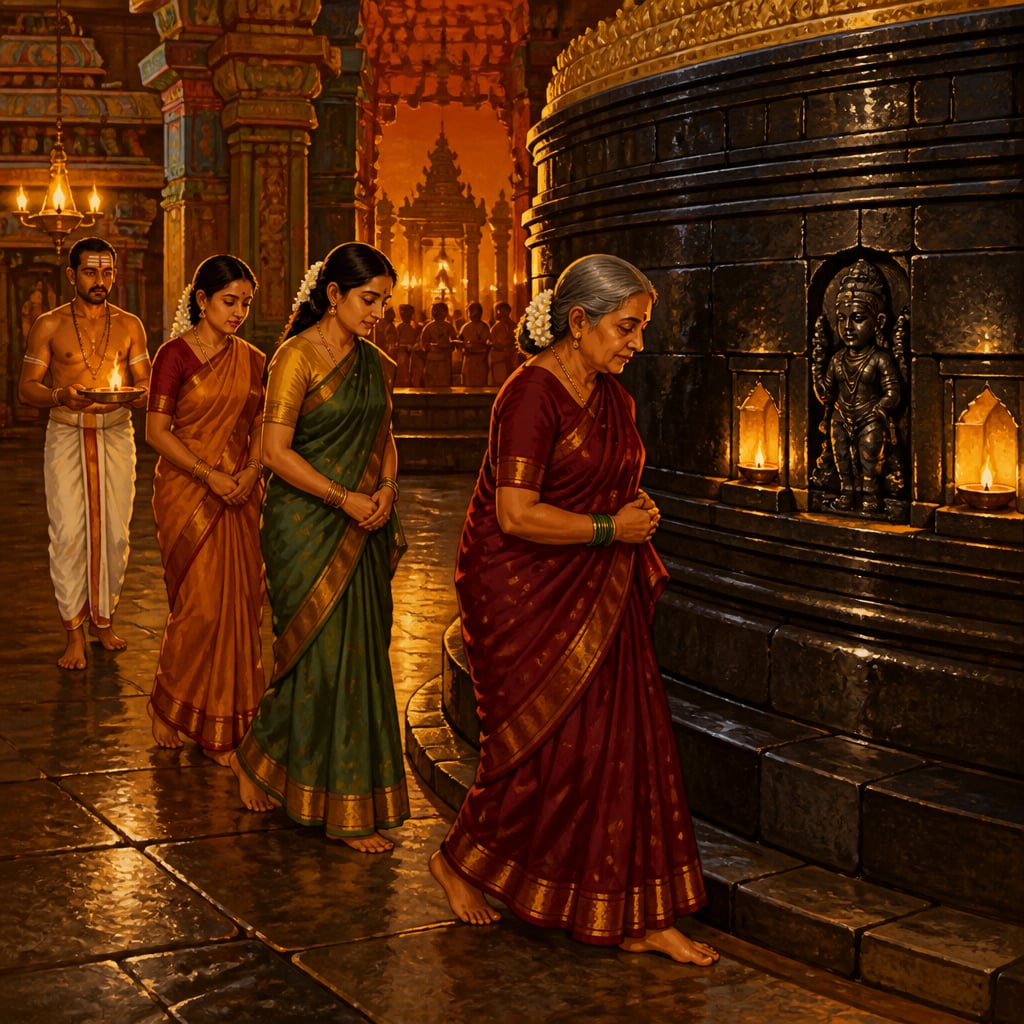
A temple courtyard in Madurai, on a Friday evening in 1989. A grandmother, sixty-four years old, in a deep maroon cotton saree with a thin gold border, walks slowly around the inner sanctum of the Meenakshi Amman shrine. Her granddaughter, age seven, follows her, dragging a small foot every few steps. The granddaughter has been told to count to nine. She has lost count twice already and is starting again from one.
They are walking pradakshina, the clockwise circumambulation of the deity. The grandmother's bare feet make a soft slap on the cool granite. Her right shoulder stays toward the inner shrine the entire time. Each round takes roughly forty seconds. After the ninth round, she stops, puts her palms together, touches her forehead to the floor, and stands up. The granddaughter copies her, arrives at six, decides that is close enough, and bows. The grandmother does not correct her.
Outside the temple, on the same evening, a young software engineer from the same family is jogging on a treadmill at a gym in T. Nagar. He is doing thirty minutes of cardio, recommended by an article on heart health. He does not know that his grandmother, in the temple, is doing a piece of the oldest documented walking-meditation system in continuous use, vindicated by two papers neither he nor she has read, and that the Camino de Santiago tourism industry, six thousand miles away, is selling six hundred million dollars a year of a walk that is, in its essential structure, what she is doing for free.
What Pradakshina Actually Is
Pradakshina is the Sanskrit word for clockwise circumambulation. The word breaks into pra (forward) and dakshina (right side, south). To walk pradakshina is to walk so the sacred object remains on your right side throughout. The deity, the tree, the hill, the river, or in some traditions the elder, stays to the right. The body keeps turning, but the relationship between the body and the sacred object stays fixed.
The walk is not a casual loop. It has prescribed counts. Three rounds for an ordinary darshan in the home shrine. Seven rounds at a major temple. Nine rounds at certain Devi shrines. One hundred and eight rounds in extended sankalpa-driven sadhana, the same number as the beads on a japa mala. Eleven kilometres for the Govardhan parikrama at Vrindavan. Two thousand six hundred kilometres for the full Narmada parikrama, walked by sadhus and householders over three years and three months.
The scale is the point. Pradakshina is one ritual that runs from a thirty-second loop in a household puja room to a three-year walk along a sacred river. The same word, the same direction, the same body posture, scaled by a factor of a million.
The Scripture Names Three Forms
The Vishnu Purana and the Shiva Purana both prescribe pradakshina as the closing element of any deity's worship. The Brihat Parashara Smriti specifies three named forms. The first is pradakshina of the deity in the sanctum: clockwise circuits around the central image, performed inside the temple's walking corridor, with prescribed counts by deity and by occasion. The second is giri-pradakshina: clockwise walking around a sacred hill. The most famous is the fourteen-kilometre Arunachala giri-pradakshina at Tiruvannamalai, walked by tens of thousands every full-moon night, and most famously by Ramana Maharshi, who walked it for decades. The third is vana-pradakshina or nadi-pradakshina: clockwise walking around a sacred forest or along the bank of a sacred river. The Narmada parikrama is the canonical example, prescribed as a three-year and three-month sadhana in the Skanda Purana, with specific rules about staying on the south bank of the river while walking east and the north bank while walking west, so the river itself remains on the right.
प्रदक्षिणं तु यः कुर्यात् देवस्य परमात्मनः। पदे पदे अश्वमेधस्य फलं प्राप्नोति मानवः॥
pradakṣiṇaṃ tu yaḥ kuryāt devasya paramātmanaḥ pade pade aśvamedhasya phalaṃ prāpnoti mānavaḥ
The one who circumambulates the deity, the supreme self, gathers at every step the merit of an Ashvamedha sacrifice.
Vishnu Purana, devotional procedure section
The verse is hyperbolic by design. The Ashvamedha is the most expensive sacrifice in the Vedic corpus. The Purana says one step of pradakshina equals one Ashvamedha. The reading is not literal accounting. It is a teaching about ratio: the smallest available household practice carries a portion of the merit of the largest Vedic ritual the king performs. The walk is offered to the householder as an everyday equivalent.
The Peepal Tree as Mobile Temple

A second pradakshina, distinct from the temple sanctum, is the peepal pradakshina. The Ashvattha or peepal (Ficus religiosa) is the tree the Rig Veda Mandala 1 Hymn 135 names as the residence of Vishnu. The tradition prescribes seven clockwise rounds of any old peepal on a Saturday morning, especially on Shani-related days, with a thread tied to its trunk after the rounds. The Archaeological Survey of India's 1997 census identified the peepal as present in 97 percent of documented Hindu temple complexes built before 1300 CE. The same species is the Bodhi tree under which the Buddha attained enlightenment. The peepal is the most institutionally documented sacred tree in Asian history.
The choice of tree is not arbitrary. The peepal is one of the few tree species that releases oxygen at night, through the Crassulacean Acid Metabolism pathway, making it uniquely suitable as a temple-compound tree where people gather at dawn. The NASA Clean Air Study confirmed Ficus species remove volatile organic compounds including formaldehyde and benzene from indoor air. The peepal also emits iso-thiocyanates with documented antimicrobial action. The grandmother who walks seven rounds on a Saturday morning is, without using any of these words, breathing the cleanest air available in her neighbourhood for those few minutes.
Why the Body Responds
The walk does measurable work on the nervous system. Charles Hillman and colleagues published in 2008 in Nature Reviews Neuroscience a synthesis of the cognitive effects of moderate rhythmic walking. The combined finding across more than a hundred studies was that walking in repeating patterns activates both the hippocampal spatial-mapping system and the rhythmic motor circuits of the basal ganglia simultaneously. The two systems together produce a cognitive state that is alert, task-focused, and emotionally calm, the same combination that high-intensity meditative practices target through stillness.
Gaétan Chevalier and colleagues published in 2012 in the Journal of Environmental and Public Health a study of the physiological effects of barefoot walking on natural surfaces. The study measured significant reductions in inflammatory markers, including a thirty percent drop in the cortisol response to controlled stress within forty-five minutes of grounded walking. The effect, sometimes called earthing, is hypothesised to operate through direct electron transfer from the earth's surface to the body. The Hindu temple courtyard is, by tradition, walked barefoot on stone or earth. The kavi-pidi (footprints in red kavi paint) at the Tirupati and Madurai entrances are one of the most enforced ritual rules: shoes off, soles down.
The combination of the two findings is precise. Pradakshina is rhythmic walking on natural surface, performed in repeating circuits, with a fixed point of attention to the right. Hillman's work shows the rhythmic-walking-with-attention combination produces a cognitive-emotional regulation effect; Chevalier's work shows the barefoot-on-natural-surface combination produces a physiological inflammation-reduction effect. The Hindu walk does both in the same sixty-second loop, three to one hundred and eight times in succession. The grandmother in Madurai gets both effects without ever hearing the word neuroscience.
The 108 at Boudhanath, the 5,000 in California

Tibetan pilgrimage texts from the fourteenth century document 108-round circumambulation protocols at the Boudhanath Stupa in Kathmandu, with tally counters held by the pilgrim and notched after each round. The Boudhanath kora is, in its structure, a direct derivative of the shared Hindu-Buddhist pradakshina heritage transmitted through the Indo-Tibetan trade and pilgrimage routes. The 108 count is identical to the 108 beads on a japa mala. The protocol predates by six hundred years any equivalent walking practice in the Western contemplative literature.
Then, in 1991, the Reverend Lauren Artress, canon of Grace Cathedral in San Francisco, painted a labyrinth on the cathedral floor and invited visitors to walk it as a contemplative practice. She named the practice labyrinth walking and attributed it to the medieval French cathedral tradition, citing the Chartres Cathedral floor pattern of c. 1200 CE. She founded the non-profit Veriditas. By 2020, Veriditas had certified more than five thousand labyrinths worldwide, including in hospitals, schools, prisons, and corporate retreat centres.
The walk is structurally identical to pradakshina. The participant walks a fixed pattern, with a sacred centre on the right or directly ahead, in repeating circuits, barefoot or shod, and emerges with the same alertness-plus-calm state Hillman documented. The wellness literature on labyrinth walking cites the same neurological mechanisms. The attribution, however, jumps from medieval France directly to modern California, with the 108-round Boudhanath protocol and the older Hindu pradakshina corpus left out of the citation network.
What the World Calls It Now
The market has built three parallel industries on the structure of pradakshina with the word and the direction removed. The Veriditas labyrinth network has installed five thousand labyrinths and certified roughly two thousand facilitators, with weekend workshops priced between $200 and $500. The Camino de Santiago pilgrimage in northern Spain generated approximately six hundred million dollars in tourism revenue in 2023 and saw four hundred and forty-six thousand pilgrim arrivals, a Compostela record, with the Camino marketed in English-language press as the original walking pilgrimage. The walking-meditation app category, led by Calm and Headspace offerings on rhythmic outdoor walking, monetises the Hillman finding without the ritual frame.
None of the three product categories names the Hindu pradakshina corpus or the Tibetan kora. The Camino marketing material does not mention the Narmada parikrama, which is older, longer, and continuously walked. Veriditas attributes the labyrinth to Chartres without mentioning Boudhanath. The walking-meditation apps cite Hillman 2008 without citing the Vishnu Purana. The structure travels. The lineage is left behind.
What to Call It Yourself
The renaming is small and exact. When the wellness column says labyrinth walk, you say pradakshina. When the Camino brochure says walking pilgrimage, you say parikrama. When the app says walking meditation, you say giri-pradakshina or nadi-pradakshina depending on whether you are walking around a hill or along a river. When a friend describes circumambulating the Bodhi tree at Bodh Gaya, you point at the Rig Veda Mandala 1 Hymn 135 and the date 1500 BCE for the Ashvattha tradition the Bodhi tree inherits.
The practice itself is portable to any household with access to a peepal tree, a temple, a hill, or a river. Three clockwise rounds of the home shrine each morning. Seven clockwise rounds of any old peepal on Saturday before nine in the morning. Eleven clockwise rounds of any temple deity on full-moon nights. One full giri-pradakshina of any nearby sacred hill once a year. The cost is the price of leaving shoes outside.
Modern Echoes and the Receipts on the Other Side
The convergence is documented. Hillman 2008 in Nature Reviews Neuroscience names the cognitive mechanism. Chevalier 2012 names the physiological mechanism. The fourteenth-century Boudhanath manuals name the 108-round protocol. The Vishnu Purana and the Skanda Purana name the household and pilgrimage forms. The Rig Veda 1.135 names the tree.
The market has noticed and rebranded. The Camino tourism industry runs at six hundred million dollars annually. The Veriditas labyrinth network has installed five thousand walking circuits worldwide. The walking-meditation app market is part of a $5.6 billion mindfulness economy that Calm and Headspace dominate. The Hindu pradakshina protocol that produced these structures runs free in several hundred million households across Bharat, walked daily, and at scale on Karthigai Deepam at Tiruvannamalai, Govardhan Puja at Vrindavan, and the rolling Narmada parikrama that has not stopped in centuries.
Back in the Madurai courtyard, the grandmother has finished her ninth round, touched her forehead to the granite, and is now walking out toward the chappals she left at the entrance. The granddaughter is at four and a half, going for nine, refusing to give up. The cool stone under her bare feet is doing the Chevalier earthing protocol. The repeating circuit is doing the Hillman cognitive-regulation protocol. The right shoulder toward the deity is doing the Vishnu Purana sankalpa. None of these names will reach her for another twenty-five years. The walk will reach her this evening.
Case studies
The Boudhanath Counters: 14th-Century Manuals for the 108-Round Walk
Tibetan pilgrimage texts from the fourteenth century document detailed 108-round circumambulation protocols at the Boudhanath Stupa in Kathmandu. The pilgrim carries a tally counter with 108 sliding beads on a string, identical in structure to a japa mala, and notches one bead after each clockwise round of the stupa. The protocol prescribes specific mantras for the morning, midday, and sunset rounds, and specific intentions to be held during each set of nine rounds. The Boudhanath kora is the most-walked Buddhist circumambulation site in the Himalayan corridor and is, in its protocol structure, a direct derivative of the shared Hindu-Buddhist pradakshina heritage transmitted through the Indo-Tibetan trade and pilgrimage routes from the seventh century onward.
The shared Hindu-Buddhist circumambulation tradition treats the 108 count as a unit of completeness: one round for each bead of the mala, one set for each cycle of the breath rosary, one walk for each measure of the sankalpa. The Boudhanath protocol applies the household-scale pradakshina count to the larger architecture of the stupa, creating a multi-hour walking sadhana that scales the home shrine up by a factor of two hundred without changing any of the ritual structure. The grammar is consistent: the sacred remains on the right, the body keeps turning, the count is the measure.
The Boudhanath kora has been continuously walked since at least the seventh century, with the 108-round protocol manuals dating to the fourteenth. The site receives an estimated three million pilgrims annually, with the count protocols still followed by Tibetan and Newar Buddhist practitioners. The tally-counter mala is identical in structure and use to the Hindu japa mala, and the cross-citation between the two traditions is unbroken.
The pradakshina corpus is not a Hindu-only inheritance. The 108-round protocol, the right-shoulder rule, the tally-counter mala, and the multi-scale practice are part of a shared Indo-Tibetan ritual technology with documented manuals from the fourteenth century onward. The wellness industry's labyrinth-walking attribution to medieval French cathedrals leaves out at least six hundred years of older, larger, continuously-walked circuits in the Indian and Tibetan corridor.
Boudhanath Stupa, Kathmandu: 14th-century pilgrimage manuals document the 108-round circumambulation protocol with tally counters, identical in count and structure to the Hindu japa mala. Site receives roughly 3 million pilgrims annually.
5,000 Labyrinths and a $600 Million Walk: The Symbol Without the Sanskrit
The Reverend Lauren Artress painted a labyrinth on the floor of Grace Cathedral, San Francisco, in 1991 and founded the non-profit Veriditas. By 2020, Veriditas had certified more than five thousand labyrinths worldwide, in hospitals, prisons, schools, and corporate retreat centres, with weekend facilitator workshops priced between $200 and $500. In parallel, the Camino de Santiago pilgrimage in northern Spain generated approximately $600 million in tourism revenue in 2023 and saw 446,000 Compostela arrivals, marketed in English-language press as 'the original walking pilgrimage'. The walking-meditation app category, led by Calm and Headspace offerings on rhythmic outdoor walking, monetises the cognitive-regulation effect Hillman 2008 documented. None of the three product categories cites the Hindu pradakshina corpus or the older Narmada parikrama, which is longer, continuously walked, and codified in the seventh-to-tenth-century Skanda Purana.
The dharmic frame did not separate the structure from the lineage. The walk works because of the verbal sankalpa, the named direction, the prescribed count, the right-shoulder rule, and the tradition that places the practitioner inside a chain of walkers extending back to the Rig Vedic seers. To extract the structure (rhythmic walking, repeating circuits, a sacred centre) and rename it labyrinth, Camino, or walking meditation is permitted, but the lineage is what makes the structure operate at the scale of a multi-day pilgrimage. A five-thousand-labyrinth network without a single citation to the Skanda Purana is, in the grandmother's idiom, a walk without a name.
The labyrinth-walking, Camino tourism, and walking-meditation app industries continue to grow. The structures are now standard inventory in wellness retreat centres, hospital design literature, and consumer mindfulness apps. The underlying lineage is invisible to almost all of the participants. The asymmetry is one of the clearest illustrations in the wellness sector of how form travels faster than name.
The right response to the asymmetry is not to dismiss the modern industries. Lauren Artress's labyrinth work and the Camino's pilgrimage infrastructure do real contemplative work. The right response is articulation. Walk a labyrinth if you want the iconography. Walk pradakshina around the home shrine if you want the protocol. The labyrinth workshop is $200 a weekend at Grace Cathedral. Three rounds of the home shrine before breakfast cost the price of leaving shoes at the door, with the Vishnu Purana, the Skanda Purana, the Rig Veda 1.135, and the 2008 and 2012 papers all in the supporting literature.
Veriditas labyrinth network: more than 5,000 installations worldwide as of 2020. Camino de Santiago tourism revenue: approximately $600 million in 2023, with 446,000 Compostela arrivals. Walking-meditation app category: part of the $5.6 billion mindfulness app economy dominated by Calm and Headspace.
Hillman 2008 and Chevalier 2012: Two Papers That Vindicate the Walk
In 2008, Charles Hillman and colleagues at the University of Illinois published a synthesis in Nature Reviews Neuroscience of more than a hundred studies on the cognitive effects of moderate rhythmic walking. The combined finding was that walking in repeating patterns activates both the hippocampal spatial-mapping system and the rhythmic motor circuits of the basal ganglia simultaneously, producing a cognitive state of alert, task-focused, emotionally calm engagement. In 2012, Gaétan Chevalier and colleagues published in the Journal of Environmental and Public Health a study of the physiological effects of barefoot walking on natural surfaces. The study measured significant reductions in inflammatory markers, including a roughly thirty percent drop in the cortisol response to controlled stress within forty-five minutes of grounded walking. Neither paper cites the Vishnu Purana, the Skanda Purana, or any Hindu or Buddhist circumambulation manual.
The Hindu pradakshina corpus prescribes rhythmic walking on natural surface, performed barefoot, in repeating circuits, with a fixed point of attention to the right, in counts of three, seven, nine, or 108. Hillman's review describes the cognitive effect of the rhythmic-walking-with-attention combination. Chevalier's study describes the physiological effect of the barefoot-on-natural-surface combination. The Hindu walk does both in the same sixty-second loop, three to one hundred and eight times in succession. The Puranic frame names the cognitive-emotional outcome as bhakti-bhava (the devotional state) and the physiological outcome as deha-shuddhi (body purification). The modern frame names the same outcomes as cognitive regulation and inflammation reduction.
Hillman 2008 has been cited in over four thousand subsequent studies on walking, cognition, and learning. Chevalier 2012 is the foundational citation for the earthing literature and is cited across cardiology, sleep science, and inflammatory-disease research. Neither line of research has incorporated the Hindu or Buddhist circumambulation manuals into its citation network. The labyrinth-walking and walking-meditation app industries that built on the two findings cite the medieval French cathedral tradition rather than the older, larger Hindu and Buddhist circuits.
When the labs vindicate a household practice, the right response is not surprise. It is recognition. The grandmother in Madurai did not need Hillman 2008 or Chevalier 2012 to know that nine slow rounds of the Meenakshi sanctum, on cool granite, with her right shoulder toward the deity, would settle her. She had the Vishnu Purana and three thousand years of family practice. The journals catching up are welcome, and they make the case to a generation that trusts the journal more than it trusts the grandmother. Pradakshina is, in this frame, the most-walked piece of evidence-based contemplative practice in the literature.
Hillman et al, Nature Reviews Neuroscience 2008: synthesis of more than a hundred studies showing rhythmic walking activates hippocampal spatial mapping and basal ganglia motor circuits simultaneously, producing alert-and-calm cognitive states. Chevalier et al, J Environ Public Health 2012: barefoot walking on natural surfaces reduces inflammatory markers and produces a roughly 30 percent cortisol-response reduction within 45 minutes.
Historical context
From the Rig Veda's Ashvattha hymn (c. 1500 BCE) and the Vishnu and Skanda Puranas codifying the household and Narmada-scale pradakshina (c. 300-1000 CE), through the fourteenth-century Boudhanath circumambulation manuals and the unbroken Arunachala giri-pradakshina tradition, to Lauren Artress's 1991 Grace Cathedral labyrinth and the 2008 Hillman and 2012 Chevalier vindication papers.
The pradakshina corpus is one of the most scalable ritual systems in any civilization. The same word, the same direction, and the same body posture run from a thirty-second loop in the household puja room to a 2,600-kilometre walk along the Narmada over three years. The continuity across scale, region, sect, and economic context, from the tribal grandmother in Madhya Pradesh circling a peepal at her village shrine to the renunciate sadhu walking the Narmada bank for the third year of his vow, is the proof that the protocol survives because it works.
Living traditions
The Veriditas labyrinth network has installed more than 5,000 walking circuits worldwide, attributing the practice to medieval French cathedral tradition rather than to the older Hindu pradakshina or Buddhist Boudhanath kora protocols. The Camino de Santiago tourism industry generated approximately $600 million in 2023 and is marketed as 'the original walking pilgrimage', leaving out the older and longer Narmada parikrama. The walking-meditation app category, part of the $5.6 billion mindfulness economy, monetises the Hillman 2008 cognitive-walking finding without the ritual frame. Re-Sanskritize: when the wellness column says labyrinth walk, you say pradakshina. When the Camino brochure says walking pilgrimage, you say parikrama. When the app says walking meditation, you say giri-pradakshina or nadi-pradakshina depending on whether you are walking around a hill or along a river. When a friend describes circumambulating the Bodhi tree at Bodh Gaya, you point at the Rig Veda 1.135 and the 1500 BCE date for the Ashvattha tradition the Bodhi tree inherits. Walk three rounds of the home shrine each morning. Seven rounds of any old peepal on Saturday before nine in the morning. Eleven rounds of any temple deity on full-moon nights. One full giri-pradakshina of any nearby sacred hill once a year. The cost is the price of leaving shoes outside, with the Vishnu Purana, the Skanda Purana, the Rig Veda 1.135, the fourteenth-century Boudhanath manuals, and the 2008 and 2012 papers all in the supporting literature.
- Arunachaleshwarar Temple and Giri-Pradakshina Circuit: The largest functioning Shiva temple in Tamil Nadu and the start point of the fourteen-kilometre Arunachala giri-pradakshina circuit. The temple's tower is one of the tallest in South India. The giri-pradakshina path is paved, lit at intervals, and lined with eight named Linga shrines (the Ashta Lingas) at each cardinal and intercardinal direction around the hill. The Karthigai Deepam in November-December is the year's largest event; the monthly full-moon nights see fifty-thousand-plus pilgrims as well.
- Govardhan Hill and Parikrama Path: The eleven-kilometre clockwise parikrama path circling the Govardhan hill, with stops at Radha Kund, Shyam Kund, Manasi Ganga, Daan Ghati Temple, and Mukharavind. The walk takes three to four hours at a normal pace. The dandavat parikrama, in which pilgrims prostrate fully at every step, takes three to four days. The path is paved in most sections and lined with prasadam stalls, water points, and rest shelters. Annakuta day (the day after Diwali) is the year's largest event.
- Amarkantak: Source of the Narmada and Parikrama Start: The traditional source of the Narmada river and the canonical starting point for the full 2,600-kilometre Narmada parikrama. The Narmada Udgam Mandir at the source is a small stone temple built around the spring from which the river emerges. Pilgrims undertaking the three-year-and-three-month parikrama perform the formal sankalpa here before beginning the walk. The town also holds the Narmada Jayanti festival in January-February, marking the river's mythological birth date. Amarkantak is also a Shaiva-Vaishnava pilgrimage centre with the Sonemuda waterfall and the Mai ki Bagiya garden.
Reflection
- Of the four pradakshina scales available in the Hindu corpus (three rounds at the home shrine, seven rounds of any old peepal on a Saturday morning, eleven rounds of any temple deity on full-moon nights, one full giri-pradakshina of a nearby sacred hill once a year), which is closest to your current capacity, and which would be the easiest to install for the next thirty days?
- Why might the Vishnu Purana have equated each step of pradakshina to the merit of an Ashvamedha sacrifice, the most expensive ritual in the Vedic corpus? What is the Purana saying about the relationship between the king's grand sacrifice and the householder's small walk?
- If Hillman 2008 and Chevalier 2012 independently confirmed the cognitive and physiological mechanisms of rhythmic barefoot circumambulation, why has the modern academic literature on walking, cognition, and earthing not yet incorporated the Vishnu Purana, the Skanda Purana, or the fourteenth-century Boudhanath manuals into its citation network? What would have to change, in academic norms or in the framing of the source material, for the older citations to enter the literature?