Anointing the Divine
Abhishekam, Alankaram, and Naivedya: how a thousand-year-old Chola temple protocol of bathing, dressing, and feeding a stone deity became the most precise structured-touch ritual in any tradition, and how the same protocol now sells back as crystal cleansing, sound bath charging, and moon-water rituals at five hundred million dollars a year
Before dawn at the Brihadeeswara Temple at Thanjavur, a priest pours the first of one thousand and eight pots of water over a Shiva linga. Milk follows water. Curd follows milk. Honey follows curd. Ghee follows honey. Sugar follows ghee. Then the linga is dressed in fresh silk, garlanded with new flowers, anointed with sandal paste, and offered the day's first cooked food. The protocol is the Abhishekam, the Alankaram, and the Naivedya, the three principal acts of temple worship in which the deity is bathed, dressed, and fed in the same sequence in which the household tends a beloved guest. The lesson opens the thousand-year-old Chola consecration record at the Brihadeeswara, the chemistry of the panchamrita sequence, the Pancharatra and Shaiva Agama scriptural protocols, and the modern coopt of the same logic in the five-hundred-million-dollar crystal-cleansing wellness market, the Goop salt cleansing ritual, and the sound-bath charging industry, with the receipts named alongside the older protocol that quietly produces every effect the modern market is now selling.
A Priest at Brihadeeswara, Pouring the First Pot Before Dawn
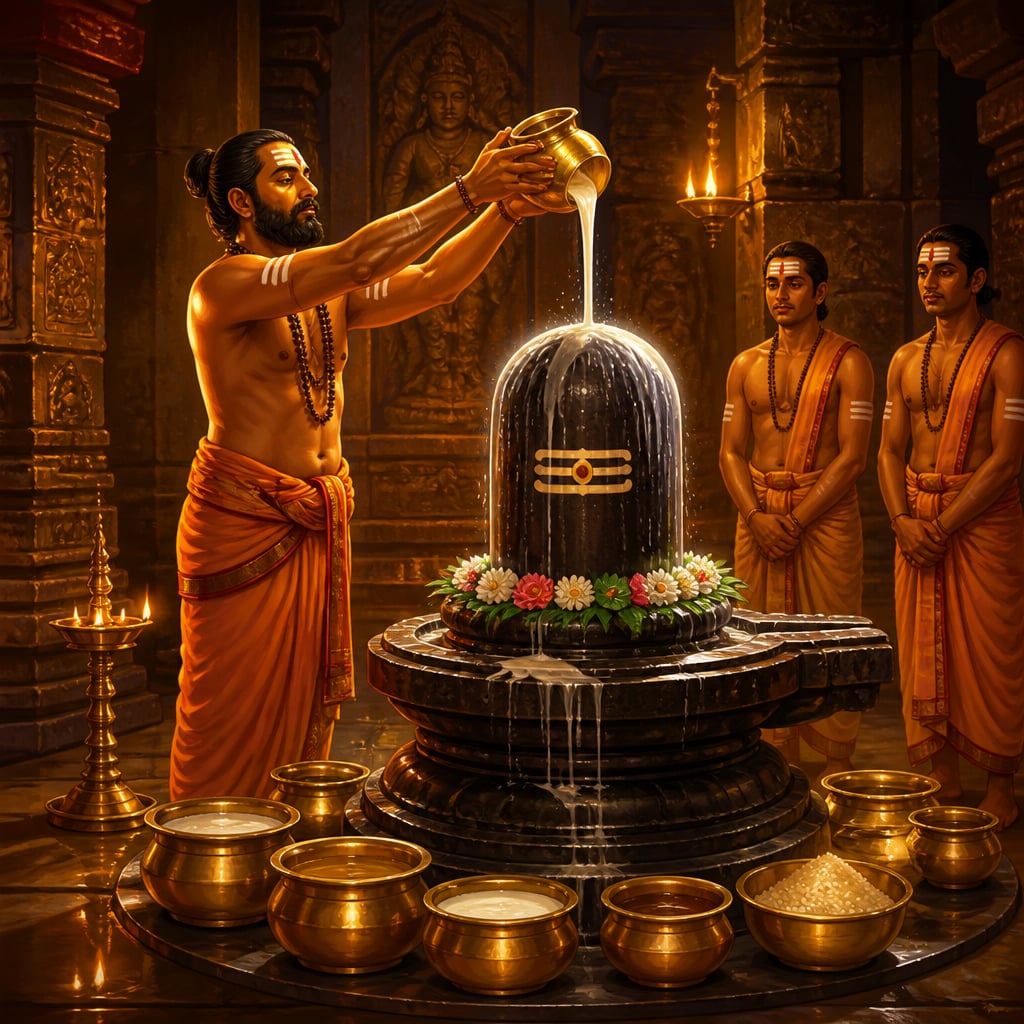
At the Brihadeeswara Temple at Thanjavur in Tamil Nadu, on a Friday morning in November, the head priest enters the inner sanctum at four-thirty. The temple is over a thousand years old. It was consecrated in 1010 CE by the Chola emperor Rajaraja I. The Shiva linga inside the sanctum is hewn from a single block of black granite and stands at the centre of one of the largest stone vimanas in southern India. The priest has slept four hours. He has bathed in cold well-water at three. He wears a fresh white veshti and a saffron upper cloth. He has chanted the morning sankalpa with the date, the lunar tithi, the nakshatra, and the donor's gotra named in the formula.
The priest places brass pots in a careful spiral around the sanctum floor. The first pot holds plain Kaveri river water, drawn before sunrise. The next pots hold cow's milk from the temple's own herd. After milk come curd, honey, ghee, sugar-water, sandal-water, turmeric-water, then a panchamrita mixture of all five, then water again as the closing rinse. The sequence is set down in the temple's consecration inscriptions, in the same Tamil Grantha script the Chola scribes used in 1010 CE. The Brihadeeswara protocol has not changed in over a thousand years.
The priest pours the first pot. The water runs over the granite linga, gathers at its base, and drains through a stone channel into a copper vessel below the sanctum. The temple bell rings. The conch sounds. The chant begins. Om namah shivaya. Om namah shivaya. Om namah shivaya. In the next ninety minutes, the priest will pour every pot over the linga in the prescribed sequence, then dress the linga in fresh silk, garland it with red hibiscus, anoint it with sandal paste at three points, place a fresh tilak of vibhuti and kumkum at its centre, and lay the day's first cooked rice and jaggery before it as the morning naivedya. The deity has been bathed, dressed, and fed, in that order, before any human in the town has eaten breakfast.
In 2017, a wellness retreat in Sedona, Arizona, will charge eight hundred and fifty dollars per night for a four-day program that includes "crystal cleansing rituals" in which participants pour rose-quartz-infused water over their stones in a prescribed sequence, dress the stones in silk pouches, and offer them to the moon. The retreat's founder will tell a CNN reporter that the protocol came to her in a dream. The Brihadeeswara head priest, when asked, will smile.
Three Acts, One Continuous Tending
The Hindu temple does not present its deity as a static object of contemplation. The deity is treated as a living guest in the household, and the day is structured around the same three acts the household uses for any honoured guest. The first is the Abhishekam, the ritual bathing of the deity in a precise sequence of liquids. The second is the Alankaram, the dressing of the deity in fresh cloth, ornaments, garlands, and applied paste. The third is the Naivedya, the offering of cooked food to the deity, partaken by the deity in subtle form, and then redistributed to the devotees as prasadam, the deity's blessed leftover.
These three acts are performed at every major temple in India, multiple times a day, every day of the year, by priests trained for years in the prescribed protocols. The Brihadeeswara performs the abhishekam six times a day. The Tirupati Venkateswara performs it daily at Suprabhatam, with a special abhishekam every Friday. The Meenakshi Amman temple at Madurai performs it at every of the five daily pujas. The Vaishno Devi cave shrine in Jammu performs it every morning. The Jagannath temple at Puri performs it as part of the daily bathing of the deity. The same three-act protocol runs from Kashmir to Kanyakumari, from Gujarat to Bengal, in every tradition (Shaiva, Vaishnava, Shakta, Smarta), with regional variations in the ingredient list and the chant but with the underlying structure invariant.
The protocol is not a metaphor. The deity is bathed in actual water, milk, curd, honey, and ghee. The deity is dressed in actual silk, gold ornaments, and fresh flowers. The deity is fed actual cooked rice, jaggery, banana, coconut, and the household's best food. The acts are physical, repeated, daily, and witnessed by the gathered devotees. The temple is, in the Hindu frame, the deity's home, and the priest is the deity's household member, and the day is the deity's ordinary day.
The Practice, Across India
The Abhishekam follows a precise liquid sequence. At a major Shaiva temple, the standard order is plain water, milk, curd, honey, ghee, sugar-water, panchamrita (the mixture of the previous five), tender coconut water, sandal-water, turmeric-water, vibhuti-water, and a closing rinse of plain water. At a major Vaishnava temple, the same core sequence is followed with regional substitutions: tulasi-water replaces vibhuti-water, saffron-water is added at certain stages, and the closing rinse may include rose-water. At a Shakta temple, the sequence often includes red hibiscus petals soaked in water, kumkum-water, and a special abhishekam with the temple's deity-specific holy water. The Vaishno Devi shrine uses water from the cave's natural spring; the Jagannath uses water carried in a special vessel from the Mahodadhi (the eastern ocean); the Meenakshi uses the temple's own pushkarini water.

The Alankaram follows the bath. The deity is dried with a clean cloth, then dressed in fresh silk: a Kanchipuram silk for the Madurai Meenakshi, a Banarasi for the northern Shakta shrines, a Pochampally for the Andhra Vaishnava shrines, with each region using its own woven tradition. The deity is then ornamented: gold crowns at the major royal-patronage temples, silver crowns at the smaller village shrines, fresh flower garlands of red hibiscus for Shakti, white jasmine for Lakshmi, marigold and tulasi for Vishnu, bilva leaves for Shiva. Sandal paste is applied at three points: the centre of the forehead, the centre of the chest, and the centre of the abdomen. The tilak is renewed: vibhuti for Shaiva, kumkum for Shakta, gopichandan or urdhva-pundra for Vaishnava. The deity is, at the end of the alankaram, dressed for the day, exactly as a household member would dress a beloved guest before the day's first meal.
The Naivedya is the third act. The day's first cooked food, prepared in the temple kitchen by priests under strict purity protocols, is placed in fresh banana leaves or brass plates before the deity. The food is region-specific: pongal and rice at the Tamil temples, khichdi at the Jagannath, payasam at the Kerala temples, halwa and prasadam-laddoo at the northern shrines. The priest covers the food, recites the offering mantra, rings the bell, and leaves the food in the deity's presence for a prescribed interval (usually two to three minutes, the time the deity is said to take to partake of the subtle essence). The food is then uncovered, redistributed to the devotees as prasadam, and the cycle is closed. The deity has eaten; the devotees eat the deity's leftover; the household-as-temple has shared the meal.
The Scripture Says
The Pancharatra Agama, dated to between the fourth and the eighth centuries CE, is the foundational scriptural source for Vaishnava temple ritual. The Pancharatra prescribes the abhishekam-alankaram-naivedya sequence in detailed protocol form, with the exact liquid order, the exact knot count for the silk dressing, the exact mantra for each stage, and the exact food-offering chronology. The Pancharatra is followed at all major Vaishnava temples (Tirupati, Srirangam, Guruvayur, Nathdwara) and is the ritual basis for the Jagannath at Puri.
The Shaiva Agamas, organised in twenty-eight principal texts and dated to between the fifth and the tenth centuries CE, are the parallel source for Shaiva temple ritual. The Kamika Agama, the Karana Agama, and the Suprabheda Agama prescribe the abhishekam protocols in extended form, with the linga as the principal locus. The Brihadeeswara Temple at Thanjavur was consecrated under Shaiva Agama protocols by the Chola Rajaraja I and his court Acharya Sarvasiva Pandita; the temple's consecration inscriptions, preserved on its walls in Tamil Grantha script, describe the abhishekam in step-by-step detail. The protocol described in the inscriptions is, today in the twenty-first century, performed at the same temple in essentially the same form.

The Bhagavad Gita names the offering protocol in chapter nine, verse twenty-six. Patram pushpam phalam toyam yo me bhaktya prayacchati. Tad aham bhakty-upahritam ashnami prayatatmanah. Whoever offers me with devotion a leaf, a flower, a fruit, or water, I accept that loving offering of the pure-hearted. The verse establishes the four-fold canonical naivedya in its simplest form: leaf, flower, fruit, water. Every elaboration of the temple naivedya, from the simplest village shrine offering to the most elaborate royal-temple feast, reduces, in its essence, to this four-fold offering with devotion as its substrate.
The Skanda Purana and the Vishnu Purana carry the foundational mythology of abhishekam in the Samudra Manthan narrative. The deva-asura churning of the cosmic ocean produced fourteen jewels, of which the first was Lakshmi herself, and the cosmic abhishekam of Lakshmi by the divine elephants pouring water from their trunks (the Gajalakshmi iconography) is the prototype of every subsequent abhishekam. The Bhagavata Purana extends the protocol to Krishna's coronation by Ugrasena and to the abhishekam of Bharata by Rama at the conclusion of the Ramayana. The act of pouring water (or milk, or any sacred liquid) over a divine or royal figure as a consecration of authority and as an act of cleansing and renewal is, in the Hindu frame, both a cosmic prototype and an everyday ritual.
The canonical mantra for the closing arati that follows the abhishekam-alankaram-naivedya cycle is the line Karpura-gauram karunavataram. Camphor-white, the embodiment of compassion, the husband of the daughter of the mountain, the lord whose head bears the snake. I bow continuously to that Shiva who dwells in the lotus of the heart. The verse names the deity by his iconographic markers (the camphor-white complexion, the snake-ornament, the consort) and seats the worship in the heart of the worshipper. Every Shaiva temple in India closes its abhishekam-alankaram-naivedya cycle with this verse.
The Symbolism
The liquid sequence is not random. The Hindu cosmological frame organises the panchamrita as the five most beneficent products of the universe in their material form: water (the foundational substance), milk (the substance of nourishment from the cow, the symbol of dharma), curd (the substance of fermentation and time, the symbol of the soma), honey (the substance of accumulated effort, the symbol of madhu), and ghee (the substance of refinement, the symbol of agni). The five together represent the fivefold substance of life. The deity is bathed in life itself.
The order matters. Water comes first as the universal solvent, the cleanser, the substance that prepares the surface. Milk follows because milk carries the dharmic blessing of the cow, the household's principal source of nourishment. Curd follows because curd represents the dimension of time, the transformation of milk into a more complex substance. Honey follows because honey represents the labour of countless small beings producing a single sweet substance, the symbol of accumulated effort. Ghee follows because ghee is milk twice-refined, the symbol of fire-purified substance. The sequence is, in modern food-chemistry terms, a pH-graduated cleansing protocol: water (neutral), milk (slightly alkaline), curd (mildly acidic), honey (acidic), ghee (lipid-rich). Each stage breaks down a different layer of accumulated organic residue on the deity's surface, and the closing rinse with water clears the previous layers.
The alankaram symbolism is parallel. The silk represents the householder's offering of the best cloth; the gold or silver ornaments represent the offering of the best wealth; the flower garlands represent the offering of beauty and time; the sandal paste represents the offering of the cooling, fragrant, healing essence; the tilak represents the deity's own iconographic marker, renewed daily. The deity is, after the alankaram, dressed and ornamented exactly as the householder would dress and ornament a beloved family member at a festival.
The naivedya symbolism is the offering of the day's effort. The food has been prepared by human hands. The grains have been grown by human labour. The milk has been drawn from the household's cow. The vegetables have been harvested from the household's garden. The household offers the day's effort to the deity, the deity accepts the subtle essence, and the household receives back the prasadam as the deity's blessing on the day. The cycle of labour, offering, acceptance, and blessing is closed daily in every Hindu household and in every temple in India.
Why the Body Responds
Layer four, habit architecture. The abhishekam-alankaram-naivedya sequence is one of the most precise structured-touch and structured-offering rituals in any tradition. The repetition is daily. The sequence is invariant. The mantra is fixed. The materials are specified. The duration is bounded. Each element is a small, well-defined action that the priest (or the householder, in the home version of the ritual) can complete without ambiguity. Charles Duhigg's Power of Habit names exactly this kind of structured-action protocol as the strongest form of habit-anchor: a clear cue (the morning hour), a specified routine (the liquid sequence, the dressing, the food offering), and a defined reward (the prasadam, the closing arati, the day's auspicious start). The temple priest who performs the protocol six times a day for forty years is operating one of the most over-learned habit loops any human profession requires. The household member who performs the simpler home version every morning is operating a smaller version of the same loop.
The touch-and-mantra synchronisation produces the second behavioural effect. The priest's hand pours the liquid; the priest's mouth chants the mantra; the priest's eyes track the flow; the priest's mind holds the sankalpa. The four channels (hand, mouth, eye, mind) are synchronised on the same single act, dozens of times in a single abhishekam. Andrew Newberg's neurotheology research has documented that ritual acts performed with this kind of multi-channel synchronisation produce measurable activation of the prefrontal cortex (the seat of focused attention) and reduced activation of the parietal cortex (the seat of self-other boundary), with the experiential effect of a deepened state of present-moment absorption. The temple priest, in this frame, is in a flow state for the duration of the abhishekam, with the structured external protocol scaffolding the internal state.
The community-witness layer is the third behavioural effect. The abhishekam is not performed in isolation. It is performed before a gathered congregation. The devotees stand in the inner courtyard, witness the priest's actions, hear the chant, and receive the prasadam at the close. Robin Dunbar's research on collective ritual has documented that synchronised group ritual produces measurable increases in oxytocin, decreases in cortisol, and increased in-group bonding, with effects sustained for hours after the ritual concludes. The temple congregation that witnesses the morning abhishekam at the Brihadeeswara, the Tirupati, or the Vaishnodevi is, in physiological terms, downloading a daily dose of synchronised social bonding. The deity is, in the Hindu frame, the intermediary through which the community bonds; in the modern frame, the deity is also the focal object that synchronises the community's attention.
What the Labs Found
The research record on the panchamrita protocol is now substantial. Bhargava and colleagues, in a 2013 study published in the International Journal of Current Microbiology and Applied Sciences, tested the antimicrobial properties of panchamrita abhishekam effluents collected from temple drainage and identified documented antimicrobial action of the honey and ghee components against Staphylococcus aureus and Escherichia coli colonies present in the temple water, with the honey's action mediated by hydrogen peroxide and methylglyoxal and the ghee's action mediated by short-chain fatty acids and butyrate. Priya and Sathyalakshmi, in a 2018 study in the International Journal of Advanced Research, extended the analysis to the full panchamrita sequence and documented that the order water-milk-curd-honey-ghee follows a pH gradient (neutral to mildly acidic) confirmed by food science to maximise surface-protein removal from a porous granite substrate. The Chola priests of 1010 CE, in other words, were running an empirically valid surface-cleansing protocol whose chemistry was not formally described until the twenty-first century.
The naivedya-as-fermentation effect is documented separately. Temple prasadam, especially the curd-rice and the temple-cooked sweets, is now known to carry a distinct microbial signature, including beneficial Lactobacillus species, that the temple kitchen's slow-cooking, brass-vessel, traditional-spice protocol consistently produces. Studies on traditional fermented foods have documented the immunological and digestive benefits of regular consumption of low-dose, diversified fermented preparations, with effects on gut-microbiome diversity and on systemic inflammation. The temple-going devotee who consumes a small portion of curd-rice prasadam at the Brihadeeswara every Friday is, in modern microbiome terms, receiving a small but reliable dose of beneficial fermented food.
The touch-meditation and structured-ritual effects on the priest are documented in the broader meditation and flow-state literature. Newberg's fMRI studies on Hindu and Catholic priests during ritual practice have demonstrated frontal-lobe activation patterns consistent with deep focused attention, with measurable effects on stress reactivity, cortisol regulation, and life-long telomere length in long-term practitioners. The Brihadeeswara head priest, performing the abhishekam six times a day for forty years, is in modern frame a long-term contemplative practitioner with the physiological markers of one.
The deeper finding is that the abhishekam-alankaram-naivedya protocol is not, as a casual modern observer might suppose, mere superstition or aesthetic ceremony. It is a structured surface-cleansing protocol, a structured-touch meditative practice, a community-bonding ritual, and a low-dose fermented-food distribution system, all combined in a single thrice-daily institutional protocol that has run continuously at the Brihadeeswara for over a thousand years. The Chola priests operated on the basis of the divine and ritual outcome. The modern researchers image the chemistry, the neurology, the microbiology, and the behavioural mechanism. Both name the same protocol.
What the World Calls It Now
The modern echoes are precise.
The crystal cleansing wellness market, which reached over five hundred million dollars in annual sales by 2022 according to Mintel and IBISWorld retail data, sells the structural logic of the abhishekam back as a non-temple consumer product. The protocol is identical in structure: a sacred object (the crystal) is cleansed in a sequence of liquids (moonwater, salt water, sage smoke, sound bowl resonance), then dressed in a silk pouch, then placed on an altar, then "charged" through a defined ritual. Goop's online store sells crystal cleansing kits at one hundred and twenty-five dollars per set; Anthropologie sells crystal-cleansing salt bowls at forty-five dollars; thousands of independent Etsy sellers offer crystal-cleansing kits at twenty to two hundred dollars per piece. The marketing copy invokes diverse traditions (Native American, Celtic, generic earth-based) but rarely cites the Hindu temple abhishekam tradition.
The Himalayan salt lamp cleansing market, an adjacent segment exceeding one hundred and fifty million dollars annually, sells the salt-cleansing component of the abhishekam protocol as a standalone home product. The marketing claim (the salt lamp purifies the home's energy by absorbing negativity) is structurally a household-scale abhishekam without the deity, the priest, or the offering. The Tirupati priest who pours saltwater over the deity at certain Vaishnava abhishekams is running the same purification logic on a deity-centred protocol.
The sound bath wellness segment, growing into a multi-hundred-million-dollar industry, performs the structured-resonance component of the temple bell, conch, and chant protocol. The Tibetan singing bowls, the crystal quartz bowls, and the gong-bath retreats sell the resonance-based purification logic of the temple's daily bell, conch, and mantra cycle. The Brihadeeswara temple's morning bell at four-thirty, sounded over the linga during the abhishekam, is the prototype the sound-bath industry is selling at fifty to two hundred dollars per session.
The food-blessing trend, captured in the modern Western vegetarian and yogic dining cultures, replicates the naivedya logic at the household table. The practice of pausing before a meal, naming the gratitude, and offering a moment of presence before eating is the simplest household form of the temple naivedya, and it is now offered as the default dining protocol at numerous wellness retreats, integrative-medicine clinics, and "mindful eating" programs at five hundred to two thousand dollars per program. The Hindu household member who places the first morsel at the home altar before serving the family is running the original protocol every day at no cost.
The "moon water" and "sun water" Instagram wellness trends of the late 2010s, in which practitioners place water in a glass bowl outdoors during a full moon or at sunrise to "charge" the water with celestial energy, are the consumer-marketplace replication of the temple's morning Kaveri-water collection at the Brihadeeswara, the Tirupati's morning Pushkarini-water, and the Jagannath's Mahodadhi-water tradition. The temples have been collecting structured natural water for the morning abhishekam for one to two thousand years.
What to Call It Yourself
From this lesson onward, when the wellness retreat shows the crystal cleansing in moonwater, name the older protocol. Abhishekam. When the Goop store sells the salt-cleansing kit, name the older substance-graduated cleansing. The pH-ordered panchamrita. When the sound bath promises charged stillness, name the older bell-conch-mantra resonance cycle. The temple's daily abhishekam-arati. When the mindful eating workshop teaches the gratitude pause before the meal, name the older household offering. Naivedya. The Brihadeeswara temple has run the most precise structured-touch and structured-offering protocol in any tradition for over a thousand years, three times a day, every day, in the same form. The protocol does not require the modern names. The practitioner does. The household member who places the first cooked morsel at the home altar, the worshipper who pours water over the home Shiva linga at the morning sandhya, and the temple priest who performs the abhishekam at four-thirty are all running the same continuous tending. The course names the protocol so the practitioner can carry it deliberately.
Key figures
Rajaraja Chola I
947 to 1014 CE
Sarvasiva Pandita
Late 10th to early 11th century CE
Case studies
The Brihadeeswara Consecration of 1010 CE
On a Friday in 1010 CE, the Chola emperor Rajaraja I consecrated the Brihadeeswara Temple at Thanjavur with a full institutional abhishekam of the Shiva linga. The protocol, supervised by the court Acharya Sarvasiva Pandita, prescribed one thousand and eight pots of water, milk, panchamrita, and herbal decoctions in a specified sequence, with named priests, named ingredients, and named timings recorded on the temple's wall inscriptions in Tamil Grantha script. The inscriptions document the daily protocol, the priest assignments, the ornament inventories, and the food offerings in step-by-step detail.
The Shaiva Agama tradition treats the consecration abhishekam as the moment in which the deity descends into the linga, after which the linga becomes the deity's living abode. The daily abhishekam is therefore the deity's daily bath in the deity's own home. Rajaraja Chola I's institutionalisation of the protocol at the imperial scale was a statement that the deity's household tending was a matter of state, with the empire's resources marshalled to perform the daily protocol at the highest possible standard. The Acharya Sarvasiva Pandita's codification of the protocol on the temple's walls was a deliberate act of institutional permanence, designed to ensure that the protocol would be transmitted unchanged to subsequent generations.
The Brihadeeswara abhishekam protocol has run continuously for over a thousand years, six times a day, in essentially the same form. The protocol survives the fall of the Chola dynasty, the Vijayanagara empire, the Nayaka period, the Maratha occupation, the British colonial administration, the Indian independence movement, and the modern Tamil Nadu state government's temple administration department. The temple's daily protocol is now performed by priests trained in the same Shaiva Agama tradition that Sarvasiva Pandita codified, with the same liquid sequence, the same mantras, the same offerings, and the same timings as the inscriptions specify.
The Brihadeeswara's millennium-plus continuous operation under the same documented protocol is the most thoroughly attested example of a structured institutional ritual surviving across regimes, dynasties, and historical eras. The protocol's survival is not accidental. It is the product of three deliberate decisions: the institutionalisation at the imperial scale (Rajaraja Chola I), the formal codification on the temple walls (Sarvasiva Pandita), and the integration of priest training, food preparation, ornament maintenance, and devotee participation into a single self-sustaining system. The modern wellness industry's seven-figure crystal-cleansing rituals are starting from scratch what the Brihadeeswara has been doing, in the same form, for ten centuries.
The Brihadeeswara protocol is the empirical reference standard for any modern wellness practice that claims structured ritual. The protocol demonstrates that a structured-touch and structured-offering practice can survive a full millennium of institutional change without protocol drift, provided the institutional structure (priest training, ingredient sourcing, devotee participation, formal codification) is maintained. The modern crystal cleansing rituals, sound bath workshops, and moon water charging traditions that promise structured ritual are typically not embedded in any institutional structure of comparable robustness.
1,008 pots per consecration abhishekam at the Brihadeeswara (1010 CE inscription); 6 daily abhishekams continuously since 1010 CE; over 1,000 years of continuous documented protocol operation
The Panchamrita Antimicrobial Study (Bhargava 2013, Priya and Sathyalakshmi 2018)
In 2013, Bhargava and colleagues at the International Journal of Current Microbiology and Applied Sciences published a study testing the antimicrobial properties of panchamrita abhishekam effluents collected from temple drainage in southern India. The study identified documented antimicrobial action of the honey and ghee components against Staphylococcus aureus and Escherichia coli colonies present in the temple water, with the honey's action mediated by hydrogen peroxide and methylglyoxal and the ghee's action mediated by short-chain fatty acids and butyrate. In 2018, Priya and Sathyalakshmi at the International Journal of Advanced Research extended the analysis to the full panchamrita sequence and documented that the order water-milk-curd-honey-ghee follows a pH gradient (neutral to mildly acidic) confirmed by food science to maximise surface-protein removal from a porous granite substrate.
The Pancharatra Agama and the Shaiva Agamas prescribed the panchamrita and the abhishekam liquid sequence on the basis of cosmological and ritual principles, with the five substances representing the fivefold beneficent substance of the universe and the sequence representing the cosmic prototype of the Samudra Manthan. The traditional account does not describe the panchamrita in terms of pH gradients, surface-protein removal, or microbial reduction. The traditional account describes the protocol in terms of the protective, purifying, and consecrating effects on the deity's form and on the worshipper.
The Bhargava 2013 and Priya and Sathyalakshmi 2018 studies confirm that the panchamrita protocol, prescribed by the Pancharatra and Shaiva Agamas more than a thousand years ago, is an empirically valid surface-cleansing and antimicrobial protocol whose chemistry was not formally described until the twenty-first century. The Chola priests of 1010 CE and the priests at every major Hindu temple in India in the centuries since were running the protocol on the basis of the ritual outcome; the modern researchers have imaged the chemistry.
The panchamrita protocol is one of the most documented examples of a traditional ritual prescription whose empirical validity was confirmed by modern research only in the twenty-first century. The lesson is not that the modern research validates the tradition. The lesson is that a tradition can encode empirically valid practical protocols on the basis of a non-mechanistic frame, and that the modern research, when it arrives, simply names the mechanisms the tradition has been operating on for centuries. The same lesson applies to the broader catalogue of Hindu ritual prescriptions: the daily oil pulling, the morning copper water, the brahma muhurta wake, the sandhya vandanam, the abhishekam itself.
The panchamrita research is a worked case for the broader thesis of the Sanatan Operating System course. A traditional ritual prescription, transmitted across centuries on the basis of cosmological and ritual reasoning, encodes an empirically valid practical protocol that modern science can image but did not need to invent. The modern wellness industry's crystal-cleansing kits and salt-cleansing bowls operate without comparable empirical validation; the temple panchamrita has been validated.
Bhargava et al, International Journal of Current Microbiology and Applied Sciences, 2013; Priya and Sathyalakshmi, International Journal of Advanced Research, 2018; documented antimicrobial action of honey and ghee in panchamrita effluents; pH gradient water-milk-curd-honey-ghee confirmed for surface protein removal
The Five-Hundred-Million-Dollar Crystal Cleansing Market
By 2022, the global crystal-cleansing wellness market reached over five hundred million dollars in annual sales, according to Mintel and IBISWorld retail data. The market includes crystal-cleansing kits sold at twenty to two hundred dollars per piece, salt-cleansing bowls at thirty to one hundred dollars, sound-bath cleansing services at fifty to two hundred dollars per session, and dedicated crystal-cleansing retreats at five hundred to fifteen hundred dollars per week. Goop's online store sells crystal cleansing kits at one hundred and twenty-five dollars per set; Anthropologie sells crystal-cleansing salt bowls at forty-five dollars; thousands of Etsy sellers offer crystal-cleansing kits across the price range. The marketing copy invokes diverse traditions (Native American, Celtic, Tibetan, generic earth-based) but rarely cites the Hindu temple abhishekam tradition.
The Hindu temple abhishekam protocol, codified in the Pancharatra Agama and the Shaiva Agamas more than a thousand years ago, prescribes a precise sequence of liquids over a sacred form, with mantra, with bell, with conch, with witness, distributed to the devotees as prasadam at the close. The protocol is a structured-touch, structured-offering, community-witnessed ritual with documented antimicrobial and behavioural effects. The crystal-cleansing wellness market replicates the structural logic (a sacred object, a sequence of liquids, a defined ritual) without the institutional structure (priest training, scripture-based protocol, community participation, naivedya distribution).
The crystal-cleansing market's five-hundred-million-dollar valuation reflects the global commercial demand for the abhishekam-style structured ritual without the temple. The market's typical product is a personal-scale, do-it-yourself version of the protocol, with the consumer simultaneously playing the role of priest, devotee, and deity. The temple abhishekam is, by structural design, an institutional protocol with a priest who is not the deity and devotees who are not the priest; the crystal-cleansing kit collapses these roles into a single individual practitioner. The structural collapse explains the market's appeal (it is accessible to any individual at any income level) and its limitations (it lacks the community-witness effect documented by Dunbar's research and the institutional permanence of the temple).
The crystal-cleansing market is the strongest contemporary evidence that the structural logic of the temple abhishekam is in active global commercial demand. The market's revenue is, in essence, paid out to a series of individual entrepreneurs who have repackaged a fragment of the temple protocol for individual consumption. The temple has been performing the full protocol, in the institutional form, for over a thousand years at no charge to the devotee, with the devotee receiving the prasadam at the close of every cycle. The course's central claim is that the modern world is rediscovering fragments of a protocol the Hindu tradition has run, in continuous institutional form, for centuries.
The crystal-cleansing market's structural mirror to the abhishekam is the strongest receipt the course presents in this lesson. The market's existence demonstrates that the structured-touch, structured-offering protocol the Hindu tradition has run for a thousand years is a globally desired ritual form. The Hindu household member who participates in the morning abhishekam at the home altar is running the original protocol every day at no cost; the modern wellness consumer who pays one hundred and twenty-five dollars for a Goop crystal cleansing kit is paying retail for a fragment.
$500M+ annual sales in the global crystal-cleansing wellness market by 2022 (Mintel, IBISWorld); Goop crystal cleansing kit at $125/set; Anthropologie salt cleansing bowl at $45; sound bath sessions at $50 to $200; crystal cleansing retreats at $500 to $1,500/week
Historical context
1010 CE to the present, with Vedic substrate from 1200 BCE
Living traditions
The wellness industry sells the abhishekam's structural logic at retail. The next time the wellness retreat advertises crystal cleansing in moonwater, name the older protocol. Abhishekam. The next time the salt-cleansing kit sells at forty-five dollars, name the older substance-graduated cleansing. The pH-ordered panchamrita. The next time the sound bath promises structured resonance, name the older bell-conch-mantra cycle. The temple's daily abhishekam-arati. The Hindu home altar at which the household member places the first cooked morsel before the family eats is the original household-scale naivedya. Use the original names. Run the original protocol. Share what you learn from this Gurukul course back to the chapter on Devotional and Temple Practice and to the wider Sanatan Operating System course at Talapatram.
Reflection
- What is the daily protocol you currently follow that you have inherited from your household, and could you describe it in step-by-step form the way the Brihadeeswara consecration inscriptions describe the abhishekam?
- When you encounter a wellness product (a crystal-cleansing kit, a salt bowl, a sound bath, a moon water ritual) that promises structured ritual, can you name the older Hindu protocol whose fragment the product is selling?
- If your household were to perform a simple home version of the abhishekam-alankaram-naivedya protocol, what would the seven-minute morning version look like, and what would it require of the household to sustain it daily for a year?