Vikṣepa: When Balance Breaks
Understanding Mental Scattering as the First Step to Recovery
Exploring vikṣepa, the scattered, fragmented state of mind that occurs when balance fails. The Rishis understood that recognizing breakdown is essential to recovery. This lesson examines how balance breaks, the warning signs of mental dispersion, and why understanding vikṣepa is the beginning of returning to stability.
In 1191 CE, Prithviraj Chauhan stood triumphant over a defeated enemy. Muhammad Ghori, the Afghan invader who had challenged Hindu India, lay at his mercy. The battle of Tarain had been decisive, Prithviraj's Rajput cavalry had shattered Ghori's forces. Now the conqueror was conquered.
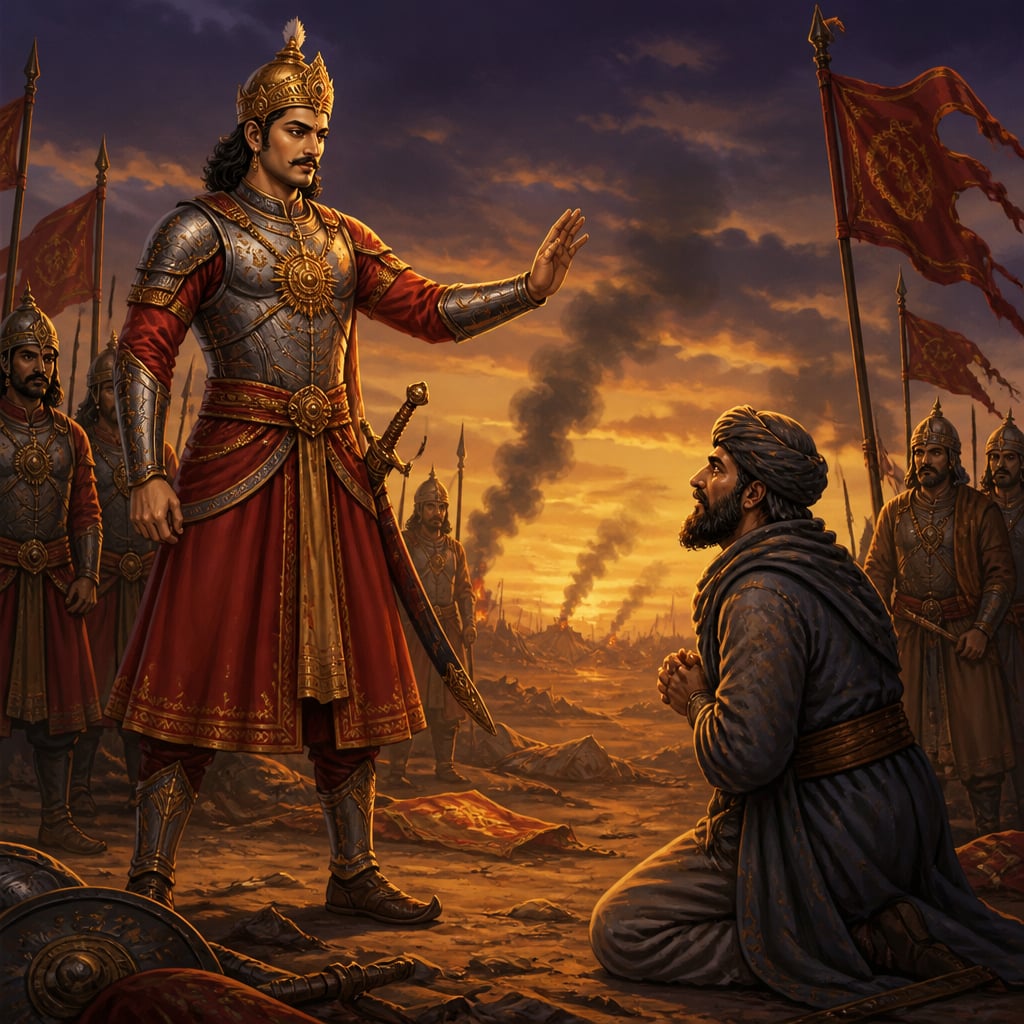
But Prithviraj's mind was not where it needed to be.
Historians describe a king whose attention was scattered across a dozen concerns. There was the romantic aftermath of the famous Sanyogita elopement, the beautiful princess he had daringly abducted from her father's swayamvara. There were the simmering resentments of fellow Rajput kings, jealous of his power and still angry about the Sanyogita incident. There were the court intrigues, the administration of a vast kingdom, the pleasures of victory.
In this scattered state, Prithviraj made a choice that would change Indian history forever. He released Muhammad Ghori.
The Rajput code of chivalry, the advice of some counselors, his own magnanimity, his divided attention, whatever the combination, the decision was catastrophic. Ghori returned the following year with a larger army. This time, Prithviraj lost. He was captured, blinded, and eventually killed. Delhi fell. The trajectory of the subcontinent shifted.
The Rishis had a word for what happened to Prithviraj's mind: vikṣepa, the scattering, the dispersion, the fragmentation that occurs when mental coherence breaks down. Understanding vikṣepa is not pessimism; it's essential preparation for recovery.
The Vedic Vision: Vikṣepa as Scattered Mind
Modern life presents unprecedented vikṣepa conditions, constant connectivity, information overload, competing demands, attention economics designed to scatter focus. Understanding vikṣepa is no longer optional; it's essential for functioning. The Rishis' framework provides something modern psychology often lacks: a systematic understanding of how balance breaks, why it cascades, and how recognition itself begins recovery. Without this framework, we're left with vague feelings of overwhelm without understanding what's happening or how to respond. With it, we can diagnose our condition and apply appropriate remedies.
The Sanskrit word vikṣepa comes from vi (apart, asunder) + kṣip (to throw, to scatter). It's the opposite of ekāgratā (one-pointedness). Where a balanced mind is like a still lake, unified, clear, reflective, the mind in vikṣepa is like that lake in a storm: fragmented into a thousand ripples, unable to hold any single reflection.
The Yoga tradition identifies vikṣepa as one of the primary obstacles (antarāya) to mental stability. But the Vedic understanding goes deeper than mere distraction. Vikṣepa is not just thinking about many things; it's the loss of the organizing center that holds mind together.
| Balanced Mind | Vikṣepa Mind |
|---|---|
| Unified around purpose | Scattered across concerns |
| Clear priorities | Competing demands, no hierarchy |
| Energy flows toward goals | Energy dissipates in all directions |
| Decisions feel coherent | Decisions feel arbitrary or impossible |
| Time feels meaningful | Time feels fragmented or pressured |
Prithviraj's vikṣepa wasn't that he had many concerns, all kings do. It was that no single concern organized the others. His romantic attachment, his political tensions, his military situation, his code of honor, all pulled him in different directions simultaneously. When the critical moment came, there was no unified will to meet it.
What the Mantras Reveal
The Rig Veda contains hymns that address mental dispersion directly. One mantra invokes protection against the scattered state:
"mā́ no dúchunā abhí naśat" "Let not bewilderment come upon us."
The word dúchunā suggests confusion, disorientation, the state where the mind loses its moorings. The prayer acknowledges that such states can "come upon" us, vikṣepa is not always chosen; sometimes it arrives through circumstance.
Another mantra reveals the antidote:
"sáṃ gacchadhvaṃ sáṃ vadadhvaṃ sáṃ vo mánāṃsi jānatām" "Come together, speak together, let your minds know together."
This verse from the Saṃjñāna Sukta (Hymn of Unity) is usually applied to communities, but it applies equally to the fragmented individual mind. The parts of self that have scattered must "come together" and "know together" again. Recovery from vikṣepa is re-gathering.
A third mantra describes what happens when vikṣepa takes hold:
"ápāṃ nápāt...ná gṛbhṇāti yá āpaḥ" "The child of the waters... he who does not grasp the waters."
This cryptic verse has been interpreted as describing the mind that cannot "grasp" its own contents, thoughts flow through like water, and nothing is held. This is vikṣepa at its deepest: not just scattered thinking but the inability to hold any thought long enough to act on it.
Traditional Interpretations: The Nine Obstacles
The Yoga Sutras of Patanjali, building on Vedic foundations, identify nine obstacles (antarāya) that cause vikṣepa:
- Vyādhi, Disease, physical illness that disrupts mental function
- Styāna, Lethargy, mental dullness that prevents focus
- Saṃśaya, Doubt, the paralysis of indecision
- Pramāda, Carelessness, loss of mindfulness
- Ālasya, Laziness, lack of effort
- Avirati, Sensory attachment, being pulled by desires
- Bhrāntidarśana, False perception, seeing things wrongly
- Alabdhabhūmikatva, Failure to attain stages, losing ground already gained
- Anavasthitatva, Instability, inability to maintain what's been attained
Sayana and later commentators note that these obstacles often operate together, creating cascading vikṣepa. Prithviraj may have experienced avirati (sensory attachment, his romantic preoccupation), pramāda (carelessness, releasing a dangerous enemy), and bhrāntidarśana (false perception, misreading the threat level). The obstacles compound.
Sri Aurobindo interpreted vikṣepa as the fundamental condition of ordinary consciousness. "The mind is naturally a field of dispersion," he wrote. "It scatters itself over a thousand objects, pursuing none to conclusion." In his view, all spiritual practice is essentially a movement from vikṣepa toward ekāgratā (one-pointedness).
Living This Today: Prithviraj's Fatal Year
Let's examine Prithviraj's vikṣepa more closely, because understanding how balance breaks helps us recognize it in ourselves.

The Sanyogita Factor: Prithviraj had recently performed one of history's most dramatic romantic acts, riding into his enemy Jaichand's court and abducting his daughter Sanyogita, who loved him. This triumph created new enemies among Rajput kings while consuming emotional attention. The romance was real; the distraction it caused was fatal.
The Rajput Politics: As the most powerful king in northern India, Prithviraj faced constant maneuvering from fellow Rajputs. His coalition was fragile; his allies were often former enemies. Managing these relationships required constant attention, attention not available for strategic military thinking.
The Victory Illusion: Having defeated Ghori decisively, Prithviraj's mind registered the threat as handled. This bhrāntidarśana (false perception) was catastrophic. Ghori was wounded, not eliminated; defeated, not destroyed. The mind that believes it has won stops preparing.
The Chivalric Code: Prithviraj operated within a code that valued certain behaviors, mercy to defeated enemies, adherence to dharma as understood in that context. The code itself wasn't wrong, but applying it mechanically in a context that required strategic exception was vikṣepa in action. He couldn't integrate the demands of mercy with the demands of survival.

When the Second Battle of Tarain came in 1192, Ghori had learned from defeat. He attacked at dawn during a strategic Muslim festival day when Hindu armies typically observed ceasefire. Prithviraj's scattered forces, surprised and unprepared, were destroyed. The king who had been too scattered to eliminate a threat paid with his kingdom, his eyes, and his life.
The Symptoms of Vikṣepa
How do you know when you're entering vikṣepa? The Rishis identified several warning signs:
Decision paralysis: The mind can't choose because everything seems equally urgent or equally unimportant. Prithviraj had to choose between mercy and security; his scattered mind couldn't hold both options clearly enough to decide wisely.
Reactive living: Instead of acting from center, you're constantly responding to whatever's loudest. Each demand gets attention; none gets completion. Life becomes an endless series of interruptions.
Time pressure without progress: You feel constantly busy but nothing moves forward meaningfully. Energy disperses across many activities; none reach fruition.
Loss of priorities: What matters most becomes unclear. The strategic (eliminating Ghori) gets treated the same as the tactical (court protocols) or the personal (romantic attachment).
Emotional volatility: Without the anchor of centered purpose, emotions swing more widely. Small setbacks feel catastrophic; small wins feel triumphant. The steady keel is lost.
Why Understanding Vikṣepa Matters
The Rishis didn't discuss vikṣepa to be pessimistic. They discussed it because recognition is the first step to recovery.
If you don't understand how balance breaks, you can't recognize when it's breaking. You can't intervene early. You can't distinguish between normal fluctuation and genuine fragmentation.
The person who knows vikṣepa can say: "I notice my mind is scattering. I'm responding to everything and completing nothing. My priorities have become unclear. This is vikṣepa." That recognition itself begins to reverse the process.
The person who doesn't know vikṣepa simply feels overwhelmed, anxious, or confused, without understanding that these are symptoms of a specific condition with specific remedies.
When Vikṣepa Comes
Vikṣepa rarely arrives as a single catastrophic event. It usually develops through accumulation:
- One additional responsibility that tips the load
- One relationship rupture that fragments attention
- One health issue that saps energy for organization
- One failure that shakes confidence in priorities
- One success that creates new demands faster than old ones resolve
Prithviraj's vikṣepa didn't begin on the battlefield. It began months earlier, in the accumulation of demands that fragmented his attention so that when the critical moment arrived, there was no unified mind to meet it.
This understanding offers both warning and hope. Warning: vikṣepa builds before it manifests. The time to address it is before the critical moment, not during it. Hope: precisely because vikṣepa builds, it can be recognized and addressed before it becomes catastrophic.
In the next lesson, we'll explore samādhāna, the process of returning to balance, re-gathering the scattered mind, restoring the center that vikṣepa has dispersed.
Attention researchers have identified 'attention residue', mental fragments that linger from one task when you switch to another. Each incomplete task leaves residue, creating accumulated vikṣepa. The remedy they recommend, completing tasks before switching, is 'coming together' in action.
Leadership studies show that executives who protect focused time (blocking distractions, batching meetings) outperform those with fragmented schedules. The strategy isn't more discipline but less dispersion, creating conditions where vikṣepa is less likely to arise.
In systems theory, 'entropy' describes the tendency toward disorder. Vikṣepa is psychological entropy, the natural drift toward dispersion. Just as physical systems require energy input to maintain order, mental systems require intentional practice to maintain coherence.
Cognitive distortions (catastrophizing, black-and-white thinking, mind-reading) are modern names for bhrāntidarśana. These distortions compound vikṣepa, wrong perception leads to wrong action leads to worse situation. CBT's emphasis on correcting distortions is essentially correcting false darśana.
Andy Grove's concept of 'strategic inflection points' addresses the need to perceive correctly when situations change. Companies that misperceive threats (Kodak, Nokia) experience organizational vikṣepa, scattered responses to wrongly-perceived reality.
In feedback systems, wrong data produces wrong response produces worse data, a negative spiral. Vikṣepa operates similarly: distorted perception produces inappropriate action produces more distortion. Breaking the cascade requires correcting perception early.
Case studies
Prithviraj Chauhan: When a Kingdom Falls to Vikṣepa
In 1191 CE, Prithviraj Chauhan was the most powerful Hindu king in northern India. His Chahamana kingdom controlled vast territories; his cavalry was legendary. When Muhammad Ghori invaded, Prithviraj met him at Tarain and won decisively. Ghori himself was captured and brought before Prithviraj in chains. The victorious king faced a choice: eliminate the threat permanently, or show mercy and release the defeated enemy.
Prithviraj's mind at this critical juncture exhibited classic vikṣepa. His attention was scattered across multiple demands: the recent Sanyogita elopement had created political turmoil with other Rajput kings; his romantic attachment consumed emotional bandwidth; court intrigues demanded attention; the chivalric code he followed prescribed certain behaviors. Each concern pulled in its own direction. The strategic question, what to do with a dangerous enemy, could not receive the unified attention it required. In this scattered state, Prithviraj released Ghori. The decision reflected not deliberate strategy but the absence of integrated thought. He was not thinking clearly about the threat; he was not thinking clearly about anything.
Ghori returned in 1192 with a larger army and a strategy designed to exploit Rajput weaknesses. He attacked at dawn during a Hindu festival when ceasefire was customary. Prithviraj's forces, caught unprepared, were destroyed. The king was captured, blinded, and eventually killed. Delhi fell to Muslim rule for the first time. The trajectory of Indian civilization shifted. A kingdom was lost not on the battlefield but in the scattered mind of a king who could not integrate his concerns into coherent action.
Vikṣepa at critical moments produces catastrophic outcomes. Prithviraj was not incompetent, he was brilliant on the battlefield. He was scattered at the decision point. The lesson is not 'be more disciplined' but 'recognize when your mind is fragmented before making critical decisions.' Had Prithviraj recognized his vikṣepa, he might have sought counsel, delayed decision, or found other ways to compensate for his scattered state.
Strategic distraction, losing focus on the real threat while being consumed by immediate but less important concerns, is a pattern visible in business leaders who chase quarterly numbers while ignoring long-term market shifts. Prithviraj's failure was not military but attentional. The discipline of distinguishing urgent from important is a direct application of this lesson.
The Second Battle of Tarain (1192 CE) is considered one of the turning points of Indian history. From this defeat, Delhi remained under non-Hindu rule for over 700 years until 1947.
Arjuna's Visada: Vikṣepa on the Battlefield
The Bhagavad Gita opens with Arjuna in vikṣepa. The greatest warrior of his age stands on the battlefield of Kurukshetra, bow in hand, armies arrayed. But looking across at the enemy lines, seeing teachers, kinsmen, beloved figures, his mind shatters. His bow falls from his hand. He cannot act. He tells Krishna: 'My limbs fail, my mouth is parched, my body trembles. I cannot stand. My mind is reeling.'
Arjuna's symptoms are the physical manifestations of vikṣepa: trembling, inability to stand, reeling mind. His attention has scattered between duty (he must fight), affection (these are his teachers and kin), ethics (killing teachers is sinful), consequence (victory brings a kingdom soaked in blood), and identity (who am I if I kill my grandfather?). No single concern organizes the others. In this scattered state, action becomes impossible. The bow, his instrument of unified action, falls because there is no unified will to wield it. This is not cowardice; it's fragmentation.
What follows is the Gita, Krishna's teaching that addresses Arjuna's vikṣepa systematically. He provides a framework (dharma, karma yoga) that reorganizes scattered concerns into hierarchy. He offers a perspective (the eternal nature of Self) that puts momentary concerns in proportion. He gives a practice (detachment from outcome while engaging in action) that enables coherent function despite uncertainty. By the Gita's end, Arjuna's vikṣepa has resolved. He can act again. The teaching is essentially a manual for recovering from scattered mind.
The Gita shows that even the greatest can experience vikṣepa, and that there is a path through it. Arjuna doesn't resolve his vikṣepa by simply trying harder or forcing himself to act. He resolves it through teaching that reorganizes his understanding. Sometimes vikṣepa cannot be addressed by willpower alone; it requires new framework that puts scattered concerns into relationship.
Overwhelm in the face of genuinely complex decisions, such as choosing between two good options, navigating ethical dilemmas at work, or facing a family crisis, mirrors Arjuna's viksepa. The Gita's prescription is not to ignore complexity but to work through it systematically: clarify values, examine duty, and then act from the clearest understanding available, even if certainty is impossible.
Arjuna's visada (dejection) in Chapter 1 of the Gita lasted only one chapter before Krishna's intervention began, yet it took 17 more chapters to fully resolve, showing that recognizing imbalance is fast but restoring balance takes sustained effort.
Reflection
- Map your current attention. What concerns are active in your mind right now? Are they organized hierarchically (some primary, others secondary), or are they competing equally? If they're competing equally, you may be in vikṣepa. What one concern, if addressed, would organize the others?
- Recall a time when your mind was scattered, when you couldn't focus, couldn't decide, couldn't act effectively. What conditions produced that state? Which of the nine antarāyas (obstacles) were operating? What ended the vikṣepa, and what did recovery look like?
- Prithviraj's vikṣepa contributed to a civilization-level shift. On what scale does your vikṣepa operate? Who depends on your clarity? What might be the cascading consequences of scattered decisions in your life? This isn't meant to create anxiety but to illuminate stakes.