Saṅkalpa: Meaning as Stabilizer

How the Rishis Used Purpose as Psychological Anchor

Exploring the Vedic concept of saṅkalpa, the deliberate formation of purpose that creates psychological stability when external circumstances cannot. The Rishis discovered that clear intention acts as an anchor, holding the mind steady through life's inevitable storms.

In 1985, a young doctor named Rajendra Singh left his government job and traveled to the drought-ravaged Alwar district of Rajasthan. The villages he found were dying. Wells had gone dry. Rivers that once flowed were now empty sand beds. Villagers were migrating to cities, abandoning the land their families had farmed for centuries.

An old man in the village of Gopalpura told him: "Doctorsahab, we don't need medicine. We need water."
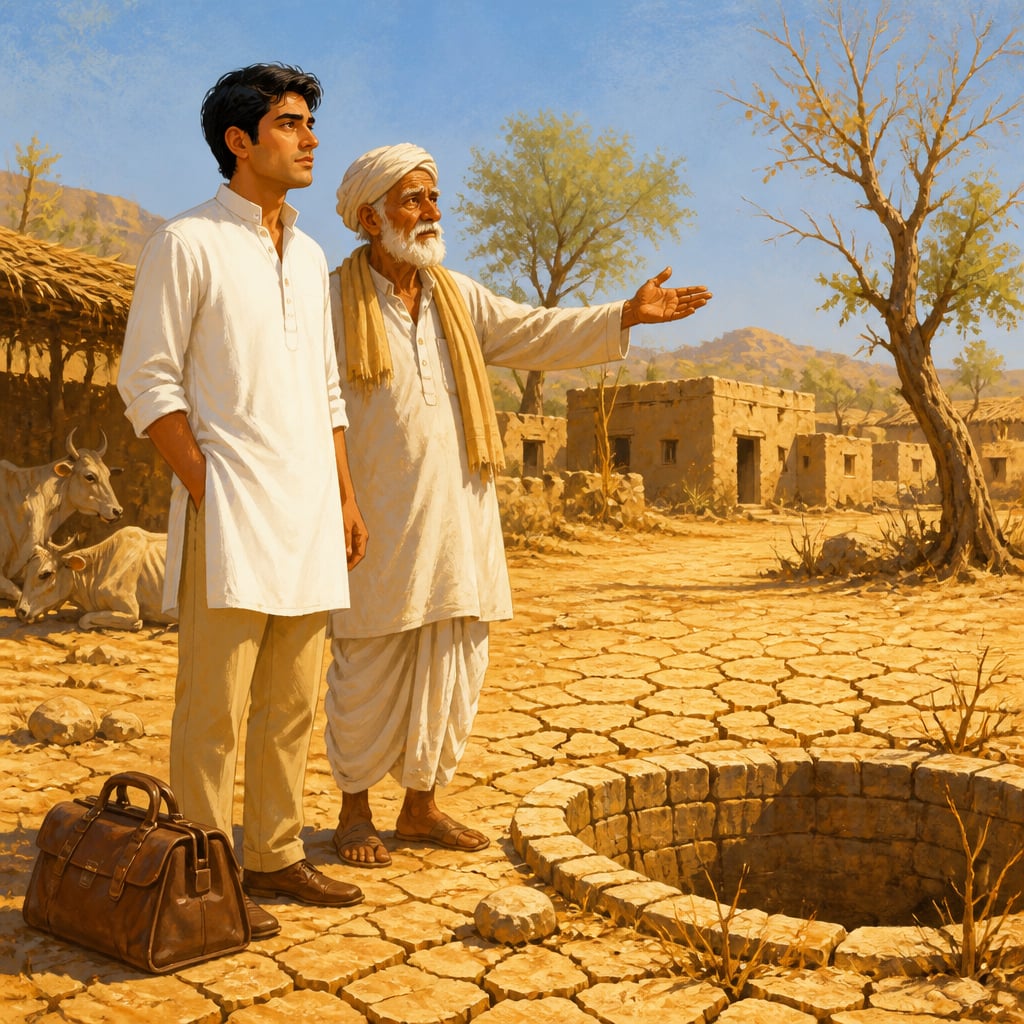
Doctor meeting villagers in dry Rajasthan

That single sentence became Rajendra Singh's saṅkalpa, his resolve, his purpose, his psychological anchor for the next four decades. "I will bring water back to these villages."

He knew nothing about hydrology. He had no funding. The government told him his methods were outdated, unscientific. Scientists dismissed him. His own family questioned his sanity. But the saṅkalpa held. And it held him.

The Rishis understood this power. They called it saṅkalpa, the deliberate formation of will-direction that creates stability independent of external circumstances. When rhythm fails, when emotion overwhelms, when the world offers no ground to stand on, saṅkalpa provides its own ground.

The Vedic Vision: Saṅkalpa as Psychological Architecture

Modern life is characterized by abundant options and scarce commitment. We can want many things, pursue multiple paths, keep options open indefinitely. The result is often a diffuse dissatisfaction, nothing is wrong, but nothing feels deeply right either. The Vedic teaching on saṅkalpa offers a remedy: the psychological stability and satisfaction that come from formed purpose. Not just having goals but being a purpose. This formation is increasingly rare and increasingly necessary. The person with saṅkalpa has something the option-abundant modern life cannot easily provide: an unshakeable ground to stand on.

The Sanskrit word saṅkalpa comes from sam (together, complete) + kḷp (to form, to accomplish, to bring about). A saṅkalpa is not merely a wish or a goal, it is a formation of the will, a deliberate shaping of consciousness toward a specific end.

The Rishis distinguished between different kinds of mental movements:

Mental State Sanskrit Term Psychological Quality
Wish Kāma Arising desire, not yet directed
Goal Lakṣya Target identified but not internalized
Intention Icchā Will pointed toward something
Saṅkalpa Saṅkalpa Complete formation of will, integrated purpose

Saṅkalpa is the most complete form, it's not just wanting something or even intending something. It's becoming the purpose. The person with saṅkalpa doesn't have a purpose; they are the purpose.

This is why saṅkalpa stabilizes. External circumstances can take away resources, relationships, even health. But they cannot take away the formation of will itself. The person anchored in saṅkalpa has an inner ground that nothing external can destroy.

What the Mantras Reveal

The Rig Veda's hymns frequently invoke the power of directed will. The most famous expression comes in contexts of ritual efficacy:

"krátur asi práchetāḥ" "You are will, you are consciousness."

The term kratu (will, purpose, intelligent resolve) appears throughout the Vedas as a divine quality that humans can invoke and embody. The Rishis didn't just pray, they formed saṅkalpa before ritual, declaring their intention clearly:

"devá savitaḥ prasuva yajñám prasuva yajñápatim bhágāya" "O divine Savitar, impel the sacrifice, impel the sacrificer toward blessings."

Notice the structure: before action comes the declaration of purpose, the alignment of will with cosmic will (Savitar's impulsion). The saṅkalpa precedes and shapes the action.

Another mantra reveals the stabilizing function:

"dhruvám ayur dhehí" "Establish firm life."

The Dhruva pole star burning steady over the night

The word dhruva (firm, stable, fixed) connects to the pole star, the one point in the sky that doesn't move while all else rotates around it. Saṅkalpa is the psychological pole star: while circumstances change, the purpose remains fixed, and everything else organizes around it.

Traditional Interpretations: Purpose as Architecture

Sayana's commentaries on ritual texts emphasize that saṅkalpa was formally declared before any significant action. The ritualist would state: "I [name], on this day, in this place, for this purpose, undertake this act." This wasn't bureaucratic formality, it was psychological architecture. By declaring the saṅkalpa, the ritualist created a structure that would hold through whatever difficulties arose.

Sri Aurobindo interpreted saṅkalpa as "the Will turned toward the Divine", but more broadly, as any complete formation of will that transcends ego-desire. When saṅkalpa is formed, Aurobindo wrote, "the being receives a new organization around this central purpose. All the energies become coordinated."

This coordination is the stabilizing power. Without saṅkalpa, psychological energies scatter, pulled by competing desires, confused by contradictory goals. With saṅkalpa, they align. Like iron filings around a magnet, the disparate forces of personality organize around the central purpose.

Living This Today: The Waterman's Four Decades

Rajendra Singh's story is a modern demonstration of saṅkalpa's stabilizing power.

After that conversation in Gopalpura, Singh began learning about traditional water harvesting, the johads (earthen check dams) that Rajasthani villagers had built for centuries before government policy destroyed them. He started building johads with whatever help he could find.

The obstacles were immense:

What held him through all this? "The saṅkalpa," he says simply. "Once I understood that these villages could live again if water returned, I could not un-understand it. The purpose was no longer separate from me. I was the purpose."

Singh and villagers building a johad together

By 2024, Singh and his organization Tarun Bharat Sangh had helped revive seven rivers that had been declared dead, built over 11,000 water-harvesting structures, and transformed thousands of villages. He received the Stockholm Water Prize, the "Nobel Prize for water," in 2015.

But more revealing than the achievements is the psychological reality: Singh maintained stability through four decades of adversity because his saṅkalpa was complete. He didn't have a purpose that could be taken away. He was the purpose.

Why Meaning Stabilizes

Modern psychology has begun to understand what the Rishis knew.

Viktor Frankl, the psychiatrist who survived Auschwitz, built his entire therapeutic approach, logotherapy, around this principle: "He who has a why to live can bear almost any how." Frankl observed that concentration camp survivors who had a sense of purpose, completing a manuscript, reuniting with loved ones, testifying to the world, survived at higher rates than those without clear meaning.

But Frankl's insight, profound as it is, describes only part of the picture. The Vedic understanding goes deeper: meaning doesn't just help you survive, it restructures your entire psychology.

When saṅkalpa is formed:

This is why people with clear purpose often seem more stable than their circumstances warrant. They have psychological architecture that those without purpose lack.

Forming Your Saṅkalpa

How do you form a saṅkalpa that stabilizes? The Rishis had a process:

First, clarify. A vague purpose is no purpose. "I want to help people" is not saṅkalpa, it's too diffuse to organize anything. "I will bring water to these drought-stricken villages" is saṅkalpa, specific, clear, actionable. What exactly is your purpose? Name it precisely.

Second, test authenticity. Does this purpose come from your depths, or from external expectation? The Rishis distinguished between kāma (surface desire) and saṅkalpa (formed will). Surface desires change with circumstances; authentic saṅkalpa persists. Ask: Would I pursue this even if no one approved, even if I received no recognition?

Third, declare. The Vedic ritualists stated their saṅkalpa aloud, formally. This wasn't superstition, it was commitment technology. When you declare your purpose, you create accountability to yourself. Write it down. Speak it. Make it real outside your head.

Fourth, integrate. Let the saṅkalpa reorganize your life. What activities serve the purpose? What distracts from it? The saṅkalpa should begin to shape decisions, priorities, relationships. If it doesn't, it hasn't truly formed.

Fifth, hold. Saṅkalpa is tested by adversity. The purpose will face obstacles. The question is not if difficulties come but whether the saṅkalpa holds when they do. Rajendra Singh's saṅkalpa held through four decades of challenge. What will yours hold through?

When Saṅkalpa Fails

Not every declared purpose becomes stabilizing saṅkalpa. Some collapse under pressure. The Rishis recognized several failure modes:

Authentic saṅkalpa survives because it's not about you, you're in service of it. Rajendra Singh didn't revive rivers for his reputation. The rivers were the purpose; he was the instrument. This instrumentality is what makes saṅkalpa stable.

In the next lesson, we'll explore what happens when balance breaks, when even saṅkalpa cannot hold, and the mind enters vikṣepa, the scattered state. Understanding breakdown is essential to understanding recovery.

Self-Determination Theory (Deci & Ryan) distinguishes between intrinsic and extrinsic motivation. Intrinsically motivated goals (pursued for their own meaning) show greater persistence than extrinsically motivated goals (pursued for reward or approval). The Vedic distinction between authentic saṅkalpa and borrowed purpose maps directly onto this research.

Jim Collins' research on great companies found that 'BHAGs' (Big Hairy Audacious Goals) only work when grounded in authentic purpose. Companies that declared ambitious goals without genuine core purpose failed; those whose goals emerged from authentic values succeeded. Saṅkalpa must be authentic to hold.

In systems architecture, the 'north star metric', the single measure that defines success, organizes all other decisions. Without it, systems fragment into competing objectives. Saṅkalpa functions as the psychological north star that prevents fragmentation.

Identity research shows that purposes integrated into identity ('being a writer' vs 'wanting to write') show far greater persistence. When purpose becomes identity, obstacles are interpreted differently, not as reasons to quit but as tests to pass. The identity wants to prove itself.

Organizational culture research finds that employees who identify with company mission (not just employed by company) show dramatically different behavior during crises. They sacrifice, innovate, persist, because the mission is who they are, not just what they do.

In complex adaptive systems, 'attractor states' organize system behavior. Purpose functions as a psychological attractor, it pulls scattered energies toward coherent pattern. The stronger the attractor, the more stable the organization around it.

Case studies

Rajendra Singh: The Waterman's Forty-Year Saṅkalpa

In 1985, Rajendra Singh was a young Ayurvedic doctor in a government job. He left it to work in rural Rajasthan with the National Service Scheme. In the drought-devastated villages of Alwar district, he encountered communities dying of water scarcity. Rivers that elders remembered flowing year-round were now empty sand beds. Wells had gone dry. Agriculture had collapsed. Villagers were becoming climate refugees in their own country.

The moment of saṅkalpa formation came when an elderly villager in Gopalpura told Singh: 'We don't need medicine. We need water.' That sentence crystallized everything. Singh's icchā (desire to help) became saṅkalpa (formed will): 'I will bring water back to these villages.' He began learning traditional water harvesting, the johad (earthen dam) system that Rajasthan had used for centuries. He had no training, no money, no support. What he had was saṅkalpa. The purpose was no longer something he *had*; it was something he *was*. This identity-level integration explains what happened next: forty years of work through obstacles that would have broken anyone merely motivated by desire.

By 2024, Singh's organization Tarun Bharat Sangh had built over 11,000 water-harvesting structures, revived seven rivers declared officially dead (including the Arvari, Ruparel, and Sarsa), and transformed thousands of villages from water-scarce to water-secure. Singh received the Stockholm Water Prize (the 'Nobel for Water') in 2015 and the Ramon Magsaysay Award in 2001. More importantly, he sparked a movement: communities across India began reviving their own traditional water systems.

Saṅkalpa stabilizes not just through motivation but through identity transformation. Singh didn't persist for forty years because he had good discipline or strong motivation, those would have depleted. He persisted because the purpose had become who he was. The obstacles weren't challenges to his goal; they were challenges to his identity. And identity, once formed, doesn't easily surrender.

Long-term social entrepreneurs and environmental activists who sustain their work for decades, rather than burning out in years, consistently describe a point where the mission stopped being something they did and became something they were. This identity-mission fusion, exemplified by Rajendra Singh, is the difference between discipline and devotion, between willpower and sankalpa.

The Arvari River, completely dry when Singh arrived in 1985, now flows year-round. The Arvari River Parliament, formed by 72 villages along its banks, is India's first community river management system, demonstrating that ecological restoration and social organization can emerge from single saṅkalpa.

Viśvāmitra's Saṅkalpa: From King to Rishi

Viśvāmitra was a king, powerful, proud, ruler of vast territories. One day, encountering the sage Vasiṣṭha, he witnessed something that shattered his royal confidence: Vasiṣṭha's spiritual power exceeded anything Viśvāmitra's armies could command. The sage's cow, Nandinī, could produce anything wished for; Vasiṣṭha's austerity had given him powers no king could match. Viśvāmitra, humiliated, formed a saṅkalpa: 'I will become a Brahmarṣi, a sage of the highest order.'

What followed was centuries of tapas (austerity). Viśvāmitra repeatedly failed, his anger disrupted his practice, his desires derailed his progress, his ego sabotaged his austerity. Each failure would have justified abandonment. But the saṅkalpa held. Not because Viśvāmitra was particularly virtuous, the texts describe his many flaws, but because the purpose had become complete. He was no longer a king who wanted to become a sage; he was a being whose entire existence was organized around that becoming. The repeated failures weren't defeats; they were iterations.

Eventually, Vasiṣṭha himself acknowledged Viśvāmitra as Brahmarṣi. The former king had achieved what he sought, not through talent or luck but through saṅkalpa that outlasted every obstacle. Viśvāmitra became one of the most important Rishis, credited with receiving the Gāyatrī mantra and composing significant portions of the Rig Veda. His story teaches that saṅkalpa, fully formed, can transform even the most unlikely candidate.

The Viśvāmitra story emphasizes that saṅkalpa works not despite obstacles but through them. His flaws were not disqualifications; they were the material that saṅkalpa transformed. The message is not 'be perfect before forming purpose' but 'form purpose, and let it work on your imperfections over time.' The saṅkalpa itself becomes the transforming force.

Career pivots that seem irrational to outsiders, leaving a lucrative job to teach, closing a successful business to pursue art, walking away from status to find meaning, often follow the Vishvamitra pattern. The obstacles that arise after such pivots are not signs of a wrong decision but the raw material through which the new identity is forged.

Vishvamitra's journey from king to Brahmarishi spanned multiple ages according to tradition, making his sankalpa possibly the longest sustained intention recorded in any world literature.

Reflection

More in Sthiti: Emotional Balance in Vedic Terms

All lessons in Sthiti: Emotional Balance in Vedic Terms · Rig Vedic Psychology course