Pratisaṃdhāna: Returning to Balance

The Vedic Art of Reconnection After Rupture

Explore pratisaṃdhāna, the Vedic principle of rejoining what has been severed. Through mantras, the story of Ahilyabai Holkar, and the myth of Cyavana's renewal, discover how the Ṛṣis mapped the sacred process of returning to wholeness after disruption.

The Severed Thread

Maheshwar, 1766 CE. A thirty-one-year-old widow sits in the chamber where her husband died just months ago. Weeks earlier, her only son fell in battle. Her father-in-law, the great Malhar Rao Holkar, followed soon after. In the span of one year, Ahilyabai has lost everyone who connected her to power, to purpose, to the structure of her life.
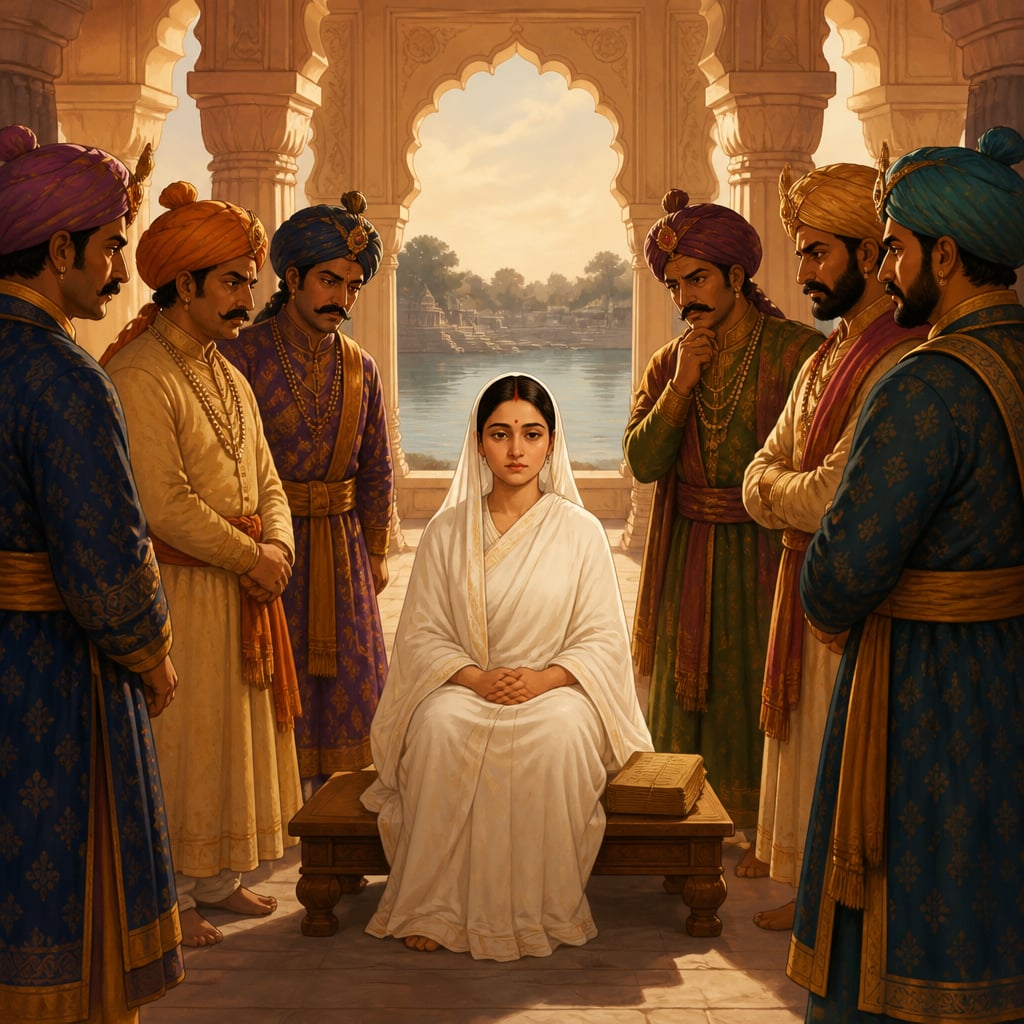
Ahilyabai Holkar in mourning

The nobles circle like vultures. A woman ruling? Impossible. They wait for her to retreat into traditional widowhood, to surrender the kingdom to male relatives, to break.

But something unexpected happens. Instead of breaking, Ahilyabai begins to reconnect. First, to the soldiers who remain loyal, she addresses them directly, something unheard of for a widow. Then, to the people, she sits personally to hear grievances. Thread by thread, connection by connection, she begins reweaving what death had torn apart.

What she accomplished over the next three decades would make her one of the most beloved rulers in Indian history. But the process began with something the Vedic Ṛṣis understood deeply: the sacred art of pratisaṃdhāna, rejoining what has been severed.

In the previous lesson, we explored vikṣepa, the scattering that breaks balance. Now we turn to its antidote: the deliberate, patient process of returning to wholeness.

Voices from the Vedic Dawn

The Ṛṣis knew that life inevitably tears us from our moorings. Their mantras don't promise immunity from rupture, they offer maps for return.

यत्ते भग्नं यत्ते च्युतं तद्ध्रुवं कृणवामसि "What of yours is broken, what has fallen away, that we make firm again." Atharva Veda 4.12.1

This healing mantra reveals the Vedic understanding of restoration. The word 'dhruva' (firm, stable) suggests that true healing doesn't just patch what was broken but establishes it more securely than before. The Ṛṣis saw restoration as creative work, not returning to a previous state, but building anew.

पुनर्मनः पुनरायुः पुनः प्राणः पुनर्धियम् "Again, the mind; again, life-force; again, breath; again, understanding." Ṛg Veda 10.57.4

The repetition of 'punar' (again) is significant, restoration happens layer by layer. First manas (mind), then āyus (life-force), then prāṇa (breath), then dhi (understanding). The Ṛṣis mapped a sequence: mental reorientation precedes energetic renewal, which precedes the return of clear thought. This isn't recovery, it's rebuilding.

सं गच्छध्वं सं वदध्वं सं वो मनांसि जानताम् "Come together, speak together, let your minds know one accord." Ṛg Veda 10.191.2

The Saṃjñāna Sūkta, hymn of mutual understanding, addresses collective reconnection. The prefix 'sam' (together) repeats throughout, emphasizing that pratisaṃdhāna is fundamentally about rejoining with others, with community, with shared purpose. Isolation scatters; reconnection heals.

Architecture of Return

The Four Reconnections

Vedic restoration works through four progressive reconnections: ātmasambandha (connection to self), lokasambandha (connection to world), kālasambandha (connection to time/rhythm), and arthasambandha (connection to meaning). Each builds on the previous. Premature attempts to reconnect with meaning before stabilizing the self lead to brittle recovery.

Modern recovery programs echo this sequence: first stabilize the individual (detox, grounding), then rebuild relationships, then establish routines, then reconstruct purpose. The Vedic insight is that this sequence isn't arbitrary, it reflects the architecture of human functioning.

Cicatrization Wisdom

The Sanskrit term vraṇaropana (wound-healing) understood that healing leaves a scar, and that the scar tissue is often stronger than the original. Vedic restoration doesn't aim to erase what happened but to integrate it. The person who returns is not the same person who was broken; they carry the rupture as transformed strength.

Psychological research on post-traumatic growth confirms that many people emerge from trauma with greater resilience, deeper relationships, and clearer purpose than before, not despite the rupture but through integrating it. The scar becomes structural support.

The Principle of Krama (Sequence)

Pratisaṃdhāna follows krama, proper sequence. The Vedic ritualists understood that restoration cannot be rushed or reordered. First comes śodhana (cleansing of what was toxic), then sthāpana (establishment of basic stability), then poṣana (nourishment), and finally varddhana (growth). Skip a step and the structure won't hold.

This maps precisely to what psychologists call 'phase-oriented treatment': stabilization before processing, processing before integration, integration before growth. The Vedic contribution is recognizing this as cosmic principle, not just therapeutic technique.

What Return Teaches

Pratisaṃdhāna Across Domains

Personal Psychology

The Atharva Veda's healing hymns prescribe specific sequences: first addressing the body, then the mind, then the social connections, then the cosmic alignment. This whole-person restoration recognizes that psychological healing cannot be separated from physical, social, and spiritual dimensions.

Integrated approaches to recovery, combining physical exercise, cognitive therapy, social support, and meaning-making, outperform single-modality treatments. The Vedic framework explains why: each dimension supports the others. Reconnection is fractal.

Leadership

The rājavidyā texts describe how a kingdom recovers from crisis: first secure the core (the capital, the treasury, the essential functions), then rebuild outward in concentric circles. A ruler who tries to restore everything simultaneously restores nothing.

Organizational turnarounds follow this pattern. Leaders who stabilize core operations, rebuild key relationships, reestablish rhythms, and only then reimagine strategy have higher success rates than those who try comprehensive transformation immediately. The Vedic insight: triage before ambition.

Systems Thinking

Vedic cosmology understood cosmic dissolution (pralaya) as prelude to fresh creation. What returns after dissolution isn't identical to what existed before, it's evolved. The universe itself practices pratisaṃdhāna, using ending as the raw material for new beginning.

Complex adaptive systems exhibit the same pattern. Economic recessions clear out inefficiencies. Forest fires enable new growth. Organizational crises catalyze innovation. The Vedic contribution: seeing this as feature, not bug. Designed obsolescence of what no longer serves.

Ahilyabai Holkar: Architecture of Reconnection

In 1766, Ahilyabai Holkar faced complete rupture. Her husband Khande Rao had died in 1754. Her son Malerao, after a troubled reign, died in 1767. Her father-in-law and protector Malhar Rao died in 1766. She was a widow in a culture that expected widows to disappear. She was a woman in a political world that expected women to be ornamental. She had no male heirs in a system that demanded them.

Every thread connecting her to power, to purpose, to the structure of her life had been severed. The nobles assumed she would retreat. Some encouraged her to commit sati. Others plotted to seize her territories.

What happened instead became a masterclass in pratisaṃdhāna.

Ahilyabai walking the ghat of rising temples

For three decades, Ahilyabai ruled with such wisdom that she became legendary. She personally led troops in battle when necessary. She established one of India's most sophisticated legal systems. She rebuilt Hindu temples that had been destroyed across the subcontinent. When she died in 1795, she was mourned by her people as 'mother.'

But perhaps most remarkably, she transformed the rupture itself. She had lost the conventional sources of a woman's power in her era, husband, son, male protector. Instead of trying to replace what was lost, she built something new. Her widowhood, which should have been her political death, became the basis of her moral authority. Her childlessness, which should have ended her legacy, freed her to treat all subjects as her children.

Ahilyabai exemplifies the Vedic understanding of cicatrization, the wound becoming the strongest point. She didn't return to what she was before the losses. She couldn't; that person no longer existed. Instead, she wove the rupture into a new pattern, using the very circumstances that should have destroyed her as the foundation for what she built.

The nobility who expected her to break had misunderstood the nature of restoration. Pratisaṃdhāna doesn't mean returning to a previous state. It means 'placing together again', and sometimes what gets placed together is stronger than what was there before.

Cyavana's Renewal: The Myth of Restoration

The ancient story of Ṛṣi Cyavana offers a mythic map of pratisaṃdhāna.

The Ashvins restoring aged Cyavana at the forest pool

Cyavana had meditated so long that an anthill grew over his body, leaving only his eyes visible. The princess Sukanyā, wandering in the forest, saw two glowing points in the anthill and, thinking them insects, pierced them with a thorn.

Blinded and broken, Cyavana emerged from his meditation, not enlightened, but damaged. The king, horrified at what his daughter had done, offered her in marriage to the sage as reparation.

But here the story turns. The Aśvins, divine physicians, offered Cyavana a bargain: they would restore his youth, his sight, his vitality, complete restoration. In exchange, he would grant them something they had been denied: a share in the soma sacrifice.

Cyavana agreed. The Aśvins took him to a sacred pool. When he emerged, he was young, beautiful, restored, but not the same. He had gained something from his rupture: the relationship with the Aśvins, the knowledge of their healing arts, the wisdom that comes only from having been broken.

The Vedic seers who told this story understood: restoration isn't regression. The healed Cyavana wasn't the pre-rupture Cyavana minus the damage. He was someone new, carrying forward both what he had been and what he had suffered.

This myth encodes the psychological truth that pratisaṃdhāna produces transformation. We don't return to who we were. We become who we are capable of becoming only because of what broke us.

Practicing Return

Pratisaṃdhāna isn't abstract philosophy, it's actionable wisdom for navigating rupture.

The Sequence Matters: When recovering from crisis, don't try to find meaning first. The Vedic sequence is: self, world, rhythm, meaning. Stabilize your own functioning. Then rebuild key relationships. Then establish routines. Only then reconstruct purpose. Skipping steps creates fragile recovery.

Small Reconnections First: Ahilyabai didn't begin by reimagining her entire kingdom. She began by hearing individual grievances. Start with the smallest possible reconnection. Call one person. Walk one familiar route. Resume one practice. Each micro-connection creates capacity for larger ones.

Honor the Scar: Don't try to pretend the rupture didn't happen. The Vedic approach integrates rather than erases. The person you're becoming isn't the person you were before the loss, and shouldn't be. Carry what happened as transformed strength, not as hidden wound.

Time as Ally, Not Healer: The Ṛṣis understood that time alone doesn't heal. 'Kālaḥ pacati' (time cooks) only if you provide the ingredients. Active participation in your restoration, not passive waiting, is what makes time work for you. Ride the river; don't stand on the bank.

The Test of True Return: You know pratisaṃdhāna is complete not when you feel like your old self, but when you feel like a new self that includes both what you were and what you've been through. Wholeness that incorporates rupture is stronger than innocence that hasn't been tested.

Continuing the Journey

We have traveled through the complete architecture of Vedic balance: samatva (dynamic equilibrium), nirodha (regulation without suppression), ṛtu (rhythm as container), saṅkalpa (meaning as anchor), vikṣepa (the scattering that breaks), and now pratisaṃdhāna (the art of return).

In our final lesson, we'll step back from ancient principles to ask: What does all this mean for life in 2026 and beyond? How do these Ṛṣi insights translate to a world of constant connectivity, artificial intelligence, climate uncertainty, and rapid change?

The Vedic framework has proven remarkably prescient about the human condition. In our concluding exploration, we'll examine whether, and how, wisdom forged three thousand years ago can serve as navigation system for the centuries ahead.

Case studies

Ahilyabai Holkar (18th century)

After losing husband, son, and father-in-law in quick succession, transformed complete rupture into three decades of legendary rule by following the sequence of reconnection: self, world, rhythm, meaning.

Ahilyabai's path mirrors the Vedic concept of pratisandhana: returning to balance not by restoring the old self but by building a new integration. The Rig Vedic seers understood that rupture creates possibility. Like a field cleared by fire that yields richer harvests, loss can become the ground for deeper purpose when met with the discipline of reconnection.

Ahilyabai transformed devastating personal loss into three decades of exemplary governance, building temples, roads, and rest houses across India. She followed the sequence of reconnection: self, world, rhythm, and meaning, emerging stronger than before.

Returning to balance after complete rupture follows a sequence: first reconnect with self, then with the world, then rebuild rhythm, and finally rediscover meaning. Ahilyabai shows that this process, done with discipline, can produce not just recovery but transformation beyond what the original state contained.

People rebuilding after devastating personal loss, whether divorce, bereavement, financial ruin, or health crisis, often try to skip directly to productivity. Ahilyabai's sequence (reconnect with self, then with world, then rebuild rhythm, then rediscover purpose) provides a more sustainable roadmap. Rushing the sequence delays genuine recovery.

Ahilyabai Holkar ruled Indore for 30 years (1767-1795) after devastating personal losses, building over 100 temples and rest houses across India and maintaining one of the most stable administrations of 18th-century India.

Cyavana's Renewal (Vedic myth)

The Ṛṣi who emerged from rupture (blinding, damage) not as his previous self but transformed, carrying forward both what he had been and what he had suffered.

Cyavana's story embodies the Vedic teaching that true healing is transformation, not restoration. The Rig Veda repeatedly shows that return to balance after rupture produces not the original state but something incorporating the rupture itself. The wound becomes part of the new wholeness, not erased but integrated.

Cyavana emerged from his ordeal not as his previous self but as something new, carrying forward both what he had been and what he had suffered. The Ashvins' healing did not restore the old Cyavana but created a transformed one.

True healing does not restore the original self but creates a new one that incorporates both what was and what was suffered. The Cyavana story teaches that we should not aim to return to who we were before disruption, but to become who we can be after it, carrying the lessons of rupture forward.

Post-traumatic growth research shows that many people who survive severe adversity do not merely return to baseline but develop new capacities they did not have before. The Cyavana myth captures this truth: healing does not restore the original self but creates a new one that integrates both what was and what was endured. This reframe transforms the narrative of trauma from pure loss to potential transformation.

The Cyavana narrative in the Shatapatha Brahmana describes his rejuvenation by the Ashvins as a transformation, not a restoration, establishing the Vedic principle that healing produces a new self, not a return to the old one.

Reflection

More in Sthiti: Emotional Balance in Vedic Terms

All lessons in Sthiti: Emotional Balance in Vedic Terms · Rig Vedic Psychology course