Samatva: Balance as Dynamic Adjustment
Why the Rishis Saw Stability as Constant Movement, Not Stillness
Exploring the Vedic insight that true balance is not a fixed state to be achieved but a continuous process of adjustment. The Rishis understood that mental health comes from dynamic equilibrium, constant recalibration, not permanent stillness.
The charioteer had a problem. His two horses, one white, one black, pulled in opposite directions. The white horse surged forward with wild energy; the black horse held back, cautious and resistant. A lesser driver would have whipped one into submission or abandoned the other. But this charioteer did something different.
He adjusted. Moment by moment, breath by breath, he shifted his weight, loosened one rein, tightened the other. Not forcing. Not fighting. Responding.
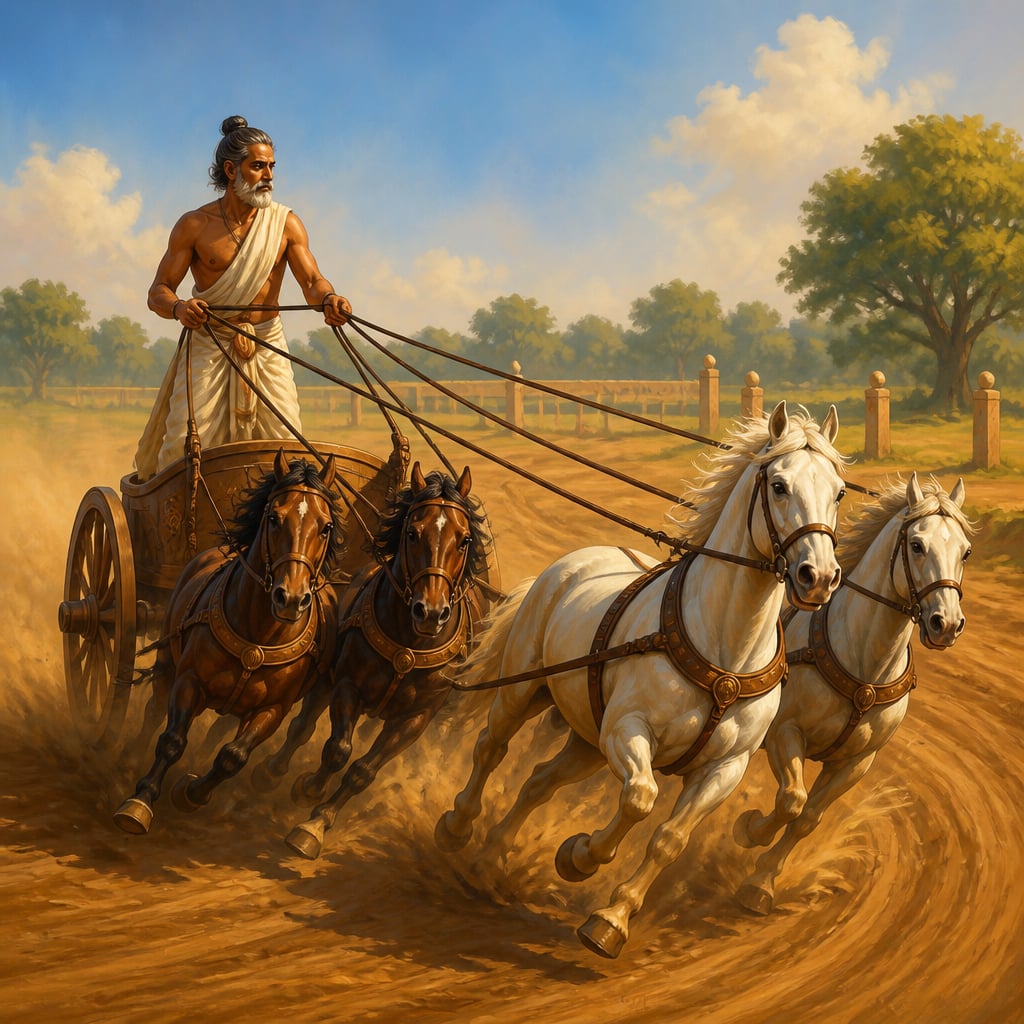
The Rishis who composed the Rig Veda watched such charioteers and saw in their art a profound truth about the mind. Balance, they realized, is not a destination you reach and then stop. Balance is what the charioteer does, a continuous, dynamic adjustment that never ends as long as the journey continues.
The Vedic Vision: Samatva as Living Equilibrium
Understanding balance as dynamic adjustment fundamentally changes our relationship to difficulty. If balance were a permanent state to achieve, every disturbance would be a failure. But if balance is continuous adjustment, then disturbance is simply what calls forth the adjusting response. This shift, from seeking a fixed state to developing responsive capacity, is the difference between fragility and resilience. The Rishis didn't promise a life without storm; they promised the capacity to navigate through it.
The Sanskrit term the Rishis used was samatva, often translated as "evenness" or "equanimity," but carrying a meaning far richer than either English word captures. Sama means "same" or "equal"; tva makes it a state. But this state is not static. The Vedic samatva is the evenness of a river, always moving, always adjusting to the terrain, yet maintaining its essential character.
This understanding sets Vedic psychology apart from both ancient and modern misconceptions about mental health. Balance is not:
- A permanent state of calm (that would be death)
- The absence of strong emotions (that would be numbness)
- Perfect equilibrium between all forces (that would be paralysis)
Balance is the capacity to adjust, to meet joy without losing yourself in it, to meet sorrow without drowning in it, to return to your center not because you never left, but because you know the way back.
What the Mantras Reveal
The Ashvin hymns offer the clearest window into this vision. The Ashvins, divine twin horsemen, appear throughout the Rig Veda as healers, rescuers, and restorers of balance. Their very nature is duality-in-unity: two beings who function as one.
One hymn captures their essence:
"yuvaṃ śubhas patī sthaḥ" "You two are lords of brightness."
But śubha means more than brightness, it carries connotations of auspiciousness, welfare, beauty. The Ashvins are lords of well-being itself, and their method is always adjustment, never force. In hymn after hymn, they rescue people from imbalance:

| Hymn | The Imbalance | The Restoration |
|---|---|---|
| RV 1.116.14 | Bhujyu drowning at sea | Ashvins provide a ship with wings |
| RV 1.116.16 | Rebha left for dead | Ashvins restore him to life |
| RV 1.117.17 | Ghoshā aging without marriage | Ashvins restore her youth and find her a husband |
Notice: they don't prevent problems. They don't create a world without imbalance. They restore, they bring back to center those who have fallen away.
Another mantra makes the psychological dimension explicit:
"samānó mánaḥ samānó hṛ́dayam" "Same in mind, same in heart."
This appears in hymns invoking unity, between people, between aspects of self. The samatva of mind and heart is not their fusion into one thing, but their alignment, two horses pulling together.
Traditional Interpretations: The Dynamic Center
Sayana's commentary on the Ashvin hymns emphasizes their role as restorers of ṛta, the cosmic order. When someone falls ill, loses their way, or suffers misfortune, they have fallen out of alignment with ṛta. The Ashvins don't create a new order; they return the person to the existing order they had lost touch with.
Sri Aurobindo reads the Ashvins as psychological principles: the divine capacity within each person to integrate opposites. In his interpretation, the twin horsemen represent the power to hold joy and sorrow, expansion and contraction, action and rest, not by choosing one over the other, but by allowing each its moment while maintaining the continuous thread of awareness.
The Nirukta of Yaska traces sama to the root meaning "to be equal to, to match." Balance, in this etymology, is not the absence of forces but the matching of one force by another, a dynamic equilibrium where energies meet rather than cancel.
Living This Today: The Kohli Principle

In 2022, Virat Kohli did something remarkable. After a century-long drought, 1,020 days without a Test hundred, form slumps, public criticism, mental health struggles, he stood at the crease at the Asia Cup and scored his 71st international century.
What happened in between? Not a magical fix. Not a sudden breakthrough. What Kohli described in interviews was a process that the Rishis would have recognized immediately: continuous adjustment.
"I was too focused on the result," he said. "I had to come back to the process." He worked with mental conditioning coaches. He took breaks when needed. He adjusted his stance, his technique, his expectations. Most importantly, he stopped trying to force the return to form and started allowing the adjustments that form requires.
This is samatva in action. Kohli didn't become a different player, he returned to his center. But that return wasn't passive waiting. It was active, continuous recalibration. Loosening one rein, tightening the other. Responding to the horses.
Psychological research supports this model. Angela Duckworth's work on "grit" distinguishes between rigid perseverance (which leads to burnout) and flexible persistence (which enables long-term achievement). The difference? Exactly what the Rishis described, the capacity to adjust while maintaining direction.
The Practice of Dynamic Balance
So what does this mean for you?
First, release the idea that balance is somewhere you arrive. You will never wake up one morning and think, "I am now balanced. Done." That's not failure, that's reality. The Rishis didn't promise permanent equilibrium. They promised the capacity for continuous return.
Second, notice your horses. What opposing forces pull at your mind today? Ambition and rest? Connection and solitude? Expression and containment? These aren't problems to solve. They're tensions to navigate.
Third, practice the micro-adjustment. When you notice yourself pulled too far in one direction, too much work, too much avoidance, too much anything, don't wait for crisis. Shift your weight. Loosen the rein. The charioteer doesn't wait until the chariot tips over.
The Ashvins are still at work. Every time you catch yourself and return, every time you notice the imbalance and begin the adjustment, you invoke their principle. Not dramatic rescue. Quiet restoration.
In the next lesson, we'll explore dhṛti, the specific capacity to hold emotions without suppressing them, the inner strength that makes continuous adjustment possible.
Dialectical Behavior Therapy (DBT), developed by Marsha Linehan, is built on this principle. It teaches patients to hold 'dialectical' tensions, acceptance AND change, emotion AND reason, without forcing resolution. This dialectical capacity is exactly what the Rishis described: not choosing between opposites but integrating them.
Jim Collins' 'Stockdale Paradox' (from 'Good to Great') describes leaders who hold two contradictory truths: unwavering faith they will prevail AND brutal honesty about current reality. This is the Ashvin principle in organizational form, two truths, one direction.
Homeostasis in biology is dynamic balance. Body temperature isn't maintained by stillness but by constant adjustment, shivering, sweating, blood vessel constriction. The body models the Vedic insight: stability through continuous response, not through fixed states.
Resilience research by Ann Masten shows that psychologically healthy people have multiple 'protective factors', relationships, skills, beliefs, that function as recovery resources. No single factor is sufficient; the multiplicity matters. This is the 'many wondrous deeds' principle.
Organizations with multiple recovery pathways survive crises better. Companies with diverse revenue streams, flexible teams, and varied problem-solving approaches embody the Ashvin principle: many ways to return to equilibrium, not dependence on one.
Ecological resilience depends on biodiversity. An ecosystem with many species can absorb shocks; a monoculture collapses. The same applies to psychological systems: multiple resources, multiple relationships, multiple practices create return capacity.
Case studies
Virat Kohli: The Thousand-Day Return
Between November 2019 and September 2022, 1,020 days, Virat Kohli, once the world's most dominant batsman, failed to score a single international century. The statistics were stark: averaging 19.33 in Tests in 2021, dropped from captaincy, publicly criticized, form in freefall. In 2022, he took a month-long break from cricket, speaking openly about mental health struggles. 'I was faking intensity,' he admitted. 'I was not feeling myself.'
Kohli's journey exemplifies samatva not as constant balance but as return capacity. His imbalance was not the problem, elite athletes routinely face form slumps. The problem was that his return routes had stopped working. The breakthrough came when he stopped forcing and started adjusting. He worked with mental conditioning coach Patrick Farhart, adjusted his technique with batting coach Sanjay Bangar, and most importantly, changed his relationship with outcome. 'I needed to come back to myself,' he said, a perfect articulation of the Ashvin principle: restoration, not transformation.
On September 4, 2022, Kohli scored 122 not out against Afghanistan in the Asia Cup, his 71st international century. More significant than the milestone was the manner: controlled, patient, adjusted to conditions. He went on to be Player of the Tournament in the 2023 World Cup (765 runs) and continues to perform at elite levels. The return was complete, but as Kohli notes, 'It's a continuous process. You have to keep working.'
Balance is not about never falling out of form. It's about knowing your way back. Kohli's thousand-day return teaches that the path back to center may be long, may require professional help, may demand releasing old patterns, but the return is possible. The Ashvins' rescues sometimes take time.
Performance slumps, whether in sports, creative work, or leadership, are universally feared but rarely discussed honestly. Kohli's public struggle and return normalize the reality that even the best lose their center. The path back is not a hack or a shortcut but a patient process of rediscovering fundamentals. Anyone in a prolonged slump can take comfort in knowing that the return is possible.
From his 2022 return to end of 2024, Kohli scored over 3,000 international runs with 10 centuries, matching his peak performance periods, demonstrating that return capacity can be rebuilt.
The Ashvins and Bhujyu: A Rescue That Models Return
The Rig Veda preserves the story of Bhujyu, son of Tugra, who was abandoned at sea during a storm. His companions, possibly his own family, left him drowning in the ocean. The hymn (RV 1.116.3-5) describes him as 'sinking in the watery abyss,' beyond all human help. There was no ship, no shore in sight, no logical path to survival.
The Ashvins' response to Bhujyu reveals the nature of divine balance-restoration. They didn't prevent the storm or the betrayal. They came *after* the catastrophe, in the midst of drowning, when all seemed lost. Their rescue vehicle was extraordinary: 'a ship with a hundred oars... that flies through the air', what commentators describe as a boat that could travel both water and sky. The Ashvins meet the situation not with a standard response but with a creative adjustment suited to this specific crisis.
Bhujyu was restored to dry land. The hymns celebrate this rescue for generations afterward, establishing Bhujyu as a model of one who returned from impossible imbalance. Notably, the story emphasizes not what Bhujyu did to save himself (he was helpless) but the availability of restoration when all human resources failed.
Sometimes balance cannot be self-restored. The Bhujyu story acknowledges that certain imbalances exceed our individual capacity, and models the availability of help. The Ashvins represent not just self-regulation but the principle that restoration can come from beyond the self. Modern translation: sometimes you need the therapist, the friend, the intervention. Asking for help is invoking the Ashvins.
Modern psychology increasingly recognizes that some forms of distress exceed individual coping capacity and require external support, whether from therapists, community, or medication. The Bhujyu story validates help-seeking rather than framing it as weakness. Knowing when you cannot self-rescue and reaching out is itself a form of strength and wisdom.
The Bhujyu hymn (RV 1.116.3-5) is one of the most detailed rescue narratives in the Rig Veda, describing a three-day sea voyage on a ship with 100 oars sent by the Ashvins.
Reflection
- What are your 'return routes', the practices, people, and perspectives that help you find center when you've lost it? Are they diverse enough that if one fails, others remain available?
- The Ashvins don't prevent problems, they restore after crisis. What does this suggest about the nature of difficulty in life? Is perfect prevention even possible, or is return capacity the deeper resource?
- If balance is dynamic adjustment and never arrives at a final state, does this mean peace is impossible? Or does peace reside in the capacity to adjust rather than in the absence of needing to?