Nirodha: Emotional Regulation Without Suppression

How the Rishis Channeled Powerful Feelings Rather Than Crushing Them

Exploring the Vedic practice of nirodha, holding and channeling emotions rather than suppressing or indulging them. The Rishis discovered that powerful feelings, properly contained, become fuel for transformation rather than causes of destruction.

The Rishi was weeping.

This was not supposed to happen. He had trained for twelve years. He had mastered the mantras. He could sit in meditation through the coldest nights. But now, receiving news that his son had died in a distant land, the tears came, unbidden, unstoppable, flowing down his face like monsoon rain on the Vindhyas.
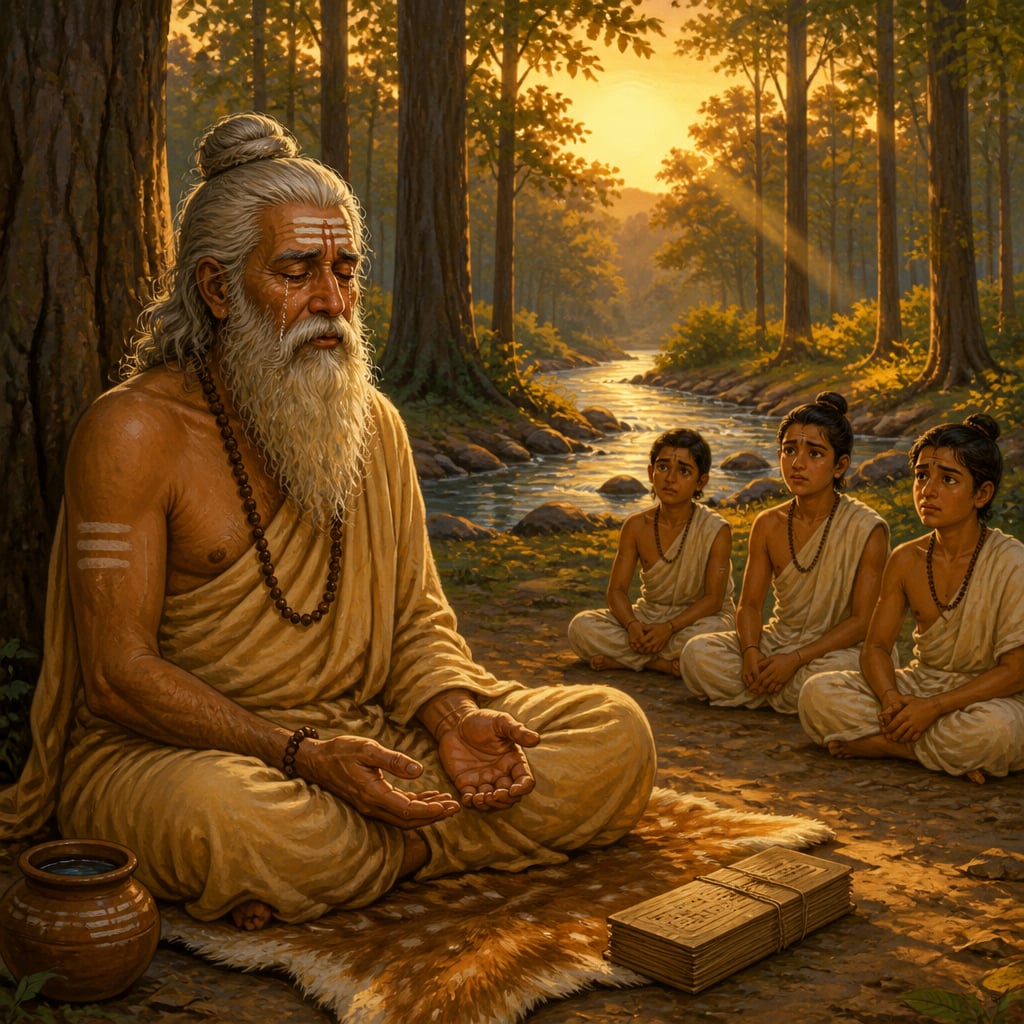
Rishi weeping in his ashram

His students watched, uncertain. Was this failure? Had their teacher lost his composure, his tapas, his hard-won equanimity?

The Rishi looked up, tears still wet on his cheeks, and spoke: "The river does not fail when it floods. It fails when it stops flowing."

This scene, or versions of it, appears across Vedic literature. The Rishis were not emotionless statues. They grieved, they raged, they loved with fierce intensity. But they had learned something that modern psychology is only beginning to articulate: emotions are not problems to solve but energies to channel.

The Vedic Insight: Nirodha as Containment, Not Suppression

Modern culture oscillates between emotional suppression ('don't cry,' 'stay professional') and emotional indulgence ('express yourself,' 'let it all out'). The Vedic concept of nirodha offers a third way: hold the emotion fully, create a container for it, then allow it to transform and express appropriately. This approach prevents both the health costs of suppression and the relational costs of reactive expression. It requires more skill than either alternative, but produces better outcomes in all domains.

The Sanskrit term nirodha is often mistranslated as "suppression" or "cessation." This mistranslation has caused immense confusion. Ni means "down, into, within"; rodha comes from the root rudh, "to restrain, to check, to hold." Nirodha is not pushing something out; it is holding something in, like a dam holds a river.

And what does a dam do? It doesn't destroy the water. It doesn't make the water disappear. It contains the water so its power can be released purposefully rather than catastrophically. The same water that would flood villages can, when properly held, irrigate fields and generate power.

This is what the Rishis meant by nirodha:

Suppression Nirodha
Denies emotion exists Acknowledges emotion fully
Pushes feeling away Contains feeling within
Energy is blocked Energy is held for release
Leads to explosion or numbness Leads to transformed expression
Says "I should not feel this" Says "I feel this, and I contain it"

The difference is crucial. Suppression treats emotion as an enemy; nirodha treats emotion as a force to be harnessed.

What the Mantras Reveal

The Rig Veda's most powerful emotional expressions are found in hymns that don't hide feeling but channel it. The funeral hymns (pitṛ sūktas) demonstrate this masterfully.

When a person dies, the grief is acknowledged fully:

"ví jīhīdhvam, Open wide, O jaws of earth"

The hymn addresses the earth directly, commanding it to receive the beloved dead. The emotion is raw, direct, powerful. But then the same hymn channels this grief toward purpose:

A mother covering her sleeping child with her garment

"mātā́ putraṃ yathā sícā ábhī enam bhūma ūrṇuhi" "As a mother covers her child with the border of her garment, so O Earth, cover him."

The grief is not denied. The grief is transformed, from raw wound to tender act, from helpless loss to purposeful ritual. The emotion moves through the mourner toward a meaningful end.

Another mantra reveals the mechanics of nirodha:

"mā́ no hṛ́daye tápuḥ" "Let there be no burning in our heart."

This prayer for emotional peace acknowledges that the heart can burn. It doesn't say "we have no feelings." It invokes protection from the burning becoming destructive. The fire is real; the prayer is for the fire to be contained.

Traditional Interpretations: Holding Without Hardening

Sayana's commentaries on emotional passages in the Rig Veda consistently emphasize the difference between dhṛti (steadiness that holds) and kāṭhinya (hardness that blocks). The Rishis cultivated dhṛti, a soft strength that can contain intensity without cracking.

Sri Aurobindo writes extensively about this in The Secret of the Veda. He interprets Vedic tapas not as ascetic self-denial but as "the heat of conscious force", emotion converted into transformative energy. The grieving Rishi doesn't stop grieving; he lets grief become the fire that burns away illusion.

The Nirukta of Yaska explains that rodh (the root of nirodha) means "to grow, to rise" as well as "to restrain." This double meaning is intentional: proper restraint enables growth. The dam allows the river to rise; the container allows the pressure to build for purposeful release.

Living This Today: The Sivan Moment

K Sivan embraced inside the ISRO control room

September 7, 2019. ISRO's Mission Control. After years of work, Chandrayaan-2's Vikram lander was seconds from touching the lunar surface. Then, silence. Contact was lost. The mission, at its final moment, had failed.

Dr. K. Sivan, ISRO Chairman, stood at the control room as years of effort slipped away. The nation watched. And then something happened that would be remembered not as failure but as a teaching moment.

Sivan walked to the exit. Prime Minister Modi, there to witness the expected triumph, met him. And in front of cameras, in front of the nation, K. Sivan, the head of India's space program, the man who had managed thousands of scientists and billions of rupees, broke down weeping. Modi embraced him, holding him as he wept.

Was this weakness? The Rishis would say the opposite: this was nirodha in action.

Sivan did not suppress his grief. He did not perform stoic composure while dying inside. But he also didn't collapse entirely, within hours, he was back analyzing data, understanding what went wrong, planning Chandrayaan-3. The emotion was allowed through, not blocked. And having moved through him, it didn't become the toxic residue that suppressed grief becomes.

The contrast with "suppressive strength" is instructive. Leaders who never show emotion often explode in inappropriate moments, develop health problems, or create toxic cultures where authentic feeling is punished. Sivan's tears, witnessed by millions, gave permission to an entire nation to feel disappointment without shame.

And Chandrayaan-3? On August 23, 2023, it landed successfully. The grief, properly channeled, became fuel for persistence.

The Practice of Nirodha

What does this look like in daily life?

First, acknowledge. Nirodha begins with naming what you feel. "I am angry." "I am afraid." "I am grieving." Not "I shouldn't feel this", that's the beginning of suppression. Just: "This is what is present."

Second, contain. Feel the emotion in your body. Where does it live? Chest? Throat? Stomach? Let it be there without acting on it immediately. This is the dam, holding the water, not releasing it yet.

Third, inquire. What is this emotion telling me? What does it need? Anger often signals a boundary violated. Fear often signals attention required. Grief often signals love that has lost its object. The emotion carries information.

Fourth, channel. How can this energy be released purposefully? Anger can become clarity about what needs to change. Fear can become careful preparation. Grief can become tenderness toward what remains. The water behind the dam becomes irrigation, not flood.

The Rishi who wept for his son didn't stop weeping. But his tears became mantras, hymns that helped others grieve, that acknowledged the pain of loss, that channeled the universal experience of mortality into sacred speech. The emotion moved through him, transformed, and emerged as service.

The River Continues

Emotional regulation, in the Vedic view, is not about becoming less emotional. It's about becoming more capable of holding emotion without being destroyed by it or destroying others with it.

The Rishis felt deeply, their hymns are proof. But they developed the inner capacity to contain those feelings long enough to transform them. The container makes the transformation possible.

In the next lesson, we'll explore ṛtu, how rhythm and routine create the conditions for emotional stability. But first, consider: What emotion are you currently suppressing that might, if properly contained, become a resource rather than a threat?

Affect regulation research distinguishes between 'suppressive' and 'reappraisal' strategies. Suppression (hiding emotion) correlates with worse outcomes; reappraisal (holding emotion while reframing) correlates with better outcomes. The Vedic nirodha is closer to reappraisal: the emotion is fully acknowledged but contained for transformation.

Amy Edmondson's research on psychological safety shows that leaders who express appropriate emotion (not suppressing, not exploding) create safer teams. K. Sivan's tears at Chandrayaan-2's loss created permission for his team to feel disappointment without shame, enabling faster recovery.

In systems engineering, 'buffering' absorbs shocks without system failure. Emotional nirodha is psychological buffering, the capacity to absorb emotional shocks without either shutting down (suppression) or cascading into crisis (emotional flooding).

James Pennebaker's research on expressive writing shows that structuring emotional experience into narrative transforms its physiological impact. Writing about trauma for 15-20 minutes over several days improves immune function. The act of giving form to feeling is transformative, the Vedic 'container' in action.

Transformational leaders channel collective emotion toward purpose. Satya Nadella channeled Microsoft's frustration at losing the mobile wars into energy for cloud transformation. He didn't suppress the disappointment; he redirected it: 'We needed to rediscover our soul.'

In thermodynamics, energy cannot be destroyed, only transformed. The same applies to emotional systems. Suppressed grief doesn't disappear; it becomes depression or somatic illness. Transformed grief becomes compassion, wisdom, or creative expression.

Case studies

K. Sivan's Tears: Nirodha in the Spotlight

September 7, 2019. ISRO's Mission Operations Complex. After 48 days in space and years of preparation, Chandrayaan-2's Vikram lander began its final descent to the lunar south pole. At 2.1 kilometers above the surface, 7 seconds from touchdown, contact was lost. The control room fell silent. The mission had failed at its final moment. Dr. K. Sivan, ISRO Chairman, stood among his team as hope collapsed into reality.

What happened next demonstrated nirodha in real-time. Sivan didn't suppress his emotion to maintain 'professional composure.' Nor did he collapse into inconsolable grief. He walked to where Prime Minister Modi waited, and there, in front of cameras broadcasting to hundreds of millions, he wept. Modi embraced him, held him as he cried. This was contained expression: the emotion was fully present, witnessed, held in the container of human connection. Then, within hours, Sivan was back analyzing data, speaking to his team, beginning the work that would lead to Chandrayaan-3.

The nation's response was remarkable. Rather than viewing Sivan's tears as weakness, the overwhelming reaction was respect. His vulnerability gave permission for an entire nation to grieve the loss without shame. More importantly, the emotion didn't derail ISRO's mission. Four years later, Chandrayaan-3 landed successfully. Sivan's nirodha, feeling deeply, expressing appropriately, then returning to work, modeled how emotion and function can coexist.

Emotional regulation doesn't mean never showing emotion. It means expressing emotion in ways that are authentic, appropriate, and don't prevent future function. Sivan's tears processed grief rather than suppressing it, making recovery faster, not slower. This is the paradox of nirodha: by allowing emotion through (in contained ways), we clear the channel for what comes next.

The expectation that leaders must never show emotion, especially in public, creates a culture of suppression that leads to worse decisions and eventual breakdown. Sivan's tears after Chandrayaan-2 were not a failure of composure but an authentic expression that deepened public trust. Emotional regulation means choosing how to express, not whether to feel.

Chandrayaan-3 landed successfully on August 23, 2023, making India the fourth country to land on the moon and the first to land at the lunar south pole. The team that wept together in 2019 celebrated together in 2023.

Valmiki's Grief: When Sorrow Becomes Verse

The sage who would compose the Ramayana was walking by the Tamasa river when he witnessed a hunter shoot down one of two krauncha birds (curlews) who were mating. The surviving bird's cry of anguish pierced Valmiki's heart. In that moment of shared grief, witnessing love shattered, hearing the cry of the survivor, something arose in Valmiki that had never existed before.

What emerged was not uncontrolled lamentation but something transformed. Valmiki's grief became verse, specifically, the first śloka in the anuṣṭubh meter that would define Sanskrit poetry. His curse upon the hunter ('mā niṣāda pratiṣṭhāṃ tvam agamaḥ śāśvatīḥ samāḥ', May you find no rest for eternity) was raw emotion, but contained in perfect meter. The grief didn't disappear; it was transmuted into a form that could endure, teach, and heal others. Brahma himself appeared and explained: 'This verse arose from your grief. Now compose the story of Rama in this meter.' Sorrow became scripture.

From that single moment of contained grief emerged the Ramayana, the first epic poem, the template for all Indian literature that followed. Valmiki's nirodha didn't suppress his sorrow; it gave it a form capacious enough to hold universal human experience. The personal became the archetypal. For three thousand years, the Ramayana has helped others process their own grief, love, and loss.

The most powerful creative transformations often come from contained emotion. Valmiki's grief, if merely vented, would have dissipated. If suppressed, it would have corroded him. Instead, held in the container of meter and meaning, it became something that transcended the original wound. This is the highest function of nirodha: emotion transformed into offering.

Journaling, songwriting, painting after loss, and other creative grief practices all follow Valmiki's pattern: containing raw emotion in a structured form that transforms it into something lasting. Grief counselors increasingly recommend creative expression not as distraction from pain but as a way to give pain meaningful shape. The contained emotion becomes fuel rather than fire.

The first shloka ever composed, according to tradition, was born from Valmiki's grief at seeing a hunter kill a bird. This verse became the meter (anushtup) for all 24,000 shlokas of the Ramayana.

Reflection

More in Sthiti: Emotional Balance in Vedic Terms

All lessons in Sthiti: Emotional Balance in Vedic Terms · Rig Vedic Psychology course