Vyavahāra: Philosophy in Everyday Choices

How Darśana Shows Itself in the Marketplace and the Home

Discover how philosophical worldview expresses itself through ordinary daily choices, in markets, kitchens, offices, and relationships. Every decision reflects a darśana.

The market buzzed with morning commerce. Vendors called their wares; housewives haggled; children darted between stalls. The teacher stopped at a vegetable seller's cart where a woman was examining tomatoes.
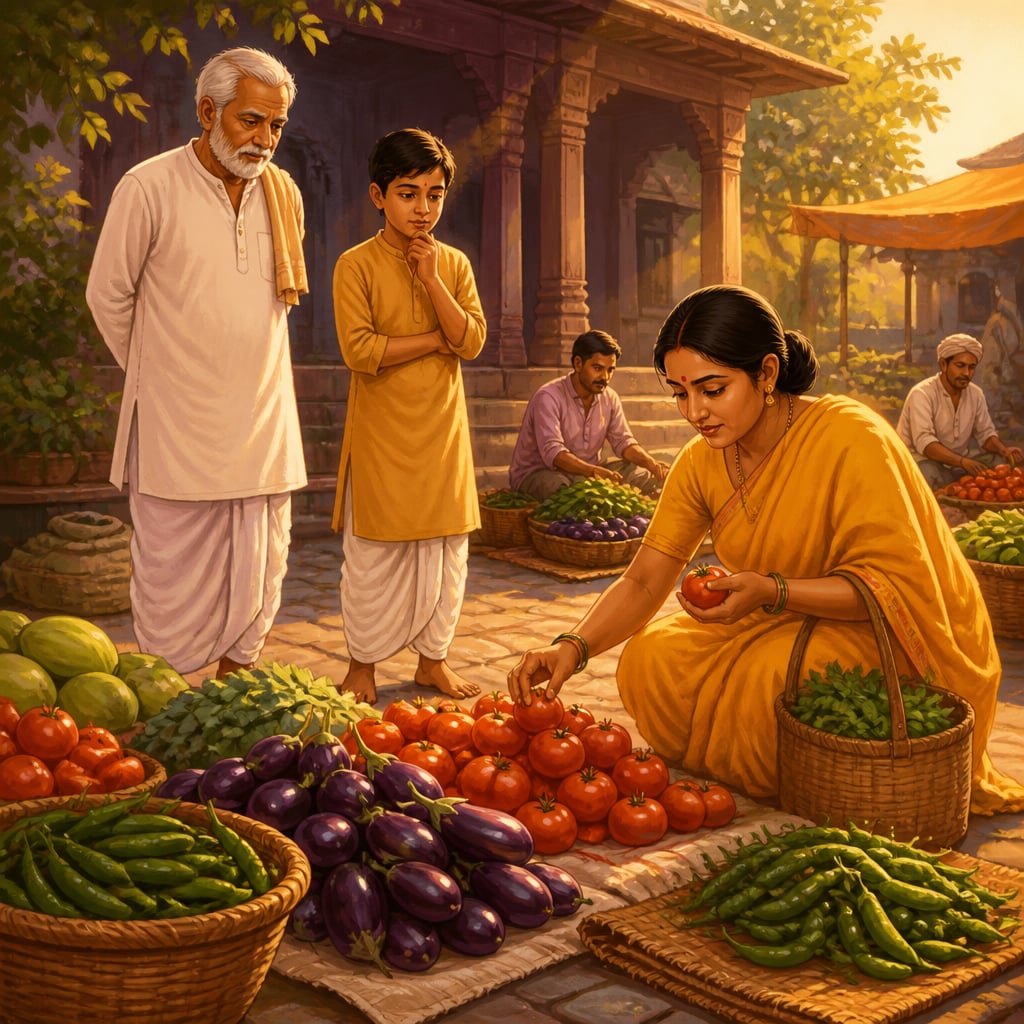
Morning vegetable market with a customer carefully choosing tomatoes

"Why those tomatoes?" he asked his student.

"She needs tomatoes. These are available."

"Watch."

The woman picked up several tomatoes, set some back, chose others. She asked the vendor where they were from. She smelled one. Finally, she selected five and paid, then took a sixth smaller one the vendor offered as goodwill.

"A simple purchase," the teacher said as they walked on. "But notice: she trusted her senses over the vendor's words. She valued knowing the source. She maintained relationship by accepting the gift but not asking for it. She chose quality over quantity, smaller, firmer tomatoes. Her philosophy shaped a choice that seemed to have no philosophy in it."

The student was quiet, beginning to see differently.

"This," the teacher continued, "is vyavahāra, the practical expression of darśana. Your philosophy isn't what you say you believe. It's what you do at the vegetable stall."

Philosophy You Can't See

Every choice embodies a worldview, whether or not we notice. When you decide what to eat, how to spend money, which relationships to prioritize, how to respond to a stranger, these choices express philosophical commitments.

The Vedic tradition understood this. The elaborate dharmaśāstras weren't abstract ethics but practical guidance for daily life: how to conduct business, how to treat guests, how to raise children, how to manage household wealth. Philosophy lived in the kitchen and the marketplace, not only in the forest hermitage.

"dharme cārthe ca kāme ca mokṣe ca bharatarṣabha"

"In dharma, in artha, in kāma, and in mokṣa", the famous verse acknowledges that wisdom applies across all domains of life, not just the spiritual.

The Rig Veda itself contains hymns for domestic rituals, for prosperity, for protection of cattle and crops. The same seers who questioned cosmic origins also blessed household fires. Philosophy and practical life were never separate.

The Gṛhastha's Wisdom

The gṛhastha, the householder, occupies a central place in Vedic social structure. Unlike traditions that privilege renunciation as the only spiritual path, the Vedic system honored the householder as the foundation of dharmic society.

The gṛhastha dharma texts are remarkably specific. They address:

An ancient householder washing the feet of a traveling guest

Hospitality (atithi-satkar): A guest is to be honored as a divine visitation. Food must be offered before asking a visitor's business. The household that turns away a guest accumulates sin. This wasn't sentiment, it was practical philosophy about how humans should relate to strangers.

Daily meals (āhāra): Food was understood as transformation, matter becoming consciousness. What you eat shapes what you think. The five daily yajñas (offerings) included feeding beings before oneself. This philosophy shaped kitchen practice.

Household economics (artha): Wealth was legitimate (artha is a puruṣārtha), but how you earned and spent mattered. Honest dealing, fair measurement, maintaining reserves for difficult times, these practices expressed philosophical commitments.

Family relationships (kuṭumba): The household was a unit of dharmic practice. Parents taught children through example more than instruction. Elders were honored not from arbitrary custom but because wisdom accumulates through experience.

These weren't rules imposed from outside. They were practical expressions of the same philosophical insights we've explored: Ṛta (cosmic order) manifests in household order. Dharma (right relationship) applies to family as much as to kingdom. Śraddhā (tested trust) operates in choosing business partners and spouses.

In an age where philosophy is often confined to academic departments and 'spiritual life' is separated from 'real life,' the Vedic integration of darśana and vyavahāra offers corrective. Your philosophy is not what you claim in discussion but what you do at the vegetable stall, in the office, with your family. The test of understanding is not conceptual clarity but transformed conduct.

The Modern Indian Family's Darśana

Consider how philosophy expresses itself in contemporary Indian middle-class financial choices.

A modern Indian family deliberating gold versus investments

Gold vs. Stocks: Many Indian families maintain gold holdings that seem economically irrational to Western financial advisors. But this choice expresses a darśana: gold is tangible, inheritable, crisis-resistant, and culturally significant. It embodies a philosophy of wealth as security passed across generations, not maximized returns in one lifetime.

Property vs. Liquidity: The strong preference for real estate, often at the cost of liquidity, expresses a philosophy of rootedness. Land is permanent; cash is ephemeral. The family home is not just asset but identity. This may reduce portfolio optimization, but it serves a different purpose.

Insurance vs. Joint Family: Traditional joint families provided built-in insurance, the extended network absorbed individual shocks. As families nuclearize, insurance products partially replace this function. The choice between maintaining family networks and purchasing insurance expresses competing philosophies about how security is achieved.

Children's Education vs. Retirement Savings: Indian families frequently prioritize children's education over retirement security, sometimes to financial advisors' alarm. But this reflects a philosophy: children are the retirement security. Investment in their capability is investment in one's own future. The philosophy may be evolving, but it shapes choices.

Festivals vs. Investment: Significant portions of annual income go to festival expenses that produce no financial return. But these expenditures express a philosophy: life is not only accumulation but celebration, not only future but present, not only individual but communal.

None of these choices are "right" or "wrong" in abstract. Each expresses a darśana, a way of seeing wealth, security, relationship, and purpose. The financially "optimal" portfolio may be philosophically impoverished. The "irrational" gold purchase may be wisdom the spreadsheet cannot see.

Examining Your Vyavahāra

The teacher's question at the vegetable stall applies to every choice: "What philosophy does this express?"

Consider your own patterns:

How do you spend the first hour of your day? This choice expresses philosophy about what matters, what prepares you for the world, what deserves your freshest attention. The person who checks email first lives a different darśana than the person who meditates first.

What do you eat, and why? Taste, health, ethics, tradition, convenience, each prioritization expresses philosophical commitment. The Vedic attention to food as consciousness-shaping isn't primitive; it's recognition that this daily choice expresses and reinforces worldview.

How do you treat service workers? The person who sees the waiter, the driver, the cleaner as fellow beings lives a different philosophy than the person who sees only functions to be managed. Vyavahāra reveals actual values.

What do you do with surplus? Save, invest, give, spend? Each choice expresses philosophy about security, generosity, pleasure, and obligation. Your bank statement is a philosophical document.

How do you speak about the absent? The Rig Veda valued truth in speech (satya) as fundamental. What you say when someone isn't present to hear reveals your actual philosophy about relationship and integrity.

The Continuity of Darśana

The Vedic insight is that philosophy and practice cannot be separated. What you believe shows itself in what you do. What you do shapes what you become. The marketplace and the meditation cushion are equally fields of dharma.

The woman buying tomatoes was practicing philosophy. She may never have read a dharmaśāstra. But her attention, her trust in direct perception, her maintenance of relationship, her preference for quality, these expressed a darśana as surely as any textual commentary.

This is the practical implication of everything we've explored:

"Philosophy in everyday choices" is not a separate topic. It is what all philosophy has been pointing toward. The test of whether you have understood is not what you can explain but how you live.

The student, walking through the market with new eyes, began to notice: every transaction was a teaching, every choice a revelation, every ordinary moment an expression of darśana.

This seeing, this attention to the philosophy embedded in the ordinary, is itself the practice.

Behavioral economics research shows that spending on others produces more lasting happiness than spending on oneself. The Vedic insight that 'eating alone is sinful' is psychologically validated, generosity serves the giver as much as the receiver.

Organizations where resources are hoarded at the top perform worse than those where sharing is normative. The 'open kitchen' design at companies like Pixar reflects a philosophy: creativity emerges from connection, not isolation.

In ecosystems, hoarding creates fragility. Flows, of nutrients, energy, information, create resilience. The Vedic principle applies to systems: healthy systems share; sick systems accumulate at nodes.

Attachment theory research shows that how we treat close relationships shapes mental health, life satisfaction, and even physical health. The Vedic insight that relationships deserve sacred attention is psychologically validated.

Leaders who treat their teams as worthy of respect, not merely as resources to be managed, generate more loyalty, creativity, and performance. The 'servant leadership' model echoes the Vedic insight.

Systems are constituted by relationships, not by isolated nodes. Attending to relationship quality, treating connections as 'divine', strengthens the entire system.

Case studies

The Indian Middle-Class Portfolio: Philosophy in Financial Choices

Consider a typical urban Indian middle-class family's financial decisions. Despite decades of financial education promoting diversified portfolios, many families maintain what advisors call 'irrational' allocations: heavy investment in gold (often 20-30% of wealth), multiple real estate holdings (often illiquid), education spending that exceeds global benchmarks, and festival expenses that seem economically unproductive.

These choices express a coherent darśana, even if unarticulated. Gold represents tangible, inheritable, crisis-resistant wealth, a philosophy that security should be visible and transferable across generations. Real estate embodies rootedness and identity, 'land is permanent' reflects a philosophy of stability in a changing world. Education spending expresses the belief that children ARE the retirement plan, investing in their capability is self-investment. Festival expenses reflect a philosophy that life is not only accumulation but celebration, not only future but present, not only individual but communal. This isn't financial irrationality, it's a different rationality grounded in different philosophical assumptions about security, identity, relationship, and purpose.

Interestingly, this traditional allocation has often outperformed 'optimal' portfolios in Indian conditions. Gold has preserved value through rupee depreciation and market crashes. Real estate in growing cities has appreciated substantially. Children educated with sacrificial investment have indeed supported parents in old age. The 'irrational' philosophy has proven practically wise.

Financial choices express philosophical commitments. The spreadsheet captures one kind of truth; the family's lived philosophy captures another. What appears irrational from one darśana may be deeply rational from another. Vyavahāra reveals worldview, and sometimes the traditional worldview contains wisdom that modern optimization misses.

Behavioral economists studying Indian household financial decisions are finding that 'irrational' traditional allocations often embed risk-management wisdom that modern portfolio theory overlooks. Gold as inflation hedge, real estate as family anchor, and temple donations as community insurance all serve functions invisible to purely financial analysis.

Gold holdings in Indian households are estimated at over 25,000 tonnes, worth approximately $1.5 trillion, representing the largest private gold reserve in the world. This is not ignorance of financial theory but an alternative theory enacted through generations of family choices.

Gṛhastha Dharma: Philosophy in Ancient Household Life

The ancient dharmaśāstra texts, Manusmṛti, Yajnavalkya Smṛti, Apastamba Dharmasūtra, provide remarkably detailed guidance for household life. They address not only cosmic questions but practical matters: how to wake (facing east), how to eat (specific foods in specific seasons), how to earn (honest dealing), how to spend (proportions for family, guests, gods, and savings), how to treat servants, how to resolve disputes with neighbors.

These texts demonstrate that Vedic philosophy was intensely practical. The gṛhastha (householder) was not a lesser spiritual category but the foundation of dharmic society. The daily practices prescribed expressed philosophical principles: rising before dawn showed respect for natural rhythms (Ṛta). Hospitality to guests (atithi-satkar) expressed interconnection. Honest dealing in business expressed satya (truth). The five daily yajñas, offerings to gods, ancestors, guests, beings, and wisdom, structured the day around relationship and gratitude. This wasn't rule-following but philosophy embodied in daily life.

The gṛhastha tradition created civilizational continuity. Practices transmitted through household dharma, hospitality norms, food traditions, relationship patterns, economic ethics, have persisted for millennia. The 'joint family' system, though evolving, still shapes Indian society. The philosophy embedded in vyavahāra proved more durable than abstract systems.

Philosophy that doesn't reach daily practice remains incomplete. The dharmaśāstras understood that worldview must be embodied in waking, eating, earning, and relating, not held abstractly. The gṛhastha who practiced hospitality, honest dealing, and regular offering was living philosophy as surely as any renunciant in a forest ashram.

The resurgence of interest in daily rituals, from morning routines popularized by self-help culture to seasonal celebrations gaining new participants, reflects a recognition that philosophy must be lived in mundane daily acts to have any effect. The most transformative practices are not retreats or breakthroughs but the small repeated choices embedded in ordinary days.

The Manusmriti contains 2,684 verses across 12 chapters. The Apastamba Dharmasutra, one of the oldest dharmasutras (c. 450-350 BCE), prescribes daily routines beginning before sunrise and includes detailed guidance for the grihastha (householder) ashrama, which traditional texts describe as the foundation supporting all other three ashramas.

Reflection

More in Darśana: Philosophy as a Way of Living

All lessons in Darśana: Philosophy as a Way of Living · Rig Vedic Philosophy course