Śraddhā: Trusting Order Without Blind Faith
The Vedic Art of Tested Trust
Explore śraddhā, the Vedic concept of trust that emerges from inquiry, not suppression of doubt. Neither blind faith nor nihilistic skepticism, but confidence grounded in tested understanding.
"How do you know the sun will rise tomorrow?"
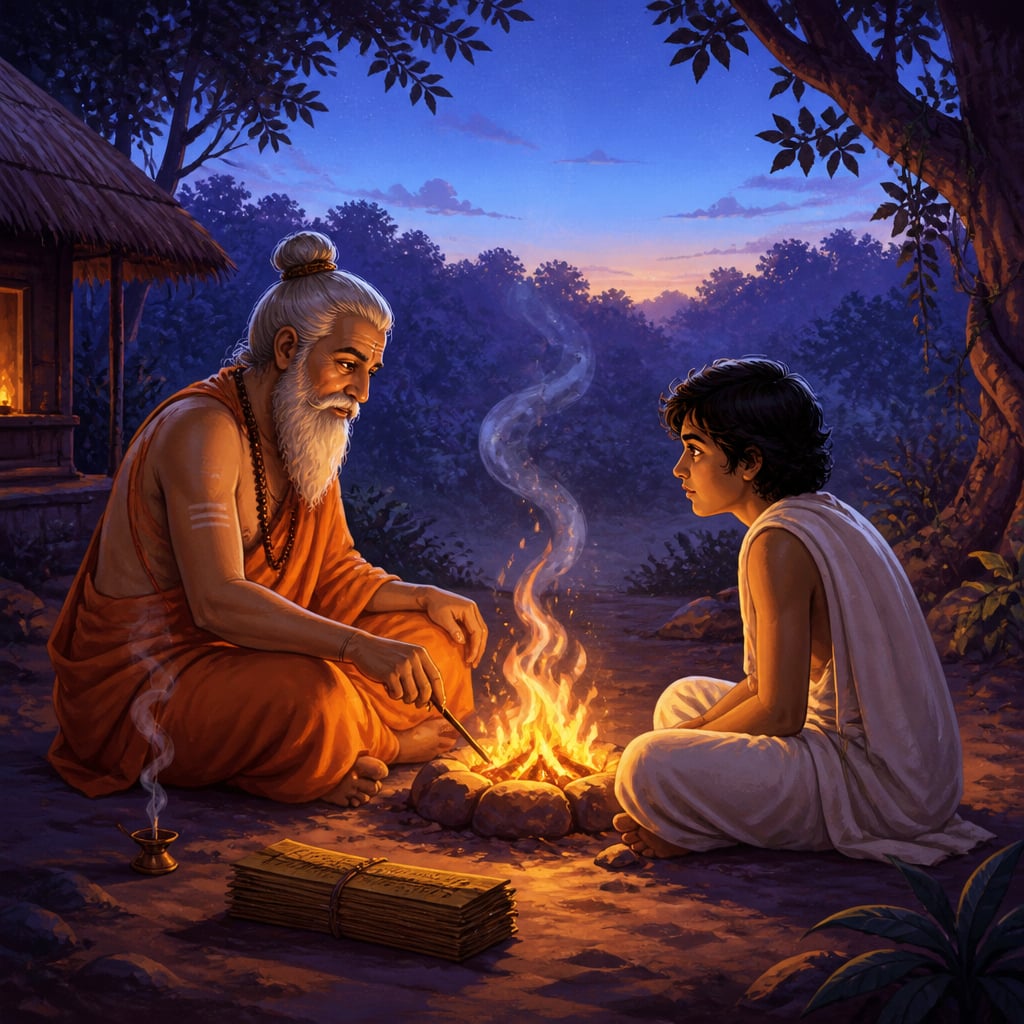
The question hung in the pre-dawn air. The student had been waiting for this moment, the moment to catch his guru in unexamined belief. He had heard the philosophers in the marketplace arguing that nothing could be truly known. Now he would expose even his teacher's certainties as mere faith.
The guru smiled, adding another stick to the fire. "I don't know," he said.
The student blinked. This was not the expected response.
"I don't know with the certainty you seem to be seeking," the guru continued. "The sun has risen every day of my life, and every recorded day before that. The patterns of Ṛta are consistent. But you want absolute proof that tomorrow must follow today. That I cannot give you."
"Then you believe on faith?"
"I trust on evidence. There is a difference." The guru looked east, where the darkness was beginning to lighten. "The traders who say 'nothing can be known', do they walk into walls? Do they refuse food, uncertain whether it will nourish them? Their philosophy contradicts their living. And the priests who demand belief without question, when their rituals fail, do they examine why, or do they blame the questioner?"
He paused. "Śraddhā is neither. It is trust that has been tested. It can be questioned, indeed, it must be questioned to become strong."
What Śraddhā Means, and What It Doesn't
We often translate śraddhā as "faith," but this imports associations from Abrahamic traditions that can mislead. Śraddhā is not belief despite evidence. It is not acceptance of authority without examination. It is not the suppression of doubt.
The word comes from śrat (heart/truth) + dhā (to place, to establish). Śraddhā is "placing one's heart in truth", a commitment to reality that emerges from engagement, not a leap that bypasses evidence.
The Rig Veda demonstrates this distinction. The same tradition that produced the Nasadiya Sukta's radical questioning, "ko addhā veda?" (who truly knows?), also speaks of śraddhā as essential for insight. These are not contradictions. Genuine inquiry and genuine trust are partners, not opponents.
"śraddhayā sattyamāpyate"
"Through śraddhā, truth is attained."
The verse does not say "through śraddhā, questions are silenced" or "through śraddhā, evidence becomes unnecessary." It says truth is attained, implying that śraddhā is a means of knowing, not a substitute for it.
Sayana and Aurobindo on Tested Trust
Sayana's commentary distinguishes śraddhā from tamas (ignorance) and moha (delusion). Śraddhā is aligned with sattva, clarity and truth. The person of śraddhā is not gullible but discerning. They place trust where trust has been earned, not where it has been demanded.
Sri Aurobindo deepens this: śraddhā is "the soul's belief in the Divine's existence, wisdom, power, and love." But crucially, this is not belief against evidence. For Aurobindo, the spiritual path itself is experimental, you practice, you observe results, you refine understanding. Śraddhā is the working hypothesis that enables the experiment; results confirm or challenge the hypothesis.
This is precisely how the Rishis approached their practice. The mantras were revealed (śruti), but they were also tested through generations of application. What worked was preserved; what didn't was refined. The tradition evolved through rigorous engagement, not through shielding beliefs from examination.
In an age of both religious fundamentalism (believe without questioning) and nihilistic skepticism (nothing can be trusted), the Vedic concept of śraddhā offers a mature middle path. Trust that has been tested, that enables action while remaining open to revision, is how humans actually navigate complex reality. This is not compromise between faith and doubt, it is their integration.
The Alternative to Nihilism and Credulity
Modern discourse often presents only two options: believe everything or trust nothing. Either accept authority without question, or dissolve into skepticism where no action can be justified.
The Vedic tradition offers a third way: tested trust. You don't believe blindly, you engage. You don't reject all trust, you recognize that trust, properly placed and periodically examined, enables knowledge and action that pure skepticism cannot.
Consider: you cannot prove with logical certainty that food will nourish you, that friends will support you, that effort will yield results. But you have evidence. You have patterns. You have tested experience. This is sufficient basis for action, for living. The demand for certainty before every decision would paralyze you.
Śraddhā is the practical wisdom of acting on well-grounded trust while remaining open to revision. It is how humans actually navigate reality successfully.
India's Semiconductor Mission: Śraddhā in National Capability
In 2021, India announced the India Semiconductor Mission, a ₹76,000 crore ($10 billion+) initiative to build a domestic semiconductor ecosystem. Critics were quick to doubt. India had tried before and failed. The technology was complex. Global players had decades of head start. Why would this time be different?
The response embodied śraddhā, not blind faith that success was guaranteed, but tested trust based on evidence.
What evidence? India had already demonstrated capability in adjacent domains. ISRO had built world-class space technology at fraction of global costs. Indian IT services had scaled to global dominance. Indian pharmaceutical companies manufactured complex generics for the world. The capability to execute complex technology projects was not speculative, it was demonstrated.
Minister Ashwini Vaishnaw articulated this explicitly: "We are not starting from zero. We have proven what Indians can do when given the opportunity. The question is not whether we can, we have already shown we can. The question is how we organize to do this particular thing."

By 2024, Micron had broken ground on a ₹22,500 crore assembly and test facility in Gujarat. Tata Electronics announced India's first commercial semiconductor fab. The ecosystem was taking shape, not through blind optimism, but through trust grounded in capability.
Nachiketa: The Boy Who Questioned Death

The Katha Upanishad tells of Nachiketa, a young Brahmin boy sent to the house of Yama, Lord of Death. There, he was granted three boons. For his third boon, Nachiketa asked the ultimate question: "What happens after death? Does the self persist, or does it not?"
Yama tried to deflect. He offered wealth, power, long life, beautiful companions, anything but this answer. Nachiketa refused everything. "These things end. Only this knowledge lasts. I will not accept a lesser boon."
What's remarkable is not just Nachiketa's persistence but the tradition's celebration of it. The Upanishad presents his questioning not as impiety but as the highest aspiration. Even Death must yield to genuine inquiry.
And when Yama finally teaches, he does not demand blind acceptance. He explains, he illustrates, he guides Nachiketa through direct understanding. The teaching culminates not in belief but in realization, direct seeing that transforms the knower.
This is śraddhā in action: Nachiketa trusted that truth could be found, that Yama could reveal it, that inquiry was worthwhile. But this trust fueled inquiry rather than replacing it. He did not believe because Yama said so; he understood because Yama guided his seeing.
The Practice of Śraddhā
Śraddhā is cultivated, not simply declared. The Vedic tradition offers guidance.
Begin with observation, not conclusion. Before trusting a teacher, a practice, or a path, observe carefully. Does this person live what they teach? Does this practice produce the claimed results? Śraddhā placed prematurely is gullibility; śraddhā placed after examination is wisdom.
Question without dismissing. The skeptic who dismisses everything avoids the vulnerability of trust. But they also avoid the possibility of learning from sources beyond their current understanding. Question sincerely, then genuinely consider the response.
Revise when evidence demands. Śraddhā is not stubbornness. Trust that cannot be updated in light of new evidence has become attachment. The Rishis revised their understanding across generations; we can revise ours within a lifetime.
The guru by the fire understood this. "Śraddhā is neither credulity nor doubt," he concluded as the first light touched the horizon. "It is trust that has been earned and can be questioned. It is how we live in a world where certainty is unavailable but action is required."
The sun rose. Not because belief made it so, but because Ṛta, cosmic order, is consistent enough to trust.
Research on 'self-efficacy' (Albert Bandura) shows that belief in one's capability to succeed is essential for attempting challenging tasks. This is not blind optimism but trust grounded in evidence of past capability, exactly śraddhā.
Organizations that trust their people's capability, based on demonstrated performance, outperform those that either blindly assume competence or cynically doubt everyone. Google's early policy of trusting engineers reflects śraddhā in action.
Systems change requires acting despite uncertainty about outcomes. Pure skepticism paralyzes; blind faith wastes resources. Śraddhā, acting on well-grounded trust while learning, is how systems actually improve.
Psychologist Todd Kashdan's research shows that curiosity, the drive to question, correlates with greater well-being and life satisfaction. Questioning and trust in meaning are not opposites but partners.
The best leaders encourage questioning as a sign of engagement, not disloyalty. Ed Catmull at Pixar institutionalized 'Braintrust' meetings where harsh feedback was expected, this was śraddhā that good work could emerge from honest inquiry.
Peter Senge's 'learning organizations' are built on the principle that inquiry improves systems. Questioning is not lack of trust in the organization but trust that the organization can improve.
Case studies
India's Semiconductor Mission: Trust Based on Demonstrated Capability
When India announced the ₹76,000 crore India Semiconductor Mission in December 2021, skeptics were quick to doubt. India had tried before, the failed SCL Mohali venture in the 1980s. Semiconductor manufacturing is extraordinarily complex: multi-billion-dollar fabs, supply chains spanning continents, technology that changes every two years. Global leaders had decades of head start. Why would India succeed now?
The government's response embodied śraddhā, not blind faith that success was guaranteed, but tested trust based on demonstrated capability. The evidence: ISRO had built world-class space technology at a fraction of global costs. Indian IT services had scaled to global dominance against initial skepticism. Indian pharmaceutical companies had become the world's generic pharmacy. Tata had successfully acquired and turned around Jaguar Land Rover. The pattern was clear: given strategic focus and capital, Indian industry could compete at the global frontier. This wasn't hope, it was inference from evidence. Śraddhā grounded in demonstrated capability.
By 2024, the semiconductor ecosystem was taking concrete shape. Micron Technology broke ground on a ₹22,500 crore assembly and test facility in Gujarat, the company's first greenfield investment in Asia in two decades. Tata Electronics announced India's first commercial semiconductor fab in partnership with Taiwan's Powerchip. The Japan-India semiconductor partnership was formalized. These weren't speculative announcements but committed investments from companies betting real capital.
Śraddhā is not the same as hope. Hope wishes; śraddhā trusts based on evidence. India's semiconductor initiative trusted capability that had been demonstrated in other domains. This is how genuine faith operates: not 'we believe despite evidence' but 'we trust because of evidence.' The questions were not suppressed, they were answered with demonstrated track record.
India's track record in building complex systems at scale, from UPI processing billions of transactions to Aadhaar enrolling over a billion citizens, provides the evidence base for trust in newer ventures like semiconductors. Genuine confidence is built on demonstrated capability, not on hope or hype.
By 2024, total committed investments in India's semiconductor ecosystem exceeded ₹1.5 lakh crore, with five major facilities announced from Micron, Tata, CG Power, and others.
Nachiketa and Yama: Questioning as the Highest Devotion
The Katha Upanishad tells of Nachiketa, a young Brahmin whose father, in a fit of irritation during a sacrifice, declared: 'I give you to Death.' Nachiketa, taking this literally, traveled to Yama's abode. Finding Yama absent, he waited three days without food. When Yama returned, embarrassed at having neglected a Brahmin guest, he offered Nachiketa three boons. For his third boon, Nachiketa asked the question that had driven sages for millennia: 'When a person dies, some say he exists, others say he does not. What is the truth?'
Yama tried everything to deflect this question. He offered Nachiketa vast wealth, kingdoms, long life, beautiful companions, elephants and horses. 'Ask anything else,' Yama pleaded. 'This knowledge is subtle; even the gods have doubted it.' Nachiketa refused every distraction. His śraddhā, his tested trust that truth could be known and was worth knowing, drove his persistence. This was not blind faith; it was faith precisely because it demanded answers, not deflection. The tradition celebrates Nachiketa's questioning as the highest form of spiritual aspiration.
Yama, recognizing Nachiketa's worthiness, taught him the nature of the Self, the immortal essence that persists beyond death. But crucially, this teaching was not 'believe this because I say so.' Yama guided Nachiketa through understanding: the Self is subtler than the subtle, greater than the great. The teaching culminated in direct realization, not mere belief. Nachiketa's questioning led not to more belief but to knowing.
The tradition presents Nachiketa as exemplar precisely because he questioned relentlessly. His śraddhā was not belief despite doubt but trust that enabled inquiry. He trusted that truth existed, that it could be known, that persistent questioning would reveal it. This śraddhā drove his refusal to accept lesser answers. The Katha Upanishad teaches that questioning and faith are not opposites, genuine questioning is faith in action.
The most productive researchers, founders, and artists share Nachiketa's quality: persistent questioning driven by trust that answers exist. This combination of relentless curiosity and underlying faith in the inquiry process itself distinguishes productive seekers from both passive believers and cynical skeptics.
The Katha Upanishad contains 119 verses across 6 sections (vallis) in 2 chapters. It is one of the mukhya (principal) Upanishads commented upon by Shankaracharya. Nachiketa's three-night wait at Yama's door earned him three boons, and his third question about the nature of the Self produced one of the earliest systematic teachings on Atman in Upanishadic literature.
Reflection
- What do you trust deeply that you have never actually tested? What might happen if you examined it carefully, would the trust strengthen or would you discover it was assumption?
- Nachiketa refused wealth, power, and long life to pursue his question about death. What question is so important to you that you would refuse distractions to pursue it?
- Can doubt and faith coexist? Is there a form of trust that becomes stronger through questioning rather than weaker? What would that look like in practice?