Anāgraha: Living Without Rigid Beliefs

The Vedic Art of Holding Views Lightly

Explore how the Rig Veda models intellectual flexibility, holding beliefs firmly enough to act on, loosely enough to revise when reality teaches otherwise.

The fire had burned low when the elder Rishi posed his question. Around him sat seven younger seers, their faces lit by dying embers. They had been discussing the Nasadiya Sukta, the hymn of creation's mystery, for three days.
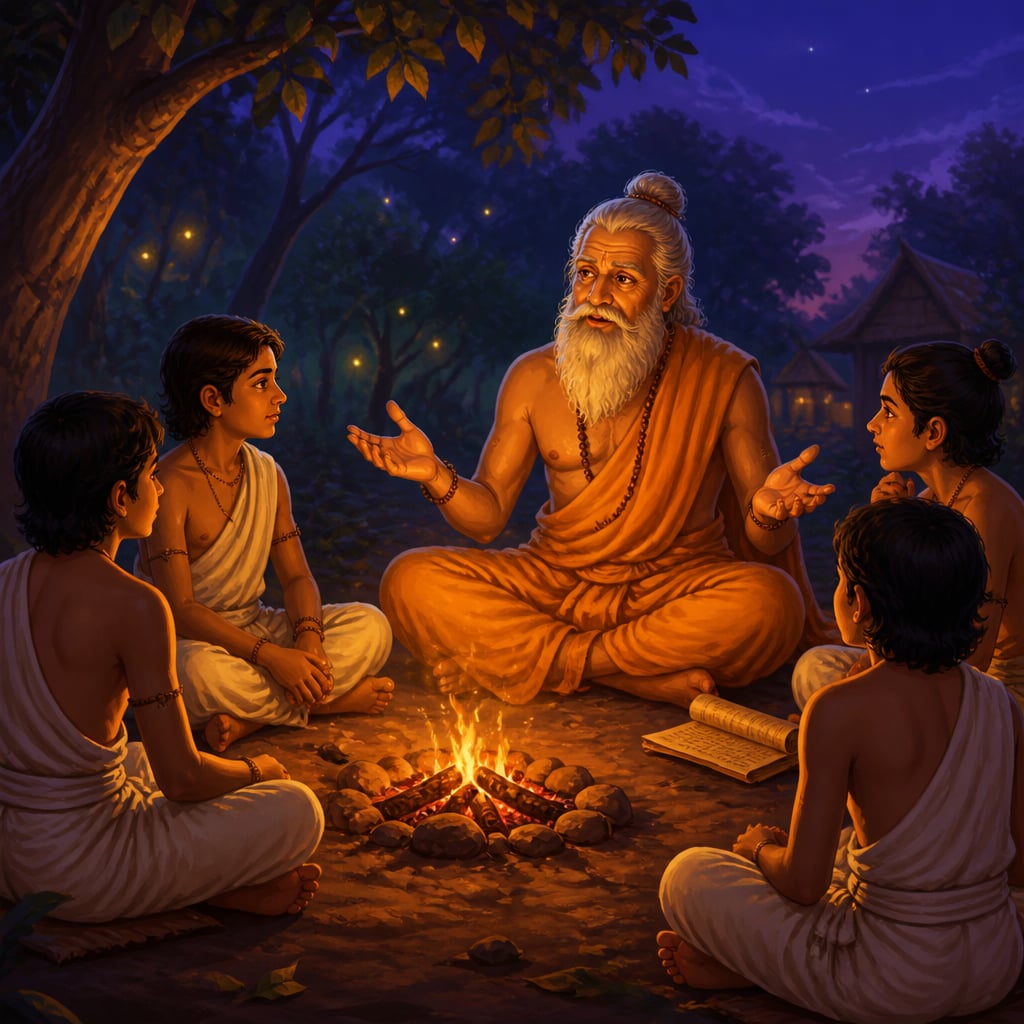
Elder rishi posing a question to young students by a low evening fire

"Ko addhā veda?" the elder repeated. "Who truly knows? The verse asks this. Now I ask you: is this question a failure of knowledge, or its highest form?"

Silence. One young Rishi finally spoke: "Surely, Guru, it is frustration. The seer wishes to know but cannot."

The elder smiled. "If that were so, why does the verse not weep? It declares uncertainty without despair. It holds the question without grasping for answer. This", he gestured to the space between his palms, "is anāgraha. The wisdom of the ungrasped."

The Problem with Grasping

The Sanskrit word āgraha means grasping, seizing, holding tightly. Its opposite, anāgraha, points to a different relationship with beliefs: holding without clutching, maintaining without rigidity.

This distinction matters because rigid beliefs create blind spots. When we grasp a position too tightly, we cannot see evidence that contradicts it. The mind that knows it is right stops learning. The Rig Veda demonstrates an alternative.

Consider: the Vedas contain not one but multiple creation accounts. The Nasadiya Sukta (RV 10.129) asks whether anyone can know creation's origin. The Purusha Sukta (RV 10.90) describes cosmic sacrifice. The Hiranyagarbha Sukta (RV 10.121) presents the golden embryo. The Vishvakarman hymns (RV 10.81-82) speak of the divine craftsman.

These are not errors to be harmonized. They are deliberate plurality, the tradition's way of saying: truth is larger than any single formulation.

What Sayana and Aurobindo Teach

Sayana, commenting on the apparent contradictions between Vedic hymns, notes that different Rishis perceived different aspects of the same reality. No single hymn captures everything. The multiplicity is not confusion but completeness, like viewing a mountain from different angles.

Sri Aurobindo goes further. In The Secret of the Veda, he argues that Vedic symbolism operates on multiple levels simultaneously. The same hymn speaks to the ritualist, the philosopher, and the mystic. Rigid interpretation closes off layers of meaning; flexible reading opens them.

"yaṃ devāso 'vatha vājaṃ saneyam"

"Whatever god you approach, may I gain the prize."

This line from RV 1.27.13 captures the spirit: the Rishi is not committed to a single deity but open to truth wherever it appears. The goal is insight, not ideological loyalty.

The Trap of Certainty

Modern psychology has documented what the Rishis intuited: certainty feels good but often misleads. Researchers call it "cognitive closure", the drive to eliminate ambiguity and reach definite answers.

High need for cognitive closure predicts:

The Vedic approach inverts this. The Nasadiya Sukta's questioning is not weakness but strength, the strength to hold open questions without anxiety, to maintain positions without calcifying them.

This does not mean believing nothing. The Rishis clearly believed in Ṛta (cosmic order), in the efficacy of ritual, in the possibility of enlightenment. But they held these beliefs with open hands, ready to deepen understanding when experience demanded.

In an age of polarization and rigid ideologies, the Vedic model of anāgraha offers a third way: conviction without rigidity, commitment without closed-mindedness. The tradition demonstrates that one can hold positions firmly enough to act while remaining open to revision. This is not weakness but the highest form of intellectual integrity.

ISRO's Lesson in Flexibility

ISRO mission control silent after Chandrayaan-2 lost contact

On September 7, 2019, ISRO's Chandrayaan-2 lander lost contact 2.1 kilometers above the lunar surface. Years of work, billions of rupees, the hopes of a nation, all ended in 47 seconds of silence.

What happened next demonstrates anāgraha in action. ISRO did not defend their original approach. They did not blame external factors or insist their calculations had been correct. Instead, they examined every assumption.

The investigation revealed multiple factors: software that couldn't handle certain trajectory deviations, a landing site more challenging than anticipated, and an overly complex descent pattern. Each assumption had seemed reasonable. Together, they had proven fatal.

Chandrayaan-3, launched in July 2023, incorporated these lessons. The landing zone was larger. The descent pattern was simpler. The software had more autonomy to respond to unexpected conditions. Most importantly, the team approached the mission with what ISRO chairman S. Somanath called "a more humble mindset."

Chandrayaan-3 Vikram landed on the lunar south pole

On August 23, 2023, Vikram touched down successfully. India became the fourth nation to land on the moon, and the first to land near the lunar south pole.

The Practice of Anāgraha

How do you hold beliefs firmly enough to act on them, loosely enough to revise them? The Rishis offer guidance.

First, distinguish principles from positions. Principles are deep commitments: truth matters, suffering should be reduced, learning is valuable. Positions are current best guesses about how to enact principles. ISRO's principle, Indian excellence in space exploration, never changed. Their positions about landing trajectories did.

Second, cultivate the question behind the question. When you find yourself defending a view, ask: "What am I really committed to here?" Often the deeper commitment survives even when surface beliefs evolve.

Third, practice the Nasadiya stance. When facing genuine uncertainty, resist the urge to fabricate certainty. "I don't know yet" is not failure. It is the honest ground from which real knowledge grows.

The elder Rishi by the fire understood this. His question was not rhetorical. He was teaching his students to hold the Nasadiya Sukta's mystery as the Rishis held it, not as problem to be solved but as space to inhabit. Truth reveals itself to the mind that remains open.

Carol Dweck's research on 'growth mindset' shows that treating setbacks as learning opportunities (rather than proof of inadequacy) predicts success across domains. The Nasadiya stance, honest uncertainty, creates psychological space for growth.

Amy Edmondson's research on 'psychological safety' demonstrates that teams where members can admit uncertainty and mistakes outperform teams that demand constant confidence. ISRO's post-Chandrayaan-2 culture exemplifies this.

Complex systems generate unexpected outcomes. Donella Meadows emphasized that 'the ability to recognize that your mental models are incomplete' is the most crucial systems skill. This is anāgraha applied.

Cognitive flexibility, the ability to hold multiple perspectives simultaneously, is a hallmark of psychological maturity. Research shows it predicts better relationships, more creative problem-solving, and greater resilience.

Organizations that can hold multiple strategic hypotheses simultaneously outperform those that commit prematurely to single approaches. 'Ekaṃ sat, bahudhā' is essentially 'one goal, multiple experiments.'

Systems thinking requires multiple mental models, no single framework captures a complex system. The Vedic approach of legitimate plurality anticipates this insight by millennia.

Case studies

ISRO's Journey from Chandrayaan-2 to Chandrayaan-3

On September 7, 2019, ISRO's Chandrayaan-2 lander Vikram lost contact just 2.1 kilometers above the lunar surface. The mission had been technically ambitious, attempting a soft landing in unexplored terrain near the lunar south pole. The failure was public, devastating, and watched by millions. Prime Minister Modi consoled a visibly emotional ISRO chairman K. Sivan on live television.

What followed demonstrated anāgraha, non-grasping of previous assumptions. ISRO did not defend their original approach or blame external factors. They conducted a root cause analysis that questioned everything: the landing algorithm, the descent trajectory, the autonomous decision-making software, even the choice of landing site. Chairman S. Somanath later described the process: 'We had to admit what we didn't know and couldn't control.' This Nasadiya stance, honest uncertainty about their own methods, enabled genuine learning.

Chandrayaan-3, launched July 14, 2023, incorporated every lesson. The landing zone was larger. The descent was gentler and more conservative. The software had greater autonomy to respond to unexpected conditions. On August 23, 2023, Vikram touched down successfully, making India the fourth nation to soft-land on the moon and the first to reach the lunar south pole.

Failure teaches only those who hold their beliefs loosely enough to revise them. ISRO's principle, Indian excellence in space, never wavered. Their positions about how to achieve it transformed completely. This is anāgraha: commitment to goals, flexibility about methods.

The most successful technology companies treat failure as data rather than disgrace. Amazon's institutional practice of writing 'post-mortems' after failed projects, and SpaceX's public celebration of rocket explosions as learning events, both reflect ISRO's approach: hold the mission constant while treating methods as revisable.

Chandrayaan-3 succeeded with a mission cost of approximately ₹615 crores (~$75 million), less than the budget of many Hollywood films, and a fraction of comparable Western missions.

The Rig Veda's Multiple Creation Hymns

The Rig Veda contains at least five distinct creation accounts: The Nasadiya Sukta (RV 10.129) questions whether creation's origin can be known at all. The Purusha Sukta (RV 10.90) describes cosmic sacrifice of a primordial being. The Hiranyagarbha Sukta (RV 10.121) presents the Golden Embryo. The Vishvakarman hymns (RV 10.81-82) speak of divine craftsmanship. The Devi Sukta (RV 10.125) centers creative power in Vāc, sacred speech.

A rigid tradition would have harmonized these into a single 'correct' account, eliminating apparent contradictions. The Vedic tradition did not. All five hymns were preserved, recited, and transmitted with equal reverence for millennia. This is 'ekaṃ sad viprā bahudhā vadanti' applied to cosmology itself: the wise speak of the One in many ways. The tradition recognized that creation's mystery exceeds any single formulation.

This pluralistic approach became foundational to Hindu philosophy. Later traditions (Sāṃkhya, Vedānta, Nyāya, etc.) developed different cosmologies, and all were considered legitimate darśanas. The Rig Veda's precedent established that philosophical diversity within unity is not error but depth.

When a tradition genuinely values truth over uniformity, it preserves multiple perspectives. The Rig Veda's editors could have selected one creation account. Instead, they recognized that bahudhā, many-foldness, serves truth better than artificial consistency. Holding multiple frameworks simultaneously is sophisticated, not confused.

Holding multiple competing hypotheses simultaneously is the standard practice in cutting-edge scientific research, from dark matter theories to COVID-19 treatment protocols. Fields that prematurely converge on a single explanation consistently produce worse outcomes than those that maintain productive pluralism.

The Rig Veda contains 1,028 hymns (suktas) organized into 10 books (mandalas), totaling 10,552 verses. At least 5 distinct creation accounts appear across its text, including the Nasadiya Sukta (10.129), Purusha Sukta (10.90), Hiranyagarbha Sukta (10.121), Vishvakarman Sukta (10.81-82), and the Devi Sukta (10.125).

Reflection

More in Darśana: Philosophy as a Way of Living

All lessons in Darśana: Philosophy as a Way of Living · Rig Vedic Philosophy course