Relevance in 2026 and Beyond
Living Philosophy in an Age of Radical Uncertainty
How the Vedic principles of darśana, anāgraha, ṛta, śraddhā, artha, and vyavahāra apply to modern life, from navigating AI uncertainty to transforming organizations to finding meaning without absolute answers.
The Modern Challenge
You don't know if your job will exist in five years. Neither does anyone else.

As ChatGPT, Claude, and their successors reshape industries, a peculiar anxiety grips contemporary life, not merely economic anxiety, but something deeper. We've built a culture that demands certainty before action, expertise before speaking, guaranteed outcomes before commitment. And now we face a technological transformation where the honest answer to almost every question is: we don't know.
Will AI replace lawyers? Probably some, maybe most, possibly none. Will creative work survive? Depends on definitions that keep shifting. Will your children's education prepare them for a world we cannot predict? No honest educator can promise it will.
This isn't new, of course, the Rishis faced radical uncertainty too. But our cultural response has become brittle. We oscillate between false certainty (experts who claim to know the future) and paralyzed nihilism (nothing can be predicted, so why try). Neither serves us.
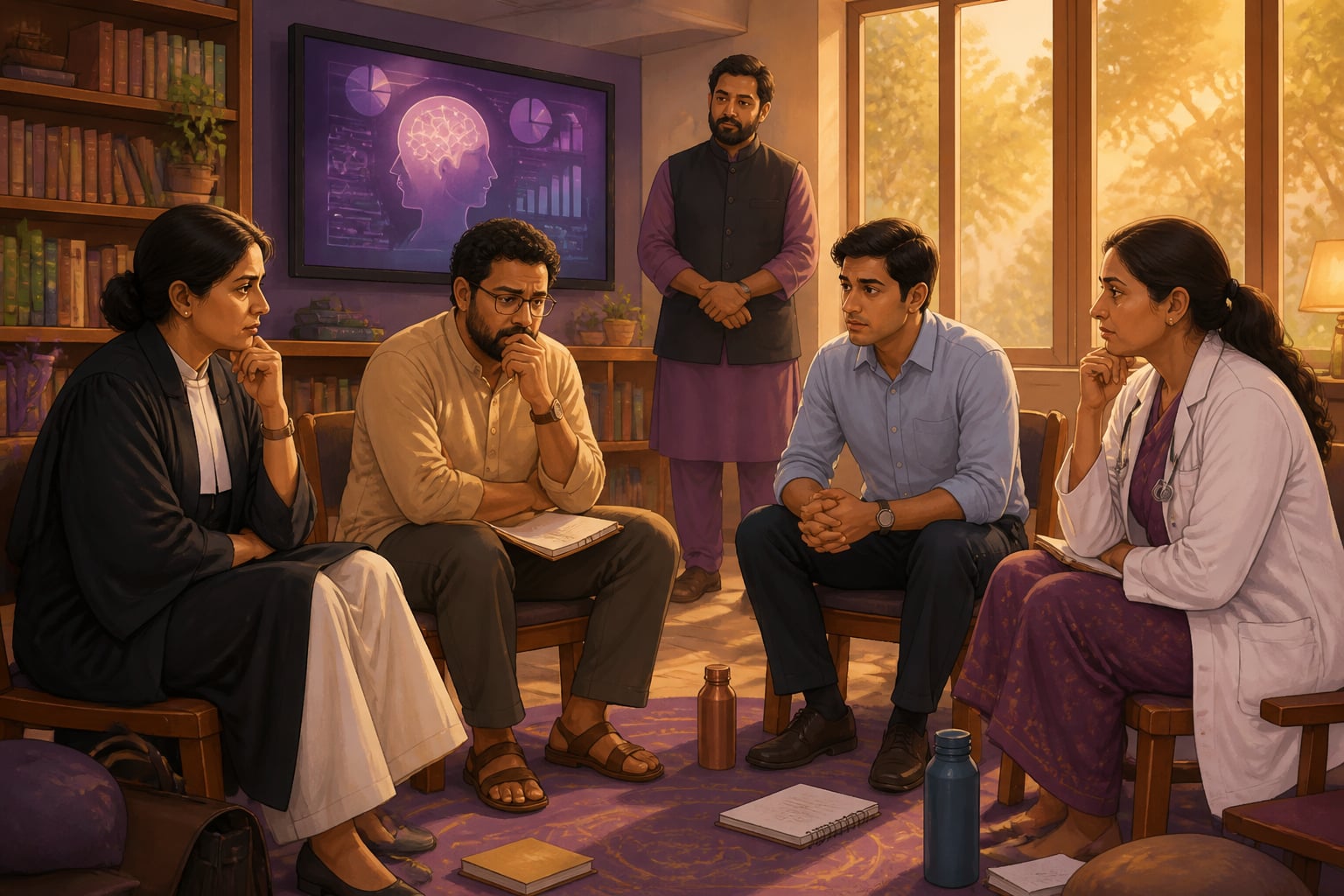
In 2024, a Pew Research study found that 52% of Americans report being "more worried than excited" about AI in daily life. Yet when asked why they're worried, responses fragment into contradictory concerns. The anxiety isn't about specific threats, it's about the uncertainty itself. We've forgotten how to hold open questions without distress.
What the Rishis Knew
This chapter has explored a Vedic approach to living philosophy, not philosophy as abstract theory but as embodied practice. The insights converge on a single recognition: you can live fully without having everything figured out.
Darśana (transformative seeing) taught us that philosophy isn't what you think but how you see. When seeing is genuine, action flows naturally. The gap between knowing and doing closes not through willpower but through the quality of perception itself.
Anāgraha (non-grasping) showed that certainty isn't strength, it's often rigidity wearing a mask. The Nasadiya Sukta's question "ko addhā veda?" (who truly knows?) wasn't defeat but wisdom. Holding views firmly enough to act, loosely enough to revise, this is mature understanding.
Ṛta (cosmic order) grounded ethics in reality rather than external enforcement. You act rightly not because punishment threatens but because you understand how things work. The universe doesn't need surveillance to maintain consequences.
Śraddhā (tested trust) offered the middle path between credulity and nihilism. Trust that has been examined, that enables action while remaining open to revision, this is how humans actually navigate irreducible uncertainty.
Artha (contextual meaning) demonstrated that purpose doesn't require metaphysical certainty. The Mahabharata finds profound meaning precisely within moral complexity, not by escaping it.
Vyavahāra (practical conduct) reminded us that philosophy lives in the marketplace and kitchen. Your actual worldview is what you do at the vegetable stall, not what you claim in discussion.
Together, these form a practical philosophy for uncertain times.
The Bridge: Ancient Wisdom, Modern Application
Consider how these principles apply to the AI uncertainty crisis specifically.
For individuals navigating career uncertainty: The demand for guaranteed career paths is a form of false certainty. Darśana suggests a different approach: see clearly what skills are actually valuable now, act fully in the present role, and remain flexible about trajectories. The meaning lies in engaged work, not in knowing how it all turns out.

For organizations adapting to change: Satya Nadella's transformation of Microsoft from a "know-it-all" to a "learn-it-all" culture embodies anāgraha in corporate form. The company that insists it has all the answers calcifies; the company that holds views lightly while acting decisively adapts.
For leaders making decisions without complete information: Every significant leadership decision involves acting despite uncertainty. Śraddhā, tested trust in principles, in team capability, in accumulated evidence, is what enables action. Not certainty, but sufficient grounds to proceed while remaining open to learning.
For parents and educators: Teaching children to tolerate uncertainty may be more valuable than any specific curriculum. The Vedic model suggests raising children who can hold open questions, who find meaning in engagement rather than guaranteed outcomes, who can act without paralysis when the future is genuinely unknown.
For anyone struggling with meaning: The AI anxiety is partly existential, if machines can do what we do, what are we for? The Vedic response: meaning was never located in what only humans can do. It's found in relationship, in attention, in the quality of engagement. Machines that write don't diminish the meaning of writing any more than printing presses did. What matters is your presence to what you're doing.
Addressing Skepticism
The skeptic might reasonably ask: "Why would 6,000-year-old wisdom help with AI disruption?"
First, a concession: the Rishis didn't face our specific challenges. They didn't contemplate large language models or technological unemployment. Claiming direct applicability would be intellectual dishonesty.
But they did face something more fundamental: the human struggle to live well amid radical uncertainty about origins, endings, and meanings. Their questions, "ko addhā veda?", resonate precisely because they're about the human condition, not specific technologies.
Second, an observation: purely modern frameworks haven't solved the meaning crisis. Despite unprecedented material abundance, psychological research shows rising rates of anxiety, depression, and reported meaninglessness, particularly among younger generations. The frameworks we've been using, achievement-orientation, outcome-obsession, certainty-demanding rationality, have produced their own pathologies.
The Vedic approach isn't a replacement for modern knowledge but a complement. It offers practices for living with uncertainty that our certainty-optimized culture has neglected.
Third, the test is practical: Does holding views more lightly reduce anxiety without reducing effectiveness? Does acting from understanding rather than fear produce more consistent ethics? Does meaning found in engagement prove more durable than meaning contingent on outcomes? Try it and observe.
Call to Practice
The course has explored philosophy; now comes the living of it.
Start with attention. Choose one daily activity and bring full presence to it this week. Notice if the quality of attention transforms the experience. This is darśana practice, seeing rather than merely looking.
Hold a view lightly. Identify one opinion you hold tightly. For one week, consider it provisional, still acting on it, but holding it as "current best understanding" rather than "certain truth." Notice if this changes how you engage with disagreement. This is anāgraha practice.
Act without certainty. Make one decision you've been postponing because you "don't have enough information." Act on the best available evidence, committed but adaptable. Notice if paralysis served any real purpose. This is śraddhā practice.
The Rishis would recognize our predicament: facing unknowable futures, seeking meaning without guarantees, trying to act rightly in a complex world. Their response wasn't certainty, it was a more mature relationship with uncertainty itself.
That relationship is available to you now. Not through belief in ancient texts, but through practicing what they practiced: seeing clearly, holding lightly, trusting discerningly, finding meaning in engagement.
The future is genuinely uncertain. That has always been true. The Vedic insight is that this uncertainty is not an obstacle to meaningful life but its natural condition. Philosophy helps not by providing answers but by changing how we hold the questions.
The marketplace continues. The choices continue. And in each one, darśana reveals itself, or doesn't. The practice begins wherever you are, with whatever is in front of you, right now.