Darśana: Thought as Action

How Vedic Seeing Transforms the Seer

Discover how the Rig Vedic concept of darśana reveals philosophy not as abstract thought, but as transformative seeing that changes both perception and action.

The first light had not yet touched the horizon when the Rishi rose from his mat by the Saraswati. The river moved in darkness, its sound older than memory. He walked to the water's edge, filled his hands, and lifted them toward where the sun would rise. Nothing visible yet, only the certainty that light would come.
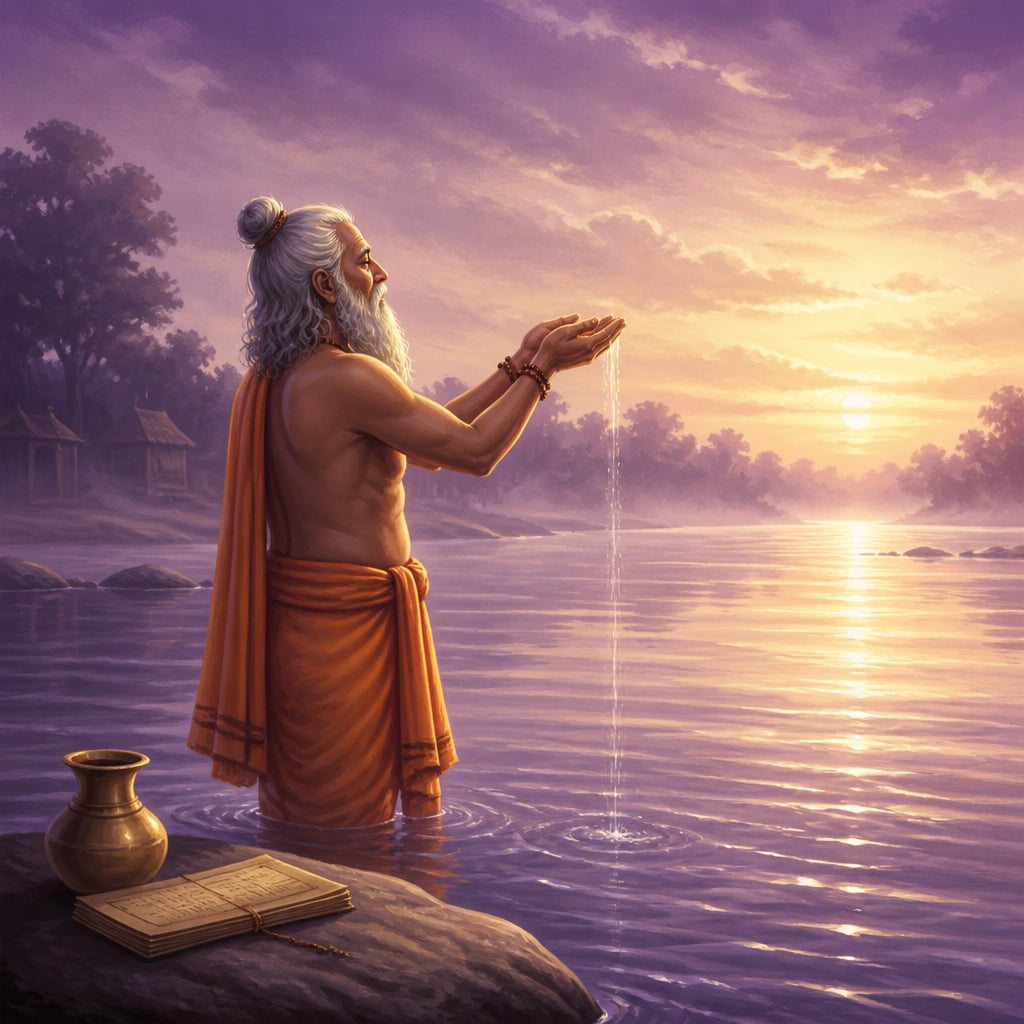
Rishi offering pre-dawn arghya at the Saraswati river

This was sandhya, the joining of night and day. But the Rishi was not merely watching dawn arrive. He was participating in it. His attention, his breath, his lifted palms were not separate from the cosmic event unfolding. In that moment, to see was to act.

The Vedic Meaning of Darśana

We translate darśana as "philosophy," but this misses something essential. The word comes from the root dṛś, to see, to perceive, to have vision. The Rishis were called draṣṭā, seers, not because they invented ideas but because they saw reality directly.

This distinction matters. Western philosophy often treats thought as preliminary to action, first you think, then you do. The Vedic tradition collapses this separation. Correct seeing is already action. When you perceive reality accurately, you are changed by the perception itself.

The Rig Veda expresses this directly:
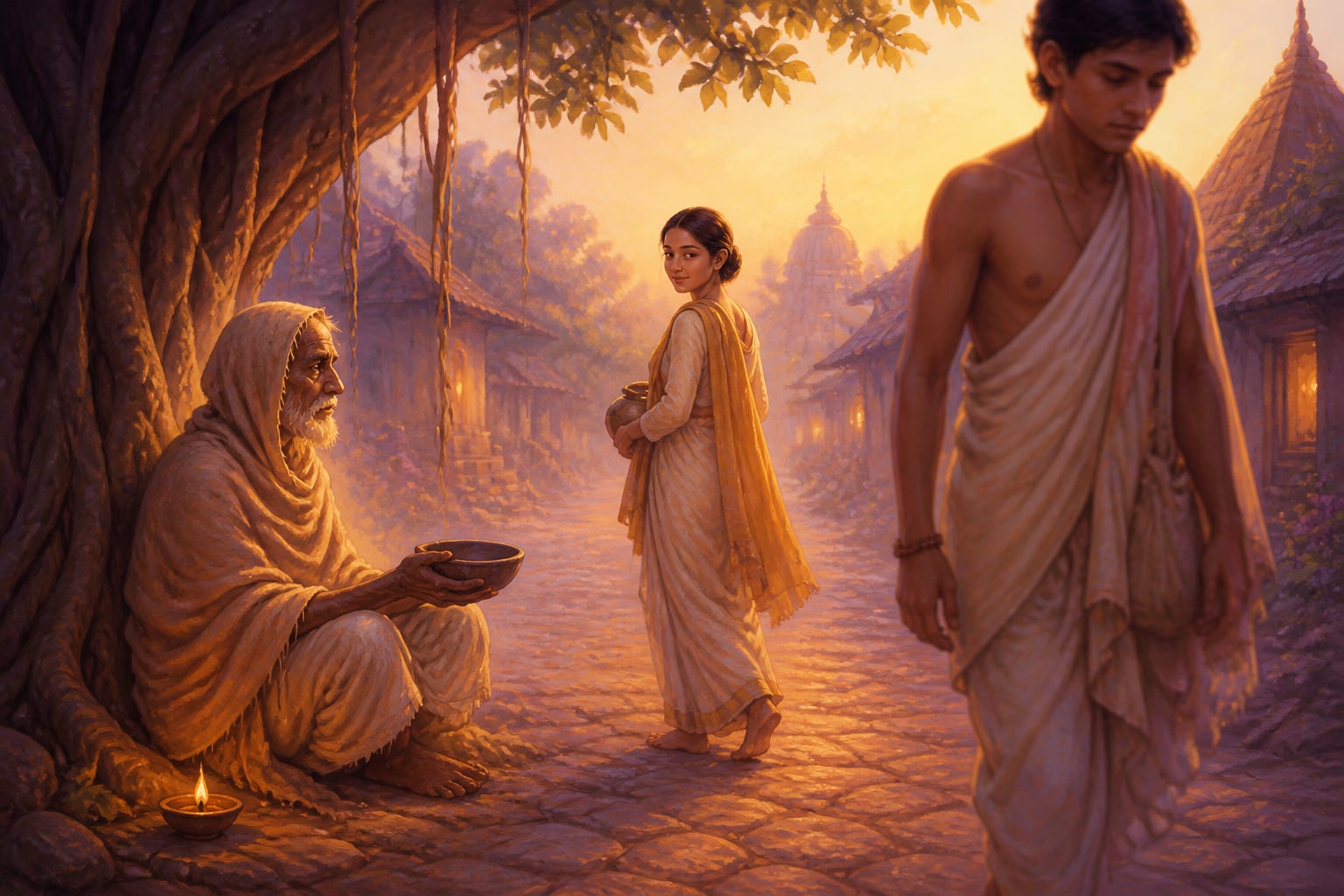
Two passersby look at a beggar, only one truly seeing

"uta tvaḥ paśyan na dadarśa vācam, uta tvaḥ śṛṇvan na śṛṇoty enām"

"One may look yet not truly see; one may hear yet not truly hear."

The mantra distinguishes surface perception from darśana. Looking is passive; seeing is transformative. The Rishi at the river was not observing dawn, he was seeing it, and in that seeing, participating in cosmic renewal.

Sayana and Aurobindo on Transformative Seeing

Sayana, the great medieval commentator, understood darśana as inseparable from the mantras themselves. The Vedic hymns were not composed through ordinary thought. They were seen, revealed to consciousness prepared by tapas (disciplined effort) and śraddhā (faith). The Rishi's role was to be transparent enough for truth to appear through them.

Sri Aurobindo developed this further in his psychological interpretation. For Aurobindo, Vedic darśana represents an integration of the outer and inner worlds. The gods (Devas) are both cosmic forces and psychological realities. When the Rishi "sees" Agni or Indra, it is not mere metaphor, the inner fire of aspiration and the outer fire of transformation are recognized as one.

This integration explains why Vedic philosophy cannot remain abstract. If Agni is both the fire on the altar and the fire of consciousness, then tending one tends the other. Thought and action merge.

Understanding darśana as transformative seeing, not abstract philosophy, reveals why Vedic wisdom emphasizes practice over theory. Modern philosophy often separates knowledge from action, treating ethics as a branch separate from epistemology. The Vedic integration of seeing and doing offers a radical alternative: genuine knowledge naturally manifests as right action. This is not moral instruction but ontological claim about the nature of true perception.

The Gap We Live With

Modern life often maintains a sharp boundary between what we believe and what we do. We might intellectually accept that kindness matters while acting unkindly. We might understand that anxiety rarely helps while remaining anxious. Our knowledge and our living stay disconnected.

The Vedic response is not moral instruction, do this, don't do that. It is an invitation to a different quality of seeing. When darśana is genuine, the gap between understanding and action narrows not through willpower but through transformation of the one who sees.

Consider: if you truly saw another person's suffering, not thought about it, not felt sympathy as a concept, but saw it with the directness of the Rishi seeing dawn, could you remain unchanged? The Vedic claim is that authentic seeing makes action natural, almost inevitable.

Living This Today

Dr. Devi Shetty pausing in his hospital corridor

Dr. Devi Shetty exemplifies this principle in contemporary India. As a cardiac surgeon trained at Guy's Hospital London, he could have built a lucrative private practice serving wealthy patients. Instead, his darśana, his way of seeing, made a different path inevitable.

"I saw that poor people in India were dying of heart disease not because we lacked surgical skills, but because healthcare was organized around the wrong assumptions," Shetty has explained. His seeing was not abstract analysis but direct perception that demanded response.

Narayana Health, which he founded in 2000, now performs more heart surgeries than any hospital in the world, at a fraction of Western costs. The transformation came not from better strategy but from a different way of seeing. When you truly see that a child's life has equal value regardless of family wealth, certain organizational forms become natural, others impossible.

Your Practice

The Rishis suggest that darśana can be cultivated. It begins with attention, the quality of presence you bring to experience. When you lift your morning cup of chai, are you merely looking at it or seeing it? When you greet a family member, are you hearing words or perceiving a person?

This is not mystical instruction. It is practical training in the integration of thought and action. The gap we live with, between what we know and what we do, narrows not through more thinking but through clearer seeing.

The Rishi at the Saraswati understood something we often forget: dawn does not need your attention to arrive, but you need your attention to participate in its arrival. The same is true for truth, for relationship, for meaningful work. Darśana is the bridge.

Research on 'perceptual set' shows we often see what we expect, not what's there. Genuine attention, what contemplatives call 'bare attention', reveals reality obscured by assumption.

Leaders who truly see their organizations, not through reports but direct perception, make decisions others cannot. Andy Grove's 'strategic inflection points' require darśana, not just data.

Systems thinkers distinguish 'events' (surface) from 'patterns' and 'structures' (depth). This parallels the Vedic distinction between looking and seeing.

The 'knowledge-behavior gap' is well-documented: knowing exercise is healthy doesn't make us exercise. Transformation requires not more information but deeper seeing.

Values statements mean nothing if not lived. Companies that 'walk the talk' have leaders whose darśana makes stated values inevitable, not aspirational.

Mental models shape perception, which shapes action. Shifting mental models, not adding information, creates systemic change.

Case studies

Dr. Devi Shetty: Seeing Healthcare Differently

In 2000, cardiac surgeon Dr. Devi Shetty founded Narayana Health in Bangalore with a radical premise: world-class heart surgery should be affordable for every Indian. At the time, a bypass surgery cost ₹3-4 lakhs in India, impossible for most families. Shetty had trained at Guy's Hospital London and operated on Mother Teresa. He could have built a premium practice. Instead, his way of seeing made a different path inevitable.

Shetty's transformation exemplifies darśana in action. He didn't analyze healthcare economics and devise a strategy. He saw something directly: 'A child's heart doesn't know if the family is rich or poor. Why should the surgery?' This seeing, not this thought, demanded response. Once you truly see that human lives have equal value, certain organizational forms become natural, others impossible. His darśana preceded his decisions.

Narayana Health now performs over 30,000 cardiac surgeries annually, more than any single hospital in the world, at costs starting from ₹80,000. Mortality rates match or exceed Western hospitals. The 'Walmart of heart surgery' model has inspired healthcare innovations globally. In 2024, Narayana Health operates 47 facilities across India and internationally.

Strategy follows seeing. Shetty didn't overcome obstacles through clever thinking, his darśana made certain obstacles simply not exist. When the fundamental seeing shifts, previously impossible becomes natural.

The frugal innovation movement across Indian healthcare, from Aravind Eye Care to Jaipur Foot, demonstrates the same principle: a different way of seeing the problem produces solutions invisible to conventional thinking. Cost is not a fixed constraint but a function of the framework through which you perceive the challenge.

Narayana Health's cardiac surgery costs are approximately 1/50th of comparable US procedures, with equivalent or better outcomes.

Vivekananda at Chicago: Darśana as World-Changing Action

On September 11, 1893, a young, unknown monk from India rose to speak at the Parliament of World Religions in Chicago. Swami Vivekananda began simply: 'Sisters and Brothers of America.' The audience of 7,000 erupted in a two-minute standing ovation before he could continue. In subsequent days, his addresses transformed global perception of Hinduism from 'primitive idolatry' to a sophisticated philosophical tradition.

Vivekananda's impact came not from rhetoric but from darśana. He didn't argue for Hindu philosophy, he embodied it. 'I have come to tell you that you are all Ātman, immortal spirit,' he declared. This wasn't assertion but direct vision shared. His address on 'the way of realization' spoke from lived experience, not learned doctrine. The audience didn't just hear ideas, they encountered someone who had seen.

Vivekananda's Parliament appearance catalyzed the first major encounter between Vedantic philosophy and Western thought. He established Vedanta centers across America and Europe, founded the Ramakrishna Mission (1897), and ignited a renaissance of Hindu intellectual confidence. His darśana continues to shape global understanding of Indian philosophy over 130 years later.

The Rishis taught that darśana transforms not only the seer but the world through the seer. Vivekananda's seeing of universal divinity, communicated through presence and speech, shifted the consciousness of thousands. Philosophy lived is philosophy transmitted.

Public intellectuals and thought leaders who shift cultural conversations, from Yuval Harari to Sadhguru, demonstrate that philosophical vision communicated through accessible presence can reach millions. The medium of personal conviction remains more persuasive than abstract argument, just as it was in 1893 Chicago.

Vivekananda's 1893 Chicago address was delivered to an audience of approximately 7,000 people. His opening words, 'Sisters and Brothers of America,' received a 2-minute standing ovation before he could continue. He went on to deliver 12 more lectures at the Parliament. The Ramakrishna Mission he founded in 1897 now operates over 200 centers in 15 countries.

Reflection

More in Darśana: Philosophy as a Way of Living

All lessons in Darśana: Philosophy as a Way of Living · Rig Vedic Philosophy course