Yajña: What Ritual Really Is
Beyond Superstition: Ritual as Cosmic Exchange
Exploring the Vedic concept of Yajña not as superstitious practice but as a sophisticated understanding of reciprocal exchange between humans, nature, and cosmos, and how this ancient insight illuminates our modern rituals.
You probably performed a dozen rituals before noon today. The specific mug for your morning coffee. The exact sequence of checking your phone. The particular route you take even when it's not the fastest. We call these "habits", and dismiss them as behavioral quirks.
The Rig Veda would disagree. What if these patterns aren't just psychological crutches, but something far more significant? What if the urge to ritualize is not a bug in human cognition, but a feature, one that connects you to something larger than yourself?
The Fire That Changed Everything
Picture the scene: dawn light filtering through smoke. A family gathered around a small fire, not for warmth but for something else entirely. The father carefully feeds ghee into the flames while his wife recites mantras, their children watching with a mixture of boredom and fascination. This is the Agnihotra, a ritual performed by Vedic householders every dawn and dusk for millennia.
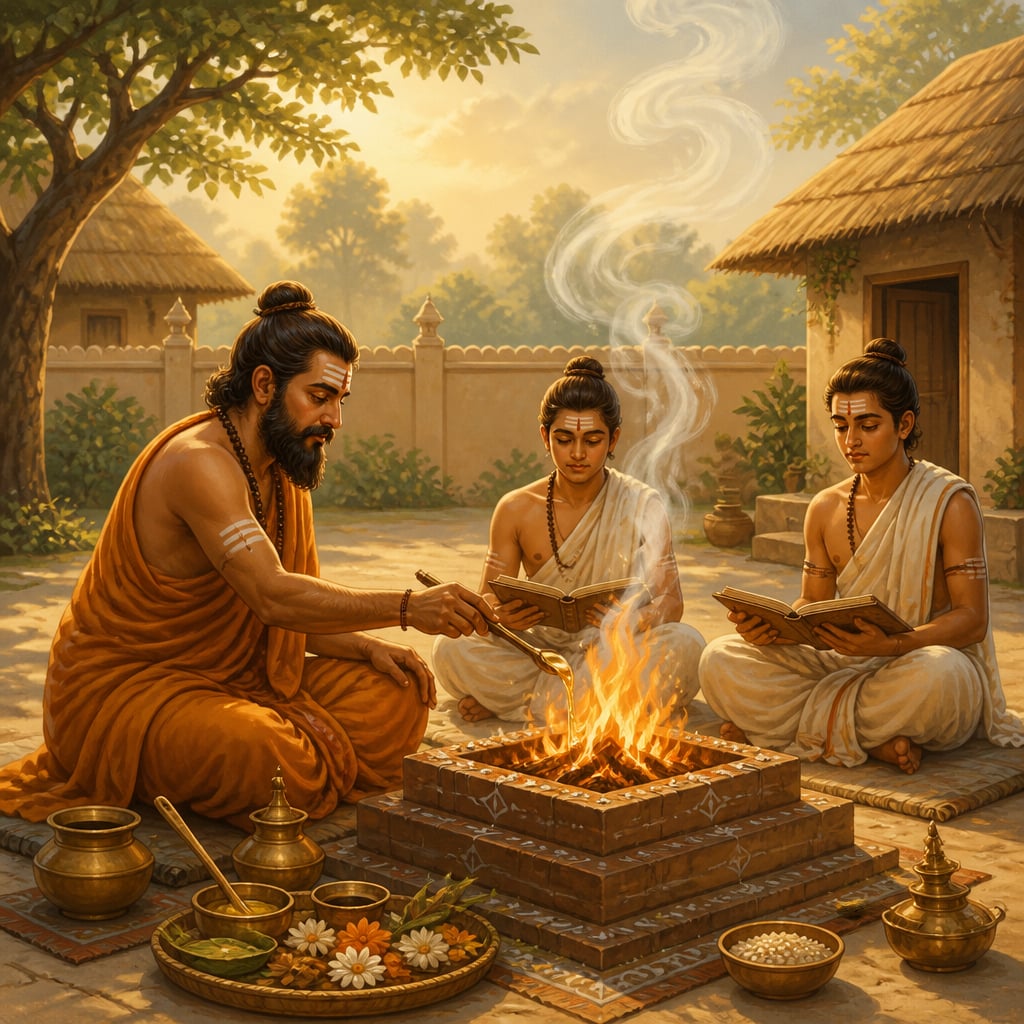
What were they doing? The Western anthropologist sees "primitive fire worship." The secular modernist sees "superstitious waste of resources." But the Rishis who composed the Rig Veda saw something else: a technology of connection.
"Agnimīḷe purohitaṃ yajñasya devam ṛtvijam" "I praise Agni, the household priest, the divine minister of the sacrifice." , RV 1.1.1
This opening verse of the entire Rig Veda tells us immediately: ritual (yajña) is not optional. It's foundational. Agni, fire, is the "purohita," the one who goes before, who mediates between human and divine, visible and invisible, offering and recipient.
Yajña: The Cosmic Exchange
The Sanskrit word yajña comes from the root yaj, meaning "to worship, to honor, to offer." But this is no one-way transaction. The Vedic understanding is radical: yajña is mutual exchange. Humans offer to the Devas (cosmic forces), and the Devas sustain the world that sustains humans.
"Devān bhāvayatānena te devā bhāvayantu vaḥ" "Nourish the Devas with this, and may the Devas nourish you." , Bhagavad Gita 3.11 (echoing Vedic principle)
This is not superstition. It's systems thinking before there was a name for it. The Rishis understood what modern ecology confirms: everything is connected. You cannot take without giving. You cannot receive without offering. The ritual makes this exchange conscious.
Sayana, the great 14th-century commentator, explains that yajña operates on multiple levels simultaneously:
- Physical: the actual offerings of ghee, grain, and soma
- Verbal: the mantras that carry intention through sound
- Mental: the focused awareness (saṅkalpa) of the performer
- Cosmic: the alignment with Ṛta, the universal order
Sri Aurobindo adds a psychological dimension: the external ritual is a symbol of the internal offering. When you pour ghee into fire, you are also learning to offer your ego into the transformative fire of awareness.
What Makes Ritual Different from Habit?
Here's the critical distinction the Rishis understood: a habit is unconscious repetition. A ritual is conscious participation.
When you reach for your coffee mug on autopilot, that's habit. When you pause, feel the warmth, acknowledge the farmers who grew the beans, the workers who transported them, the water that made it possible, that's ritual. Same action. Radically different meaning.
The Vedic framework identifies three elements that transform habit into ritual:
| Element | Sanskrit | Function |
|---|---|---|
| Intention | Saṅkalpa | Conscious purpose declared before action |
| Awareness | Dhyāna | Present-moment attention during action |
| Offering | Āhuti | Sense that action is given, not just done |
Without these elements, you're just going through motions. With them, you're participating in something that connects you to patterns far larger than your individual life.
The Radical Claim
The Rig Veda makes a claim that sounds outrageous to modern ears: ritual doesn't just express connection, it creates it.
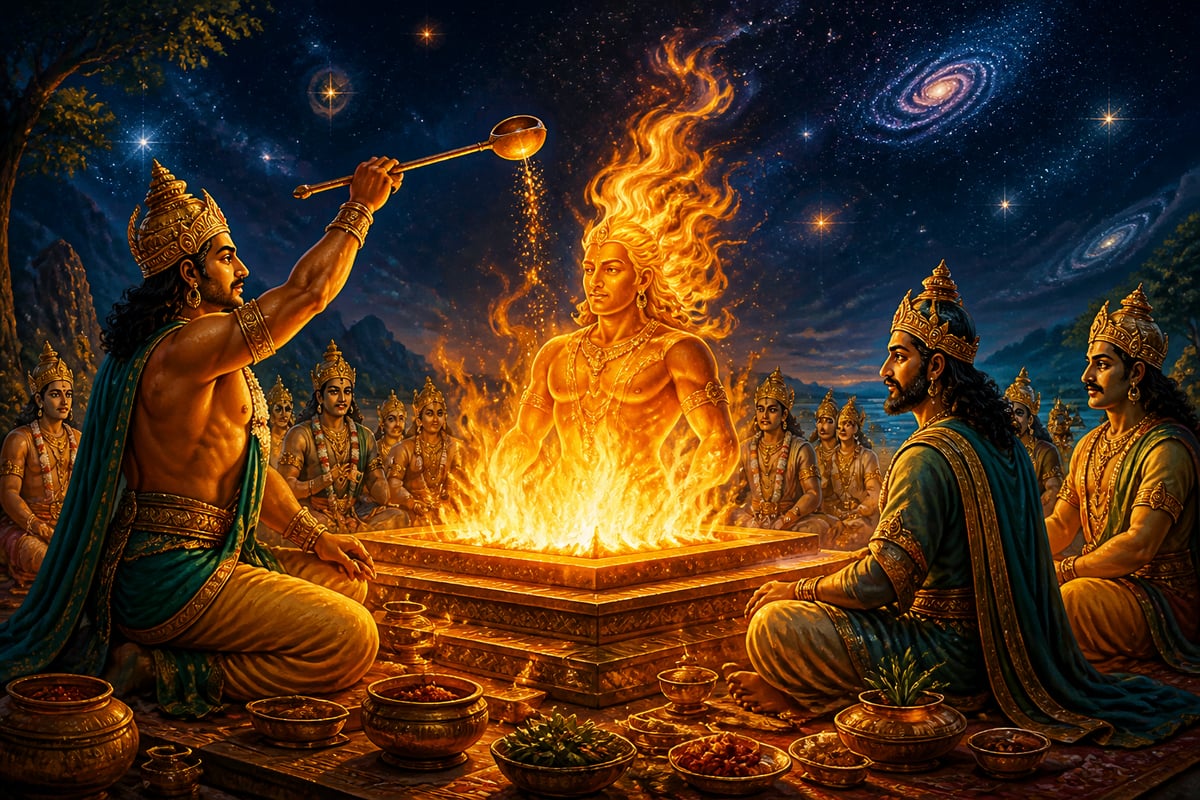
"Yajñena yajñam ayajanta devāḥ" "By sacrifice the Devas performed sacrifice." , RV 10.90.16
Even the cosmic forces themselves participate in ritual. This isn't primitive thinking. It's a profound recognition that the universe itself operates through patterns of giving and receiving, offering and sustaining. Ritual is how humans consciously enter that pattern.
R.L. Kashyap, the Vedic scholar, notes that the Rishis weren't describing belief, they were describing experience. When ritual is performed correctly, with proper intention and awareness, something shifts. The practitioner experiences connection rather than isolation, participation rather than separation.
Living This Today
You don't need fire and ghee to practice yajña. You need three things:
- Intention before action: Before your morning routine, pause. What are you offering? To whom?
- Awareness during action: Be present. The coffee isn't just liquid; it's connection.
- Gratitude after action: Acknowledge what you received. The ritual is complete when the exchange is recognized.
Consider how this transforms ordinary moments. A meal becomes an offering. A meeting becomes a gathering. Work becomes contribution rather than extraction.

The Rishis would recognize your morning coffee ritual, not as superstition, but as an attempt to do what humans have always done: find meaning through pattern, connection through repetition, and significance through conscious participation in the web of reciprocity that sustains all life.
In the next lesson, we explore why humans need ritual, not as cultural accident, but as biological and psychological necessity.
Gratitude research (Robert Emmons, UC Davis) shows that conscious acknowledgment of what we receive rewires neural pathways toward well-being. The Vedic 'praise first' approach anticipates this by millennia.
Servant leadership models (Robert Greenleaf) emphasize giving before expecting return. Organizations with strong 'contribution cultures' outperform extraction-focused ones in long-term sustainability.
Ecological economics (Herman Daly) recognizes that sustainable systems require reciprocity, you cannot extract indefinitely. Yajña is the psychological equivalent of sustainable economics.
Behavioral science shows that rituals reduce anxiety and increase performance (Harvard's Francesca Gino). The mechanism is focus, ritual forces present-moment attention, reducing rumination.
High-performing teams develop rituals (Amazon's 6-page memos, Bridgewater's radical transparency meetings). These aren't arbitrary, they create shared mental models and reduce coordination costs.
Complex systems maintain stability through repeated patterns. Ritual is how human systems achieve the same stability, predictable practices that allow flexible responses.
A word of caution as we explore these teachings: understanding Vedic ritual requires abandoning the lens of 'primitive superstition evolving to modern rationality.' The Rishis were not proto-scientists waiting for enlightenment. They were sophisticated thinkers who understood that consciousness and action, properly aligned, participate in patterns that sustain reality. Their insights about ritual's function, creating shared meaning, reducing uncertainty, aligning human and cosmic rhythms, are being rediscovered by cognitive science, organizational theory, and systems thinking.
Case studies
DevOps Rituals at Google: The Sacred Standup
Google's Site Reliability Engineering (SRE) teams maintain some of the world's most critical infrastructure. Their secret isn't just technical, it's ritualistic. Every team practices 'blameless postmortems' after incidents: structured ceremonies where failures are analyzed without finger-pointing. They have 'production readiness reviews' before launches, formal ceremonies where code must pass through specific gates. The daily standup isn't optional; it's as mandatory as the Vedic Agnihotra was for householders. These aren't called 'rituals,' but they function identically: repeated practices with specific forms that create shared understanding and reduce uncertainty.
The Vedic yajña required specific roles (Hotṛ, Adhvaryu, Udgātṛ, Brahman), specific timing (aligned with cosmic rhythms), and specific offerings (ghee, soma, mantras). Google's rituals mirror this: specific roles (incident commander, communication lead), specific timing (immediately after incidents, regularly for standups), and specific 'offerings' (honest post-mortems, readiness documentation). Both systems understood that complex coordination requires ritualized practice, not because of superstition, but because ritual reduces cognitive load and builds trust.
Google's SRE practices have become industry standard, documented in their freely available 'SRE Book.' Companies that adopt these ritualistic practices report 50-80% reduction in incident resolution time. The 'blameless postmortem' ritual has been particularly transformative, teams that practice it consistently show higher psychological safety scores and better incident response over time.
Modern technology teams have independently rediscovered what the Rishis knew: complex systems require ritualized practices. The form matters less than the function, creating shared mental models, reducing uncertainty, and enabling coordinated action.
Agile sprints, daily standups, and sprint retrospectives have become the default operating rhythm for software teams worldwide. Their effectiveness comes not from the specific format but from the ritualized consistency. Teams that skip these practices in favor of 'efficiency' consistently underperform teams that maintain them, because the ritual creates the shared awareness that makes coordination possible.
Google's SRE teams handle over 4 billion requests per second across their services, with 99.99% uptime, maintained through ritualistic practices that echo Vedic principles of conscious, structured, repeated action.
The Ashwamedha Yajña: Ritual as Cosmic-Political Order
The Ashwamedha (horse sacrifice) was the grandest Vedic ritual, a year-long ceremony performed by kings to establish sovereignty. A consecrated horse was released to wander freely for a year, followed by the king's army. Any territory the horse entered either submitted to the king or fought. After a year, the horse returned for an elaborate sacrifice involving hundreds of priests, precise mantras, and offerings that could last for days. The ritual was not just symbolic; it was the mechanism by which kingship became legitimate. Emperors from the Mauryas to the Guptas performed it, not for superstition, but because it *constituted* their sovereignty in the eyes of the cosmic and human orders alike.
The Ashwamedha reveals yajña at its most ambitious: the claim that ritual can align human political order with cosmic order (Ṛta). The horse represents the sun's journey across the sky; its year-long wandering mirrors the sun's annual cycle. The king performing Ashwamedha is not just conquering territory but *re-enacting* cosmic creation, placing himself as the human representative of cosmic sovereignty. Sayana's commentary emphasizes that the ritual's power came not from magic but from the completeness of participation, every element (priests, mantras, timing, offerings) had to align perfectly.
Historical records show that kings who successfully completed Ashwamedha gained recognition that no military victory alone could provide. Samudragupta (4th century CE) is described in inscriptions as one who 'revived the Ashwamedha', his sovereignty was legitimized not just by conquest but by correct ritual performance. The ritual created social consensus that pure force could not.
Ritual creates legitimacy that raw power cannot. The Ashwamedha shows that for complex systems (kingdoms, corporations, nations), shared symbolic practices are not decorative, they are constitutive. They create the very reality they appear to merely represent.
Modern state ceremonies, from presidential inaugurations to Olympic opening ceremonies, serve the same legitimacy-creating function. The ritual does not merely celebrate existing authority; it constitutes it. Companies understand this intuitively, which is why IPO bell-ringings, product launches, and annual shareholder meetings follow precise ceremonial formats.
The Ashwamedha required a full year of preparation and performance, involving hundreds of priests and specialists. Samudragupta's Allahabad Pillar inscription (4th century CE) records his Ashwamedha, and coins minted for the occasion have been found across the subcontinent.
Reflection
- What daily actions in your life have the potential to become rituals, if performed with conscious intention rather than autopilot?
- The Rishis claimed that ritual doesn't just express connection, it creates it. What would it mean to take this claim seriously?
- What is the difference between ritual that degenerates into empty formalism and ritual that remains alive? How do you tell the difference?