Nītya: Why Humans Need Ritual
The Biological and Psychological Necessity of Repeated Practice
Exploring why ritual is not cultural ornament but psychological necessity, how the Vedic concept of nītya-karma (regular practices) addresses a deep human need for rhythm, transition, and shared meaning.

A surgeon pauses before the first incision. She takes a breath, feels her feet on the floor, and says, always, the same three words to her team. It's not superstition. It's not religion. It's what keeps her hands steady when everything is on the line.
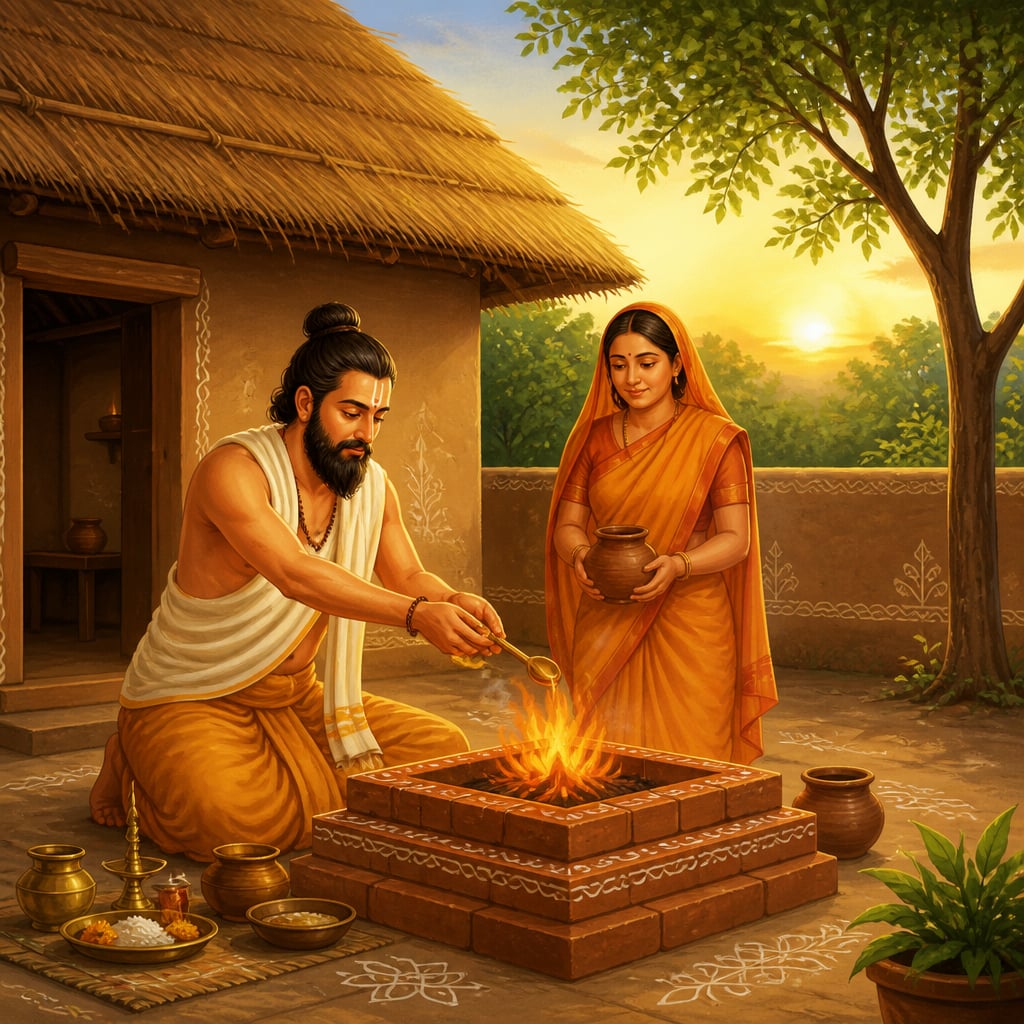
Three thousand years earlier, a Vedic householder pauses at dawn. He faces east, feels his feet on the earth, and speaks, always, the same Sanskrit syllables. Both are performing nītya, regular, non-negotiable practice. Both understand something modern culture has forgotten: humans are not wired for continuous novelty. We need repetition to function.
The Problem of the Unmarked Day
Imagine waking tomorrow with no markers. No morning routine. No scheduled meals. No sense of when work starts or ends. No weekend to look forward to. Just undifferentiated time stretching in all directions.
Most people would experience this not as freedom but as disorientation, what psychologists call "temporal anxiety." Without rhythm, the mind loses its bearings. Depression rates spike in people with disrupted routines (shift workers, long-haul travelers, those in prolonged isolation). We are creatures of cycle, not chaos.
The Rishis understood this millennia ago. The Vedic calendar wasn't just organization, it was psychological architecture. The day was marked by Sandhyavandana (twilight rituals), the month by lunar phases, the year by seasonal yajñas. Time wasn't empty; it was shaped.
"Ṛtasya pathā pretī" "She moves along the path of Ṛta." , RV 1.124.3
Usha, the Dawn goddess, is praised for her unfailing regularity. She never misses a day. This isn't just astronomy, it's modeling. The cosmos itself performs nītya-karma. The sun rises daily, the seasons cycle yearly, the stars wheel nightly. Ritual is how humans join this cosmic regularity.
The Three Functions of Nītya
The Vedic tradition distinguished between nītya-karma (regular duties), naimittika-karma (occasional duties triggered by events), and kāmya-karma (optional rituals for specific desires). Why was nītya given such primacy?
Sayana's commentary identifies three irreplaceable functions:
| Function | Sanskrit | What It Does |
|---|---|---|
| Anchoring | Sthiti | Creates stability in a changing world |
| Transition | Saṅkramaṇa | Marks and enables movement between states |
| Participation | Bhāga | Connects individual to larger patterns |
Anchoring: The Agnihotra performed at dawn and dusk creates two fixed points around which the entire day organizes. Whatever else happens, these remain. In chaos, the ritual is solid ground.
Transition: How do you move from sleep to wakefulness? From work to rest? From one life stage to another? Without ritual, transitions are jarring. With ritual, they're navigated.
Participation: When you perform Sandhyavandana at dawn, you're not alone. Thousands of others are doing the same thing at the same moment. The ritual creates invisible community.
Sri Aurobindo deepens this: the external ritual is training for internal capacity. By showing up reliably for external practice, you develop the ability to show up reliably for yourself, in meditation, in crisis, in moral challenge.
Why Regularity Matters More Than Intensity
Modern culture worships intensity, the transformative retreat, the breakthrough experience, the once-in-a-lifetime ceremony. The Vedic approach was the opposite: small, regular, non-negotiable.
The Agnihotra takes about 10 minutes. The Sandhyavandana perhaps 15-20. These aren't heroic undertakings. They're sustainable rhythms. And the Rishis understood something counterintuitive: consistent small practice shapes you more than occasional big practice.
"Sa ha nāvam ivāyaṃ lokam" "This world is like a boat." , Shatapatha Brahmana

The boat metaphor is telling. You don't steer a boat once; you steer it continuously. Small corrections maintain direction. The same applies to the mind and life: nītya-karma is continuous course-correction, not one-time navigation.
Modern habit research confirms this. Charles Duhigg's work on "keystone habits" shows that small, regular practices cascade into broader life improvements. BJ Fogg's "Tiny Habits" method proves that consistency beats intensity for lasting change. The Rishis arrived at this conclusion through practice rather than research, but the conclusion is identical.
The Cost of Ritual Loss
What happens when ritual disappears? The modern world is running an unintended experiment.
Secular societies often pride themselves on abandoning "superstitious" practices. But something has been lost in the process. The markers are gone. Transitions go unrecognized. Life becomes a series of unmarked days.
Anthropologist Victor Turner called this "liminality", the threshold state between defined positions. Without ritual, people get stuck in liminality. They know the old identity is gone but have no way to claim the new one. This is why graduation ceremonies, wedding rituals, and funeral rites persist even in secular contexts, some marking is psychologically non-negotiable.
The Rishis would diagnose modern anomie, the loss of meaning and connection, as nītya-bhraṃśa: the breaking of regular practice. When daily rhythm dissolves, so does the scaffolding that holds identity and meaning in place.
What Nītya Actually Creates
Let's be precise about what regular ritual does for the human system:
Neurologically: Repetition creates neural pathways. Ritual literally wires the brain. The more you perform a practice, the more automatic, and thus available in crisis, it becomes.
Psychologically: Ritual reduces cognitive load. When some decisions are pre-made ("I always do X at Y time"), mental energy is freed for what matters.
Socially: Shared rituals create shared reality. When everyone pauses at the same time (for prayer, for meals, for holidays), a community is continuously reconstituted.
Existentially: Ritual addresses the human terror of meaninglessness. When actions are embedded in larger patterns, even mundane moments carry significance.
Living This Today
You already have nītya-karma, you just might not recognize it as such. The morning coffee, the evening walk, the weekly call with a parent. These are your anchors.
The question is: are they conscious or unconscious? Habitual or intentional?
The Vedic insight is that conscious regularity creates different effects than unconscious repetition. When you perform your morning ritual knowing it connects you to rhythm, transition, and participation, the same action carries different weight.
Here's how to apply nītya-consciousness:
- Name your existing rituals: What do you already do regularly? Acknowledge these as practices, not just habits.
- Add one conscious anchor: Choose a daily moment (waking, eating, sleeping) and add 30 seconds of intention.
- Honor transitions: Before shifting contexts (work to home, waking to activity), pause. Mark the crossing.
The Rishis didn't invent ritual out of superstition. They discovered that humans require rhythm to function, transitions to navigate change, and regularity to participate in patterns larger than individual life. This isn't archaic wisdom, it's permanent truth about what humans need.
In the next lesson, we'll explore how to preserve ritual's power while stripping away superstition, how to practice without magical thinking.
James Clear's 'Atomic Habits' demonstrates that identity change comes from repeated small actions, not occasional big ones. 'Every action is a vote for who you want to become.' The Vedic nītya-karma is precisely this, daily votes for your intended self.
High-reliability organizations (hospitals, airlines, nuclear plants) succeed through routinized practice, not heroic intervention. Checklists, briefings, and debriefings are their nītya-karma, regular practices that prevent catastrophic failure.
Complex systems are maintained through continuous small corrections, not occasional large interventions. Regular maintenance (nītya) prevents the crises that require emergency repair. The same applies to relationships, health, and organizations.
Transition research (William Bridges) shows that unacknowledged endings create 'neutral zone' distress. Ritual provides the acknowledgment: 'This phase is ending. Something new is beginning.' Without ritual, people get stuck between identities.
Organizations fail transitions (mergers, leadership changes, strategy shifts) when they don't ritualize them. Town halls, symbolic acts, and formal acknowledgments aren't soft extras, they're how large groups process change.
Phase transitions in systems (water to ice, startup to corporation) require energy input at the boundary. Saṃskāra is the psychological 'energy input' that enables human phase transitions, growing up, taking responsibility, letting go.
A word of caution as we explore these teachings: the concept of nītya-karma offers a sophisticated alternative to both rigid traditionalism and formless modernity. It recognizes that humans genuinely need regular practice, not because gods demand it, but because our psychology requires rhythm. It provides principles (regularity, transition-marking, conscious participation) that can be adapted across cultures and eras. The question isn't whether to ritualize but how, and the Vedic tradition offers millennia of refined insight.
Case studies
The Surgical Checklist: How Ritual Saves Lives
In 2007, surgeon Atul Gawande partnered with WHO to implement a simple surgical checklist, a 19-item ritual performed before every operation. The checklist included seemingly obvious items: confirm patient identity, mark the surgical site, verify antibiotics given. It required the team to pause, introduce themselves, and state what they expected. It was a ritual, not just a list, the same actions performed the same way every time, creating a moment of shared attention before the high-stakes work began.
The surgical checklist is modern nītya-karma: a regular, non-negotiable practice that creates safety through repetition. Like the Vedic saṅkalpa (intention declaration) before ritual, the checklist forces conscious attention at the moment of transition, from preparation to procedure. The team's self-introduction echoes the Vedic naming of participants (ṛtviks) before yajña. The pause before cutting parallels the pause before offering, a moment of alignment before irreversible action.
Implementation of the checklist across 8 hospitals in 8 countries reduced surgical complications by 36% and deaths by 47%. In some hospitals, the improvement was even more dramatic, complications dropped by half. The ritual worked not because of any single item but because it created reliable shared attention at a critical moment.
High-stakes environments require ritual, not despite their complexity but because of it. The checklist proves what the Rishis knew: regular, conscious practice reduces error not by adding work but by creating presence. Nītya-karma is cognitive technology.
Aviation's pre-flight checklist culture, which reduced fatal accidents by over 90% since the 1950s, operates on the same principle. Industries from nuclear power to restaurant kitchens now use checklist protocols, confirming that ritualized verification outperforms individual vigilance in every high-stakes domain where human attention is the weakest link.
The WHO Surgical Safety Checklist is now used in operating rooms worldwide, estimated to prevent over 500,000 deaths annually.
The Sixteen Saṃskāras: Ritualizing the Human Journey
The Dharmashastra tradition identifies sixteen saṃskāras, rituals that mark every major transition from conception to death. These include garbhādhāna (conception ceremony), puṃsavana (quickening), sīmantonnayana (hair-parting for pregnant woman), jātakarma (birth rituals), nāmakaraṇa (naming), annaprāśana (first solid food), cūḍākaraṇa (first haircut), upanayana (sacred thread/initiation), vivāha (marriage), and antyeṣṭi (funeral). Each saṃskāra had specific timing, mantras, and procedures, nothing was left unmarked.
The saṃskāra system represents the Vedic answer to human development: left unattended, transitions are merely biological events. With ritual attention, they become psychological crossings. The child's naming (nāmakaraṇa) is not just administrative, it's the ritual acknowledgment that a new person exists. Upanayana doesn't just start education, it marks the death of childhood and birth of the student. Each saṃskāra is a controlled death-and-rebirth: the old identity is released, the new one is claimed.
The saṃskāra system created a society where life stages were clear and transitions were supported. While modern practice has often reduced these to empty formality, traditional communities that maintain conscious saṃskāra practice report stronger family bonds, clearer identity formation, and more meaningful life narratives. The rituals provide what developmental psychology calls 'scaffolding', external support for internal development.
Transitions don't just happen, they're made. The saṃskāra system shows that cultures that ritualize development produce individuals who can navigate change. The ritual doesn't cause the change (puberty happens regardless); it creates the psychological container for the change to be integrated rather than chaotic.
Modern psychology recognizes the value of marking transitions through ritual: graduation ceremonies, retirement parties, funerals, and even divorce rituals help people psychologically process change. Adolescents in cultures without clear transition rituals show higher rates of identity confusion and risk-taking behavior, suggesting that the absence of samskara has measurable developmental costs.
The sixteen samskaras span the entire human lifespan from conception (garbhadhana) to death rites (antyeshti). Communities that maintain all sixteen report stronger intergenerational bonds, and UNESCO has recognized several samskara-related traditions as intangible cultural heritage.
Reflection
- What transitions in your life have you navigated without any ritual marking? How might acknowledging them now, even belatedly, help you integrate them?
- The Rishis looked to the dawn as a model of reliable practice. What does it mean that cosmic forces themselves perform nītya-karma?
- When does healthy ritual become unhealthy compulsion? What distinguishes nītya-karma from obsessive behavior?