Navyatā: Breaking and Rebuilding Rituals
When Old Forms No Longer Serve: The Art of Ritual Renewal
Exploring how rituals break down, why they sometimes must be broken, and the dharmic principles that guide their renewal, from the Bhakti revolution to modern diaspora adaptations.
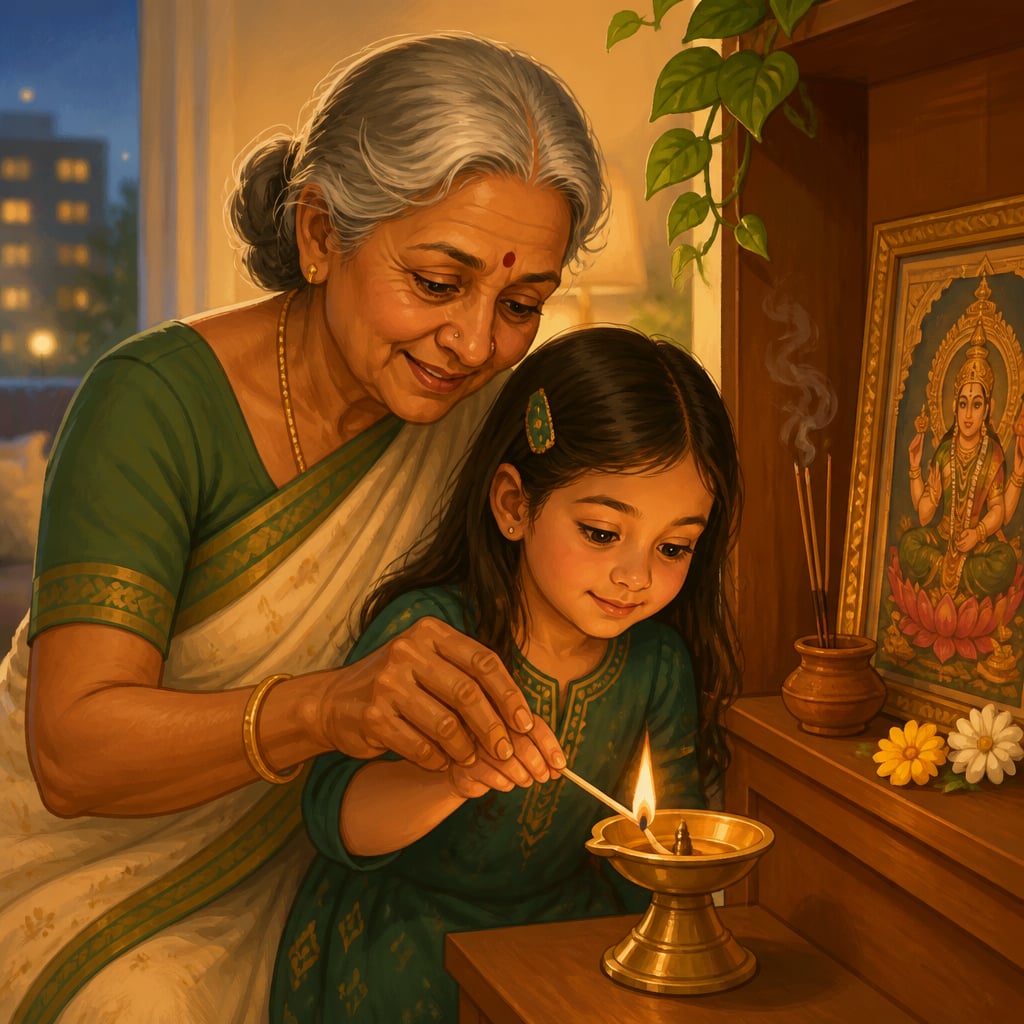
In a small apartment in New Jersey, a Tamil grandmother is teaching her American-born granddaughter how to light a lamp. The brass lamp is correct, the wicks are right, but nothing else matches what the grandmother knew in Chennai. There's no puja room, just a corner shelf. The oil is from Amazon. The granddaughter's questions are in English.
The grandmother pauses. This isn't how it was done. This isn't how she learned. But she looks at her granddaughter's face, eager, curious, reaching for something, and she makes a choice. She adapts.
"The lamp is what matters," she says. "The light is what matters. Everything else... we can figure out."
This is navyatā, renewal. The ancient made new, not by abandonment but by adaptation. It's been happening since the Vedic period, and it's the reason the tradition is still alive.
Why Rituals Break Down
Rituals don't last forever in fixed form. They can't. The conditions that created them change:
- Geography shifts: Vedic rituals developed on the Saraswati plains; what happens when practitioners move to tropical Kerala, or suburban California?
- Language evolves: Sanskrit mantras that once were understood become sounds without meaning.
- Social structures change: Rituals designed for joint families don't fit nuclear households.
- Resources become unavailable: Specific ingredients, implements, or spaces may no longer exist.
- Context disappears: Rituals tied to agricultural cycles make little sense in urban settings.
When these gaps grow too large, ritual becomes empty form, performed but not felt, maintained but not meaningful. The letter survives while the spirit dies.
The Rig Veda itself acknowledges this danger:
"Nava-navīyasī uṣā" "Dawn ever new, ever newest." , RV 1.92.5
Usha (Dawn) is praised for being perpetually fresh. She comes daily, but never stale. This is the ideal: tradition that renews itself, that remains alive by constantly becoming new.
The Dharmic Principle: Function Over Form
The tradition provides a crucial principle for navigating change: function matters more than form.
This isn't modern permissiveness, it's orthodox teaching. Sayana, commenting on the Vedas, distinguishes between artha (purpose/meaning) and rūpa (form). When circumstances make the traditional form impossible, the purpose must be preserved even if form changes.
Sri Aurobindo is explicit: "The letter of the Veda is not the Veda. The spirit of the Veda is the Veda. When the letter contradicts or obscures the spirit, the spirit must take precedence."
This principle, function over form, is what allowed the tradition to survive 5,000 years of change. Every generation has faced the question: how do we practice in these conditions, with these constraints, for these people?
How Rituals Get Renewed
The tradition shows consistent patterns in how renewal happens:
1. Simplification without Loss
Complex rituals get distilled to essential elements. The full Soma yajña, which required days, dozens of priests, and elaborate materials, was simplified in the Upanishadic period to practices a single person could do. The principle (yajña) remained; the complexity was reduced.
2. Internalization
External rituals become internal practice. We explored this in the prāṇāgnihotra, the external fire becomes internal breath. This isn't abandonment but deepening. The form changes radically; the function is preserved and intensified.
3. Translation
Rituals designed for one context get translated to another. Temple worship (pūjā) translated Vedic yajña into forms suitable for settled agricultural communities. The fire sacrifice became image worship, different form, same principles of offering, attention, and exchange.
4. New Vehicles for Old Truths
Sometimes entirely new forms emerge to carry ancient functions. The Bhakti movement created devotional songs (bhajans), stories (kathā), and community gathering (satsang), forms not found in early Vedic practice, but carrying the same function of connecting human and divine.
The Bhakti Revolution: A Case in Renewal
The most dramatic ritual renewal in Hindu history happened between the 12th and 17th centuries. The Bhakti saints, Ramanuja, Kabir, Mirabai, Tukaram, Chaitanya, transformed how millions practiced.
The context: Vedic ritual had become the province of specialists. Most people could neither perform the rituals nor afford the priests. Sanskrit was inaccessible. Temples were controlled by elites. For ordinary people, farmers, artisans, women, lower castes, the tradition's forms were unreachable.
The saints asked the essential question: What is the function of ritual? Connection with the divine. Community with fellow seekers. Transformation of consciousness. Offering of self.
They created new forms that preserved these functions:
- Vernacular hymns replaced Sanskrit mantras, now anyone could sing to God in their own language
- Public kīrtans replaced private rituals, community became the vehicle
- Personal devotion replaced priestly mediation, no intermediary needed
- Stories and poetry replaced elaborate procedures, accessible entry points for everyone
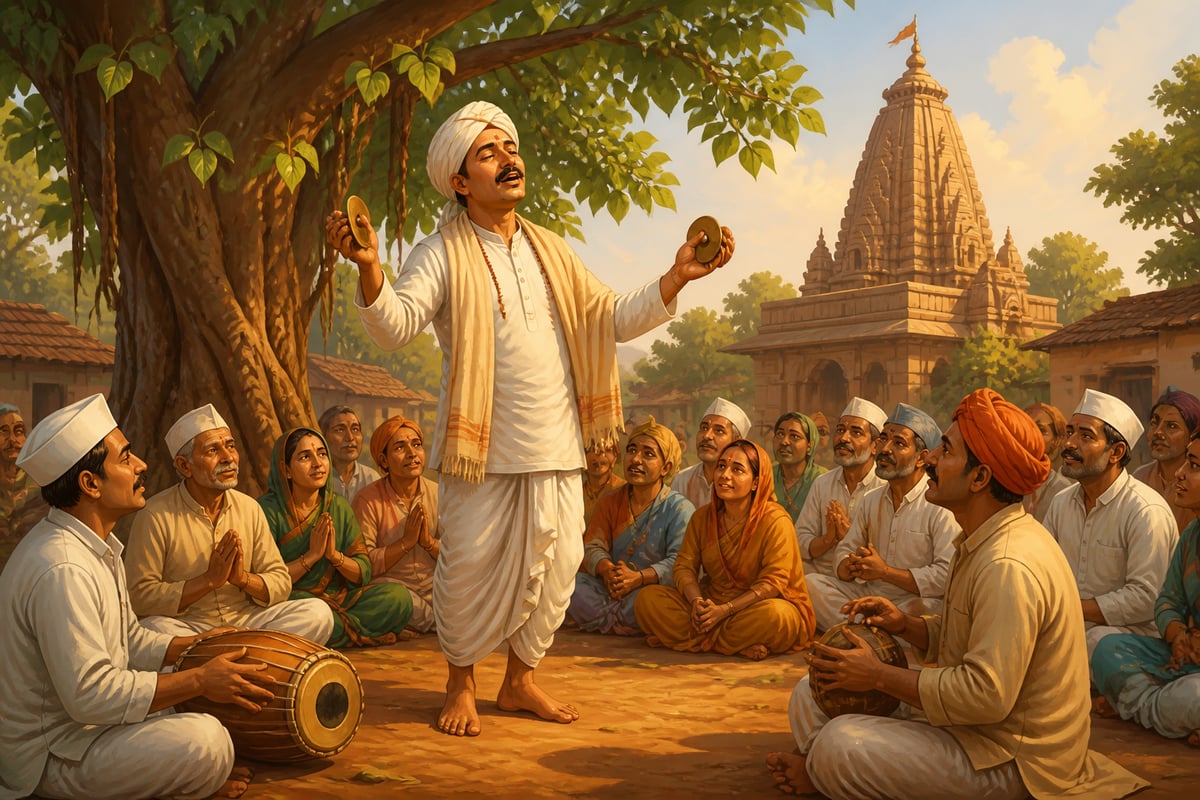
Tukaram exemplified this: a grocer by trade, he composed thousands of abhangas (devotional poems) in Marathi. He declared that sincere heart matters more than proper form, that God responds to love, not to technique.
"He who has nothing to offer except himself, > That offering is accepted." , Tukaram Gatha
Was this a break with tradition? In form, dramatically. In function, it was preservation, keeping the living connection alive when the old forms had become barriers.
Navyatā: The Word for Renewal
The Sanskrit word navyatā (from navya, "new") captures this quality: newness, freshness, the capacity to be renewed. It's not about discarding the old but about keeping the old alive by making it new.
The Rig Veda uses navya to describe what's desired:
"Navyase gīrbhiḥ" "With songs ever new." , RV 5.30.6
Even in the Vedic period, the praise was for new songs, new hymns, not for mechanical repetition of old formulas. The tradition was born with renewal built in.
R.L. Kashyap notes: "The Rishis were not conservatives in the modern sense. They were explorers, always seeking new expressions for eternal truths. The tradition preserved their method (exploration) as much as their conclusions (specific hymns)."
When Breaking Is Necessary
Sometimes renewal isn't enough. Sometimes forms must be broken before they can be rebuilt.
The tradition recognizes prāyaścitta, a process of correction and restoration that may require temporarily stopping a practice that has become corrupted. If a ritual has become a vehicle for ego, exploitation, or harm, continuing the form is worse than stopping it.
Adi Shankara (8th century) broke with ritualistic interpretation to emphasize jñāna (knowledge). He didn't reject ritual, he practiced it, but he subordinated it to understanding. Form without insight was worse than no form at all.
The Bhagavad Gita teaches:
"Śreyān svadharmo viguṇaḥ para-dharmāt svanuṣṭhitāt" "Better is one's own dharma, though imperfect, than another's dharma well performed." , BG 3.35
This applies to ritual: better an imperfect practice that is authentically yours than a perfect form that doesn't fit your reality. The renewal may be rough, incomplete, uncertain, but if it's genuine, it's dharmic.
Principles for Renewal
The tradition offers guidance for those navigating ritual change:
1. Preserve the Purpose (Artha)
Ask: What is this ritual for? Connection? Transition? Purification? Offering? Keep the purpose central; let form adapt.
2. Maintain the Thread (Sūtra)
Some continuity matters. The grandmother teaching lamp-lighting is maintaining a thread, lamp, oil, flame, prayer, even as context changes. Total innovation loses the connection to what came before.
3. Honor the Transmission (Paramparā)
Acknowledge what you're inheriting, even as you adapt it. "This is what I received; this is how I'm passing it on", both parts matter.
4. Serve the Present (Desa-kāla-pātra)
Dharma always considers context: deśa (place), kāla (time), and pātra (the person/vessel). What's appropriate differs across these dimensions. The same ritual form shouldn't be forced onto incompatible contexts.
5. Test by Fruits (Phala)
The test of adapted ritual is whether it produces its intended effects. Does the practice create connection, awareness, transformation? If yes, the adaptation is working. If not, further renewal is needed.
Living This Today
If you're practicing tradition in a new context, different country, different generation, different life circumstances, you're participating in navyatā. This is not deviation from tradition; it's continuation of tradition's living process.
Here's how to navigate:
1. Find the essence: What is the heart of the practice you want to maintain? Strip away what's circumstantial.
2. Identify constraints: What genuinely can't be done in your context? Be honest about real limitations vs. mere inconvenience.
3. Adapt with intention: Make conscious choices about what to change. Each adaptation should have a reason.
4. Maintain some continuity: Keep some element unchanged, a word, a gesture, an object, that connects to the source.
5. Pass it on: Renewal is complete when what you've adapted can be transmitted to others.
The grandmother in New Jersey, adapting lamp-lighting for her granddaughter, is doing exactly what every generation has done: making the ancient new enough to be alive. This is navyatā. This is how tradition survives.
In the next lesson, we'll explore how to design personal rituals from scratch, creating new practices that carry the dharmic principles you've now learned.
William Bridges' transition research shows that healthy change requires honoring endings, navigating the neutral zone, and embracing new beginnings. Navyatā is precisely this: acknowledging what's ending, holding uncertainty, and creating new forms.
Organizational change succeeds when core purpose is preserved while operational forms adapt. Leaders who try to change everything lose connection; those who change nothing become obsolete. Navyatā is strategic adaptation with maintained identity.
Living systems maintain identity through constant change, every cell in your body replaces, yet 'you' persist. Traditions survive the same way: the pattern continues while the elements renew. This is biological navyatā.
Carl Rogers' person-centered therapy emphasizes congruence, alignment between inner experience and outer expression. Forcing yourself into practices that don't fit creates incongruence, which damages psychological health. Authentic adaptation is healthier.
Jim Collins' research on built-to-last companies shows they preserve core ideology while stimulating progress in practices. Companies that can't change practices become rigid; those that abandon core ideology lose identity. The balance is navyatā.
Complex systems require periodic restructuring to remain adaptive. If old structures prevent necessary response to new conditions, they must be broken and rebuilt. This is creative destruction in service of system survival.
A word of caution as we explore these teachings: every generation faces the question: how do we practice tradition in our circumstances? Understanding navyatā, the dharmic principle of renewal, provides guidance. You're not the first to face this question, and the tradition itself authorizes adaptation. Function over form; continuity through change; imperfect authentic over perfect imitation. These principles have kept the tradition alive for 5,000 years. They'll keep it alive for the next 5,000.
Case studies
The American Mandir: Hindu Practice in Diaspora
In 1977, the Sri Venkateswara Temple opened in Pittsburgh, one of the first traditional South Indian temples built outside India. But 'traditional' required massive adaptation. The priests came from India but served congregants who couldn't take time off for multi-day festivals. The temple's architecture followed śilpa-śāstra specifications, but the HVAC system was thoroughly American. Devotees drove from hours away for darshan, then needed to return home. The diaspora context demanded navyatā: Saturday havans because families couldn't attend weekday mornings; condensed festivals completed in single days; youth programs in English; cultural classes for children who might never see India.
The Pittsburgh temple exemplifies dharmic navyatā: the function (connecting with the divine, maintaining tradition, building community) remained central, but forms adapted radically to deśa-kāla-pātra (place-time-person). The temple preserved paramparā, priests trained in traditional lineages, rituals following established āgama, while adapting everything else. Critics from India sometimes complained of impurity; the diaspora response was pragmatic: better imperfect practice than no practice at all. Better adaptation than extinction.
Today, there are over 1,000 Hindu temples in the United States, serving a vibrant diaspora community. Second and third-generation Indian-Americans maintain connections to tradition through these adapted forms. The temples have become not just religious centers but cultural anchors, maintaining identity while enabling integration. The navyatā worked: function was preserved through transformed form.
Tradition survives diaspora through creative adaptation, not rigid preservation. The Pittsburgh model, traditional core, adapted forms, has been replicated worldwide. Where communities insisted on unchanged form, practice often died with the first generation. Where they embraced navyatā, tradition lives on.
Every diaspora community faces this challenge: maintaining cultural identity while adapting to new contexts. Chinese communities in Southeast Asia, Jewish communities worldwide, and African diaspora traditions all demonstrate that survival requires creative adaptation. The communities that thrive are those that distinguish between negotiable forms and non-negotiable principles.
The Hindu American population grew from approximately 200,000 in 1970 to over 3 million in 2020, with temple attendance remaining strong across generations, evidence that adapted tradition can transmit successfully.
The Bhakti Revolution: When the Saints Remade Practice
By the 12th century CE, Vedic ritual had become largely inaccessible. Sanskrit was understood by few. Elaborate yajñas required resources most people lacked. Temple entry was restricted by caste. For the majority of Hindus, farmers, craftspeople, women, lower castes, the tradition's forms were unreachable. Into this context came the Bhakti saints: Basavanna in Karnataka, Ramanuja in Tamil Nadu, later Kabir and Tukaram in the north, Chaitanya in Bengal. They asked: What is the essential function of religious practice? Connection with the divine. They then created new forms: devotional songs in vernacular languages, community gatherings open to all, personal devotion that needed no priest, stories and poetry that transmitted truth accessibly.
The Bhakti movement was radical navyatā. The saints didn't reject tradition, they renewed it. Chaitanya danced in ecstasy, following the Vedic principle that the divine responds to sincere offering, not to technical correctness. Tukaram's abhangas carried the same essence as Vedic hymns, praise, surrender, seeking, in forms accessible to illiterate farmers. The function (connection with the divine) remained unchanged; the forms transformed completely. Critically, the saints maintained paramparā: they honored what came before even as they created new expressions. They didn't claim to invent but to translate.
The Bhakti movement democratized Hindu practice more effectively than any reform. Millions who could never have performed Vedic yajña found authentic spiritual practice through bhajans and kīrtan. The temple traditions adapted, incorporating Bhakti elements. By the colonial period, Bhakti forms had become standard Hindu practice, sung by all castes, performed in all regions. The navyatā succeeded: tradition survived by transforming.
When traditional forms become barriers to traditional function, renewal isn't optional, it's survival. The Bhakti saints demonstrated that authentic navyatā preserves what matters by changing what doesn't. Their courage to innovate is why the tradition is still alive.
Modern movements for religious reform, liturgical innovation, and accessible worship follow the same pattern. Churches that shifted to contemporary music and vernacular services grew, while those insisting on unchanged forms often declined. The Bhakti insight, that accessibility serves tradition better than exclusivity, repeats across every culture and era.
The Bhakti movement produced over 300 saint-poets across 15 Indian languages between the 6th and 17th centuries. Their compositions are still sung daily in millions of homes and temples. Kabir alone has over 500 documented compositions that remain in active circulation.
Reflection
- What practices or rituals have you had to adapt due to changed circumstances? How did you decide what to preserve and what to change?
- The Vedas praise 'songs ever new', yet we also speak of 'sanātana' (eternal) dharma. How can something be both eternally the same and constantly renewed?
- When does legitimate adaptation become betrayal of tradition? Is there a line, and if so, what defines it?