Vidhi: Ritual Without Superstition
Method, Not Magic: How Ritual Works Without Magical Thinking
Exploring how the Vedic tradition understood ritual as vidhi, precise method that works through natural principles, not supernatural intervention. How to preserve ritual's power while releasing magical thinking.
The Toyota factory floor in Nagoya has a peculiar rhythm. Every morning at 8:15, workers gather in their teams. They recite the same words. They perform the same gestures. They walk the same paths around their stations, checking the same points in the same order.
An outside observer might call it ritual. A skeptic might call it superstition. But Toyota calls it 5S, and it has made them the most reliable automaker on Earth.

Here's the strange thing: the workers know exactly why each element matters. The ritual isn't magic; it's method. And this distinction, between ritual as magical compulsion and ritual as rational practice, is precisely what the Vedic concept of vidhi illuminates.
The Problem with "Superstition"
The modern critique of ritual usually runs like this: "Ancient people performed rituals because they superstitiously believed that specific actions would compel supernatural forces. We now know better. Ritual is primitive magic that should be abandoned."
This critique misses something crucial: the Vedic tradition itself made this distinction thousands of years ago.
The Sanskrit word vidhi means "injunction" or "procedure", the how of correct action. It's related to the root dhā (to place, to put). Vidhi is about placement: putting the right elements in the right order to produce the right result.
"Codanā lakṣaṇo'rtho dharmaḥ" "Dharma is that which is known through injunction (vidhi)." , Jaimini's Mīmāṃsā Sūtra 1.1.2
The Mīmāṃsā school, the Vedic tradition's own philosophy of ritual, spent centuries analyzing exactly how rituals work. Their conclusion: ritual efficacy comes from correct procedure (vidhi), not from magical causation.
Two Types of Ritual Thinking
The tradition distinguished between two approaches to ritual:
| Type | Sanskrit | Belief | Attitude |
|---|---|---|---|
| Magical Thinking | Māyā-vāda | "The ritual forces gods to act" | Anxiety, compulsion |
| Methodical Understanding | Vidhi-jñāna | "The ritual aligns conditions for results" | Confidence, skill |
Magical thinking says: "If I say the exact words and perform the exact gestures, supernatural forces must respond." This is superstition.
Methodical understanding says: "These procedures have been refined over generations to produce reliable effects, psychological, social, and systemic. I follow them because they work, not because they're magic."
Sayana, commenting on the Rig Veda, repeatedly emphasizes that mantras work through śakti (inherent power), but this power operates through natural laws (niyama), not arbitrary divine whim. The fire transforms the offering through chemistry, not miracle. The mantra affects consciousness through sound and attention, not spell-casting.
What Makes Vidhi Different from Magic
Sri Aurobindo offers perhaps the clearest distinction: magic tries to manipulate reality from outside its laws; vidhi works within reality's patterns.
Consider the Agnihotra:
- Magical interpretation: "Pouring ghee makes gods give us what we want."
- Vidhi interpretation: "This practice creates physiological relaxation (through rhythmic breathing), psychological focus (through attention), social bonding (through shared practice), and ecological awareness (through fire and offering). These effects compound over time."
Both interpretations perform the same ritual. But one creates dependent, anxious practitioners. The other creates skilled, confident ones.
The Vedic tradition itself warned against the magical view:
"Na sa jānāti dharmaṃ yaḥ kevalaim āmṣa-yajñam" "One who knows only the ritual's external form does not know dharma." , Shatapatha Brahmana
Empty formalism, performing ritual without understanding, was explicitly criticized. The goal was vidhi-jñāna: knowledge of proper procedure and its rationale.
The Science of Ritual
The Mīmāṃsā philosophers developed a rigorous analysis of how ritual works:
1. Apūrva (Unseen Potential): When you perform a ritual correctly, something is created, not a magical charge, but a potency that unfolds over time. Modern terms: habit formation, neural pathway strengthening, social capital accumulation.
2. Phala (Fruit): Results arise when conditions mature, not immediately upon action. The ritual plants seeds; circumstances determine when harvest comes.
3. Niyama (Natural Law): Ritual works because it operates within the cosmic order (Ṛta), not against it. A ritual that violates natural principles won't work, no matter how precisely performed.
This is remarkably sophisticated. The Mīmāṃsā thinkers were not arguing that ritual is magic. They were arguing that ritual is technology, a refined set of procedures that produces reliable effects because it aligns with how reality operates.
The Nalanda Synthesis
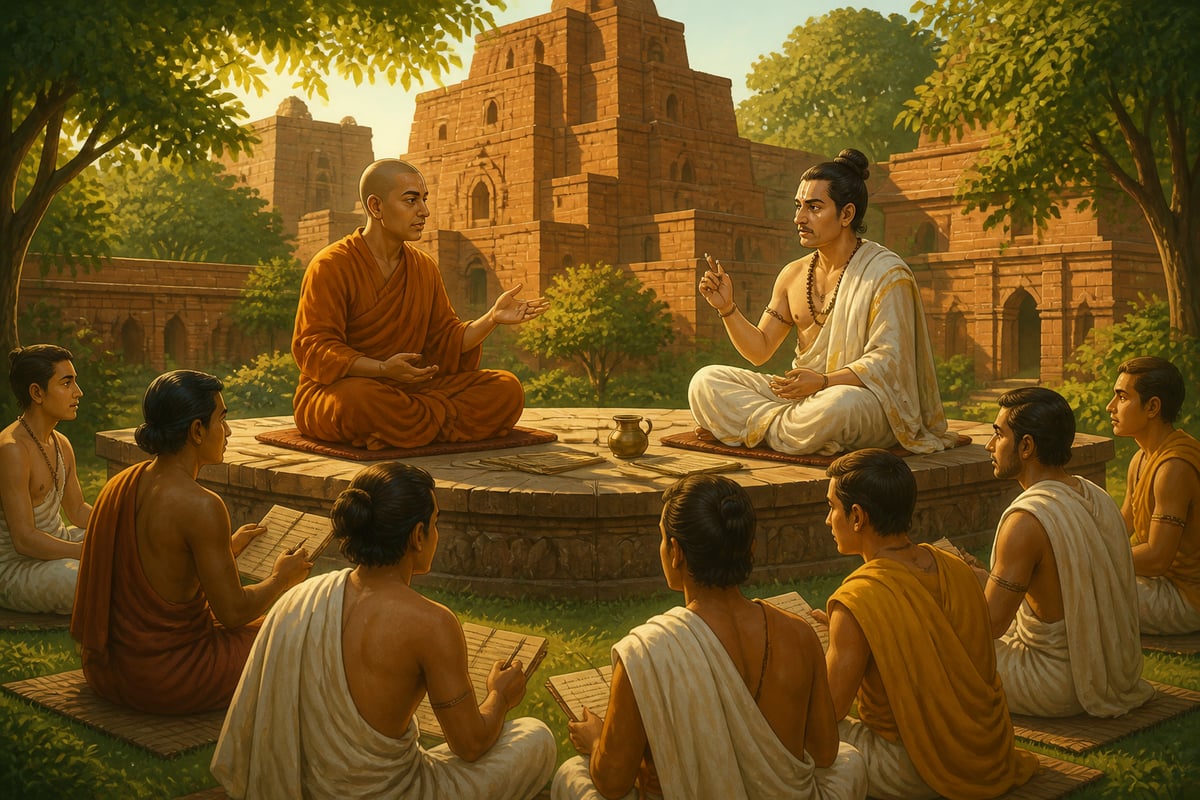
Between the 5th and 12th centuries CE, the great university at Nalanda became a laboratory for exactly this question: how can ritual be practiced with philosophical rigor?
Buddhist and Hindu scholars debated intensely. The Buddhists challenged Hindu ritualism as attachment to forms. The Hindus challenged Buddhist rejection of ritual as nihilistic.
The synthesis that emerged was powerful: ritual is upāya (skillful means), a method that works on practitioners regardless of their metaphysical beliefs. You don't need to believe in gods to benefit from the psychological effects of organized practice. You don't need supernatural explanations for the social power of shared ceremony.
The great teacher Shantarakshita (8th century) articulated this: rituals are like medicine. You don't need to understand pharmacology to benefit from aspirin. The method works because of underlying principles, not because of your belief in it.
But unlike magic, the method can be studied, refined, and improved. Nalanda's scholars analyzed rituals systematically, keeping what worked and questioning what didn't. This is vidhi-jñāna in action: the ongoing inquiry into effective practice.
Stripping Superstition, Keeping Method
How do you practice ritual without superstition? The Vedic answer is clear:
1. Understand the mechanism: Know why each element is there. The ghee isn't for gods; it's for fire. The mantra isn't a spell; it's focused attention. The timing isn't magical; it's alignment with biological and social rhythms.
2. Focus on process, not outcome manipulation: Superstition tries to force specific results. Vidhi creates conditions; outcomes emerge. The farmer prepares soil, plants seeds, and tends carefully, but doesn't imagine this forces rain.
3. Hold the form lightly: The form is vehicle, not end. If understanding is present, minor variations don't matter. If understanding is absent, perfect form accomplishes nothing.
4. Embrace refinement: Vidhi implies that procedures can be improved. The tradition evolved over millennia, dropping what didn't work, refining what did. This is the opposite of superstitious rigidity.
R.L. Kashyap notes that the Rishis themselves were experimentalists: "They were not preserving frozen forms but developing living practices." Vidhi is alive; superstition is dead.
Living This Today
Every day, you perform rituals. The question is whether you perform them superstitiously or methodically.
Superstitious: "I must have my lucky mug or the day will go wrong." Methodical: "My morning routine cues focus and transitions me into work mode."
Superstitious: "If I break my streak, everything is ruined." Methodical: "Consistency builds capacity; missing once is data, not disaster."
Superstitious: "The exact form is what matters." Methodical: "The function is what matters; form serves function."
The Vedic practitioner asks: What is this ritual doing? What conditions is it creating? What effects can I observe? This is vidhi-jñāna, ritual knowledge, not ritual superstition.
When you approach your practices this way, something shifts. The anxiety of "getting it right" dissolves. The confidence of "understanding why" emerges. You become a skilled practitioner, not a fearful supplicant.
In the next lesson, we'll explore how this external ritual practice translates into inner transformation, the move from outer yajña to inner yajña.
Research distinguishes between 'procedural knowledge' (knowing how) and 'declarative knowledge' (knowing what). Experts have deep procedural knowledge, they understand why each step matters. This is vidhi-jñāna applied to any skill.
High-performing organizations document procedures not as bureaucratic constraint but as accumulated wisdom. Amazon's '6-pagers' and Netflix's 'culture deck' are corporate vidhi, methodology distilled from experience.
Effective interventions work with system dynamics, not against them. 'Leverage points' (Donella Meadows) are places where small actions create large effects, understanding vidhi means knowing where those points are.
Growth mindset (Carol Dweck) treats ability as developable through effort and learning. This is the vidhi attitude: improvement comes from understanding and practice, not from fixed talent or magical intervention.
Toyota's kaizen philosophy treats improvement as continuous inquiry. 'Ask why five times', keep questioning until you understand root causes. This is industrial vidhi-jñāna.
Scientific method is formalized inquiry: hypothesize, test, refine. The Rishis practiced this millennia earlier, treating ritual as hypothesis about what works.
A word of caution as we explore these teachings: the vidhi tradition offers a middle path between superstitious ritualism and secular rejection of all ritual. It affirms that ritual is powerful while explaining that power without magic. This is precisely what modern practitioners need: confidence in practice without the anxiety of superstition. The Nalanda synthesis shows that rigorous inquiry and deep practice can coexist, indeed, they strengthen each other.
Case studies
Toyota Production System: Ritual as Scientific Method
In the 1950s, Toyota was a small, struggling automaker. By the 2000s, it had become the world's largest and most reliable car company. The secret wasn't technology, it was ritual. The Toyota Production System (TPS) is built on practices that look exactly like Vedic vidhi: standardized procedures (vidhi), continuous improvement (kaizen), and deep understanding of why each element matters (jñāna). Every worker learns not just what to do but why it works. The famous '5 Whys' technique, asking 'why' repeatedly until root cause is found, is industrial vicāra (inquiry). Nothing is accepted superstitiously; everything is understood methodically.
TPS embodies vidhi-jñāna: procedural knowledge coupled with understanding. Toyota explicitly rejects 'cargo cult' practices, copying forms without understanding. When they train other companies, the hardest lesson is that you can't just copy the procedures; you must understand the principles. This is exactly the Mīmāṃsā position: vidhi works because of underlying principles (niyama), not because of magical form. Toyota's 'respect for people' principle echoes the Vedic insight that ritual practitioners must understand, not just obey.
Toyota vehicles consistently rank among the most reliable worldwide. The company survived crises (2008 recession, 2011 tsunami) that destroyed competitors. The method proved antifragile, it got stronger under stress. Companies that copied Toyota's forms without understanding its principles failed to replicate results, proving that vidhi without jñāna is cargo cult.
The most effective modern 'rituals' work exactly as Vedic vidhi: not through magical form but through understood method. Toyota proves that ancient insight scales to industrial complexity, procedure plus understanding beats superstitious form-copying.
Amazon's 'Working Backwards' process, where teams write the press release before building the product, embodies the same principle: ritual form (the PR/FAQ document) channels understanding, not just compliance. The most effective business methodologies combine structured process with deep comprehension of why each step matters.
Toyota's assembly lines produce a car every 55 seconds with defect rates under 0.03%, achieved through ritualized practice that every worker understands, not through automation or magical procedures.
Nalanda: The University That Questioned Everything
From the 5th to 12th centuries CE, Nalanda University was the world's greatest center of learning. Buddhist, Hindu, and Jain scholars studied together, debating everything, including the nature and purpose of ritual. The Nalanda approach was radically empirical: if a practice worked, understand why; if it didn't work, abandon it. Scholars like Shantarakshita (8th century) developed sophisticated frameworks for evaluating ritual: rituals were 'upāya' (skillful means), methods that produced effects regardless of metaphysical beliefs. A mantra wasn't magic; it was technology of consciousness. A ceremony wasn't supernatural; it was social and psychological engineering.
Nalanda represented vidhi-jñāna at its most sophisticated. The scholars didn't reject ritual (as some Buddhist traditions did) or accept it superstitiously (as some Hindu traditions did). They analyzed it. Dignaga and Dharmakirti developed pramāṇa (epistemology), how do we know what we know? This was applied to ritual: how do we know this practice works? What's the evidence? What's the mechanism? This is Mīmāṃsā philosophy evolved: not just analyzing Vedic ritual but analyzing any effective practice.
Nalanda's synthesis influenced all subsequent Indian philosophy. Tantra, which developed in this period, explicitly understood ritual as technology rather than magic. The Tibetan Buddhist tradition, which inherited Nalanda's methods, maintains this approach: rituals are practiced with precision but understood as means (upāya), not magical ends. The scholarly rigor meant that only effective practices survived; superstition was subjected to analysis and discarded.
The highest expressions of the Dharmic tradition combined rigorous practice with rigorous inquiry. Nalanda proves that questioning doesn't weaken tradition, it strengthens it. The practices that survived Nalanda's analysis work; the ones that didn't were well lost.
Modern universities that combine rigorous intellectual debate with practical application, like Stanford's d.school or MIT's Media Lab, echo Nalanda's model. The institutions that produce the most impactful graduates are those that welcome challenge to their own methods, treating questioning not as rebellion but as the highest form of engagement.
At its peak, Nalanda housed 10,000 students and 2,000 teachers from across Asia. Its library, the Dharmaganja, had three buildings up to nine stories tall and took six months to burn when destroyed in 1193 CE. The university operated continuously for over 700 years.
Reflection
- What practices in your life do you perform superstitiously (from anxiety about what happens if you don't) versus methodically (from understanding of how they work)?
- If ritual works through natural principles rather than supernatural forces, what does this imply about the nature of reality and our place in it?
- Is there a role for mystery in ritual, or does understanding exhaust it? Can you fully understand a practice and still find it profound?