Sambandha: Interdependence of Natural Forces
How Everything Connects to Everything Else
The Rishis observed that no force in nature operates alone. Rivers depend on rain; rain depends on forests; forests depend on soil; soil depends on the creatures within it. This lesson explores the Vedic understanding of Sambandha, the web of relationships that connects all natural forces, and how this ancient systems thinking anticipates modern ecology.
The Rishi Bharadvāja sat in the forest at the edge of a clearing, watching. He had been watching for three days now, barely moving, eating little. His students thought he was meditating. He was not. He was observing.
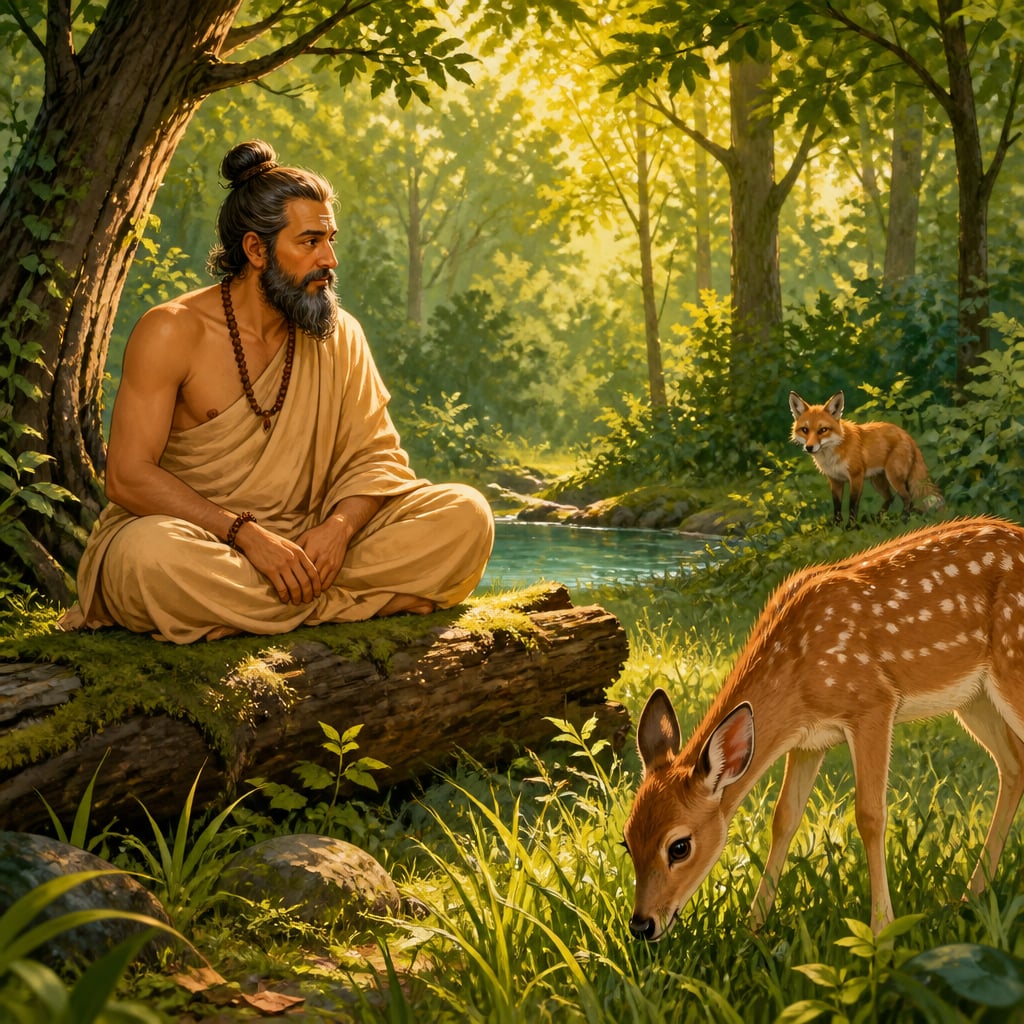
On the first day, he watched a deer graze on the grasses. On the second day, he watched a tiger stalk and take the deer. On the third day, he watched vultures and jackals feed on what remained. And as he watched, a pattern revealed itself.
The grass fed the deer. The deer fed the tiger. The tiger's remains fed the vultures and jackals and eventually the soil. And from that enriched soil, more grass would grow. Nothing was wasted; nothing existed alone. The deer was not separate from the tiger; the tiger was not separate from the soil. They were all expressions of one continuous flow.
'Sarvam idam brahma,' he said quietly, 'All this is One.' But he was not speaking mystically. He was describing what he saw: a web of connections so dense that no element could be understood in isolation. He called this web Sambandha, relationship, connection, the ties that bind.
What Is Sambandha?
The Sanskrit word Sambandha means 'binding together', from sam (together) and bandha (binding, connection). It refers to the network of relationships that connect all elements of a system.
In the Vedic worldview, Sambandha is not merely a descriptive term; it is an ontological principle. Nothing exists independently. Everything arises in relationship:
- Agni (fire) depends on Vāyu (air) to burn and Āpas (water) in the wood to fuel it
- Vāyu depends on Sūrya (sun) to create the temperature differentials that generate wind
- Āpas depends on Agni (sun's heat) to evaporate and form clouds
- Pṛthivī (earth) depends on all three to nurture life
This is not metaphor. It is precise observation. Remove one element, and the others cannot function. The Rishis understood what modern systems science calls interdependence: the property of complex systems where components cannot be understood apart from their relationships.
What the Mantras Reveal
The Purusha Sukta (RV 10.90) presents the universe as a single cosmic being, Purusha, from whose body all things emerge:
"सहस्रशीर्षा पुरुषः सहस्राक्षः सहस्रपात्" "The Cosmic Being has a thousand heads, a thousand eyes, a thousand feet."

Word by word:
- Sahasra, a thousand (meaning 'countless')
- śīrṣā, heads
- puruṣaḥ, the Cosmic Being
- akṣaḥ, eyes
- pāt, feet
The hymn continues to describe how from this one being, the moon was born from the mind, the sun from the eyes, the wind from the breath, the earth from the feet. Mountains, rivers, animals, humans, all are 'limbs' of one body.
This is not primitive mythology. It is a sophisticated model of interdependence: just as a body's organs depend on each other (the heart needs the lungs; the lungs need the blood; the blood needs the heart), so the cosmos is a single organism in which all parts are connected.
The Ṛg Veda explicitly states:
"विश्वेदेवाः समनसः सजातास्तोतिं जुषन्ताम्" "All the Devas, of one mind, born together, rejoice in praise."
The Devas, cosmic forces, are 'born together' (sajātāḥ) and 'of one mind' (samanasaḥ). They are not separate powers fighting for dominance but aspects of one reality working in concert. Fire does not oppose water; they are partners in a larger system.
Traditional Interpretations: Sayana and Aurobindo
Sayanacharya interprets the Sambandha of the Devas through the lens of Vedic ritual. The yajna (fire sacrifice) is a technology for harmonizing cosmic forces. When the priest offers ghee to Agni, the flames rise; the rising heat evaporates moisture; the clouds form; the rain falls; the crops grow; the cow produces ghee; the cycle continues. The ritual enacts interdependence, training the performer to see how one action affects the whole system.
Sri Aurobindo reads Sambandha as describing both outer and inner realities. The Devas within us, the powers of aspiration (Agni), breath (Vāyu), and vital flow (Āpas), are as interconnected as their cosmic counterparts. One cannot develop spiritual fire without proper breathing; one cannot breathe properly without vital nourishment; all inner capacities support each other. The inner world mirrors the outer: both are webs of relationship.
Correcting a Misconception
Western modernity was built on reductionism, the assumption that you can understand a whole by studying its parts in isolation. Take the machine apart, understand each gear, and you understand the machine. This approach produced the scientific revolution and industrial age.
But living systems are not machines. In living systems, the whole is greater than the sum of its parts because relationships create properties that parts alone do not possess. A forest is not just a collection of trees; it is trees plus soil plus fungi plus water plus insects plus deer plus tigers, all bound together in relationships that create something none could create alone.
The Vedic Rishis understood this intuitively. They never tried to isolate fire from air or water from earth. Their rituals, their hymns, their cosmology all emphasized connection. Modern systems science, emerging in the late 20th century, is essentially rediscovering this Vedic insight: reductionism fails for complex systems; only relational thinking succeeds.
A word of caution as we explore these teachings: understanding Vedic Sambandha offers an alternative to the reductionist thinking that created many modern crises, from ecological collapse to supply chain fragility to health problems treated in isolation. The Rishis understood that in living systems, relationship is primary. This insight is now essential for navigating a connected world.
Modern Resonance: Systems Thinking in Crisis
Ecosystem Collapse: In 1995, wolves were reintroduced to Yellowstone National Park in the United States after a 70-year absence. Within a decade, the park had transformed. Wolves hunted elk, reducing overgrazing. Vegetation returned to riverbanks. Beavers came back. Their dams created ponds. Fish populations increased. Songbirds returned. Even the rivers changed course as stabilized banks altered water flow.

This phenomenon, called a 'trophic cascade', demonstrated that removing one species affects the entire system. The Rishis' observation that everything is connected was validated by ecology: in a living system, you cannot change one thing without changing everything.
Supply Chain Disruptions: The COVID-19 pandemic revealed the fragility of modern supply chains. When semiconductor factories in Taiwan closed, car factories in Germany stopped. When shipping containers piled up in Los Angeles, products became unavailable in Mumbai. When one node in the network failed, ripples spread globally.
This is Sambandha in modern economic form. Just as the Rishis saw that fire depends on wood depends on rain depends on sun, modern supply chains are webs where electronics depend on chips depend on rare earth minerals depend on mining equipment depend on semiconductors. The system is connected; disruption spreads.
Microbiome Research: Perhaps the most striking modern confirmation of Sambandha is the discovery that humans are not individuals but ecosystems. Your body contains 38 trillion bacteria, more than the number of your own cells. These microbes digest food, produce vitamins, train your immune system, and affect your mood. You are not 'you'; you are a community.
The gut-brain axis, now extensively researched, shows that intestinal bacteria affect mental health. Depression, anxiety, and even personality traits correlate with gut microbiome composition. The Vedic insight that the body is not separate from its environment, that we are nodes in a web, not isolated units, is now mainstream science.
Systems therapy (Bowen, Minuchin) maps family dependencies that aren't obvious. The 'identified patient' often expresses a family-wide dysfunction. Mapping hidden relationships reveals where intervention actually works.
Supply chain analysts now map 'Tier 2' and 'Tier 3' suppliers, the suppliers of your suppliers. These hidden dependencies became visible during COVID disruptions. The Vedic insight: dependencies go deeper than you see.
Donella Meadows' 'iceberg model' shows that visible events arise from invisible patterns, structures, and mental models. Mapping these hidden layers is essential for effective intervention.
Game theory shows that cooperative strategies ('tit-for-tat,' 'generous tit-for-tat') outperform purely competitive strategies in repeated interactions. The Vedic insight: in ongoing relationships, cooperation wins.
Research on high-performing teams (Google's Project Aristotle) found that psychological safety, the ability to take risks without fear, was the top predictor of team success. Cooperation trumps internal competition.
Symbiosis is more common in nature than parasitism. Mycorrhizal fungi help 90% of plant species absorb nutrients; bacteria enable all animal digestion. Competition exists within a matrix of cooperation.
Your Path Forward
The Rishi Bharadvāja, sitting in that forest clearing, saw what modern ecologists have quantified: nothing exists alone. The deer is not separate from the grass, the tiger, the soil, the rain. Remove any element, and the system shifts.
This insight has immediate practical application. When facing any problem, ask:
- What is this connected to? No problem exists in isolation. Trace the connections.
- What happens if I change this? Interventions have ripple effects. Anticipate them.
- Where are the hidden dependencies? The system may depend on things you haven't noticed.
This week, try mapping the Sambandha of something in your life, a relationship, a project, a problem. Draw the connections. What depends on what? What affects what? You may discover that the 'problem' is actually a symptom of a larger system, and that the solution lies in a relationship you hadn't considered.
In the next lesson, we will explore where humans fit within this web, not as masters above it, but as participants within it.
Case studies
Wolves in Yellowstone: How One Species Changed Rivers
In 1995, wolves were reintroduced to Yellowstone National Park after a 70-year absence. No one expected what happened next. As wolf populations grew, elk changed their grazing behavior, they avoided valleys where they were vulnerable. Vegetation returned to those areas. Trees grew on riverbanks. Beaver populations recovered, building dams. Fish thrived in the new ponds. Songbirds returned. And the rivers themselves changed course as stabilized banks altered water flow.
This 'trophic cascade' demonstrates the Vedic principle of Sambandha: everything is connected. The wolves didn't directly affect the rivers, they affected elk, which affected vegetation, which affected erosion, which affected rivers. The Rishis' observation that no element exists in isolation was validated spectacularly: in a living system, touch one thing and everything responds.
Yellowstone is now a textbook example of ecosystem interdependence. The wolves didn't just add a predator; they reshaped the entire park's ecology. George Monbiot's viral video 'How Wolves Change Rivers' has been viewed over 40 million times, bringing the concept of trophic cascades to public awareness.
The Vedic insight that 'all Devas are born together', that forces work in concert, not isolation, has profound implications. Managers, policymakers, and individuals often focus on single factors. The Yellowstone case shows that interventions ripple through systems in unexpected ways. Systems thinking is essential.
Ecosystem-based management is now standard practice in marine conservation, where protecting one keystone species (like sea otters or coral) triggers cascading recovery across entire food webs. Urban planners are applying the same logic, recognizing that a single intervention like adding street trees can reduce crime, improve mental health, and lower energy costs simultaneously.
Within 20 years of wolf reintroduction, riparian vegetation increased by 170% in some Yellowstone areas, beaver colonies grew from 1 to 12, and river erosion decreased measurably. One species reshaped the landscape.
The Chip Shortage: Global Sambandha Revealed
In 2021, a global semiconductor shortage crippled industries from automobiles to appliances. The causes were multiple: COVID-related factory closures, a fire at a Japanese chip plant, a drought in Taiwan affecting water-intensive chip fabrication, and surging demand for consumer electronics. Car manufacturers idled assembly lines; appliance prices spiked; gaming consoles became scarce.
The chip shortage revealed the hidden Sambandha of the modern economy. A car contains over 1,000 chips; a car factory depends on chip factories; chip factories depend on water, energy, and specialized chemicals; each of these has its own supply chains. When one node failed, the entire network wobbled. The Vedic insight, that everything is 'bound together' (sam-bandha), describes modern supply chains precisely.
The shortage triggered a global rethinking of supply chain resilience. Companies began 'near-shoring' (moving production closer to home), building strategic chip stockpiles, and mapping Tier 2 and Tier 3 suppliers. Governments invested billions in domestic chip production. The hidden dependencies became visible, and the system is being redesigned for resilience.
Just as the Rishis observed that drought affects not just plants but the entire cosmic order, the chip shortage showed that disruption in one industry (semiconductors) ripples through all others (cars, appliances, healthcare). In a connected world, there is no such thing as an isolated problem.
The COVID-19 pandemic exposed identical vulnerabilities. A virus in one city shut down factories, airlines, and economies worldwide within weeks. Supply chain resilience has become a board-level priority, with companies diversifying suppliers and re-shoring production to reduce the risk of cascading failure across tightly coupled global networks.
In 2021, the global chip shortage cost the automotive industry alone an estimated $210 billion in lost revenue. General Motors, Ford, and Toyota all halted production at various plants. A fire at a single Renesas factory in Japan affected one-third of global automotive chip supply.
The Vedic Yajna: Engineering Interdependence
The Vedic yajna (fire sacrifice) was not merely a religious ritual but a technology for demonstrating and maintaining cosmic interdependence. The ceremony required precise coordination: specific woods for the fire, ghee from cattle, grains from the harvest, seasonal timing according to celestial positions, and the combined effort of multiple priests with specialized roles.
The yajna enacted Sambandha. When ghee was poured into Agni, the flames rose. The Rishis understood this as a chain of connection: the ghee came from the cow; the cow ate the grass; the grass grew from the rain; the rain fell from the clouds; the clouds formed from the evaporated waters; and the waters were drawn up by the sun's heat. Offering ghee to Agni was participating in a cosmic cycle, acknowledging that nothing humans have is truly separate from the forces that produced it.
The yajna tradition shaped Indian civilization for millennia. It produced the precise astronomical observations needed to determine ritual timing (leading to mathematical astronomy). It required community coordination (building social cohesion). It trained attention on interdependence (cultivating systems thinking). The ritual was a technology for encoding and transmitting the Sambandha worldview.
The Vedic yajna shows that the Rishis didn't just observe interdependence, they designed practices to embody it. Ritual was pedagogy: by performing the yajna, the participant experienced themselves as part of a larger web, not an isolated individual. This is 'embodied systems thinking.'
Modern team-building offsites, corporate retreats, and even hackathons serve a similar function: they create shared experiences that make abstract interdependence tangible. The most effective organizations design rituals that force cross-functional collaboration, making participants feel the connections between their work and the larger system.
A single Soma yajna required coordination of up to 17 specialized priests performing over 400 distinct ritual actions across 12 days, making it one of the most complex coordinated human activities documented in the ancient world.
Reflection
- Think of a challenge you're currently facing. What is it connected to? What systems, people, or forces does it depend on? What depends on it? Does mapping these connections change how you see the problem?
- The Rig Veda describes all Devas as 'born together' (sajātāḥ) and 'of one mind' (samanasaḥ). What does it mean for fire, water, wind, and earth to be 'of one mind'? How can forces be cooperative rather than competitive?
- If everything is connected to everything else (Sambandha), can we ever act without affecting the whole? Is it possible to 'do no harm'? Or is every action a ripple in the cosmic web?