Manuṣya: Humans as Part of the System
Participants, Not Masters, Our Place in Prakṛti
The Vedic vision places humans within nature, not above it. We are not masters of the earth but participants in its rhythms, dependent on clean air, pure water, fertile soil, and the countless organisms that sustain us. This lesson explores what it means to recognize our place as nodes in the web rather than rulers of it.
The young man's fever would not break. For three days, his family had watched him burn, applying wet cloths, feeding him water, praying. Now they had called for the Vaidya, the healer, who lived by the forest's edge.
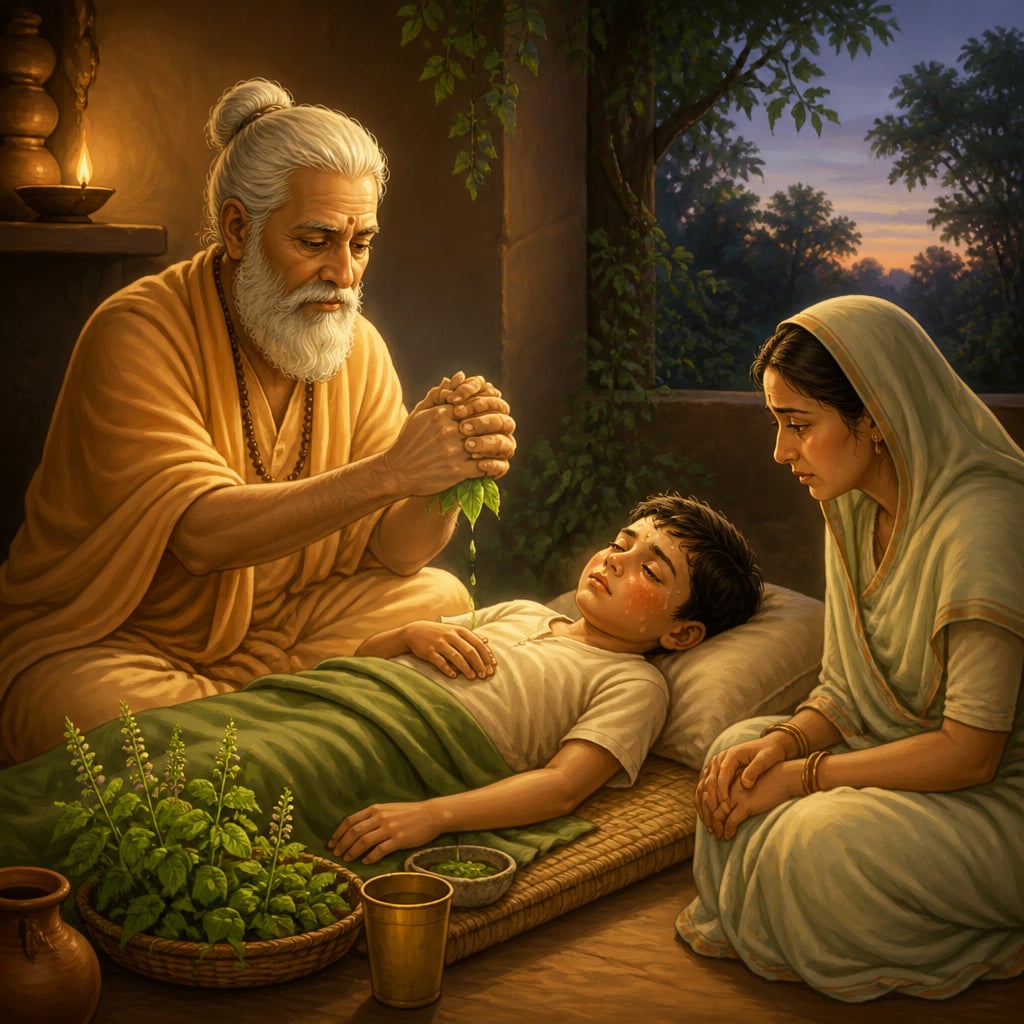
The Vaidya, an old Rishi with steady hands, examined the patient. He felt the pulse, rapid, uneven. He smelled the breath, sharp, metallic. He looked at the tongue, coated white. Then he walked outside and returned with a bundle of fresh leaves.
'This is tulasī,' he said. 'And this is aśvagandhā. And this is haridrā.' He prepared a paste, a tea, a poultice. And as he worked, he spoke to the young man's mother.
'Do you see what I am doing? I am not healing your son. I am asking the forest to heal him. This tulasī grew from the same earth he grew from. It drank the same rain. It breathed the same air. His body knows this plant as kin. When I give him this medicine, I am reconnecting him to the system that made him.'
By morning, the fever had broken. The Vaidya left before dawn, accepting only a basket of fruit in payment. But his words stayed with the family: The forest healed him. We only asked.
What Is the Human Place in Prakṛti?
The modern world is built on a peculiar assumption: that humans are separate from nature. We speak of 'the environment' as if it were something outside us, a backdrop to human activity rather than the matrix in which we are embedded. We build cities as if we could wall out the natural world, as if our food, water, and air came from nowhere.
The Vedic vision is different. In the Vedic worldview, humans are Manuṣya, from the root man (to think), the 'thinking ones.' But thinking does not exempt us from Prakṛti. The thinker breathes the same air as the bird; drinks the same water as the deer; returns to the same earth as the tree. We are participants in the system, not observers of it.
The Taittirīya Upaniṣad makes this explicit:
"अन्नाद्भूतानि जायन्ते" "From food, beings are born."
And:
"अन्नं ब्रह्मेति व्यजानात्" "Food is Brahman, the ultimate reality."
This is not metaphor. The human body is literally made from what we eat. And what we eat comes from the earth, the rain, the sun. We are not separate from nature, we are nature's expression. The calcium in your bones came from soil; the iron in your blood came from plants that absorbed it from earth; the water in your cells fell as rain somewhere, sometime. You are a condensation of nature, temporarily walking around.
What the Mantras Reveal
The Prithvi Sukta, that magnificent hymn to the Earth, includes this verse:
"पृथिव्यां बहवः प्रजाः विश्वं भूतं चराचरम्" "On the earth are many creatures, all beings moving and still."
Word by word:
- Pṛthivyām, on the earth
- bahavaḥ, many
- prajāḥ, creatures, offspring
- viśvam, all
- bhūtam, beings
- cara-acaram, moving and non-moving
Note what is not said. The hymn does not say 'On the earth are many creatures, plus humans who rule them.' It says 'many creatures', and humans are among them. We are prajā, offspring of the earth, alongside the elephant and the ant, the tree and the grass.
Another Vedic verse makes the relationship even clearer:
"माता भूमिः पुत्रो अहं पृथिव्याः" "The earth is my mother; I am her son."
A son does not own his mother. A son receives from her, is nourished by her, eventually returns to her. The relationship is one of gratitude and duty, not dominion.
Traditional Interpretations: Sayana and Aurobindo
Sayanacharya reads the Vedic hymns to nature as acknowledgments of practical dependence. Humans need food from plants, water from rivers, warmth from fire. The rituals of the Veda, offering ghee to Agni, water to the rivers, grain to the earth, are formal recognitions of this dependence. We give back a portion of what we receive, acknowledging that we are recipients, not origins.
Sri Aurobindo finds deeper significance. For him, the human place in Prakṛti is not just physical but evolutionary. Humans represent the emergence of self-aware consciousness within matter. We are nature becoming conscious of itself. This gives us a unique responsibility: to guide our own evolution consciously, in harmony with the larger system that produced us.
Both readings converge on humility. Whether practically or spiritually, humans are embedded in a larger reality. Forgetting this is the root of many modern crises.
Correcting a Misconception
The Western tradition, particularly after the Scientific Revolution, often framed nature as 'raw material' for human use. Francis Bacon wrote of 'putting nature to the rack' to extract her secrets. Descartes described animals as 'automata', machines without souls. This view enabled unprecedented technological progress, and unprecedented environmental destruction.
The Vedic tradition never separated humanity from nature in this way. There is no 'dominion' granted in the Vedas. The five great elements, earth, water, fire, air, space, are the same in the human body as in the cosmos. We are made of nature. Destroying nature is not exploiting a resource; it is destroying ourselves.
This is not romanticism. It is systems thinking applied to the self. If the forest disappears, the medicine disappears. If the rivers pollute, the body pollutes. If the soil depletes, the food depletes, and we deplete with it. Our well-being is not separate from the well-being of the system we inhabit.
A word of caution as we explore these teachings: the Vedic recognition that humans are praja, offspring of nature, offers an antidote to the hubris that created modern environmental crises. If we had remembered that 'earth is my mother,' we might not have treated her as a resource to extract. Reclaiming this wisdom is not nostalgia but necessity.
Modern Resonance: The Forgetting and the Remembering
When Humans Forget: The 20th century is littered with examples of civilizations that forgot their place in nature:
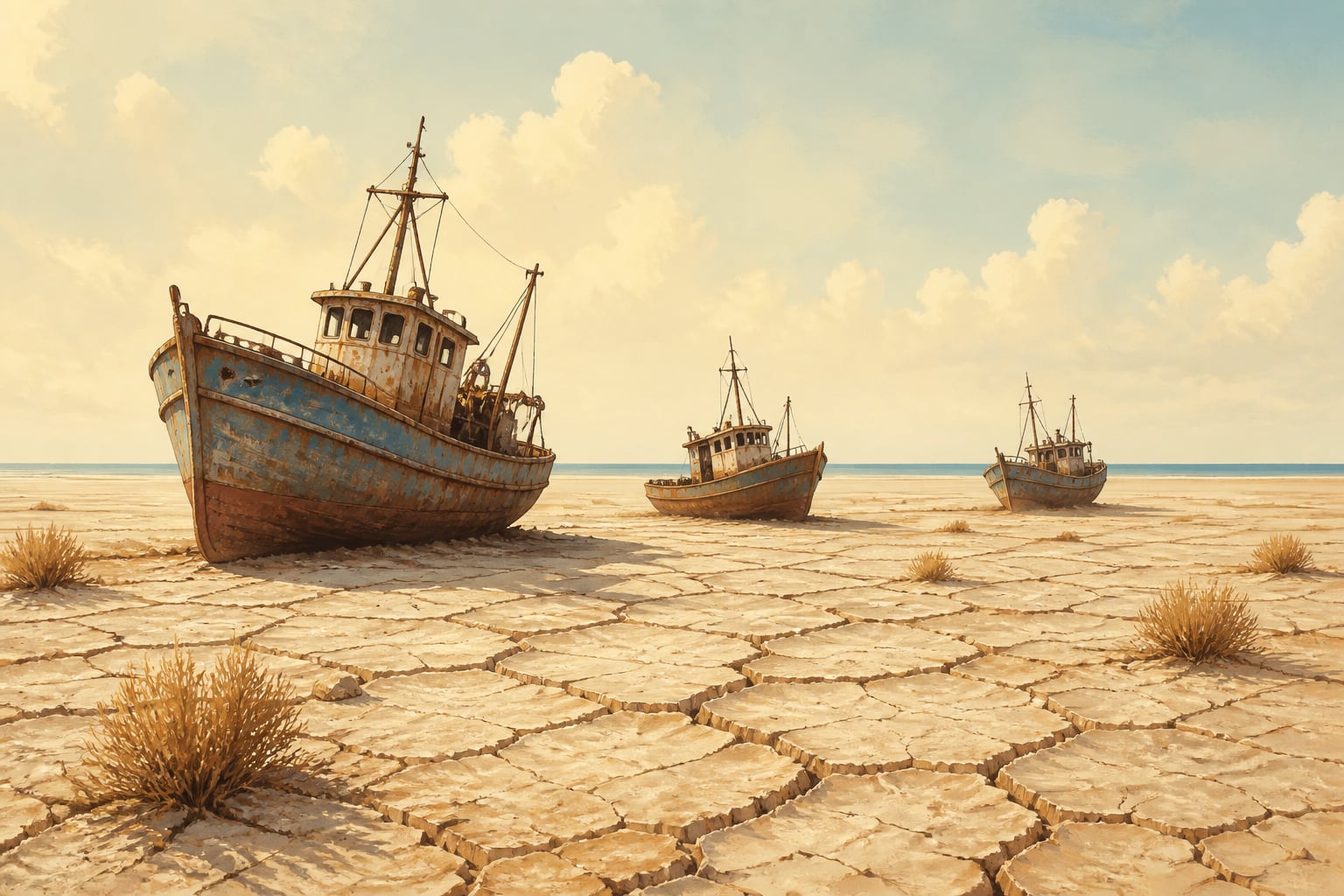
The Aral Sea, once the world's fourth-largest lake, was drained to irrigate cotton fields. What remains is a toxic desert. Fishing communities vanished. The climate of the entire region shifted. The Soviets who diverted the rivers thought they were 'conquering nature.' They were sawing off the branch they sat on.
Easter Island's deforestation is a cautionary tale. The island's inhabitants cut down every tree, losing the ability to build fishing boats, depleting soils, and triggering societal collapse. Archaeological evidence suggests the population crashed by 90% before European contact. When the trees went, everything followed.
When Humans Remember: But there are counter-examples, cases where humans designed with nature rather than against it:

Biophilic design integrates natural elements into buildings: living walls, natural light, water features, organic materials. Research shows that biophilic buildings reduce stress, increase productivity, and speed healing in hospitals. The body recognizes that it belongs in nature and responds when nature is present.
Singapore's Supertree Grove and Gardens by the Bay are examples of cities integrating nature at scale. Vertical gardens absorb carbon, reduce urban heat, and create habitats for birds and insects. This is not decoration, it is recognition that even cities are ecosystems, and humans thrive when embedded in living systems.
Research on 'nature connectedness' shows that people who feel embedded in (not separate from) nature report higher well-being, less anxiety, and more pro-environmental behavior. The feeling of belonging is therapeutic.
Leaders who remember their dependence on teams, organizations, and systems make better decisions than those who imagine themselves as lone geniuses. Humility about dependence improves judgment.
Ecological footprint analysis reveals how much land and water individuals require. Seeing this makes abstract dependence concrete: every person requires acres of 'invisible' nature to sustain them.
Research on 'helper's high' shows that giving activates reward centers in the brain. Reciprocity is not just moral duty but psychological need. We thrive when we give back.
Regenerative business models (Patagonia's '1% for the Planet,' B Corps) are structured around giving back to the systems that sustain them. This is corporate yajña, acknowledging that profit depends on natural capital.
Circular economy models close loops: waste becomes input, outputs regenerate inputs. This is yajña as economic principle, reciprocal exchange that sustains the system.
Your Path Forward
The Vaidya who healed the young man knew something profound: He was not separate from his medicine, and neither was his patient. The tulasī, the aśvagandhā, the haridrā, these were not external agents acting on a body. They were parts of the same system, temporarily separated, now reunited.
This week, try this practice: Notice one thing you depend on that comes from nature, your food, your water, your breath. Trace it backward. Where did it come from? What grew it? What forces (sun, rain, soil, labor) brought it to you?
As you trace these connections, you may begin to feel what the Rishis felt: not separate from nature, not a master of it, but a participant, one node in an ancient web, held by forces far larger than any individual. This is humility. But it is also belonging.
In the next lesson, we will explore how to hold nature with respect without falling into naïve romanticism, honoring Prakṛti while remaining clear-eyed about its dangers and complexities.
Case studies
The Aral Sea: When Humans Forget Their Place
In the 1960s, Soviet planners diverted the rivers feeding the Aral Sea, then the world's fourth-largest lake, to irrigate cotton fields in Central Asia. The plan worked: cotton production soared. But the Aral Sea began to shrink. By 2007, it had lost 90% of its water. Fishing villages found themselves 100 km from water. The exposed seabed, contaminated with pesticides and salt, created toxic dust storms affecting millions. The regional climate shifted; winters became colder, summers hotter.
The Aral Sea disaster is what happens when humans forget they are prajā, children of nature, not masters of it. The Soviet planners treated the rivers as 'resources' to redirect at will, ignoring the Sambandha that connected rivers, lake, climate, fish, and humans. The Vedic principle would have asked: What does this water sustain? What depends on it? What are we part of that we cannot see?
The Aral Sea disaster displaced millions, collapsed the fishing industry, and created one of the world's largest environmental catastrophes. Remediation efforts have partially restored the northern section (in Kazakhstan), but the southern section (in Uzbekistan) remains largely dead. The 'conquest of nature' became a cautionary tale.
The Vedic teaching that humans are participants, not masters, is not naive romanticism, it is systems wisdom. Forgetting our place in nature leads to predictable collapse. The question 'What system am I part of?' could have prevented the Aral disaster.
China's Three Gorges Dam and Brazil's Amazon deforestation follow the same pattern: short-term resource extraction that ignores systemic consequences. The Aral case is now studied in every environmental science program as a textbook example of what happens when planners optimize for one variable while ignoring the system it belongs to.
The Aral Sea's salinity increased from 10 g/L to over 100 g/L as it shrank. Fish populations collapsed completely. The region's infant mortality rate is among the highest in the former Soviet Union, linked to dust-borne toxins.
Biophilic Design: Bringing Nature Back to Humans
Biophilic design integrates natural elements into built environments: living walls, natural light, water features, organic materials. The term was coined by biologist E.O. Wilson, who argued that humans have an innate affinity for nature (biophilia), and that modern environments, by excluding nature, harm our well-being.
Biophilic design is the architectural expression of the Vedic insight that humans are part of nature, not separate from it. When we remove nature from our environments (sealed buildings, artificial light, no plants), we are denying our annamaya kosha, our body made of nature, its proper context. Biophilic design reunites what industrial architecture severed.
Research consistently shows that biophilic design improves health and productivity. A study at a Sacramento call center found that employees with views of nature processed calls 6-12% faster. Hospital patients with natural views healed faster and needed less pain medication. Singapore's Marina Bay Sands and Amazon's Spheres are large-scale examples of biophilic architecture.
When humans are removed from nature, we suffer, measurably. When we are reunited with nature, we heal. This is the annamaya principle in action: the body made of nature thrives in nature. Our buildings should reflect this truth.
Post-COVID office design has accelerated biophilic adoption, with companies like Amazon building the Spheres (a 40,000-plant workspace in Seattle). The $50 billion wellness real estate market is built on the same premise: humans perform better when their built environment reconnects them with the natural systems they evolved within.
Studies show that just 40 seconds of viewing a green roof can restore attention capacity. Hospital patients with natural views require 23% less pain medication and leave 1 day earlier on average. Nature is not luxury; it is necessity.
Easter Island: A Civilization That Forgot
Easter Island (Rapa Nui) was once covered with giant palm forests. Its Polynesian settlers used these trees to build fishing canoes, construct houses, and transport the famous moai statues. But they cut down every tree. By the time Europeans arrived in 1722, the island was treeless, the population had crashed from an estimated 15,000 to around 2,000, and the survivors were impoverished.
Easter Island is a tragic illustration of what happens when the principle 'mātā bhūmiḥ', the earth is my mother, is forgotten. The islanders treated trees as resources to consume, not as kin to protect. When the trees disappeared, so did the fishing boats (and protein), the building materials, and the soil fertility. The forgetting was fatal.
The Easter Island collapse is now a canonical example in sustainability literature. Jared Diamond devoted a chapter to it in 'Collapse: How Societies Choose to Fail or Succeed.' The lesson: civilizations that forget their dependence on ecosystems destroy themselves, sometimes rapidly, sometimes irreversibly.
The Vedic Rishi, observing Easter Island, would have seen the failure of yajña, the failure to give back, to restrain consumption, to recognize dependence. The island had no tradition that said: 'These trees are sacred; do not cut the last ones.' Without such a tradition, nothing stopped the cutting.
The collapse parallels modern concerns about deforestation in the Amazon, where removing tree cover disrupts rainfall patterns that sustain agriculture thousands of kilometers away. Easter Island is now invoked in climate policy debates as proof that no civilization is too advanced to destroy the ecosystem it depends on.
Pollen core analysis shows Easter Island lost its entire palm forest (estimated 16 million trees) between 1200 and 1650 CE. By contrast, India's sacred grove tradition has preserved over 100,000 forest patches across 19 states for centuries.
Reflection
- What is one thing you consume daily (food, water, air, electricity) that you usually take for granted? If you traced its origins, how far back would the chain go? How does this tracing change your relationship to it?
- 'The Earth is my mother; I am her son.' What does it feel like to say this sincerely? What emotions arise? Resistance? Belonging? What would change if you really believed it?
- If humans are 'participants' in nature rather than 'masters' of it, what happens to human exceptionalism? Do we lose our special status? Or does participation offer a different kind of dignity?