Ṛtu: Patterns in Nature
Seasons, Cycles, and the Wisdom of Right Timing
The Rishis observed that nature operates in patterns, seasons turn, moons wax and wane, stars return to their positions. They called this principle Ṛtu: the right time, the proper season, the natural rhythm. This lesson explores how the Vedic understanding of cyclical time offers a profound alternative to linear thinking, with implications for agriculture, health, and decision-making.
The farmer had walked from his village before dawn to consult with the Rishi who lived by the confluence of the rivers. His question was simple: When should I plant? The monsoon had been irregular last year, and the village elders disagreed about the timing.
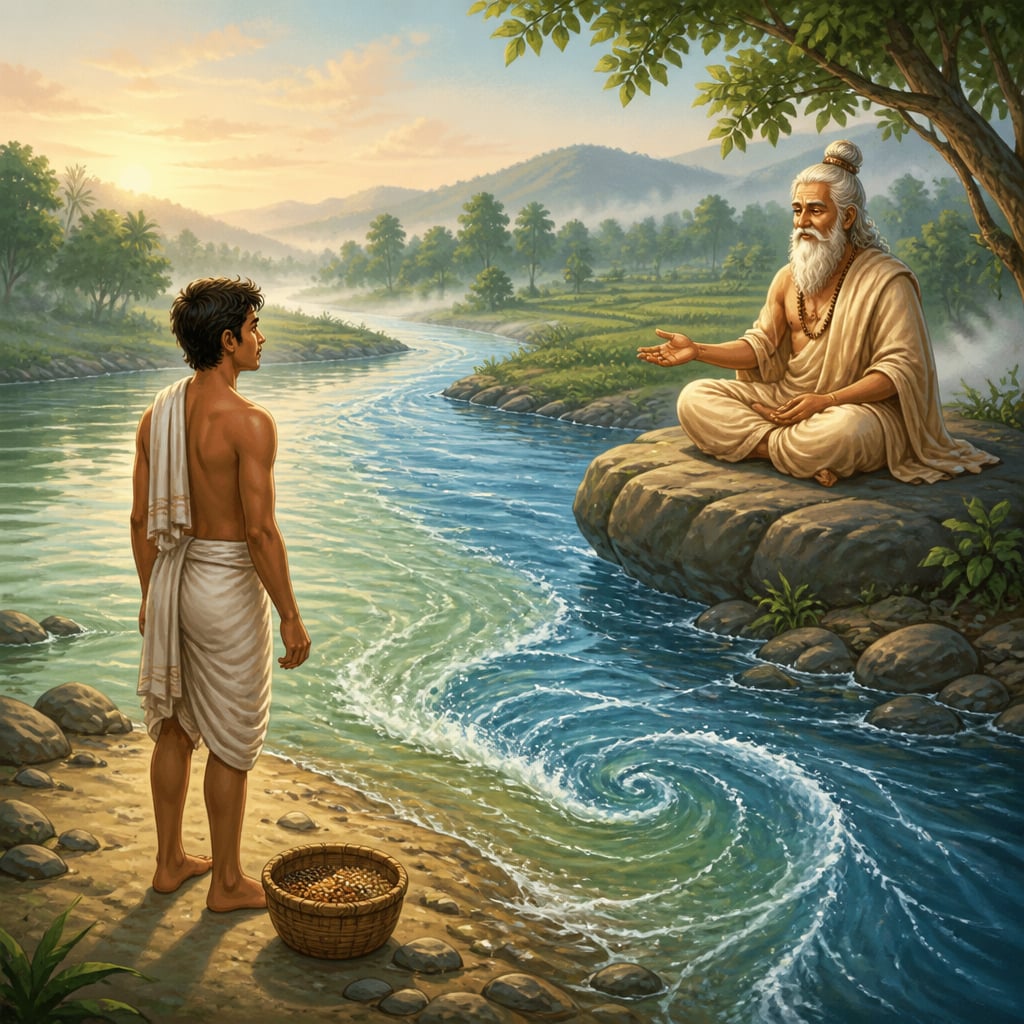
The Rishi did not answer immediately. Instead, he pointed to the sky. 'Which nakshatra rose at sunset yesterday?' The farmer knew, he had been watching. 'Rohini,' he said. The Rishi nodded. 'And the ants, have they begun building their mounds higher?' Yes, the farmer had noticed. 'The frogs, have they started calling in the evening?' They had, just three nights ago.
The Rishi smiled. 'The universe is telling you when to plant. The stars, the ants, the frogs, the moisture in the soil, the direction of the wind, they are all reading the same pattern. You need only learn to read it with them. This is Ṛtu, the right time. Plant when Ṛtu tells you, not when the calendar says.'
What Is Ṛtu?
The Sanskrit word Ṛtu comes from the same root as Ṛta, the cosmic order. While Ṛta refers to the underlying principle of order itself, Ṛtu refers to its expression in time, the seasons, the cycles, the proper moments for action.
The Vedic year recognized six Ṛtus:
| Ṛtu | Season | Approximate Months | Nature's Character |
|---|---|---|---|
| Vasanta | Spring | Mid-March to Mid-May | Renewal, flowering |
| Grīṣma | Summer | Mid-May to Mid-July | Heat, intensity |
| Varṣā | Monsoon | Mid-July to Mid-Sept | Rain, nourishment |
| Śarad | Autumn | Mid-Sept to Mid-Nov | Clarity, harvest |
| Hemanta | Early Winter | Mid-Nov to Mid-Jan | Withdrawal, rest |
| Śiśira | Late Winter | Mid-Jan to Mid-March | Cold, stillness |
Each Ṛtu has its own character, not just in weather but in what actions are appropriate. Vasanta is time for beginning; Grīṣma for intensity; Varṣā for nourishment; Śarad for harvesting; Hemanta for rest; Śiśira for preparation. To act against the Ṛtu is to fight the tide; to act with it is to be carried.
What the Mantras Reveal
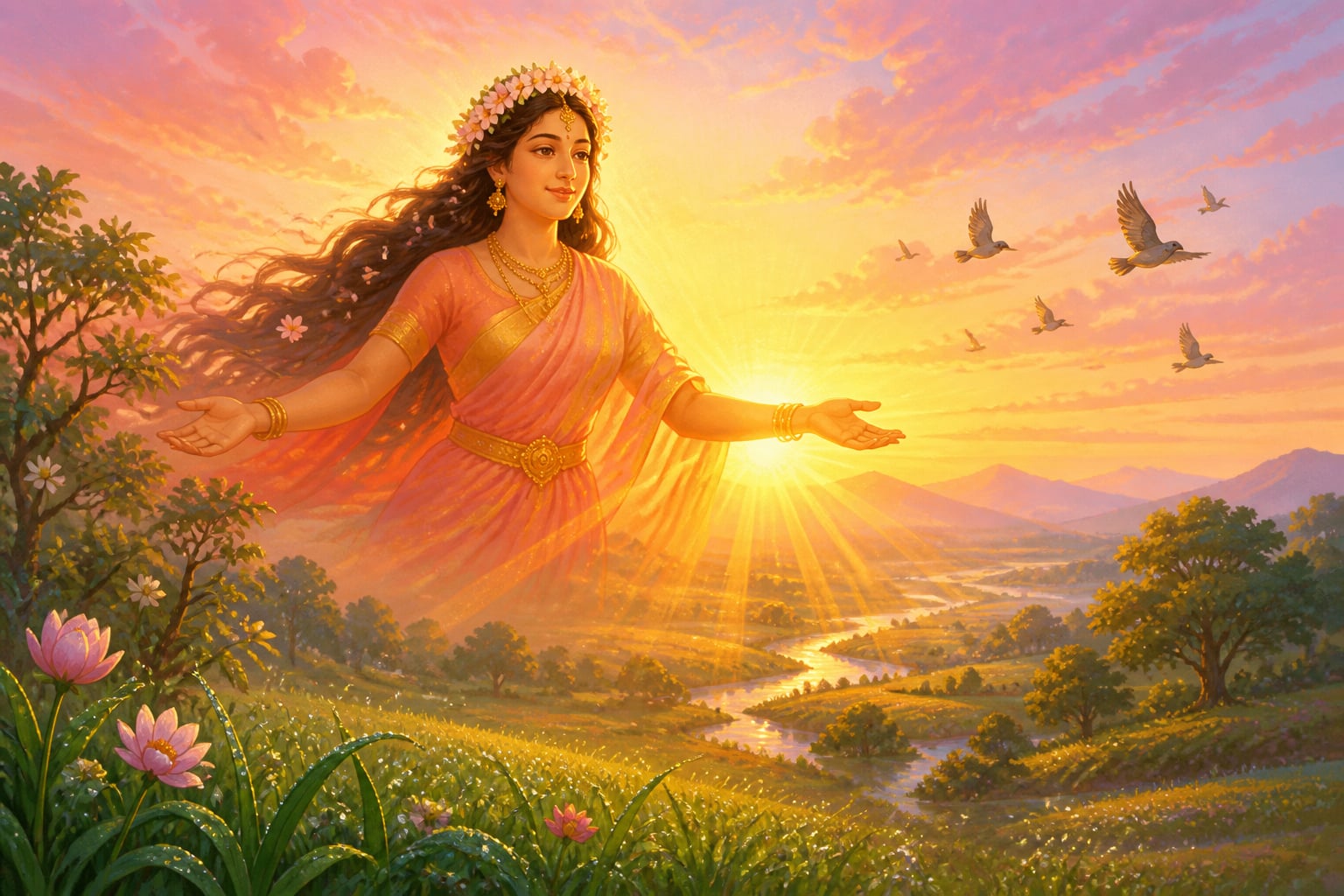
The Rig Veda is filled with hymns marking the turning of seasons. One of the most beautiful is the Uṣas Sukta (Dawn Hymns), celebrating the goddess of dawn who returns unfailingly each morning:
"उषा उच्छन्ती पृथिवीम् उर्वीम्" "Ushas rises, illuminating the wide earth."
Word by word:
- Uṣāḥ, Dawn (as feminine deity)
- ucchanți, rising, shining forth
- pṛthivīm, the earth
- urvīm, wide, vast
The Rishis did not merely describe dawn as a phenomenon. They recognized it as a pattern, utterly reliable, returning each morning without fail. Ushas embodies the principle of cyclical return: what sets will rise again; what ends will begin again; what seems lost will return.
This is not abstract philosophy. It is the foundation of a worldview:
"पुनरापि जननं पुनरापि मरणं" "Again birth, again death."
But also:
"पुनरापि उदयं पुनरापि विकासं" "Again rising, again flourishing."
The Vedic seers understood that time is not a line running toward extinction but a spiral, patterns recurring at different scales, from the daily cycle of dawn to the vast cosmic cycles of creation and dissolution.
Traditional Interpretations: Sayana and Aurobindo
Sayanacharya reads the seasonal hymns as practical guides for ritual timing. The Vedic yajna was not performed randomly but at specific muhurtas (auspicious moments) aligned with celestial and seasonal patterns. The Ṛtvik priest, from the same root as Ṛtu, was the one who knew the proper times. Sayana emphasizes that Vedic life was synchronized with cosmic rhythms through meticulous observation.
Sri Aurobindo sees deeper significance. The outer seasons mirror inner cycles. Vasanta (spring) corresponds to spiritual awakening; Grīṣma (summer) to the intensity of tapas; Varṣā (monsoon) to the descent of grace; Śarad (autumn) to the clarity of realization. The Rishi who attunes to outer Ṛtu also learns the inner rhythms of consciousness.
Both readings suggest the same practical wisdom: life has seasons. There are times to act intensely and times to rest. Times to plant and times to harvest. Fighting these rhythms leads to exhaustion and failure; aligning with them brings ease and abundance.
Correcting a Misconception
Modern industrial society operates on linear time, the assumption that effort can be applied uniformly at any moment, that machines (and people) should produce at constant rates regardless of season or hour. This view treats time as a neutral medium, ignoring the rhythmic nature of living systems.
The Vedic view is radically different. Time is not neutral, it has quality. Some moments are aligned with certain actions; others are not. This is not superstition but pattern recognition. A farmer who plants at the wrong time fails not because of bad luck but because they ignored the pattern.
Modern chronobiology has rediscovered this truth. Circadian rhythms, seasonal affective patterns, and biological clocks are now measured with precision, confirming what the Rishis observed: living systems operate in cycles, and ignoring those cycles has consequences.
A word of caution as we explore these teachings: understanding Vedic Rtu wisdom reveals that time is not a neutral medium but has quality, different moments suit different actions. This insight, now confirmed by chronobiology, offers an alternative to the industrial model of constant, uniform production. Aligning with natural rhythms is not nostalgia but practical wisdom for sustainable living.
Modern Resonance: Cycles in the 21st Century
Circadian Rhythm Research: In 2017, Jeffrey Hall, Michael Rosbash, and Michael Young received the Nobel Prize for discovering the molecular mechanisms of circadian rhythms. Their research showed that every cell in the body operates on a 24-hour cycle, and disrupting this cycle (through shift work, jet lag, or constant artificial light) leads to metabolic disorders, cancer risk, and cognitive decline.
The Vedic practice of aligning activity with the sun's position, rising at brahma-muhurta (before dawn), eating the main meal at midday, sleeping after sunset, is now validated by molecular biology. The body is not a machine that can work at any hour; it is a living system attuned to cosmic rhythms.
Traditional Agriculture: Dr. Debal Deb, who runs the Vrindavan seed conservation farm in Odisha, documents how traditional farmers time planting by the nakshatra (lunar asterism) calendar, the same system the Rishi advised. His research shows that panchang-based planting often outperforms calendar-based planting because it accounts for local microclimate variations that correlate with celestial positions.
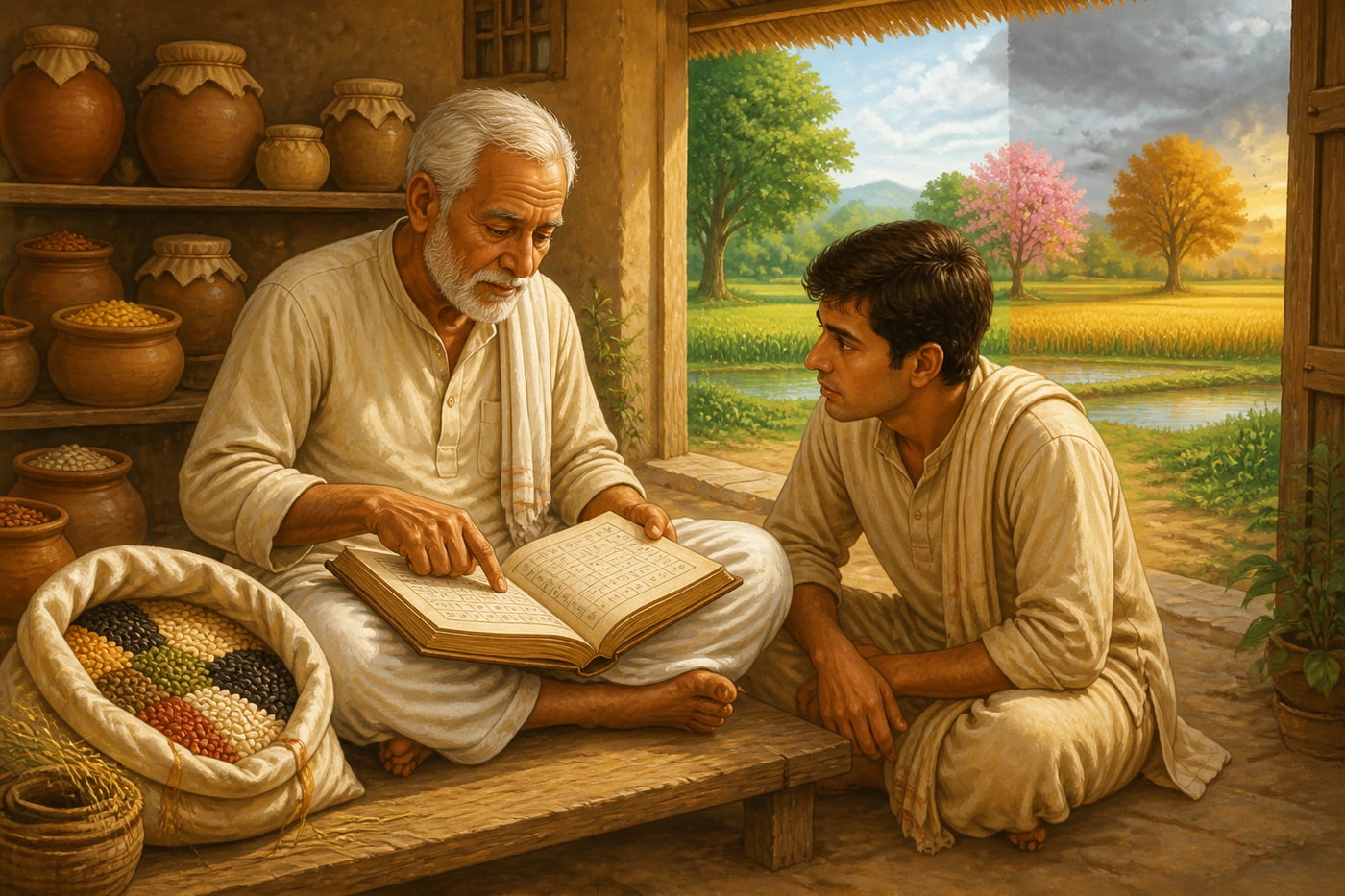
Navdanya, founded by Vandana Shiva, preserves not just seeds but the knowledge of when to plant them. This includes Ṛtu-specific practices: which seeds for which season, when to let land rest, how to read the signs of approaching rains. This is Ṛtu wisdom in living form.
Climate Patterns: Modern meteorology has identified cycles like El Niño and La Niña, oscillations in Pacific Ocean temperatures that affect global weather. Indian monsoon forecasters now integrate these cycles with traditional pattern recognition. The Rishis' observation that weather follows patterns, not random variation, is confirmed by climate science.
Circadian psychology shows that cognitive performance, mood, and willpower follow predictable daily rhythms. Peak alertness for most people occurs mid-morning; the 'afternoon slump' around 2-3 PM is biological, not weakness. Fighting these rhythms depletes energy; aligning with them optimizes performance.
Companies like Basecamp and Buffer have experimented with 'energy management' over 'time management', allowing employees to work when they're naturally focused rather than enforcing 9-5. Results: higher productivity, lower burnout, greater creativity.
Systems exhibit oscillation, boom-bust cycles in economies, predator-prey cycles in ecosystems, innovation cycles in technology. Fighting oscillation creates worse oscillation; understanding and anticipating cycles enables smoother adaptation.
Interoception, the ability to sense internal bodily signals, correlates with better emotional regulation and decision-making. Learning to 'read' your own body's signals (hunger, fatigue, stress) is the internal equivalent of reading nature's patterns.
The best leaders develop 'pattern recognition' for organizational dynamics, sensing when morale is shifting, when projects are at risk, when markets are turning. This is cultivated attention, not just data analysis.
Leading indicators in complex systems often appear in unexpected places, ant behavior predicting rain, yield curve inversions predicting recessions. Systems thinkers cultivate wide-ranging attention to catch early signals.
Your Path Forward
The farmer who consulted the Rishi learned something profound: the universe is already telling you what to do, if you learn to read the signs. The ants, the frogs, the stars, the soil, they are all expressions of the same pattern, the same Ṛtu.
Try this practice for one week: Notice the rhythms in your own energy. When do you feel most alert? Most creative? Most tired? Rather than forcing constant productivity, experiment with aligning your tasks with your natural cycles. Schedule deep work when you're naturally focused; rest when your energy dips.
You may find, as the Rishis did, that working with your rhythms produces more than fighting against them. The universe has patterns; your body has patterns; even your mind has patterns. To recognize these patterns and align with them is to practice Ṛtu in daily life.
In the next lesson, we will explore how natural forces work together, the principle of Sambandha (interdependence), and how the Vedic vision of interconnection anticipates modern systems ecology.
Case studies
The Nobel Prize for Circadian Rhythms: Science Confirms Ṛtu
In 2017, Jeffrey Hall, Michael Rosbash, and Michael Young received the Nobel Prize in Physiology or Medicine for discovering molecular mechanisms controlling circadian rhythms. Their research revealed that every cell in the body has its own 24-hour clock, regulated by genes that turn on and off in predictable cycles. Disrupting these rhythms, through shift work, jet lag, or artificial light at night, leads to metabolic disorders, increased cancer risk, depression, and cognitive decline.
The Vedic tradition organized daily life around natural rhythms: rising before dawn (brahma-muhūrta), main meals at midday (when digestive Agni is strongest), sleep after sunset. These weren't arbitrary customs but empirical observations encoded in practice. The Nobel research validated what Ayurveda had prescribed for millennia: align your activities with the sun's position.
The research has transformed health recommendations. The American Academy of Sleep Medicine now recommends maintaining consistent sleep schedules; the WHO has classified night shift work as a 'probable carcinogen.' Hospitals are redesigning lighting to support patients' circadian rhythms. The ancient wisdom of Ṛtu has become mainstream medicine.
The Rishis observed that time has quality, different hours suit different activities. Modern molecular biology confirmed this at the cellular level. Ignoring Ṛtu is not just inefficient; it's harmful. Aligning with natural rhythms is not optional for health; it's essential.
Chrono-medicine is now an active research frontier, with hospitals experimenting on timing chemotherapy and surgery to patients' circadian profiles. Apple Watch and Oura Ring have made personal rhythm-tracking mainstream, validating the ancient insight that when you do something matters as much as what you do.
Nurses who worked rotating night shifts for 10+ years had a 79% higher risk of coronary heart disease compared to those who never worked nights (Nurses' Health Study, Harvard). The body tracks Ṛtu whether we acknowledge it or not.
Navdanya and Panchang-Based Farming
Dr. Vandana Shiva's Navdanya movement, based in Uttarakhand, preserves over 4,000 native seed varieties along with traditional knowledge of when and how to plant them. Farmers in the network use the panchang (traditional lunar-solar calendar) to time agricultural activities, planting, transplanting, harvesting, rather than relying solely on the Gregorian calendar.
The panchang tracks the position of the moon through 27 nakshatras (lunar asterisms), each associated with specific agricultural activities. Rohini nakshatra, for instance, is considered ideal for planting root vegetables; Mrigashira for transplanting rice. This is Ṛtu wisdom encoded in almanac form, the same tradition the Rishi advised the farmer to follow.
Comparative studies by Debal Deb (Vrindavan Farm) show that panchang-timed planting often produces yields comparable to or better than calendar-based methods, with significantly lower inputs (water, fertilizer, pesticides). The nakshatra calendar captures local microclimate variations that the Gregorian calendar ignores.
Traditional knowledge systems encoded millennia of observation into practical calendars. These are not superstitions but pattern-recognition tools. The Ṛtu wisdom of the Rishis, preserved in the panchang, remains relevant for sustainable agriculture.
As industrial monoculture farming faces mounting soil depletion and pest resistance, regenerative agriculture movements worldwide are rediscovering indigenous planting calendars. The convergence of satellite weather data with traditional seasonal knowledge is producing hybrid farming systems that outperform either approach alone.
Navdanya has trained over 500,000 farmers in seed sovereignty and traditional agricultural practices since 1991. Their network spans 16 states in India.
The Vedic Calendar: Engineering Time
The Vedic civilization developed one of the most sophisticated calendar systems of the ancient world. The Vedāṅga Jyotiṣa (astronomical appendix to the Vedas, c. 1400-500 BCE) describes methods for calculating solstices, equinoxes, lunar phases, and the intercalation needed to keep lunar and solar cycles aligned. This was not abstract mathematics but practical necessity: rituals had to occur at astronomically precise moments.
The Vedic view was that ritual aligns human action with cosmic order. For this alignment to work, the timing had to be exact. Sacrifices performed at wrong times were ineffective or harmful. This drove the development of precise astronomical observation, the origin of Indian mathematical astronomy.
The Vedic calendar tradition evolved into the sophisticated jyotiṣa (astronomy/astrology) system that still guides Hindu religious life. The calculation of tithis (lunar days), nakshatras, and muhūrtas continues to determine festival dates, marriage timing, and ritual schedules for over a billion people. The Vedic insight, that time's quality matters, remains culturally operative.
The Vedic civilization's investment in astronomical precision was driven by the conviction that Ṛtu matters, that aligning human action with cosmic rhythms produces better outcomes. This conviction generated scientific knowledge that persists to this day.
GPS satellites, stock market opening bells, and international time zones all serve the same function the Vedic calendar served: synchronizing collective human action across distance. The precision has increased, but the underlying insight remains. Societies that align their activities with reliable rhythmic structures coordinate more effectively.
The Vedanga Jyotisha calculated the lunar month at 29.5 days, matching the modern value of 29.53 days with 99.9% accuracy, and tracked a 5-year yuga cycle of 1,830 days to synchronize solar and lunar calendars.
Reflection
- When do you feel most alive, alert, and creative during the day? When do you feel tired or foggy? Are you currently fighting these rhythms or aligning with them?
- The Vedic vision is that time is cyclical, patterns return, what is lost comes back in new form. How does this differ from the modern sense of time as linear and running out? What would change if you experienced time as a wheel rather than a line?
- If the universe operates in patterns (Ṛtu) and we are part of the universe, does human freedom exist? Or are we simply expressions of cosmic rhythms, like the seasons themselves?