Prakṛti: Nature in the Rig Veda
How the Rishis Saw the World as a Living System
The Rig Veda presents nature not as a backdrop to human activity but as a living, interconnected system where every force participates in maintaining cosmic order. This lesson introduces the Vedic vision of Prakṛti, a world where rivers, fire, wind, and earth are not mere resources but active participants in a web of mutual relationships.
The Rishi Vasiṣṭha sat by the Saraswati at dawn, watching the great river in silence. Kingfishers dove for fish. Herons waded in the shallows. A farmer led his cattle to drink. Fish broke the surface, and the ripples caught the first light. The Rishi noticed something that would shape his hymns: nothing here existed alone. The river fed the fish, the fish fed the birds, the birds spread seeds that grew into trees, and the trees held the riverbanks firm. Remove one element, and the others would suffer. This was not poetry, it was observation. And from such observation, the Rishis developed a way of seeing the world that modern science is only now beginning to articulate: everything is connected.

The Vedic Vision of Prakṛti
When the Rishis spoke of Prakṛti (nature), they did not mean a passive backdrop for human activity. They saw a living system, dynamic, self-regulating, and sacred. The Sanskrit root pra-kṛ means 'to bring forth' or 'to create.' Prakṛti is not static matter but active creation, constantly producing, transforming, and renewing.
This vision appears throughout the Rig Veda. The hymns describe a world where cosmic forces, Devas, are not distant gods but active principles working within nature. Agni is the fire that transforms; Vāyu is the wind that moves; Āpas are the waters that purify and nourish. These are not metaphors for natural phenomena, they are natural phenomena understood as conscious, purposeful forces.
The Rishi Dīrghatamas declared:
"एकं सद् विप्रा बहुधा वदन्ति" "The One Reality, the wise describe in many ways."
Behind the apparent diversity of nature, rivers, mountains, forests, storms, the Rishis perceived a single, interconnected order. They called this order Ṛta, the cosmic law that governs how everything works together.
What the Mantras Reveal
The Rig Veda contains over a thousand hymns, and nature pervades nearly all of them. Consider this verse from the Prithvi Sukta (Earth Hymn):
"माता भूमिः पुत्रो अहं पृथिव्याः" "The Earth is my mother, and I am her son."
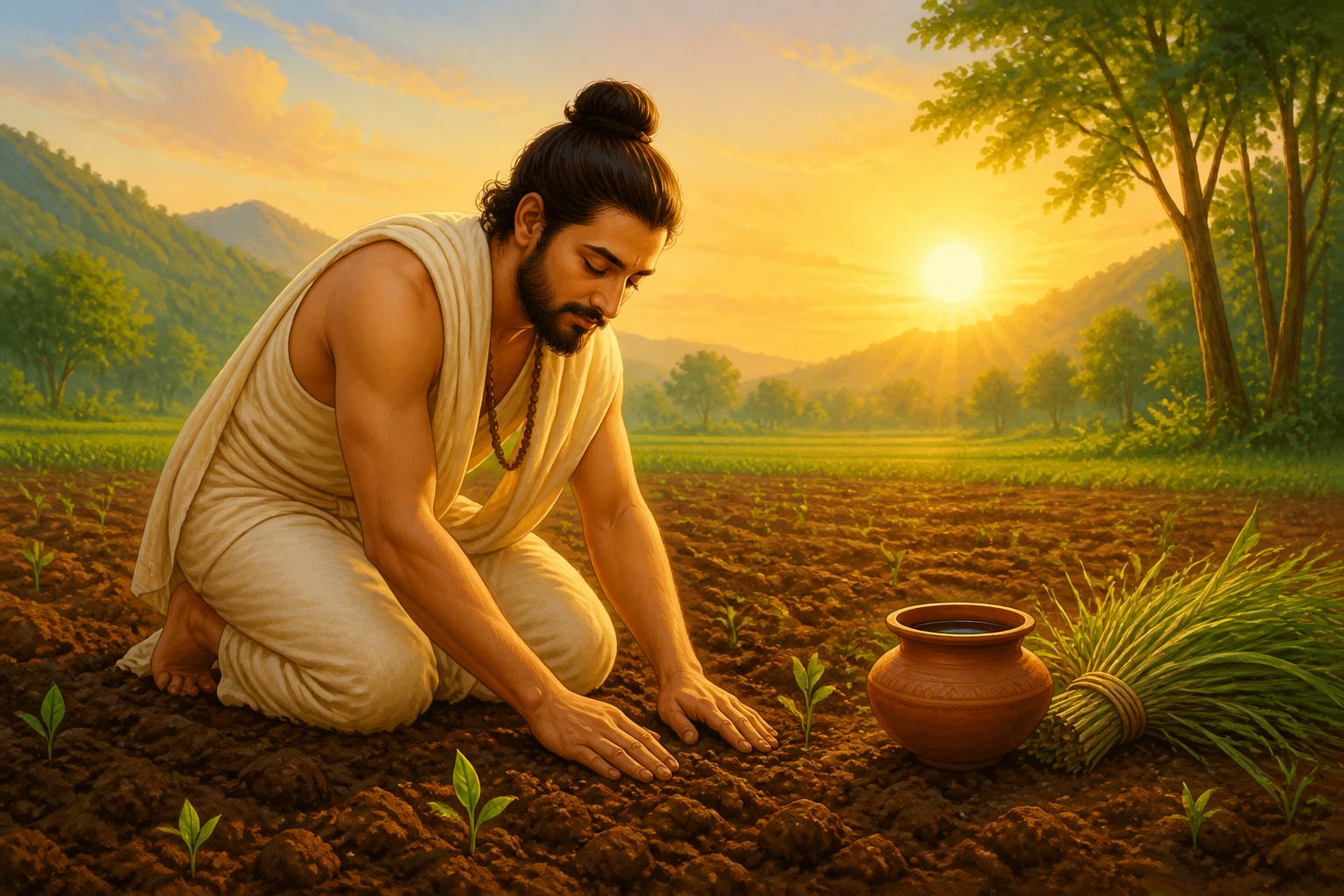
This is not sentimental poetry. It is a statement of relationship and responsibility. A son does not exploit his mother; he honors, protects, and nourishes her. The Rishi Atharvan saw humans not as masters of the earth but as participants in a larger family, bound by duty, not dominance.
Word by word, the mantra reveals its depth:
- Mātā (mother), source of life, deserving reverence
- Bhūmiḥ (earth), not just soil, but the entire living planet
- Putraḥ (son), implying obligation, not ownership
- Aham (I), the speaker accepts personal responsibility
The Vedic relationship with nature was one of reciprocity, not extraction. Humans received food, water, shelter, and medicine from nature. In return, they were expected to maintain balance, through mindful action, ritual, and restraint.
Traditional Interpretations: Sayana and Aurobindo
Sayanacharya, the 14th-century commentator, interprets the Vedic hymns to nature as invocations seeking blessings, rains for crops, rivers for travel, fire for sacrifice. His reading emphasizes the practical relationship between humans and natural forces. The Rishis depended on nature and acknowledged that dependence through prayer and ritual.
Sri Aurobindo offers a deeper reading. In The Secret of the Veda, he argues that the Devas represent not just outer forces but inner psychological powers. Agni is the fire of aspiration; Vāyu is the breath of life-force; the waters are the flow of consciousness. Nature, in this view, is a mirror of the inner world. To understand the outer ecosystem is to understand the self.
Both interpretations coexist. The Vedic Rishi saw no division between the practical and the spiritual. Tending the fields was spiritual practice. Observing the river was meditation. Nature was both classroom and temple.
Correcting a Misconception
Western scholars often described Vedic religion as "nature worship", a primitive animism where people prayed to rivers and fire out of superstitious fear. This framing misses the sophistication of the Vedic worldview.
The Rishis were not worshipping nature as gods. They recognized that natural forces operate according to Ṛta, a cosmic order that is impersonal, self-regulating, and far older than humanity. The Devas are not arbitrary spirits to be appeased but principles to be aligned with. Worshipping Agni is not fear of fire but recognition that transformation (the essence of fire) is a fundamental process in the universe.
This is systems thinking, not superstition.
A word of caution as we explore these teachings: understanding the Vedic context prevents us from projecting modern categories onto ancient texts. The Rishis did not divide 'science' from 'religion' or 'practical' from 'spiritual.' Their systems thinking emerged from lived engagement with a natural world they considered sacred, intelligent, and interconnected. This integrated view offers an alternative to the fragmentary thinking that underlies many contemporary environmental crises.
Modern Resonance: Systems Thinking in the 21st Century
In 1969, ecologist Eugene Odum published Fundamentals of Ecology, establishing that ecosystems are interconnected networks where energy flows from one organism to another. This was revolutionary, and yet the Rishis had observed precisely this dynamic six thousand years earlier.

Today, systems thinking has become essential across fields:
- Ecology recognizes that species cannot be understood in isolation, only in relationship.
- Medicine is shifting from treating isolated symptoms to understanding the body as an integrated system (the microbiome revolution).
- AI safety researchers emphasize that artificial intelligence must be understood within the larger system of human society, not as an isolated technology.
The Vedic principle is the same: no force exists in isolation. Whether studying a river, a body, or an algorithm, the question is always: What is this connected to? What does it depend on? What depends on it?
Dr. Vandana Shiva, the physicist and environmental activist, explicitly draws on Vedic thought in her critique of industrial agriculture. She argues that treating soil as "dead matter" to be exploited leads to ecological collapse. The Vedic view, that soil is alive, part of the living Prakṛti, offers a more accurate and sustainable model.
Systems psychology (Bronfenbrenner's ecological model) shows that human development cannot be understood by studying individuals in isolation, family, school, culture, and biology all interact. The 'one reality' behind diverse behaviors is the system.
Peter Senge's 'The Fifth Discipline' argues that organizational problems arise from fragmented thinking, treating departments as silos instead of interconnected parts. The Vedic insight: see the organization as one living system.
Donella Meadows in 'Thinking in Systems' emphasizes that leverage points for change are rarely where problems appear. Understanding the whole system, the 'one reality', reveals where intervention actually works.
Research on 'nature connectedness' (Mayer & Frantz, 2004) shows that people who perceive kinship with nature show greater well-being and more sustainable behavior. The felt sense of relationship, not just knowledge, drives change.
Companies like Patagonia frame their relationship with nature as 'family', leading to decisions that prioritize long-term sustainability over short-term extraction. The ownership mindset leads to exploitation; the kinship mindset leads to stewardship.
The 'Tragedy of the Commons' occurs when individuals treat shared resources as ownerless. The Vedic solution: recognize the commons as 'mother', a relationship of care, not competition.
Your Path Forward
The Rishi by the Saraswati did not discover something new that morning. He simply noticed what had always been true: the world is a web, not a collection of separate objects. Every element depends on others. Every action sends ripples through the system.
This week, try this simple practice: Choose one natural element in your environment, a tree, a bird, a patch of soil. Ask yourself: What does this depend on? What depends on it? How many connections can you trace?
You may find, as the Rishis did, that the web extends further than you imagined. And in tracing those connections, you begin to see the world as they saw it, not as a resource to exploit, but as a living system to participate in.
In the next lesson, we will explore specific natural forces, rivers, fire, and wind, as the Rishis understood them: not as passive elements but as active Devas, each with their own character and role in maintaining cosmic order.
Case studies
ISRO's Earth Observation: Seeing India as One System
When drought struck Maharashtra in 2015-16, ISRO didn't just provide rainfall data. Their satellite imagery revealed a systems failure: deforestation in the Western Ghats had disrupted moisture patterns, groundwater extraction had depleted aquifers, and watershed degradation had reduced soil's water-holding capacity. The drought wasn't caused by one factor but by interconnected failures across the land-water-vegetation system.
The Vedic principle of 'ekam sat', one interconnected reality, guided ISRO's analysis. Rather than treating drought as a 'weather problem' (isolated), they traced connections across the entire land-water-forest-human system. This is precisely what the Rishis did when observing the Saraswati: seeing how river, fish, birds, trees, and farmers formed one web.
ISRO's integrated approach informed Maharashtra's Jalyukt Shivar Abhiyan (water conservation scheme), which treated watersheds as systems, combining check dams, farm ponds, desilting, and afforestation. By 2019, over 16,000 villages had become water-positive, with groundwater levels rising in formerly depleted zones.
Environmental problems are rarely single-cause. The Vedic systems view, seeing forests, water, soil, and human activity as one interconnected reality, is more accurate and more actionable than fragmented analysis.
Today's climate scientists use the same integrated approach when modeling Earth systems. Cities like Copenhagen and Singapore now design infrastructure around watershed-level thinking, treating drainage, green cover, and urban heat as one interconnected problem rather than separate engineering challenges.
ISRO's Bhuvan platform now provides free, public access to satellite imagery covering 80% of India's geographical area, enabling citizens and local governments to monitor watershed health in real-time.
The Saraswati Civilization: Systems Thinking at Scale
The Harappan-Saraswati civilization (3300-1300 BCE) built over 2,000 settlements along the Saraswati and Indus rivers. What distinguished them wasn't monumental architecture but sophisticated systems management: standardized brick sizes across 1,000+ km, integrated drainage systems, shared weights and measures, and granaries that suggest coordinated food storage.
The Rig Veda celebrates the Saraswati as 'best of rivers, best of mothers, best of goddesses' (RV 2.41.16). The civilization that flourished on her banks demonstrated the Vedic principle that human systems must align with natural systems. They didn't fight the river; they worked with its rhythms, settling on flood plains during dry seasons, managing water distribution through careful engineering.
When the Saraswati began drying up around 1900 BCE (due to tectonic shifts and changing monsoon patterns), the civilization didn't collapse violently. Archaeological evidence shows gradual, organized migration eastward to the Ganga-Yamuna plains. This adaptive resilience suggests societies that understood themselves as part of larger systems, able to move with change rather than resist it.
Civilizations that see themselves as embedded in natural systems, rather than opposed to them, demonstrate greater resilience when conditions change. The Saraswati civilization's ability to migrate and adapt mirrors the Vedic teaching: humans are part of Prakṛti, not masters of it.
Modern cities facing sea-level rise and resource depletion face the same choice the Saraswati civilization did: adapt by redesigning systems around new realities, or collapse by clinging to arrangements that no longer match conditions. The difference is whether institutions treat environmental change as a signal to reorganize or a threat to resist.
Archaeological surveys have identified over 2,000 Harappan-Saraswati settlements along the ancient river's course, with standardized brick ratios (4:2:1) maintained across 1,000+ km, indicating system-wide coordination without centralized enforcement.
Reflection
- Think of a natural element you encounter daily (a tree, a river, the sky, the soil). Do you relate to it as a 'resource' to use, or as a living presence with which you have relationship? What would change if you shifted to kinship?
- The Rishis perceived 'one reality' (ekam sat) behind nature's diversity. What might they have meant by this? Is it a mystical claim, a scientific observation, or something else entirely?
- If nature is truly a self-regulating system operating according to Ṛta (cosmic order), what is the appropriate role of human beings within it? Are we stewards, participants, observers, or something else?