Vinaya: Victory Is Temporary
Why the Rig Veda Distrusts Unchecked Success
The Rig Veda treats victory not as a final state but as a dangerous transition point. Through the stories of Indra and the concept of vinaya, the Rishis warn that unchecked success breeds the very forces that lead to downfall. This lesson explores why Vedic wisdom is deeply suspicious of triumph untempered by humility.
Indra had done it. Vritra, the cosmic serpent who held back the waters of life, lay shattered. The rivers flowed free. The gods rejoiced. The Rishis composed hymn after hymn praising the Thunderer's might.
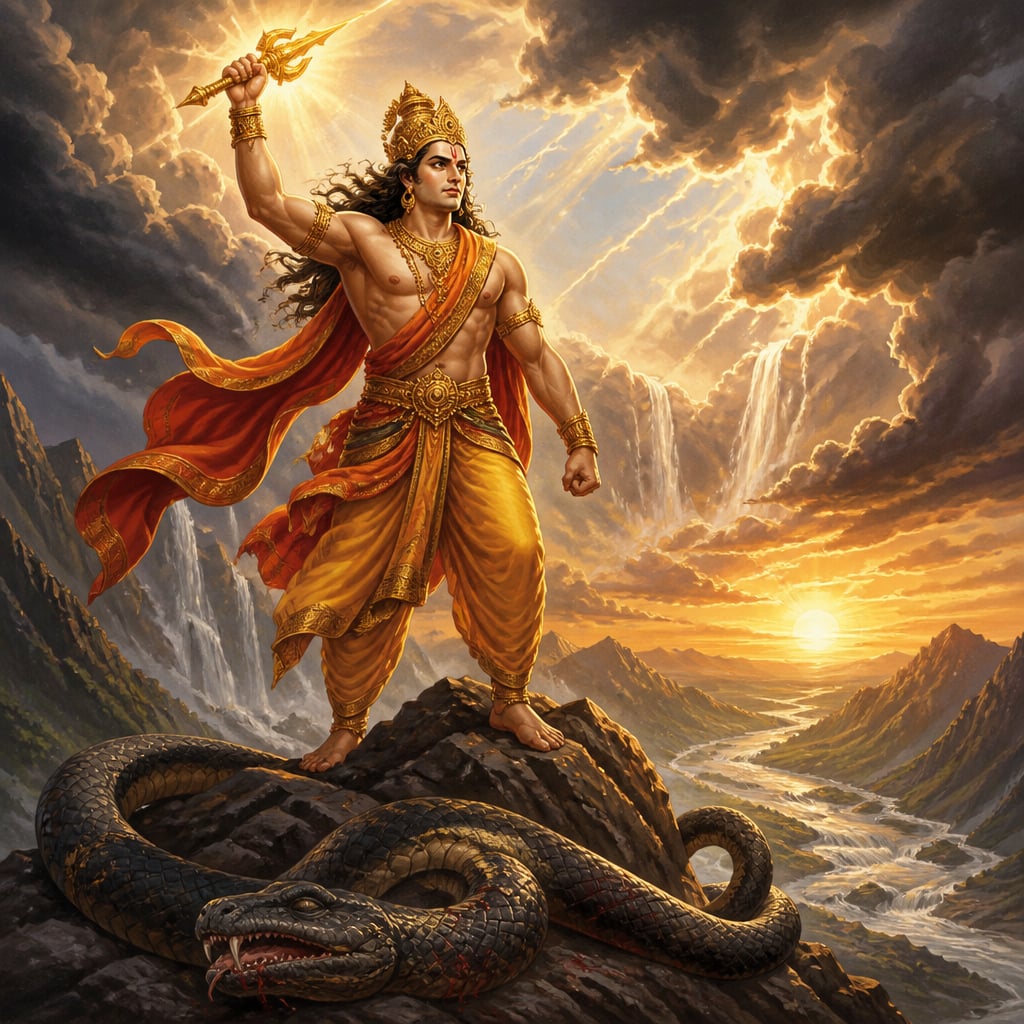
But watch what happens next in the Vedic narrative. Indra, drunk on victory, becomes careless. He makes errors of judgment. He grows suspicious of rivals. The texts that celebrate his triumph in one breath warn of his vulnerability in the next.
This is not narrative inconsistency. It is the Rig Veda's most important teaching about power: victory is the moment of greatest danger.
A word of context as we explore this teaching: The Vedic insight about success is directly applicable today because human psychology hasn't changed. The mechanisms by which victory produces blindness operate identically in ancient kings and modern CEOs. Understanding this pattern provides practical protection: if you know that success tends to produce mada, you can deliberately cultivate vinaya as a countermeasure.
The Vedic Suspicion of Success
The Rishis who composed the Rig Veda lived in a world where rulers rose and fell, where powerful tribes were displaced by newcomers, where the mighty were humbled by the very forces they thought they controlled. They observed this pattern so consistently that it became embedded in their understanding of cosmic order.
The word vinaya captures this insight. Often translated as "humility" or "modesty," vinaya is more precisely the discipline of not being intoxicated by success. Its opposite is mada, the intoxication that comes from victory, wealth, power, or praise. Mada clouds judgment, breeds arrogance, and sets the stage for collapse.
The Rishis saw this pattern everywhere: in kings who overreached, in sacrificers who became proud, even in the gods themselves. Indra's story is instructive precisely because even the king of gods is not immune.
The Mantra of Warning
Consider this verse from the Rig Veda:
"indraṃ vardhanto apturaḥ kṛṇvanto viśvam āryam"
"Increasing Indra's power, they made the whole world noble." , RV 9.63.5
The Rishis celebrated Indra's victories, but always with awareness. The same hymns that praise his strength contain subtle warnings. Varuna, the god of cosmic order (ṛta), watches even Indra. No victory places one beyond the law.
Sayana's commentary emphasizes that Indra's power is conditional, it exists in service of ṛta, the cosmic order. When power serves order, it is legitimate. When power begins to serve itself, it has already begun to decay.
The Danger Zone: Why Success Corrupts
The Vedic analysis of success is remarkably sophisticated. The Rishis identified several mechanisms by which victory leads to decline:
The intoxication of mada: Success produces a kind of drunkenness. The victor feels invincible, stops listening to counsel, takes greater risks. This is why Soma, associated with both victory and intoxication, has a double edge in Vedic thought.
The erosion of vigilance: The desperate fighter pays attention to every detail. The victorious warrior grows complacent. The very effort that produced success relaxes after success is achieved.
The accumulation of resentment: Every victory creates losers. The triumphant leader often fails to notice the quiet gathering of opposition until it is too late.
The forgetting of allies: In the struggle for success, one remembers every ally. In the enjoyment of success, the allies fade from memory, until they are needed again and are no longer there.
Traditional Wisdom: Indra and Namuci

The Vedic texts contain a telling story. After his great victories, Indra entered into a truce with the demon Namuci. But Namuci extracted a promise: Indra would not kill him by day or night, with wet or dry weapon.
Later, Indra found himself in conflict with Namuci again. He killed him at twilight (neither day nor night) with foam (neither wet nor dry). The technicality of the victory troubled even the gods. Indra had won, but at the cost of his own integrity.
This story appears across Vedic literature as a warning: the victories we achieve through clever maneuvering rather than straight dharma carry hidden costs. The how of victory matters as much as the victory itself.
Modern Resonance: The Jack Welch Paradox

In 2001, Jack Welch retired from General Electric as perhaps the most celebrated CEO in American history. He had transformed GE from a $12 billion company to a $410 billion empire. Business schools taught his methods. Leaders worldwide sought to emulate "Neutron Jack."
Twenty years later, GE was worth less than $100 billion and had been broken into pieces. What happened?
Welch's celebrated techniques, aggressive cost-cutting, "rank and yank" employee evaluation, financial engineering, quarterly earnings management, produced spectacular short-term results while hollowing out the company's long-term capabilities. The very methods that created triumph created decay.
Engineers who could have innovated were driven out by the ruthless ranking system. The obsession with quarterly numbers led to accounting that obscured reality. The culture of fear eliminated the candor needed to identify problems. By the time Welch left, GE was running on the fumes of its reputation.
The Vedic analysis applies precisely: mada (intoxication with success) → erosion of vigilance → decay of the very capabilities that produced success.
The Vinaya Response
If success is dangerous, what is the antidote? The Rig Veda points to vinaya, the active cultivation of humility precisely at the moment of triumph.
Vinaya is not false modesty or self-deprecation. It is remembering what is true when success tempts you to believe what is false. The victorious king who performs a ritual of humility is not pretending to be humble, he is reminding himself that his victory exists within a larger order, that the forces that raised him can bring him down, that his power is conditional on its alignment with ṛta.
| Without Vinaya | With Vinaya |
|---|---|
| Victory → Pride → Blindness → Fall | Victory → Gratitude → Vigilance → Sustainability |
| Success → Entitlement → Neglect → Erosion | Success → Responsibility → Attention → Renewal |
| Triumph → Mada → Isolation → Collapse | Triumph → Dharma → Connection → Continuity |
Research on CEO hubris (Hayward & Hambrick, 1997) shows that media praise of leaders correlates with poor subsequent decisions, they pay premium prices for acquisitions, take on excessive risk, and ignore dissenting voices. The psychological mechanism is clear: success literally impairs judgment through overconfidence.
Jim Collins' research on company failures (How the Mighty Fall) identifies Stage 2 as 'Undisciplined Pursuit of More', the phase after success when companies overreach. The discipline of vinaya directly addresses this: systematic practices that counter the natural tendency to overextend after winning.
The Vedic insight that even gods answer to ṛta suggests that ethical accountability is not optional at any level. The leader who believes success has placed them beyond normal rules is already in the grip of mada.
Attribution research shows successful people systematically overestimate their personal contribution and underestimate situational factors and others' help. This 'self-serving bias' is automatic, countering it requires deliberate practice.
The CEO who takes credit and shifts blame creates a self-reinforcing cycle: talented people leave, honest feedback disappears, and the leader becomes surrounded by yes-men precisely when they need challenge most.
Acknowledging the sources of success is both truthful (accurate attribution) and strategic (maintains the relationships that produced success). Vinaya is where ethics and pragmatism align.
Your Path Forward
The Rig Veda's message is not that success is bad, the texts are full of prayers for victory, prosperity, and strength. The message is that success is dangerous and requires a specific discipline to navigate safely.
The discipline is vinaya: when you win, remember you can lose. When you are praised, remember who helped you. When you stand at the summit, look for the forces gathering below.
The next time you achieve something significant, watch your own mind. Do you feel the pull of mada, that pleasant intoxication that whispers you are special, you have arrived, you can relax now? That whisper is the beginning of decline.
Indra's victories are still sung. But so are his humiliations. The Rishis recorded both, because both are true. Your victories will pass. The question is whether you will pass through them with your integrity and vigilance intact.
Case studies
Jack Welch's GE: How the Greatest CEO Created the Seeds of Collapse
In 2001, Jack Welch retired from General Electric as perhaps the most celebrated CEO in history. Under his 20-year leadership, GE's market value grew from $12 billion to over $400 billion. He was "Manager of the Century" (Fortune). Business schools taught his methods as gospel. Leaders worldwide sought to become the next Welch. GE was considered the gold standard of American management. By 2021, just 20 years later, GE was worth less than $100 billion and had announced it would break itself into three separate companies. The industrial giant that had endured for 130 years was being dismantled.
The Vedic framework illuminates what happened: Welch's celebrated methods produced spectacular short-term results through practices that systematically destroyed long-term capability. His "rank and yank" system (firing the bottom 10% yearly) eliminated candor, no one would share bad news. Financial engineering masked operational decay. The obsession with quarterly earnings led to accounting that obscured reality. This is mada at an institutional level: the intoxication of success leading to blindness about what was actually happening. Welch was praised so extravagantly that criticism became impossible. The mechanisms that should have corrected course, board oversight, honest feedback, long-term thinking, were all impaired by the sheer success of the moment. Most tellingly: Welch took credit for GE's rise but was long retired when the bill came due. The time lag between mada and its consequences can be decades.
GE's power generation and aviation businesses struggled to innovate. GE Capital, which Welch had grown aggressively, required a government bailout during 2008. The company's legendary training programs had produced executives skilled in financial manipulation but not in building durable capabilities. Former GE leaders who went on to lead other companies (Home Depot, 3M, Chrysler) often replicated the same pattern: impressive short-term results followed by longer-term erosion.
The time lag between mada and consequence is dangerous precisely because it allows the intoxication to seem sustainable. Welch retired in glory; his successors dealt with the wreckage. The Vedic insight applies: victory achieved through methods that violate the deeper order (ṛta) will eventually be corrected, but the correction may come long after the triumph, and to different people.
The pattern of celebrated leaders leaving hidden damage is common in modern business. WeWork under Adam Neumann, Theranos under Elizabeth Holmes, and FTX under Sam Bankman-Fried all showed spectacular growth metrics that masked structural rot. The lesson applies to any leader whose methods achieve results while violating fundamental principles of sound operation.
GE's stock, adjusted for inflation, is worth less today than when Jack Welch became CEO in 1981. Forty years of apparent growth was revealed as value destruction once the accounting games ended.
Ravana's Lanka: Absolute Power Undermined by Absolute Pride
Ravana, king of Lanka, had achieved what seemed impossible. Through severe tapas, he won boons from Brahma that made him invulnerable to gods and demons. He conquered the three worlds, humiliated the Devas, and made even the celestial bodies obey his commands. Kubera, the god of wealth, was his half-brother, and Ravana took his flying chariot (Pushpaka Vimana) and his golden city. Lanka under Ravana was described as a city of wonders: gardens, palaces, wealth beyond imagination. He commanded armies of rakshasas. He was a master of the Vedas and a skilled musician. By any objective measure, he had won completely.
The Ramayana, though later than the Rig Veda, develops the Vedic insight about mada perfectly. Ravana's downfall began not with the abduction of Sita but earlier, in the moment when success convinced him that normal limits no longer applied to him. Note the progression: Ravana wins boons through legitimate tapas (effort), but then uses them to violate ṛta (cosmic order). He takes what is not his. He insults sages and women. He ignores advice from his own brother Vibhishana, his wife Mandodari, and his grandfather Malyavan. Every warning is dismissed, he has won so completely that counsel seems unnecessary. The Vedic pattern is precise: victory → mada → rejection of good counsel → isolation → actions that accelerate destruction → fall.
A single human prince, with an army of monkeys, destroyed everything Ravana had built. The invulnerable king died on the battlefield. His golden city burned. His dynasty ended. But the lesson is subtler than "good defeats evil." Ravana's defeat was made possible by his own success. Had he remained hungry, careful, attentive to counsel, he might have lasted. It was precisely his total victory that created the blindness that undid him.
Ravana's boon requested immunity from gods and demons, he didn't bother asking for protection from humans and animals because they seemed beneath notice. This single blind spot, born of contempt that success created, was exactly where the fatal blow came. Mada narrows vision, and what we cannot see is where we are most vulnerable.
Every successful organization has blind spots created by its own success. Google's dominance in search made it slow to recognize the threat from AI chatbots. Facebook's social graph advantage made it complacent about short-form video. The areas we consider beneath our notice are precisely where disruption originates.
Ancient texts describe Lanka as having a treasury of 10,000 chariots, 200,000 horses, and armies numbering in the hundreds of thousands, yet a single strategic vulnerability brought the entire empire down.
Reflection
- Think of a past success that eventually led to problems. Looking back, can you identify the moment when mada (success intoxication) began to cloud your judgment? What warning signs did you miss or dismiss?
- Why might the Rishis have chosen Indra, the king of gods, as their primary example of someone susceptible to mada? What does this say about their understanding of power's effects?
- If success is genuinely dangerous, as the Vedic tradition suggests, should we be less ambitious? Or is the answer to pursue success while cultivating specific practices to counter its dangers?