Cakra: The Rise-and-Fall Pattern of Power
Power as Wheel, Not Ladder
The Rig Veda sees power not as a ladder to be climbed and held, but as a wheel that turns. All power rises, peaks, and declines, this is not tragedy but cosmic law. This lesson explores the predictable pattern by which authority cycles, and how understanding this pattern transforms how we hold power.
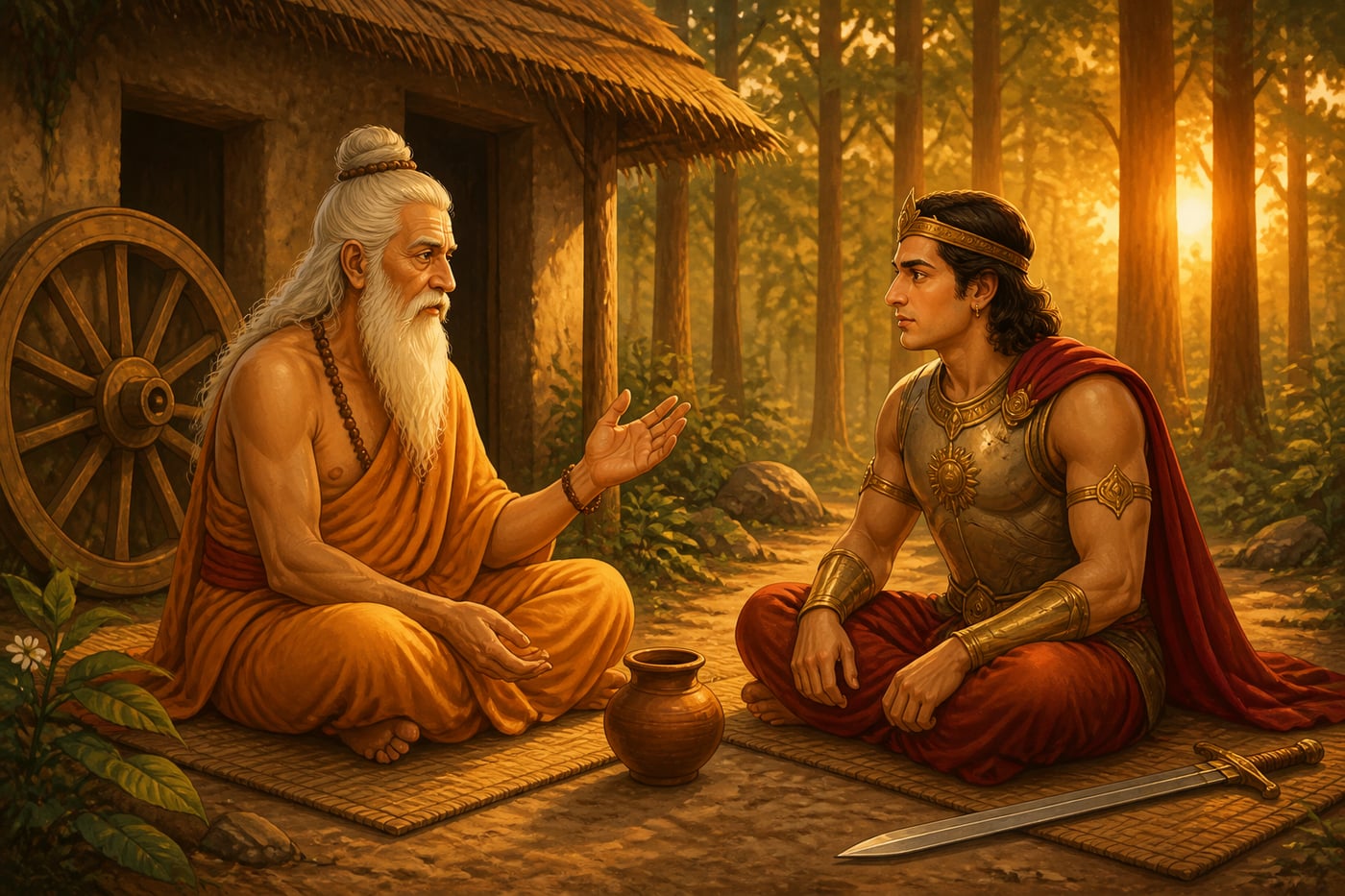
The old Rishi sat with the young king who had just won his first major battle. The kingdom was celebrating. The courtiers spoke of how this was the beginning of an unstoppable ascent.
"Guru-ji," the king said, "tell me how to make this last forever."
The Rishi smiled. "Tell me, young king, have you ever seen a river that only flows upward?"
"That is impossible, Guru-ji."
"And yet you ask me how to make power flow only upward, never down. You are asking for a river that defies its nature."
The king was silent. He had never thought of power as something with a nature, only as something to acquire and keep.
This understanding emerges from lived experience: The wheel of power turns today exactly as it turned in Vedic times. The mechanisms are identical; only the surface details change. A tech company's arc, a political leader's career, a nation's rise and decline, all follow the ancient pattern. Understanding this pattern is immediately practical: it tells you what phase you're in, what dangers to expect, and how to navigate skillfully.

The Cakra: Power as Wheel
The Rig Veda uses a profound image for understanding power: the cakra, the wheel. In RV 1.164, the Rishi asks:
"dvādaśāraṃ nahi taj jarāya varvarti cakram"
"The twelve-spoked wheel revolves, it never ages."
The wheel itself is eternal. But every point on the wheel rises, reaches the top, and descends. No spoke stays at the summit permanently. This is not a design flaw, it is how wheels work.
The Vedic insight is that power operates the same way. Every rise contains within it the seeds of decline. Every peak is followed by descent. Every ascent prepares the next fall. This is not pessimism, it is the nature of the phenomenon being observed.
The Pattern: Four Phases of Power
The Rishis observed a predictable pattern in how power cycles:
1. Ārohana (Ascent): The hungry phase. The rising power is alert, adaptive, willing to take risks and learn from failure. Allies are courted and remembered. Every advantage is pressed. The ascent is fueled by genuine capability plus some fortune.
2. Sthiti (Peak/Plateau): The comfortable phase. Success has arrived. The urgency fades. The leader believes they have "figured it out." The very alertness that enabled ascent begins to relax. This is when mada (intoxication) is strongest.
3. Avarohana (Descent): The declining phase. The gap between self-perception and reality widens. Warning signs are dismissed. Younger, hungrier rivals begin to circle. The skills that produced success are no longer sufficient for the new environment.
4. Kṣaya (Dissolution): The ending phase. The old order gives way. What seemed permanent reveals its impermanence. Space opens for new cycles to begin.
| Phase | State | Danger | Opportunity |
|---|---|---|---|
| Ārohana | Rising | Overextension | Build genuine capability |
| Sthiti | Peak | Mada (complacency) | Consolidate wisely |
| Avarohana | Declining | Denial | Prepare graceful transition |
| Kṣaya | Ending | Bitterness | Seed the next cycle |
The Deva-Asura Cycle
The Vedic texts illustrate this pattern through the cosmic struggle between Devas (gods) and Asuras (titans). Neither side wins permanently. Power shifts back and forth:
The Devas defeat the Asuras → The Devas become complacent → The Asuras grow stronger through tapas → The Asuras defeat the Devas → The Asuras become arrogant → The Devas recover through new strategies → The cycle repeats.
This is not a story about good versus evil permanently. It is a story about how any power, even divine power, follows the wheel's pattern. The Devas are not inherently superior, they are simply in a particular phase of the cycle at any given moment.
The lesson for leaders: you are not fighting to end the cycle. You are navigating within it.
Traditional Wisdom: Seeing the Pattern Changes Everything
Sayana's commentary on the wheel verses emphasizes that understanding the cycle is itself a form of power. The leader who knows the pattern can:
- In Ārohana: Build for sustainability, not just speed. Plant seeds that will bear fruit in later phases.
- In Sthiti: Resist the comfortable belief that the peak is permanent. Stay alert when alertness feels unnecessary.
- In Avarohana: Accept reality rather than fighting it. Prepare successors. Preserve what matters while releasing what must go.
- In Kṣaya: Let go with grace. The energy wasted fighting the inevitable could seed the next cycle.
Sri Aurobindo adds a deeper insight: the soul that witnesses the cycle without attachment to any phase has already transcended it. The Vedic goal is not to stop the wheel but to recognize the still point at its center.
Modern Resonance: Kodak Saw It Coming

In 1975, a young Kodak engineer named Steve Sasson invented the digital camera. He showed it to his bosses. Their response, as Sasson later recalled: "That's cute, but don't tell anyone about it."
Kodak was at the absolute peak of the photography world. They had 90% of film sales and 85% of camera sales in America. Film was enormously profitable. Every business school case study praised them.
Kodak didn't fail to see digital coming, they invented it. They failed because they were in Sthiti and couldn't accept that Avarohana was beginning. Every signal that digital was the future was filtered through the assumption that the current order would last.
- They assumed people would always want prints (they didn't)
- They assumed film quality would always matter (phones changed that)
- They assumed they had time to transition (they waited too long)
- They assumed their brand would carry them (it didn't)
By 2012, Kodak filed for bankruptcy. The company that had defined photography for a century was finished, not because they lacked intelligence or resources, but because they couldn't accept which phase of the cycle they were in.
The Vedic reading: Kodak's leaders were in Sthiti but believed they had escaped the wheel entirely. They thought their dominance was a permanent state rather than a phase. The pattern continued operating whether they acknowledged it or not.
The Vinaya Response: Holding Power Lightly
If the cycle is inevitable, what should a leader do?
The Rig Veda's answer is not resignation but viveka (discernment), seeing clearly which phase you are in and responding appropriately rather than fighting reality.
In Ārohana: Build with awareness that this phase will end. Don't sacrifice integrity for speed. The shortcuts of ascent become the vulnerabilities of decline.
In Sthiti: This is the most dangerous phase because it feels least dangerous. Practice active vigilance. Seek out the signals you least want to hear. Remember that the very success you're enjoying is planting the seeds of its own end.
In Avarohana: Stop denying. Start preparing. The question is not whether transition will come but whether it will be graceful or catastrophic. Invest in successors. Preserve core values while releasing attachment to specific forms.
In Kṣaya: Let go. The energy spent fighting the inevitable is energy that could seed the next cycle. Some of the greatest leaders are those who knew when to step aside.
The 'peak-end rule' in psychology (Kahneman) shows that people judge experiences by their peaks and endings, not averages. Leaders at their peak often can't imagine decline because they evaluate from the peak. Cognitive science confirms what the Vedas taught: the peak distorts perception of the pattern.
Andy Grove (Intel) famously said: 'Only the paranoid survive.' This is Sthiti navigation, staying alert precisely when success suggests you can relax. Intel's survival through multiple technology transitions came from treating the peak as the most dangerous phase.
The ethical risk at Sthiti is entitlement: 'We've earned this; normal rules don't apply to us.' This is the origin of many corporate scandals. Ethical violations often begin when success convinces leaders they are exempt from ordinary standards.
Elisabeth Kübler-Ross's stages of grief (denial, anger, bargaining, depression, acceptance) map onto how leaders often respond to organizational decline. The Vedic approach suggests skipping to acceptance: acknowledge the phase, navigate it well, don't waste energy on denial.
Lou Gerstner's IBM turnaround began when he accepted that IBM's old model was finished rather than trying to revive it. He didn't fight Avarohana, he navigated it toward a new Ārohana. The energy saved from denial was available for reconstruction.
Clinging to power past its natural term often leads to ethical violations, cheating to maintain position, silencing critics, distorting reality. Accepting Avarohana allows ethical exit. The leader who leaves gracefully preserves their legacy.
Your Path Forward
Take an honest inventory: In your career, your organization, your influence, which phase are you in?
The answer requires brutal honesty. Ārohana feels exciting but uncertain. Sthiti feels secure but breeds blindness. Avarohana feels like temporary setback rather than fundamental shift. Kṣaya feels like failure rather than natural completion.
Most leaders have trouble seeing Sthiti for what it is. The peak is precisely when the wheel's turning is least visible. Everything seems stable. But stability at the top of a wheel is an illusion, the wheel never stops turning.
The Rishis didn't record these patterns to depress us but to free us. If you know the wheel turns, you can ride it rather than being crushed by it. You can be fierce in ascent, vigilant at the peak, graceful in decline, and at peace in dissolution.
The wheel will turn. The only question is whether you will turn with it, or be broken by your refusal to move.
Case studies
Kodak: The Company That Invented Its Own Disruption and Couldn't Respond
In 1975, Steve Sasson, a young Kodak engineer, invented the digital camera. He built a working prototype and presented it to executives. Their response: 'That's cute, but don't tell anyone about it.' Kodak wasn't blindsided by digital photography, they created it. But they were so thoroughly in Sthiti, dominating 90% of film sales and 85% of camera sales in America, that they couldn't accept what they were seeing. For the next 30 years, Kodak watched digital photography grow while making minimal pivots. As late as 2007, a Kodak executive said: 'We're not going to go away. We're a brand that's been around 100 years.' By 2012, Kodak filed for bankruptcy.
Kodak is a perfect illustration of the Sthiti trap. At the peak, the warning signs of Avarohana look like noise rather than signal. Kodak had the technology (they invented it), the resources (billions in cash), and the talent (world-class engineers). What they lacked was the ability to see which phase of the cycle they were in. The cakra was turning, but Kodak's leaders were so convinced they had arrived at a permanent destination that they couldn't feel the motion. They kept trying to preserve Sthiti rather than navigate Avarohana. The result: instead of managed decline that preserved core capabilities, they experienced catastrophic collapse. The Vedic lesson: the peak is when you can least feel the wheel turning, and therefore when you most need external signals and internal discipline to perceive it.
Kodak emerged from bankruptcy as a much smaller commercial printing company. The brand survives, but the business that defined photography for a century is gone. More importantly, the engineering talent dispersed, the patents were sold, and the institutional knowledge evaporated. A managed transition during the 1990s could have preserved far more value. The delay from Sthiti denial made Kṣaya far more destructive than it needed to be.
Innovation is not enough. Kodak had the innovation, they invented digital photography. What they lacked was the capacity to see that their current position was a phase, not a destination. The leader who assumes the peak is permanent cannot hear warnings about descent. Kodak didn't fail despite seeing the future; they failed because they couldn't accept that the future meant leaving their present behind.
Many incumbent companies possess the technology to transform their industry but cannot bring themselves to deploy it because doing so threatens current revenue. This pattern repeats across industries: automakers with electric vehicle patents, publishers with digital distribution capability, and telecom companies with internet protocols they chose not to prioritize.
Kodak held over 1,000 patents related to digital photography. Their technology enabled others to dominate the industry they created. The value of those patents at bankruptcy auction was a fraction of what they would have been worth if deployed a decade earlier.
Bali Chakravarti: The Emperor Who Knew How to Fall
Bali, the Asura emperor, was the most successful ruler the three worlds had ever seen. Through legitimate tapas (austerity) and righteous rule, he had conquered heaven, earth, and the netherworld. Even Indra could not defeat him. The Devas had been driven from their realm, and Bali ruled with such dharmic perfection that even his opponents could find no fault. When Vishnu incarnated as Vamana, a small Brahmin boy, and approached Bali for charity, Bali's guru Shukracharya warned him: 'This is no ordinary Brahmin. If you grant his wish, you will lose everything.' Bali knew the warning was true. He gave anyway.
Bali's story is the ultimate teaching about navigating the cycle with grace. He had reached the absolute peak, ruler of all three worlds. But he understood something Kodak and GE did not: the wheel turns for everyone, and how you ride the descent matters. When Vamana asked for three paces of land, Bali knew this was the beginning of Avarohana. He could have refused (Shukracharya advised exactly this). He could have fought. Instead, he chose to descend with magnificence. His reasoning: 'If I break my word to protect my position, I will lose both my position (eventually) and my dharma (immediately). If I keep my word and lose my position, I preserve what matters most, my integrity and my relationship with the divine.' The result was extraordinary: Bali became more venerated in losing than many emperors in winning. Vishnu, moved by his grace, made him ruler of the netherworld and promised that he would return to rule heaven in the next cosmic cycle.
Bali Chakravarti is still worshipped across India. In Kerala, the Onam festival celebrates his reign as a golden age and his return each year to visit his people. The emperor who fell gracefully is remembered more fondly than emperors who never fell at all. His example became the template for noble defeat in Dharmic culture: the warrior who accepts death with courage, the king who cedes to the rightful heir, the teacher who lets the student surpass them.
There is a way to fall that is itself a form of victory. Bali lost his kingdom but gained immortal renown. He understood that the position was temporary but the character was permanent. By navigating Avarohana with dharma intact, he seeded a better future cycle than if he had clung to power. The comparison to Kodak is instructive: both faced inevitable decline. Kodak fought, denied, and collapsed chaotically. Bali accepted, gave gracefully, and is celebrated millennia later. The phase of the cycle matters less than how you navigate it.
Leaders facing inevitable organizational decline, whether from market shifts, regulatory changes, or technological disruption, can choose between denial and graceful transition. Companies like IBM, which acknowledged its hardware decline and pivoted to services, preserved institutional value and reputation far better than those that fought the tide.
Bali's yajna was so vast that he could give away three steps of land to a dwarf Brahmin without hesitation, having already donated wealth equivalent to ruling all three worlds. His fall from supreme power to Patala took the span of three footsteps.
Reflection
- Consider your current career or primary endeavor: Which phase of the cycle are you in, Ārohana (rising), Sthiti (peak), Avarohana (declining), or Kṣaya (ending)? What evidence supports your assessment? What evidence might you be ignoring?
- Why might the Rishis have seen the cycle as liberating rather than depressing? If decline is guaranteed, what is freed by accepting this?
- If the wheel turns for everyone, including the gods themselves, is there any stable ground to stand on? Or is the stability found in the turning itself?