Ahaṅkāra: Arrogance as the Enemy of Order
Why the Cosmos Eventually Corrects Every Overreach
The Rig Veda identifies a specific force that accelerates decline: ahaṅkāra, the inflated ego that believes it is exempt from cosmic law. This lesson explores how arrogance becomes the enemy of ṛta, why the universe cannot tolerate sustained violation of order, and the inevitability of correction for those who believe they stand above the rules.
There is a story the Rishis told about a particular kind of blindness.
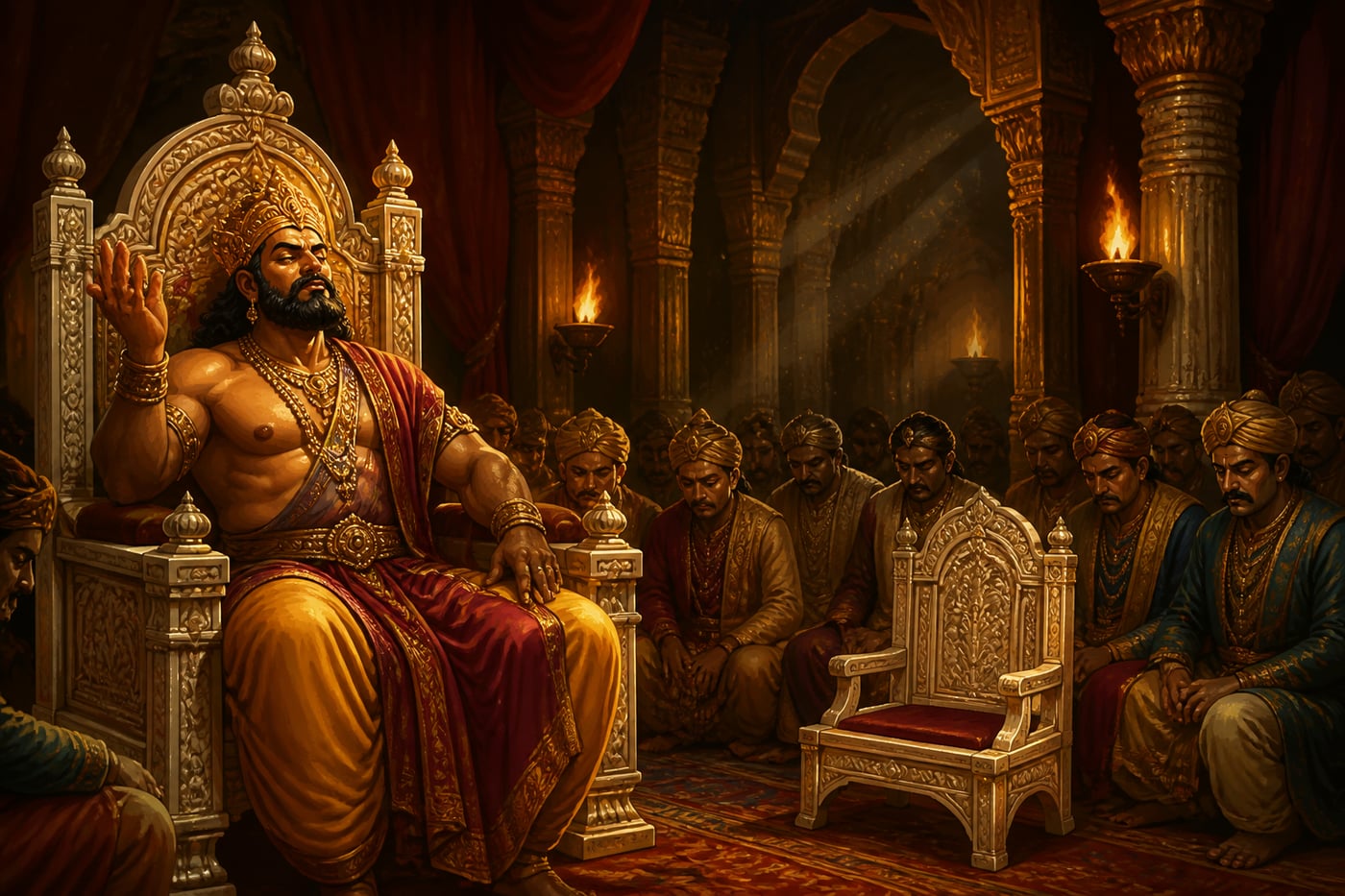
A powerful king, having conquered all rivals, declared: "I am the law. What I will, becomes right. The old rules were made by weaker men, they do not apply to me."
His counselors, who had once challenged him, now fell silent. His court poets composed verses celebrating his transcendence of ordinary limits. His enemies, for the moment, were crushed.
But the Rishis watching from their forest retreats smiled sadly. They had seen this before. They knew what came next.
As we explore this principle: Ahaṅkāra operates identically in ancient kings and modern CEOs. The dynamic by which success inflates self-perception beyond reality is hardwired into human psychology. Understanding this pattern provides defense: if you know that power tends to produce the conviction that you are exempt, you can deliberately cultivate the practices that counter this inflation.
The Nature of Ahaṅkāra
The Sanskrit word ahaṅkāra is often translated as "ego," but this captures only part of its meaning. Ahaṅkāra is specifically the "I-making" faculty, the mental function that constructs and defends the sense of a separate, special self.
In its healthy form, ahaṅkāra provides the functional identity needed to navigate the world: "I am hungry," "I made a commitment," "I have responsibilities." This is necessary for action.
But ahaṅkāra becomes pathological when it inflates beyond functional identity into grandiose exemption: "I am above the rules that bind others. I am special. The consequences that apply to ordinary people do not apply to me."
This inflated ahaṅkāra is what the Rig Veda identifies as the specific enemy of ṛta, the cosmic order that governs all things.
The Vedic Warning: No One Is Above Ṛta
The Rig Veda is remarkably consistent on this point: even the gods are accountable to ṛta. Varuna, the deity who oversees cosmic order, watches everyone, including Indra, the king of gods.
"satyam bṛhad ṛtam ugraṃ dīkṣā tapo brahma yajñaḥ pṛthivīṃ dhārayanti"
"Truth, the great ṛta, fierce austerity, consecration, brahman, and sacrifice, these uphold the earth." , RV 10.85.1 (adapted)
The message is clear: the cosmos is upheld by order, not by power. Power that aligns with order is sustainable. Power that sets itself against order has declared war on the structure of reality itself.
The Rishis observed that this war is always lost. The only question is how much damage occurs before the correction comes.
The Mechanism: How Arrogance Accelerates Decline
Mada (success intoxication) clouds judgment. But ahaṅkāra does something more dangerous: it redefines reality around the inflated self.
The leader gripped by ahaṅkāra doesn't merely make poor decisions, they reconstruct their entire perception so that poor decisions appear brilliant, warnings appear as jealousy, and critics appear as enemies to be crushed.
This creates a specific pattern of acceleration:
1. Exemption thinking: "The rules that apply to others don't apply to me." This opens the door to actions that accumulate karmic debt.
2. Feedback destruction: Critics are punished or exiled. Only those who validate the inflated self-image remain. The correction mechanisms that could save the leader are systematically dismantled.
3. Reality divergence: The gap between the leader's self-perception and actual reality grows. Since feedback is destroyed, this gap is invisible to the leader but increasingly visible to everyone else.
4. Accumulating violations: Each uncorrected violation encourages the next. The leader who "got away with it" once will push further. The violations compound.
5. Sudden collapse: When correction finally comes, as it must, because ṛta is not optional, it often comes catastrophically. The accumulated violations all come due at once.
Traditional Wisdom: Hiranyakashipu's Ultimate Arrogance
The Puranic story of Hiranyakashipu is the Vedic tradition's most complete teaching on the dynamics of ahaṅkāra.
Hiranyakashipu was an Asura king of extraordinary power. Through severe tapas, he obtained boons that made him nearly invulnerable: he could not be killed by man or beast, indoors or outdoors, by day or night, on earth or in the sky, by any weapon.
With these protections, Hiranyakashipu declared himself the supreme deity. He commanded that all worship be directed to him alone. The name of Vishnu, the divine principle that maintains cosmic order, was forbidden throughout his kingdom.
Here is the teaching: Hiranyakashipu's power was real. His conquest was genuine. His boons were effective. And yet he was engaged in a fundamental error, he believed that power could substitute for alignment with ṛta.
His own son, Prahlada, saw through the illusion. Despite torture and attempts on his life, Prahlada continued to worship Vishnu. This infuriated Hiranyakashipu precisely because it was a living refutation of his claim to ultimate sovereignty.
The resolution came through the Narasimha avatara: Vishnu appeared as a being that was neither man nor beast, at twilight (neither day nor night), on a threshold (neither indoors nor outdoors), placed the king on his lap (neither earth nor sky), and killed him with claws (not a weapon).

The teaching is not that Vishnu was cleverer than Hiranyakashipu. The teaching is that reality itself, ṛta, found the gap in his defenses. When you declare war on cosmic order, cosmic order eventually finds a way through.
Modern Resonance: Travis Kalanick and the Uber Ethos

Uber's founding culture was built on a phrase: "Ask forgiveness, not permission."
Travis Kalanick, Uber's co-founder and CEO, didn't just break rules, he cultivated a company-wide philosophy that rules were obstacles created by lesser minds. Taxi regulations, labor laws, competitive norms, privacy standards, all were treated as suggestions to be bypassed on the way to victory.
For years, it worked spectacularly. Uber grew from a San Francisco startup to a global force valued at over $70 billion. Kalanick was celebrated as a visionary who understood that disruption meant not playing by established rules.
But Uber's ahaṅkāra created a specific pattern:
Exemption thinking: The company operated a program called "Greyball" that deliberately evaded regulators. They deployed in cities without permission, assuming fines were just a cost of doing business.
Feedback destruction: Employees who raised concerns were marginalized. A culture of "brilliant jerks" was celebrated. Susan Fowler's complaints about harassment were met with HR dismissal. Critics were seen as people who "didn't get it."
Reality divergence: Kalanick believed Uber was changing the world for the better. Much of the world saw a company that exploited drivers, evaded law, and treated opposition as proof of its own superiority.
Accumulating violations: The list grew: alleged theft of trade secrets from Waymo, the "God View" tracking of users including journalists, the toxic workplace culture, the response to a rape victim in India.
Sudden collapse: In 2017, a cascade of revelations, Fowler's blog post, the Waymo lawsuit, the dashcam video of Kalanick berating a driver, converged. Investors forced his resignation. The correction came suddenly, but the violations had been accumulating for years.
The Vedic reading: Kalanick built a company on the assumption that ṛta (order) could be indefinitely bypassed through sheer will and velocity. He was not wrong that you can violate order for a while, Hiranyakashipu also enjoyed a long reign. He was wrong that the violations wouldn't accumulate and eventually come due.
The Vinaya Response: Alignment Over Dominance
The alternative to ahaṅkāra is not weakness. The Rig Veda's warriors are fierce. Its kings are powerful. The distinction is not between strength and meekness but between aligned power and arrogant power.
| Aligned Power | Arrogant Power |
|---|---|
| Seeks to understand ṛta | Seeks to override ṛta |
| Welcomes feedback as information | Destroys feedback as threat |
| Sees rules as boundaries of sustainable action | Sees rules as obstacles for the timid |
| Builds lasting order | Achieves temporary dominance |
| Knows it is part of a larger pattern | Believes it is exempt from the pattern |
Vinaya here means recognizing that your power exists within a larger order, not above it. This doesn't limit ambition, it focuses it. The leader who understands ṛta can be extraordinarily effective precisely because they work with the grain of reality rather than against it.
The Correction Is Not Punishment
A crucial Vedic insight: ṛta's correction is not vengeance but restoration. The cosmos is not angry at the arrogant, it simply cannot sustain violations of its operating principles indefinitely.
Water seeks its level. Systems seek equilibrium. Leaders who create massive distortions eventually see those distortions correct. This is not moral judgment from outside, it is the nature of how ordered systems work.
Understanding this removes the question of "getting away with it." You cannot get away with sustained violation of ṛta any more than you can get away with sustained violation of gravity. The question is only when and how the correction occurs.
Research on organizational silence (Morrison & Milliken, 2000) shows that leaders systematically receive filtered information, subordinates suppress bad news. The more powerful the leader, the more filtered the feedback. This is structural ahaṅkāra: the organization protects the ego by hiding reality.
Bridgewater's 'radical transparency' practices, recording all meetings, encouraging direct challenge, are attempts to counter this dynamic. Whatever the specific mechanism, the principle is the same: build systems that prevent the natural destruction of feedback.
Many corporate scandals could have been prevented by heeding early warnings. But the culture of 'don't bring me problems' or 'you're not a team player' silences exactly the voices that could have enabled course correction. Ethical failure often begins with feedback destruction.
Self-serving bias (attributing success to self, failure to circumstances) is universal and automatic. Countering it requires deliberate effort. The practice of asking 'What did I do wrong?' rather than 'Who can I blame?' is a specific technique for countering automatic ahaṅkāra.
After-action reviews that begin with 'What could I have done better?' rather than 'What went wrong?' model the Vasiṣṭha approach. Leaders who genuinely seek their own contribution to problems create cultures of accountability rather than blame.
Ethical failure often follows a pattern of externalization: 'The market made me do it,' 'Everyone else was doing it,' 'I had no choice.' The Vasiṣṭha question interrupts this: 'What was my offense?' puts the focus back on personal agency and choice.
Your Path Forward
Examine your own ahaṅkāra. Where do you believe you are exempt from rules that apply to others? Where have you convinced yourself that your situation is special enough that the normal consequences won't apply?
These beliefs are seductive precisely because they often seem validated by short-term success. The person who cuts corners and prospers appears to have proven the rules wrong. But the Vedic teaching is that the correction timeline can be very long, decades, even, but it is not infinite.
The practice of vinaya includes regularly checking: Am I aligned with ṛta, or am I accumulating violations? Am I building sustainable power or fragile dominance? Would my current approach survive if all the information became public?
Hiranyakashipu's kingdom was vast. Kalanick's Uber was valued at $70 billion. Neither number meant anything when the correction came. What matters is not the size of your power but its relationship to the order that sustains all things.
The Rishis saw this clearly. They recorded it for anyone wise enough to listen.
Case studies
Travis Kalanick's Uber: When 'Ask Forgiveness' Meets Ṛta
Uber's founding ethos was captured in its internal slogan: 'Ask forgiveness, not permission.' Travis Kalanick built a company predicated on the belief that rules were obstacles to be bypassed, not boundaries to be respected. For years, this worked spectacularly. Uber launched in cities without regulatory approval. They developed 'Greyball' software specifically to evade regulatory enforcement. They tracked users (including journalists) through 'God View.' They responded to competition through allegedly illegal means. They dismissed employee complaints about workplace toxicity as the cost of 'hustling.' By 2016, Uber was valued at over $70 billion. Kalanick was celebrated as a visionary who understood that disruption meant not playing by the old rules.
Uber under Kalanick is a near-perfect case study in institutional ahaṅkāra, the collective conviction that 'the rules don't apply to us.' The pattern matches the Vedic prediction precisely: **Exemption thinking:** Kalanick explicitly believed that Uber's mission justified bypassing normal rules. Regulation was seen as captured by incumbents. Labor law was seen as outdated. Competition law was seen as applying to lesser companies. **Feedback destruction:** Susan Fowler's complaints about sexual harassment were dismissed. Employees who raised ethical concerns were marginalized. Eric Holder's eventual investigation revealed systematic suppression of dissent. **Reality divergence:** Kalanick genuinely believed he was building a better world. The mounting evidence of harm, to drivers, to competitors, to users, to employees, was filtered through this self-image. **Accumulated violations:** Each 'successful' violation encouraged the next. The Greyball software, which started as a response to regulators, ended up being used to deceive and evade across multiple domains. **Sudden collapse:** In 2017, Fowler's blog post triggered a cascade. The video of Kalanick berating a driver went viral. The Waymo lawsuit revealed alleged theft. Investors forced his resignation. The correction came suddenly, but the violations had been accumulating for years.
Kalanick was removed as CEO in 2017. He later sold most of his Uber shares and resigned from the board in 2019. Uber's new leadership explicitly rejected the 'win at all costs' culture. The company eventually went public at a valuation significantly below its peak private valuation and has yet to turn a sustained profit. More significant than the financial outcome: the Uber name became synonymous with a certain kind of toxic tech culture. 'Uberization' became a warning rather than an aspiration. The cultural correction extended beyond the company itself.
Uber's speed and scale were real. Kalanick's ability to execute was genuine. What was false was the assumption that ṛta (order) could be indefinitely violated through velocity alone. The 'ask forgiveness' model works when forgiveness is actually granted, when violations are small enough that they can be absorbed. Accumulated violations at scale do not disappear; they wait for the right moment to all come due at once.
The 'move fast and break things' philosophy has a shelf life. Companies like Uber, WeWork, and various crypto platforms discovered that accumulated regulatory violations, cultural toxicity, and broken trust eventually present a collective bill that dwarfs any speed advantage gained in the early years.
Between 2017-2019, Uber faced regulatory actions, lawsuits, or investigations in over 100 jurisdictions worldwide. The cost of accumulated violations, in legal fees, settlements, and lost market access, dwarfed whatever was saved by not asking permission initially.
Hiranyakashipu: The Asura Who Demanded to Be God
Hiranyakashipu was the king of the Asuras who, through extraordinary tapas, obtained boons of near-invulnerability from Brahma. He could not be killed by man or animal, indoors or outdoors, by day or night, on land or in sky, by any weapon. With these protections, Hiranyakashipu did something unprecedented: he declared himself the supreme deity. He forbade the worship of Vishnu throughout his kingdom. He commanded that all prayers, all sacrifices, all devotion be directed to him alone. His reasoning was logical: if he could not be killed, he was effectively immortal. If he was immortal and all-powerful, was he not, functionally, God? Why worship an absent deity when a present god stood before them? But his own son, Prahlada, refused. Despite torture, despite threats, despite isolation, Prahlada continued to worship Vishnu. This was not just disobedience, it was a living refutation of Hiranyakashipu's claim to ultimate sovereignty.
Hiranyakashipu represents the terminal stage of ahaṅkāra: not merely believing oneself exempt from ṛta, but attempting to replace ṛta itself. He wanted to be the source of order, not a participant in it. The teaching is subtle: Hiranyakashipu's power was real. His boons were effective. His conquest was genuine. There was a period, perhaps a long period, when it really did appear that he had succeeded in placing himself above the cosmic order. But the story emphasizes two things: **First**, the boons had gaps. Hiranyakashipu asked for invulnerability according to categories he could imagine. But ṛta is more creative than any individual imagination. There were configurations he did not anticipate, and Narasimha (man-lion) at twilight on a threshold was precisely such a configuration. **Second**, Prahlada represented ṛta's persistence. The young boy's unshakeable devotion was not supernatural, it was the natural consequence of reality being more resilient than any individual attempt to suppress it. Hiranyakashipu could control armies, but he could not control the truth that lived in his own son's heart. The Narasimha resolution, Vishnu appearing in a form that fit none of Hiranyakashipu's categories, is not a trick. It is the demonstration that ṛta will find the gaps in any defense against it.
Hiranyakashipu was killed by Narasimha on the threshold of his palace at twilight. His vast kingdom fell. His dynasty ended. His attempt to replace the divine with himself became a teaching story about the futility of ultimate arrogance. Prahlada, his son, became one of the most venerated figures in the Dharmic tradition, demonstrating that alignment with ṛta, even at great personal cost, produces lasting fruit where defiance of ṛta produces only delayed destruction.
Hiranyakashipu's story is extreme, most leaders don't literally claim to be God. But the underlying pattern is common: the belief that one has accumulated enough power to be exempt from the rules that govern others. The lesson is that ṛta is more patient and more creative than any individual. The longer you violate it successfully, the more confident you become in your invulnerability, and the more certain your eventual correction becomes.
The pattern of engineering seemingly complete protection against failure, only to be undone by an unconsidered scenario, repeats in modern risk management. Long-Term Capital Management hedged against every identifiable risk but failed when multiple 'impossible' events occurred simultaneously. The more elaborate the protection, the more creative the failure mode.
Hiranyakashipu's boons covered five categories of protection: not by man or animal, not indoors or outdoors, not by day or night, not on earth or sky, not by weapon or tool. Despite this seemingly complete coverage, the protection failed at every category simultaneously.
Reflection
- Where do you currently believe you are an exception to rules that apply to others? In what domains have you convinced yourself that your situation is special enough that normal constraints don't apply?
- Why might the Rishis have emphasized that even the gods are accountable to ṛta? What does this say about the Vedic understanding of the relationship between power and order?
- If correction is inevitable but the timeline can be very long, how does a leader distinguish between genuine success (aligned with ṛta) and temporary success (violating ṛta but not yet corrected)?