Sthitaprajña: Staying Grounded After Success

The Vedic Art of Maintaining Inner Stability Amid External Achievement

This lesson explores the Vedic concept of sthitaprajña, the person of steady wisdom who remains unshaken by success or failure. Through mantras that describe the centered consciousness of the realized sage, we discover practical methods for maintaining humility after achievement. The lesson examines how leaders like Satya Nadella transformed organizational culture through genuine humility, and how Ramana Maharshi exemplified groundedness despite global reverence. We learn that true stability comes not from suppressing pride but from a deep understanding of one's place in the larger cosmic order.

The Paradox of Achievement

There is a peculiar intoxication that accompanies success. When our efforts bear fruit, when recognition comes, when we rise above where we began, something subtle shifts within. The Vedic seers had a name for this inner transformation: mada, the intoxication of achievement. But they also knew something deeper: that the truly great souls remain untouched by this intoxication, not because they suppress their joy, but because they understand something fundamental about the nature of reality.

This understanding produces what the Bhagavad Gita calls the sthitaprajña, the person of steady wisdom. The Rig Veda's descriptions of realized sages, of those who have touched the cosmic order and returned, reveal that groundedness is not a personality trait to be cultivated but a natural consequence of seeing clearly.
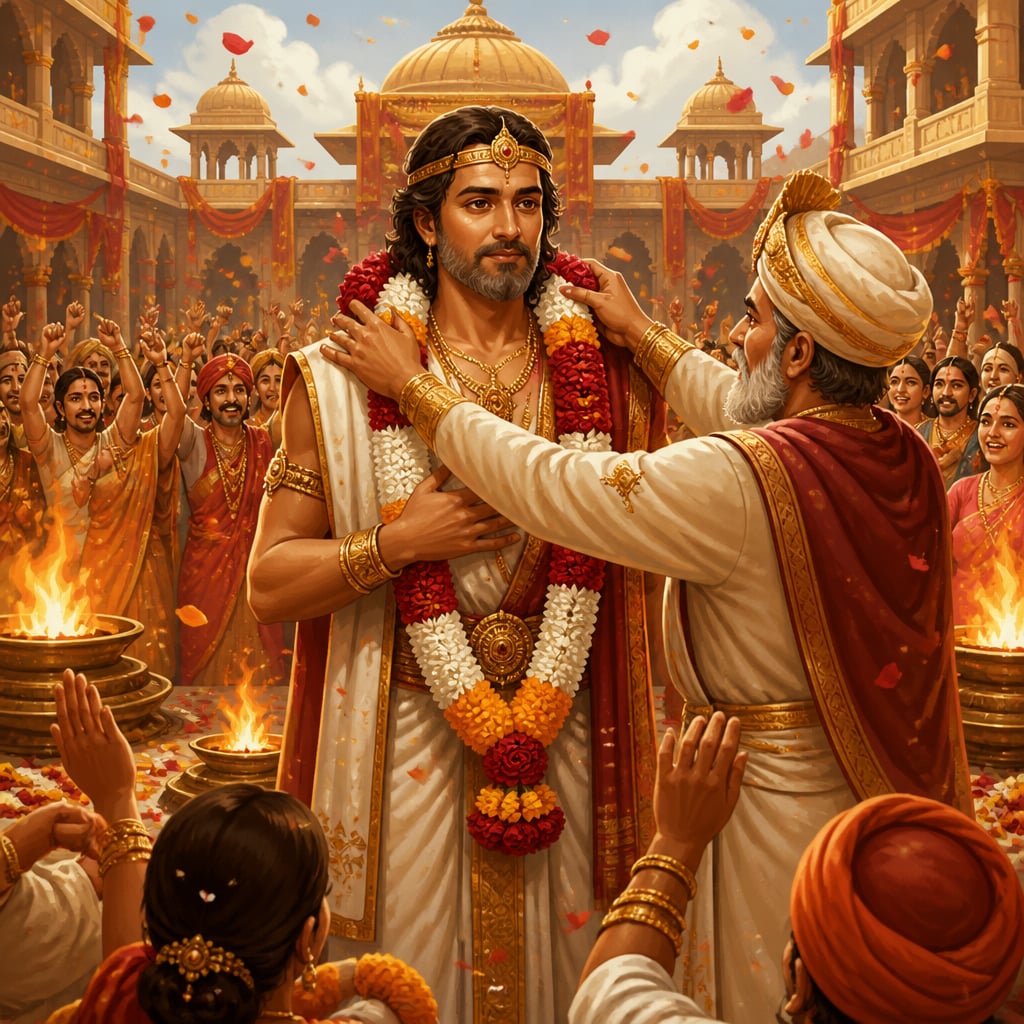
A Vedic king stands calm as his minister places a victory garland

Sama: The Principle of Equanimity

The Vedic concept of sama (समता), equanimity or evenness of mind, offers the foundational principle for staying grounded. The Rig Vedic seers understood that the universe operates in cycles of expansion and contraction, that success and failure are waves upon the same ocean. The leader who grasps this truth neither inflates during prosperity nor deflates during adversity.

This is not stoic suppression of emotion. The Vedic sages were not advocating for emotional flatness. Rather, sama describes a state where emotions arise and pass without creating fundamental disturbance in one's sense of self. The successful leader feels the joy of victory but doesn't become lost in it. They feel the sting of criticism but don't collapse under it.

The practical application begins with what the Vedas call sākṣī-bhāva, the witness consciousness. When success arrives, the grounded leader observes: "Success has come to this endeavor." Not: "I am successful." This grammatical shift reflects a profound psychological reorientation. The success is real, the joy is real, but the identification with success as defining one's worth is gently refused.

The Three Anchors of Groundedness

Vedic wisdom offers three anchors that keep the successful leader from drifting into the dangerous waters of ego inflation:

1. Ṛta-Smṛti: Remembering the Cosmic Order

The first anchor is continuous remembrance of ṛta, the cosmic order that governs all phenomena. Every achievement, no matter how personal it feels, occurs within a vast web of causes and conditions. The right market timing, the team that executed, the mentors who taught, the failures of competitors, the cultural moment that made the offering relevant, success is never solo performance but orchestral emergence.

Leaders who stay grounded practice a form of causal tracing. When praised, they mentally trace the contribution of others. When credited, they genuinely redistribute that credit. This isn't false modesty, it's accurate perception. The Vedic seers called this seeing with ṛta-cakṣu, the eye of cosmic order.

2. Sevā-Niṣṭhā: Devotion to Service

The second anchor is the orientation toward service rather than self-aggrandizement. The Rig Vedic hymns repeatedly emphasize that the gods themselves serve, Agni serves as messenger, Indra protects, Varuṇa maintains order. If the cosmic powers define themselves through service, how much more should human leaders?

This service orientation protects against groundlessness because it maintains relationship. The moment a leader begins to see others primarily as admirers rather than as beings to be served, the ground beneath them begins to shake. Service keeps leaders connected to reality, the real needs of real people become the constant reference point, not the leader's image or legacy.

3. Mṛtyu-Smṛti: Awareness of Mortality

The third anchor, paradoxically, is the contemplation of death. The Vedic tradition is unflinching in its recognition that all achievements are temporary, all positions are borrowed, all renown fades. This isn't morbid dwelling but realistic assessment.

The leader who holds their mortality gently in awareness finds it difficult to become puffed up. Not because death makes achievements meaningless, they remain genuinely valuable, but because the awareness of death provides correct proportion. In the face of mortality, the question shifts from "How great can I become?" to "How can I serve while I'm here?"

The Internal Ecology of Groundedness

Staying grounded is not a single decision but an ongoing cultivation, what we might call an internal ecology. Just as an external ecosystem requires certain conditions to maintain balance, the inner ecosystem of the grounded leader requires specific nourishment and protection.

Nourishment comes through:

Protection is needed against:

The Vedic tradition recognized that the environment around successful people naturally becomes toxic to humility. Others begin to treat them differently, offering deference, softening criticism, amplifying praise. Without conscious countermeasures, even the most grounded leader will drift.

The Transformation of Relationship

Perhaps the most reliable indicator of groundedness is how a leader's relationships transform, or don't, after success. The ungrounded leader begins to relate to others as audience members, supports for their narrative, potential threats or assets. People become instrumental.

The grounded leader maintains what the Vedic tradition calls ātma-tulyatā, seeing others as essentially equal selves. Success doesn't change who deserves respect, whose pain matters, whose voice should be heard. The CEO remains the same person to the security guard as to the board member, not through performed humility but through genuine perception of shared humanity.

This equality of regard proves practically valuable beyond its ethical importance. The grounded leader continues to receive honest feedback because they haven't signaled that only certain voices matter. They continue to learn because they haven't projected that they've graduated from learning. They continue to grow because they haven't calcified into a fixed image of achieved greatness.

Practices for the Path

The Vedic tradition offers several practical methods for maintaining groundedness:

Morning Recalibration: Beginning each day with practices that reset perspective, recitation of texts that remind of larger truths, contemplation of those who taught and supported, gratitude for conditions that made effort possible.

The Guru Function: Maintaining relationship with at least one person who has full permission to puncture pretension. In traditional Vedic culture, this was the guru; in modern contexts, it might be a mentor, coach, spouse, or trusted friend who commits to honest speaking.

A councillor serving meals himself at a temple community kitchen

Symbolic Practices: Physical acts that embody humility, serving others directly, sitting in learning postures, touching the feet of elders or teachers. These aren't merely symbolic; they create somatic patterns that resist inflation.

Regular Anonymity: Periodically placing oneself in contexts where one's achievements are unknown, being simply another participant, another learner, another seeker. This interrupts the feedback loop of recognition.

The Sthitaprajña in Action

The fully grounded leader embodies what the Gita calls sthira-buddhi, stable intelligence. This stability manifests not as rigidity but as reliable centeredness. Others experience this leader as a calm presence, someone whose mood doesn't swing with every market fluctuation or media mention.

This stability proves practically essential during crisis. The leader who has inflated during good times will collapse during bad times, their self-worth was borrowed from circumstances. The grounded leader draws from a deeper well. Their identity doesn't depend on outcomes, so they can face difficult outcomes without fragmentation.

But perhaps the most profound benefit of groundedness is what it enables in others. The inflated leader unconsciously demands constant tribute, pulling energy toward their need for recognition. The grounded leader creates space for others to shine, grow, and contribute fully. Organizations led by grounded leaders tend toward vitality; organizations led by inflated leaders tend toward depletion.

The Continuing Practice

The Vedic seers understood that groundedness is never finally achieved but must be continuously renewed. Each new success brings a new test. Each round of recognition offers another opportunity for inflation. The practice never ends.

This ongoing nature is actually good news. It means that past inflation doesn't disqualify one from present groundedness. The leader who recognizes they've drifted can always return to center. The practices are available in every moment. The choice to remember, to serve, to maintain accurate self-perception is always fresh.

The Rig Veda's vision of the realized sage is not someone who has transcended humanity but someone who has fully inhabited it, with all its tendency toward pride and its capacity for presence, its gravitational pull toward inflation and its possibility of grounded stability. The sthitaprajña walks among us not as a distant ideal but as a practical possibility, renewed choice by choice, day by day, success by success.

Case studies

MacKenzie Scott: Radical Generosity Without Recognition

In 2019, MacKenzie Scott emerged from her divorce from Jeff Bezos with approximately $38 billion. Rather than building the typical billionaire philanthropic infrastructure with her name on it, giving pledges designed for publicity, and strategic grants that purchase influence, Scott chose a radically different path. She gave quickly, quietly, and with almost no conditions. She refused naming rights. She declined to impose extensive reporting requirements on recipients. She trusted organizations to know their own needs. She announced gifts through brief Medium posts rather than press events.

MacKenzie Scott embodies the Vedic principle of dana, giving without expectation of return, recognition, or influence. Her approach reflects the understanding that wealth, like success, is borrowed rather than owned. By refusing the typical ego-architecture of billionaire philanthropy, she demonstrates that groundedness is not about modesty in words but modesty in structure, actively refusing to build systems that feed pride.

Within four years, Scott distributed over $14 billion to more than 1,600 organizations, many of which had never received major gifts before. Her second marriage to a Seattle schoolteacher and her notably private life demonstrate that her groundedness extends beyond philanthropy into how she structures her entire existence.

True generosity requires dismantling the ego-structures that typically accompany giving. The leader who gives without building systems of recognition around that giving demonstrates a groundedness rooted in seeing wealth as a trust, not a possession.

The rise of effective altruism and pledge-based philanthropy reflects a growing recognition that wealth administered as a trust produces more impact than wealth displayed as status. The contrast between foundation-building philanthropy and direct, high-speed giving highlights how ego structures can either amplify or diminish the impact of generosity.

Scott donated $14.4 billion to over 1,600 organizations between 2019 and 2023, making her the most prolific philanthropist in modern history by distribution speed. Her net worth decreased from $38 billion to $24 billion during this period.

Ramana Maharshi: Unshaken by Global Reverence

At sixteen, Venkataraman experienced a spontaneous spiritual awakening. He left for Arunachala mountain and spent years in caves, so absorbed in awareness that devotees had to force-feed him. When an ashram grew around him, he refused special treatment, sat in the common hall, ate the same food as visitors, and when VIPs arrived expecting privileged access, they were directed to the same queue as everyone else. When sarcoma developed in his arm and devotees wept at his impending death, he asked, 'Where can I go? I am here.'

Ramana Maharshi represents the ultimate expression of the sthitaprajna, one so established in witness consciousness that even bodily death created no disturbance. His life demonstrates that groundedness is not a strategy for managing success but a consequence of seeing clearly. When identity does not depend on external circumstances, there is simply nothing to inflate. His teaching method of redirecting attention from himself to the seeker's direct experience models the service orientation that keeps leaders grounded even amid devotion.

Despite (or because of) this groundedness, his influence extended globally. Carl Jung, Somerset Maugham, and thousands of seekers made pilgrimage to Tiruvannamalai. His ashram continues today, seven decades after his death. Yet throughout his life, he claimed no specialness, initiated no lineage, wrote almost nothing.

Groundedness is not a technique for handling fame but a natural consequence of clear seeing. The leader whose identity does not depend on external validation has nothing that success can inflate or failure can deflate.

In an age of personal branding and constant self-promotion, leaders who remain unaffected by their own fame stand out precisely because of their rarity. The principle applies across fields: scientists who stay in the lab after winning prizes, artists who keep creating after critical acclaim, and executives who maintain the same habits regardless of their net worth.

Ramana Maharshi spent 54 years at Arunachala (1896-1950) without ever leaving. His ashram, Sri Ramanasramam, continues to receive over 300,000 visitors annually, more than 70 years after his death, despite him having written no systematic teachings.

Reflection

More in Vinaya: Success, Failure & Humility

All lessons in Vinaya: Success, Failure & Humility · Rig Vedic Leadership course