Vṛtrahan: Indra as the Archetype of Power
What the King of Gods Teaches About Legitimate Force
Indra, the most celebrated deity of the Rig Veda, embodies the archetype of legitimate power: strength deployed for cosmic benefit, not personal glory. Through the myth of Vritra's slaying, the Rishis encoded profound lessons about when force is justified, how power must be earned before it can be wielded, and why even the mightiest must remain accountable to a larger order.
No one would face him.
The serpent Vṛtra had coiled around the mountains, holding captive the waters that all life depended upon. Rivers stagnated. Rains ceased. The earth cracked under drought. The Devas, Agni, Vayu, Varuṇa, each mighty in their own domain, looked at the monstrous obstruction and turned away. The risk was too great, the outcome too uncertain.
Then came Indra.
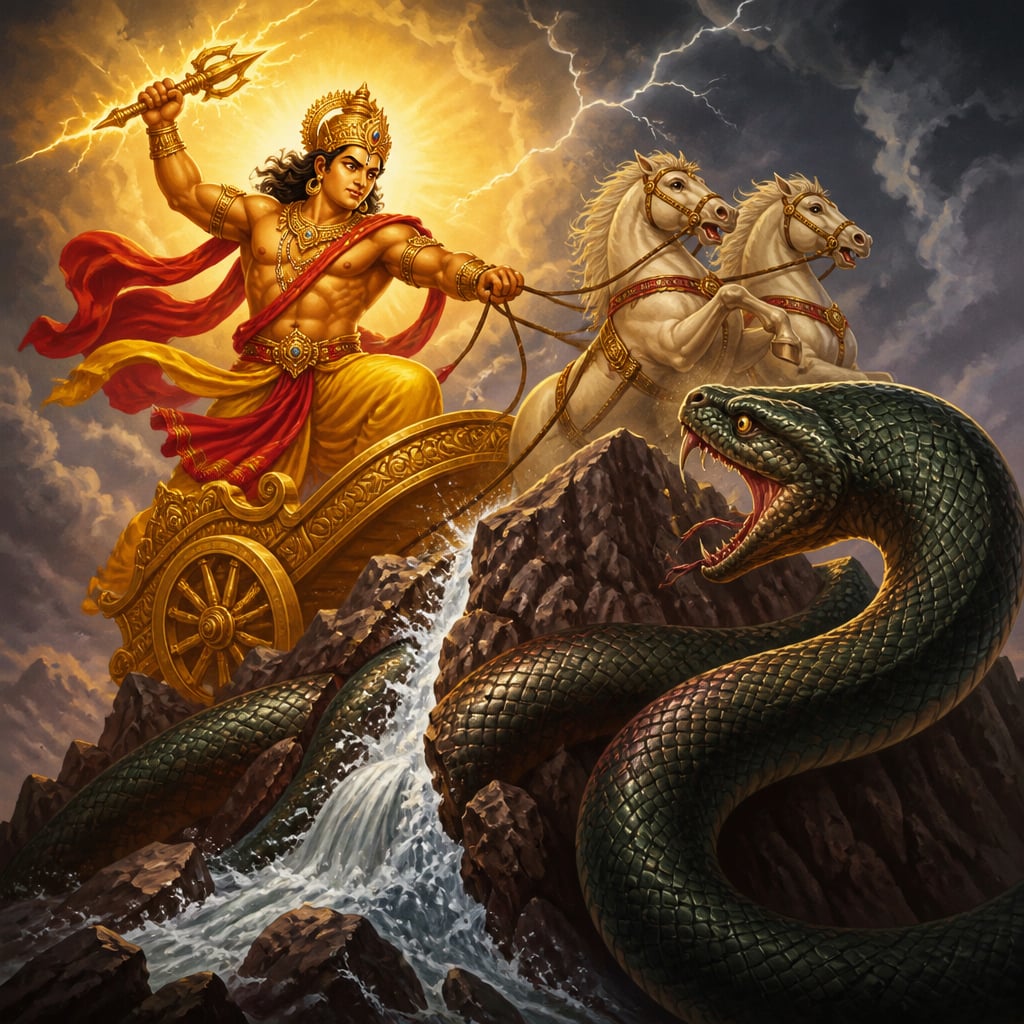
But here's what the popular telling often misses: Indra didn't simply appear with thunderbolt in hand, overflowing with arrogance. Before he could face Vṛtra, he had to become worthy of the confrontation. The Rig Veda devotes hymn after hymn not just to Indra's victory, but to his preparation, the rituals that empowered him, the Soma that fortified him, the prayers that aligned him with cosmic purpose.
The Making of a Champion
The Rishis understood something profound: power must be built before it can be legitimately wielded. Indra's strength didn't come from himself alone. Consider what the texts describe:
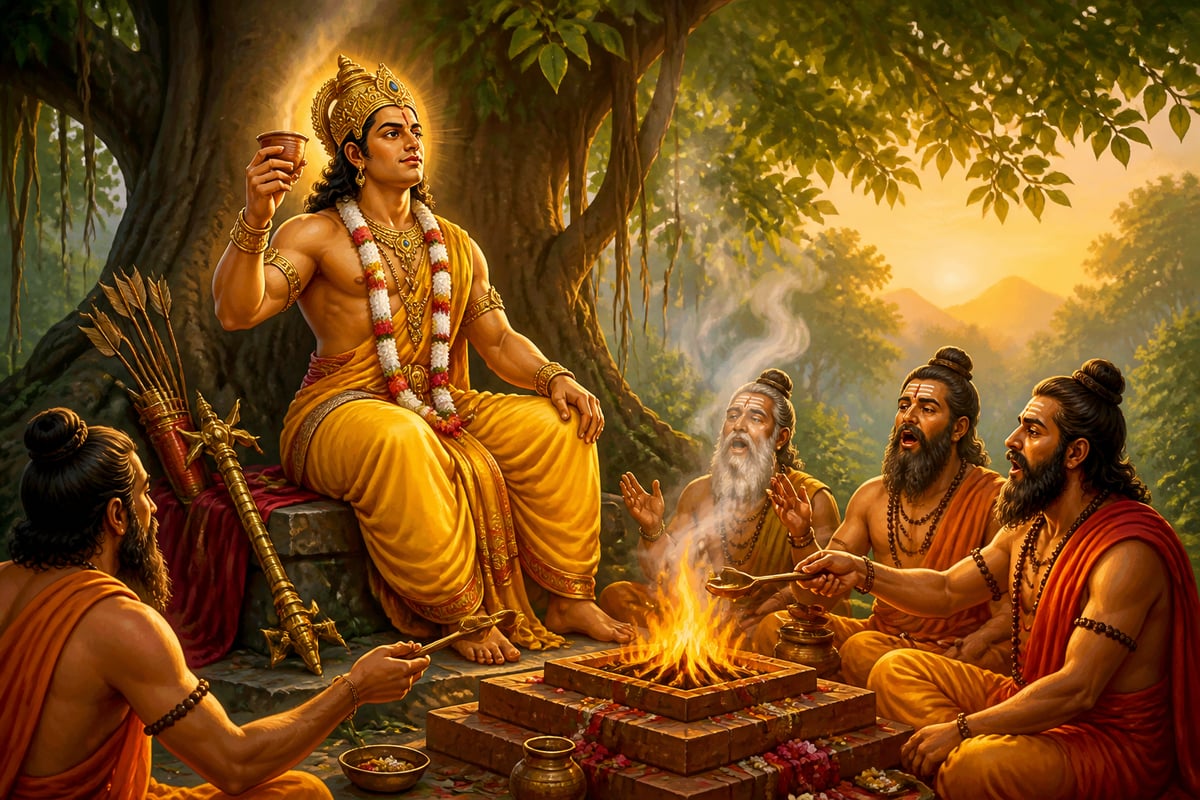
"indraṃ vardhanto apturaḥ kṛṇvanto viśvam āryam" "Increasing Indra, the waters, making all things noble" (RV 10.134.1)
The word vardhanto, "increasing, strengthening", is key. Indra's power grew through relationship: through the offerings of devotees, the support of fellow Devas, the alignment with ṛta. He was not self-made; he was community-made.
This is the first lesson: true power is not self-generated but emerges from one's place in a larger system. The leader who imagines their strength comes solely from within has already begun the slide toward hubris.
As we engage with these hymns, it is worth remembering: Understanding Indra in context reveals that the Rishis were not celebrating violence for its own sake but articulating when force is legitimate: when it is prepared for, when it serves universal rather than personal ends, and when it remains accountable to cosmic order. These criteria remain relevant for evaluating power today.
The Confrontation
When Indra finally faced Vṛtra, the stakes were not personal. He wasn't fighting for glory, territory, or revenge. The waters Vṛtra hoarded were needed by everyone, gods, humans, animals, plants. Indra's cause was universal.
"ahaṃ apsu vṛtram ādardam" "I struck down Vṛtra in the waters" (RV 1.32.1)
The simplicity of this declaration is striking. No boasting about personal prowess. The focus is on the deed, ādardam (I struck), and its location, apsu (in the waters). Indra defines his victory by what was liberated, not by his own magnificence.
Sayana comments that Indra becomes Vṛtrahan, "slayer of obstruction", not as a personal title but as a functional descriptor. His identity is bound to his purpose. He is the one who removes obstacles to life's flourishing. When he ceases to serve that function, the title becomes hollow.
The Complexity of Indra
Now, the Rig Veda is not naive hagiography. Indra is portrayed with striking complexity. He can be:
- Heroic: risking everything to free the waters
- Excessive: drinking too much Soma, becoming intoxicated with his own power
- Questioned: other hymns challenge his supremacy, ask where he is when needed
- Dependent: requiring constant praise and offerings to maintain his strength
This complexity is instructive. The archetype of power is not perfect virtue but dynamic balance. Indra's greatness lies not in never faltering but in the cosmic system that holds him accountable.

Consider RV 4.42, the remarkable dialogue hymn where Varuṇa (cosmic order) and Indra (executive power) debate their respective roles:
"mama aham asmi rājaḥ" "I am the sovereign," says Varuṇa. "aham indro varuṇa" "I am Indra, and also Varuṇa's [servant]," Indra replies.
Even the king of gods acknowledges a higher principle. Power that doesn't recognize its own limits becomes tyranny.
What Makes Indra's Power Legitimate
From these hymns, we can distill the Vedic criteria for legitimate power:
| Criterion | Sanskrit | In Indra's Example |
|---|---|---|
| Purpose beyond self | Para-hita | Fights for waters needed by all |
| Preparation through discipline | Tapas | Undergoes ritual preparation |
| Empowered by community | Vardhana | Strengthened by offerings, prayers |
| Accountable to order | Ṛta-bandhu | Acknowledges Varuṇa's sovereignty |
| Identity bound to function | Karma-nāma | Named for what he does (Vṛtrahan) |
Strip away any of these, and power becomes something else, something the Vedas would recognize as adharmic.
Sri Aurobindo's Psychological Reading
Sri Aurobindo, in The Secret of the Veda, offers a deeper reading. Vṛtra, he suggests, represents not just a cosmic demon but the inner obstruction, the force of inertia, resistance, contraction that holds back the flow of consciousness and vitality.
On this reading, Indra represents the warrior aspect of consciousness, the inner force that breaks through psychological blockages, liberates suppressed energies, and allows life to flow.
"Indra is the power of pure Existence self-manifested as the Divine Mind," Aurobindo writes. "He is the lord of mental force."
This interpretation doesn't replace the external reading but complements it. The outer leader who defeats obstacles on behalf of the community must first have developed the inner Indra, the capacity to overcome their own hesitations, fears, and confusions.
Living This Today
What does Indra's archetype teach the modern leader?
First, power wielded for self-interest, no matter how effective, lacks the legitimacy that sustains. Indra freed the waters for everyone. The leader who acts only for personal advancement may win battles but will eventually lose the support that made victory possible.
Second, preparation matters more than we often acknowledge. Indra didn't improvise against Vṛtra. He was built up through systematic practice. The leader who skips preparation, who relies on raw talent or positional authority, is fighting without the Soma.
Third, identity should be bound to function. Indra is Vṛtrahan, his name is his purpose. When leaders define themselves by titles rather than contributions, they've lost the Vedic thread.
Fourth, even the mightiest must acknowledge what they serve. Indra's dialogue with Varuṇa shows that executive power (Indra) exists to serve cosmic order (Varuṇa), not to replace it.
Taking This Forward
The Indra hymns are the most numerous in the Rig Veda, over a quarter of all verses. The Rishis clearly found in this deity something essential about the nature of power.
But they also knew that power is tested. The next lesson explores why every leader, from Indra to the modern CEO, faces challenges that question their legitimacy, and why this testing is not a flaw in the system but a feature.
Psychologist Adam Grant's research on 'givers vs. takers' shows that the most successful individuals define themselves by what they contribute, not what they accumulate. This echoes the Vṛtrahan principle: identity through service.
Jim Collins' concept of 'Level 5 Leadership' describes leaders who channel ambition into the organization rather than themselves. Like Vṛtrahan, their significance lies in what they clear away for others.
In system dynamics, 'leverage points' are often about removing blockages rather than adding inputs. The leader as Vṛtrahan identifies what's obstructing system flow and focuses energy there.
Social psychologist Robert Cialdini's research shows that influence is fundamentally relational, built through reciprocity, consistency, and genuine connection. The 'self-made' myth is psychologically false.
Venture capitalist Reid Hoffman argues that professional success depends on 'networks of alliance.' Like Indra strengthened by offerings, leaders are empowered by the relationships they cultivate and honor.
Network theory shows that power flows through connections, not individuals. A node's influence depends on its relationships. Indra's 'vardhana' is network-building at the cosmic scale.
Case studies
N. R. Narayana Murthy's Midnight Covenant
In 1981, N. R. Narayana Murthy and six colleagues started Infosys with ₹10,000 (about $1,250). They could have structured the company as Murthy's sole proprietorship, he had the vision and the most capital. Instead, on a train from Delhi to Bombay, they made a covenant: decisions would be collective, equity would be shared, and Murthy's role would be defined by what he did for the group, not what he claimed over it.
Murthy chose the Vṛtrahan model: identity through function, power through relationship. He didn't hoard the 'waters' of founding vision for himself. His subsequent authority at Infosys was legitimate because it emerged from demonstrated service to shared purpose, like Indra strengthened by offerings rather than seizing power alone.
Infosys became India's second-largest IT company. The founding covenant created a culture of shared ownership that attracted talent and sustained growth for decades. Murthy's authority was renewed 'dive dive' through consistent alignment with collective purpose.
The leader who chooses relational power over solitary control doesn't weaken their position, they legitimize it. Murthy's midnight covenant was his 'Soma preparation': the discipline that made his subsequent wielding of power righteous.
Startup founders who share equity generously with early employees often build stronger, more resilient companies than those who hoard ownership. The cooperative ownership models at companies like Costco and Patagonia echo this principle: shared power generates more durable success than concentrated control.
By the time Murthy retired, Infosys had grown from ₹10,000 to a $100+ billion market cap, creating thousands of millionaires among employees through the shared ownership model.
Lalitaditya Muktapida: The Protector Who Never Hoarded
In the 8th century CE, Lalitaditya Muktapida of Kashmir faced multiple threats: Arab armies pressing from the west, Tibetan forces from the north, and rival Indian kingdoms to the south. He could have consolidated defensively, hoarding his considerable military resources. Instead, he launched preemptive campaigns that liberated neighboring kingdoms from external threats before they reached Kashmir's borders.
Lalitaditya embodied the Vṛtrahan principle: he defined his kingship by the obstructions he removed for the larger region, not by the territory he accumulated. His campaigns freed trade routes, protected pilgrimage sites, and established a period of security that benefited communities far beyond Kashmir. Like Indra releasing the waters, he freed resources for collective flourishing.
Lalitaditya's reign marked Kashmir's golden age. The Martanda Sun Temple, one of the largest Hindu temples ever built, was constructed under his patronage. His empire stretched from the Caspian Sea to Bengal, but he ruled through alliance and protection rather than subjugation. Contemporary chronicles describe him as 'the remover of darkness.'
The ruler who uses power to remove threats for others, not just to accumulate for himself, builds legitimacy that outlasts his lifetime. Lalitaditya's memory endured in Kashmir for centuries precisely because his power was experienced as liberation, not domination.
Leaders who invest surplus resources into public goods rather than private reserves tend to create ecosystems that sustain their influence long after direct control fades. Companies like TSMC, which invested heavily in shared semiconductor infrastructure, built more lasting strategic positions than competitors who hoarded proprietary advantages.
Lalitaditya's Martand Sun Temple, built at 2,100 meters elevation in Kashmir, remains one of the largest temple complexes ever constructed in the subcontinent, showcasing the scale of resources channeled into public works rather than personal treasuries.
Reflection
- What 'Vṛtra', what obstruction that hoards resources others need, could you help remove in your organization, community, or family?
- The hymns describe Indra being 'increased' (vardhana) through offerings and prayers. In what ways is your own capacity, your strength, wisdom, effectiveness, increased by others?
- Indra's dialogue with Varuṇa suggests that executive power must acknowledge moral order. In today's world, what should serve as the 'Varuṇa' that constrains and directs institutional power?