Parīkṣā: Why Power Is Always Tested
Testing as the Guardian of Legitimate Authority
The Rig Veda treats the testing of power not as a threat to leadership but as its essential guardian. Through rituals like the Rājasūya and through the constant questioning that even Indra faces, the Vedic tradition established a principle: untested power cannot be trusted. This lesson explores why legitimate authority welcomes challenge rather than fearing it.
The king-to-be stood at the center of the ritual arena, stripped of his royal garments.
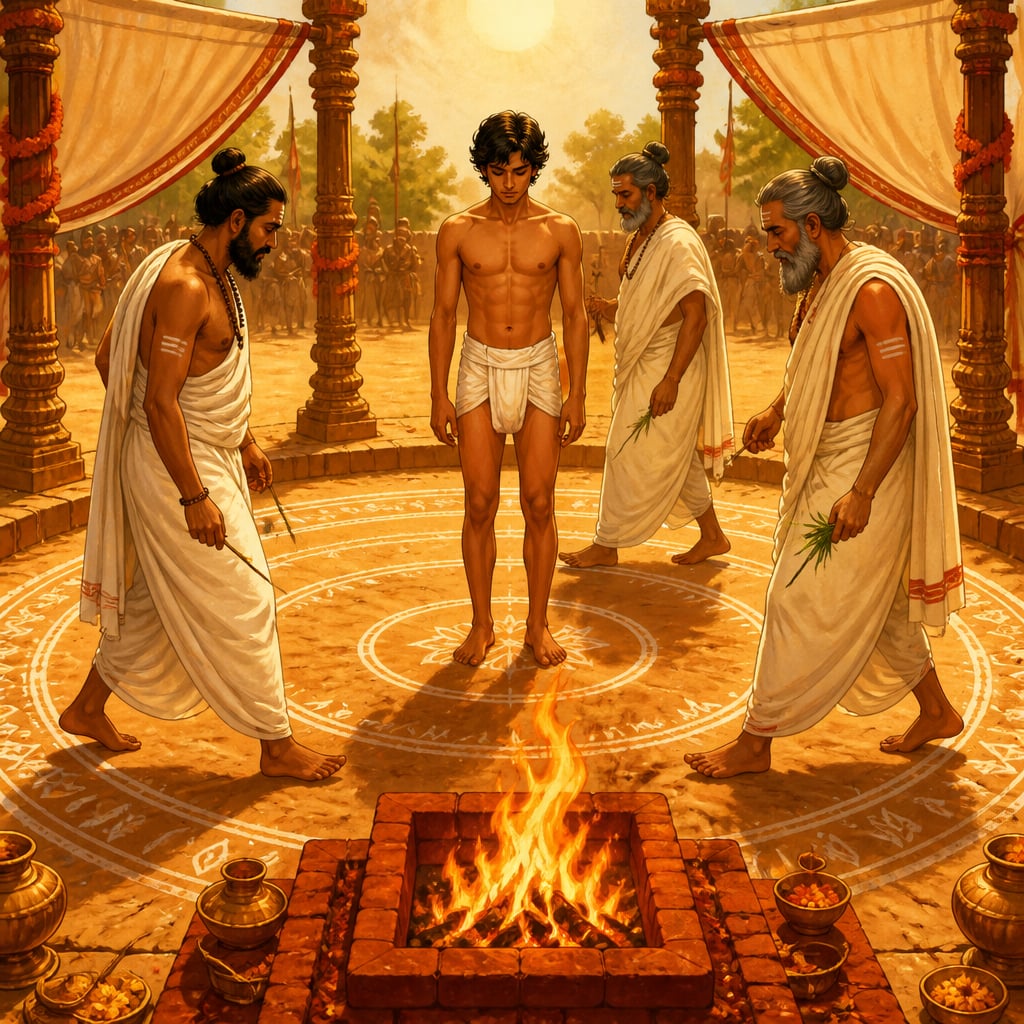
For the next twelve months, he would be tested. Not by enemies on a battlefield where his bala might prevail, but through a sequence of challenges designed to probe something deeper: his fitness to rule.
The Rājasūya, the Vedic coronation ritual, was not a ceremony of celebration. It was a parīkṣā: a comprehensive examination. The candidate would race chariots against competitors, play dice games that tested his fortune, perform a mock cattle raid that demonstrated economic judgment, and submit to questioning by priests who represented cosmic order itself.
Why such elaborate testing for someone already designated to rule?
Because the Rishis understood what modern institutions often forget: power that escapes testing becomes power that escapes accountability.
This principle emerges from practical experience: Understanding the Vedic testing structures reveals an ancient society grappling with the same challenge modern institutions face: how to ensure power remains accountable. Their solution, comprehensive, multi-level testing that continues beyond acquisition, remains relevant. Every system that grants power must answer: How is this power tested? And what happens when it fails the test?
The Logic of Testing
In the Vedic framework, testing serves multiple functions:
1. Revelation of Character
Pressure reveals what comfort conceals. The calm, capable person in ordinary circumstances may become something else entirely when tested. The Rājasūya didn't ask whether the candidate claimed to be fit for rule, it created conditions where fitness (or its absence) would become visible.
"agne vṛtrahā vipraṃ parīkṣya" "O Agni, slayer of obstacles, test the wise one" (RV 10.118.1)
Agni, the fire god who witnesses all rituals, is invoked as the examiner. Fire cannot be deceived. What is offered to fire is either consumed (accepted) or rejected. The king's qualities are similarly laid bare.
2. Earning of Legitimacy
The Vedic texts are clear that kṣatra cannot be simply conferred, it must be earned through demonstrated capacity. Testing provides the arena where this earning happens. A king who has passed the tests rules by proven right, not merely by inheritance or conquest.
3. Continuous Accountability
Importantly, testing in the Vedic system is not a one-time event. Even Indra, who slew Vṛtra and freed the waters, is repeatedly questioned throughout the Rig Veda:
"kuhayaṃ kuha sa indraḥ" "Where is he? Where is that Indra?" (RV 8.100.3)
The hymns don't treat this questioning as disrespectful. It's a necessary function: power that cannot be questioned is power that cannot be trusted.
Indra Under Question
Remarkably, the Rig Veda includes hymns that directly challenge Indra's reliability:
"yo aśvānāṃ yo gavāṃ gopāḥ" "Where is the guardian of horses, of cattle?" (RV 8.100.3)
Devotees ask: When we needed you, where were you? This is not blasphemy but built-in accountability. The hymns acknowledge that even divine power must answer to those it serves.
Sayana's commentary on these questioning hymns is illuminating. He doesn't treat them as expressions of lost faith but as expressions of relationship. The questioner has standing to question precisely because they have made offerings, performed rituals, upheld their side of the cosmic exchange. Testing is the right of the invested.
The Three Levels of Testing
From the Vedic materials, we can identify three levels at which power is tested:
| Level | Nature | What It Tests | Example |
|---|---|---|---|
| Ritual/Formal | Structured tests within ceremonies | Baseline qualifications | Rājasūya challenges |
| Situational | Real crises that arise | Applied capacity | Indra vs. Vṛtra |
| Ongoing | Continuous accountability | Sustained legitimacy | Hymns questioning Indra |
A system that provides only one level of testing, say, only formal qualifications at entry, leaves power dangerously unchecked at other levels.
The Dice Game: Fortune as Test

One element of the Rājasūya merits special attention: the ritual dice game (akṣa-dyūta). Why would kingship include a test of luck?
The Vedic answer is profound: a leader must acknowledge the role of forces beyond their control. The dice game tests not whether the king can guarantee outcomes, he cannot, but whether he can maintain composure and right action when outcomes are uncertain.
"akṣair mā dīvyaḥ kṛṣim it kṛṣasva" "Do not gamble with dice; cultivate your field" (RV 10.34.13)
This famous verse from the Gambler's Hymn warns against the addiction to gambling. But within the ritual context, the dice test something different: the capacity to engage with uncertainty without being destabilized by it.
Sri Aurobindo interprets the ritual dice game as a test of samata, equanimity. The ruler who cannot maintain inner balance when fortune turns will not maintain outer stability when crises arise.
Why Untested Power Fails
The Vedic system's insistence on testing wasn't arbitrary. It reflected deep understanding of what happens when power escapes scrutiny:
Untested power breeds overconfidence. Without challenge, leaders come to believe their successes are entirely self-generated. They lose awareness of the community support (vardhana) that actually sustains them.
Untested power loses touch with reality. Testing forces contact with actual conditions. The leader who is never tested may be ruling an imaginary kingdom, believing things are stable when they're not, believing they are loved when they're merely feared.
Untested power becomes brittle. Like metal that hasn't been tempered, power that hasn't been tested shatters under real pressure. The first genuine crisis destroys what looked strong.

The Rig Veda's own metaphor is instructive: Agni tests gold not to weaken it but to prove and strengthen it. Testing is not the enemy of power but its guardian.
The Wisdom of Inviting Challenge
Perhaps the most counterintuitive Vedic insight is this: legitimate power welcomes testing.
The king who fears examination reveals that his power is not rooted in true kṣatra. The king who invites it demonstrates confidence that his authority can survive scrutiny.
Consider the Rājasūya structure: the candidate doesn't undergo testing reluctantly, as if enduring an ordeal. The tests are integral to the ceremony that establishes his authority. To skip them would be to claim illegitimate power.
This principle applies beyond formal rituals. In the ongoing relationship between ruler and ruled, the willingness to be questioned, to answer to those one serves, is itself evidence of legitimate authority.
Living This Today
What does this teach modern leaders?
First, design systems that include real testing. Many organizations have nominal accountability structures that don't actually challenge anyone. The Rājasūya tests were designed to reveal truth, not to confirm predetermined outcomes.
Second, distinguish between different levels of testing. Are you only tested on formal entry (credentials, interviews) but never situationally or continuously? That's an accountability gap.
Third, examine your relationship to challenge. Do you avoid situations where your judgment might be questioned? Do you surround yourself with those who agree? These are symptoms of power that fears testing, and power that fears testing is power that knows it might not be legitimate.
Fourth, recognize that surviving tests builds credibility. The leader who has been tested and has passed, openly, visibly, rules with a different kind of authority than the one who has only ever been confirmed.
Taking This Forward
The Vedic system's elaborate testing structures were not bureaucratic impositions but wisdom about power's nature. They knew that kṣatra must be proven, that bala alone is not enough, and that the line between legitimate authority and tyranny often runs through the question: "Can this power be tested?"
But what happens when power fails its tests? What happens when authority operates without accountability? The next lesson explores the Vedic understanding of power divorced from responsibility, adharmic power, and why such power ultimately destroys itself.
Research on 'selection effects' shows that nominal tests often fail to predict performance. Philip Tetlock's work on expert judgment found that credentials correlated poorly with accuracy. The Vedic insight: tests must be designed to reveal, not merely confirm.
Companies like Amazon use 'working backwards' documents that force product leaders to articulate customer value before getting resources. This is modern parīkṣā: the idea is tested before investment, not after.
Complex systems require 'stress testing', deliberately exposing them to challenging conditions. The Rājasūya's dice game was an early form of stress testing: how does the candidate respond when randomness strikes?
Research on 'emotional regulation' by James Gross shows that leaders who can modulate emotional responses under pressure make better decisions. Samatā is a teachable skill, not just a personality trait.
Ray Dalio's 'Principles' emphasizes separating what you can control from what you cannot, and focusing energy appropriately. This mirrors the ritual dice game: accept uncertainty while maintaining right action.
Complex systems inevitably produce unexpected outcomes. Leaders who destabilize when facing surprises amplify rather than absorb volatility. Samatā is a system-stabilizing capacity.
Case studies
Ratan Tata's Crucible: The Indica Launch
In 1998, when Ratan Tata unveiled the Indica, India's first indigenously designed car, the automotive press was brutal. Headlines called it 'ugly,' predicted failure, and questioned Tata's judgment. International auto majors offered to buy the division at distressed prices, providing an easy exit. Tata's board was divided. The market was skeptical. This was his parīkṣā, not the ceremonial testing of assumption but the real testing of crisis.
Rather than retreat, Tata welcomed the test. He visited dealerships personally, collected customer feedback, and implemented 120+ improvements in the next year. He treated criticism as information, not attack. His samatā under pressure, neither defensive nor despairing, allowed clear-headed response. The test revealed his character.
The improved Indica became India's bestselling car for several years. More importantly, the experience established Tata's credibility for bolder moves: Nano, the Jaguar-Land Rover acquisition, and the broader globalization of Tata Motors. The test that could have ended his automotive ambitions instead legitimized them.
Real tests cannot be avoided, only met. The leader who maintains samatā under pressure, who treats challenge as information rather than assault, converts testing into credential. Tata's willingness to face the fire (Agni's parīkṣā) proved what comfortable success could not.
Every founder faces a moment when critics declare the product dead on arrival. The ones who treat harsh feedback as data rather than personal attack, like Brian Chesky at Airbnb during its early ridicule phase, convert public testing into lasting credibility that insulates them from future criticism.
The Indica, initially mocked, sold over 1.5 million units and established Tata Motors as a credible automotive player, paving the way for the $2.3 billion Jaguar-Land Rover acquisition in 2008.
Pulakeshin II: The King Who Invited Testing
When Pulakeshin II (610-642 CE) became the Chalukya emperor, he held significant territory in the Deccan. But instead of consolidating defensively, he deliberately sought tests of his authority: challenging the Pallava kingdom to the south, the Kalachuris to the north, and famously, halting the expansion of Harsha of Kanauj, the most powerful ruler in northern India. He sent diplomatic missions to Persia, inviting international scrutiny.
Pulakeshin understood the Vedic principle: untested power is questionable power. By actively seeking challenges rather than avoiding them, he demonstrated that his authority could survive scrutiny. His court poet Ravikirti's Aihole inscription explicitly frames his victories as tests passed: each challenge met was legitimacy earned.
Pulakeshin's defeat of Harsha became legendary, the first major check on northern expansion into the Deccan. His fame spread to Persia and the Arab world; the Chinese pilgrim Xuanzang described his kingdom admiringly. The Chalukya dynasty's prestige rested on tests deliberately faced and passed.
Some leaders avoid challenge to preserve the appearance of power. The wiser approach, as Pulakeshin demonstrated, is to invite challenge and convert successful testing into deeper legitimacy. Power proven through trial is power that compels respect.
Organizations that actively seek external audits, red-team exercises, and customer scrutiny build deeper institutional trust than those that avoid examination. Companies like Toyota, with their open approach to quality testing, demonstrate that inviting challenge strengthens rather than weakens competitive position.
Pulakeshin II's Aihole inscription (634 CE) by court poet Ravikirti documents victories against the Pallavas, Cholas, Pandyas, and Harsha of Kanauj, confirming military engagements across the entire Indian subcontinent.
Reflection
- In what areas of your life does your authority go largely untested? What would meaningful testing look like there?
- The hymns questioning Indra show that even divine power must answer to those it affects. What does it mean to have 'standing to question' authority?
- The Rājasūya included a dice game, a test of response to uncontrollable chance. What is the relationship between leadership and acceptance of what cannot be controlled?