Rakṣā: Protection as the Core Function of Leadership

The Leader as Shelter, Not Sovereign

The Rig Veda defines the purpose of power in one word: rakṣā, protection. The leader is not primarily a commander to be obeyed but a shelter under which others flourish. This lesson explores how the protective function transforms the relationship between power-holder and those affected, and why leadership defined by protection proves more durable than leadership defined by domination.

The storm came without warning.

The old farmer, his fields still unharvested, watched the dark clouds gathering with despair. A season's labor, gone. His family's survival through winter, threatened. He had no recourse, no reserve, no power.

But then the village headman appeared, with a dozen others: "We harvest together. The grain will be saved. You will not stand alone."
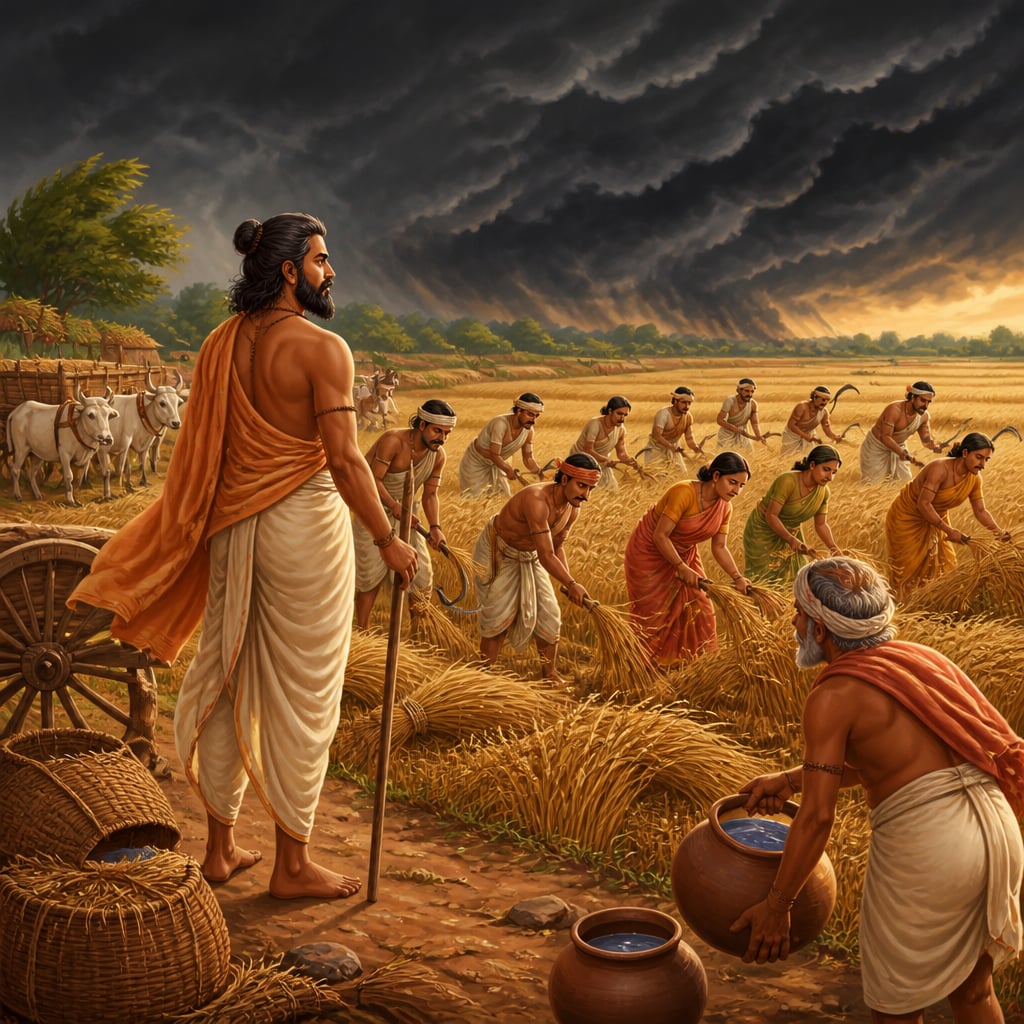
A village headman leading a harvest before the storm

This simple scene, repeated across millennia, in countless villages, in every vulnerable moment, contains the Vedic answer to why power exists: rakṣā. Protection. Shelter. The gathering of strength so that those without strength need not perish.

What Rakṣā Means

The Sanskrit word rakṣā comes from the root rakṣ, "to protect, to guard, to take care of." But the Vedic usage goes beyond mere defense against external threats. Rakṣā includes:

The king who provides rakṣā is not just a soldier-defender but a comprehensive guardian. His power exists to create the conditions under which farmers can farm, merchants can trade, scholars can study, and families can raise children without fear.

This understanding of leadership as shelter rather than sovereignty has profound implications: Understanding the rakṣā principle reveals that the Vedic tradition grounded leadership legitimacy in service, not domination. This has profound implications for how we evaluate leaders today: not by what they control or achieve for themselves, but by what flourishes under their protection.

"pāhi no agne duritād avadyād" "Protect us, O Agni, from evil and from harm" (RV 10.87.18)

This prayer, addressed to Agni but modeling what's expected of all protective powers, uses pāhi (protect, guard). The request is not for conquest or glory but for shelter from what threatens.

The Leader as Shelter

The Rig Veda's imagery for the good ruler is striking in what it emphasizes:

"bṛhad vayo hi bhārave" "For great shelter is for the devoted" (RV 1.91.20)

The word vayaḥ here can mean "shelter, protection, home." The leader is not primarily someone who commands but someone who provides refuge. Under good leadership, people feel protected, not controlled, not dominated, but safe.

This framing fundamentally changes the power relationship:

Domination Model Protection Model
Power demands obedience Power provides safety
Subjects exist to serve ruler Ruler exists to serve subjects
Strength measured by control Strength measured by flourishing
Compliance is extracted Loyalty is earned
Fear is the mechanism Trust is the mechanism

The Vedic king who understands his role as rakṣaka (protector) doesn't ask "How do I maintain control?" but "Are my people thriving? Are they safe? Can they pursue their lives without fear?"

Why Protection Creates Power

The Rishis understood something that modern political science has only recently formalized: protection creates legitimacy more durably than domination.

When people feel protected by a leader, they invest in that leader's success. They warn of threats. They contribute resources. They defend the leader's position because the leader's position protects them. This is not coerced loyalty but rational exchange.

When people feel dominated by a leader, they calculate. They wait for weakness. They contribute the minimum. They abandon the leader at the first opportunity because the leader's fall improves their condition.

A king as shelter under a banyan canopy

"yasya chāyā amṛtaṃ yasya mṛtyuḥ" "Whose shadow is immortality, whose shadow is death" (RV 10.121.2)

This verse, from a hymn to the creator, uses chāyā (shadow, shade, shelter) as a defining quality. The shadow of the protective power is amṛtam, immortal, life-giving. The absence of that shadow is mṛtyu, death. Leadership is understood through its sheltering function.

The Obligations of the Protector

Rakṣā is not a posture but an obligation. The Vedic texts are clear that the leader who fails in protection loses legitimacy regardless of other qualities:

A kshatriya guard on the parapet at pre-dawn

The protector must be vigilant. Threats don't announce themselves. The leader whose attention wanders invites harm. The Rig Veda's prayers for protection often emphasize wakefulness, the protector doesn't sleep while others are vulnerable.

The protector must prioritize correctly. Not all threats are equal; not all protected parties have equal vulnerability. The ethical complexity of protection lies in prioritization: who needs shelter most urgently?

The protector must absorb cost. True protection means the protector faces the threat so others don't have to. A leader who pushes risk onto followers while claiming safety is not providing rakṣā, he's extracting it.

The protector must be competent. Good intentions without capacity are not protection. The Vedic system's testing rituals (discussed in Lesson 3) exist precisely to ensure that those claiming the protective role can actually fulfill it.

Sayana's commentary emphasizes that rakṣā is not a privilege but a kartavya, a duty, an obligation. The king who enjoys royal power but fails in protection is not merely ineffective; he is adharmic.

Protection vs. Control

A crucial distinction: protection is not control. The protective leader doesn't micromanage the flourishing of those protected; he creates the conditions for that flourishing and then steps back.

Consider the difference:

The controlling leader says: "I will decide what you need and ensure you get it, my way, on my schedule, with my approval required at each step."

The protective leader says: "I will ensure that threats don't reach you and that resources are available. What you do with that safety is your affair."

The first creates dependence. The second creates capacity.

This is why the Vedic image is shelter rather than control. The shelter doesn't determine what happens under it; it simply ensures that weather doesn't destroy what's growing. The farmer under the shelter still farms; the family still lives its life. The protection enables autonomy rather than replacing it.

Sri Aurobindo on the Protective Function

Sri Aurobindo's interpretation adds psychological depth to the protective function. He sees the Vedic gods who provide rakṣā as representing aspects of consciousness that guard the seeker's inner development.

On this reading, protection is not just external defense but the creation of safe space for growth. The inner Indra protects our developing consciousness from the forces (inner and outer) that would arrest its unfolding.

"The guardians of the divine action," Aurobindo writes, "must ensure that the sacrificial progression is not interrupted by the hostile powers."

This interpretation applies directly to leadership: the leader's protective function is not just keeping physical threats at bay but creating the conditions for human development, where people can take risks, make mistakes, learn, and grow without fear of destruction.

Living This Today

What does the rakṣā principle mean for modern leaders?

First, reframe success. Instead of asking "How much control do I have?" or "How much have I achieved?" ask "Are those I lead thriving? Do they feel safe enough to take creative risks? Are threats being absorbed before they reach them?"

Second, practice visible protection. In many modern organizations, protection happens invisibly, the manager who shields the team from unreasonable demands, the executive who absorbs political risk. Making protection visible builds the trust that protection creates.

Third, distinguish protection from control. Are you creating conditions for flourishing, or are you creating dependence? True rakṣā enables autonomy; false protection creates captivity.

Fourth, accept the costs. Protection without personal cost is not protection. The leader who won't take risks, absorb criticism, or sacrifice comfort for the protected is enjoying the title without performing the function.

Taking This Forward

The rakṣā principle, protection as the core function of power, reframes leadership from the ground up. The leader is not primarily a commander, an achiever, or a visionary. The leader is first and foremost a shelter under which others can flourish.

But how does one acquire the capacity to provide this shelter? The next lesson explores the distinction between tejas (personal power, inner radiance) and positional authority. True protective capacity requires more than a title, it requires developed inner strength.

Attachment theory (Bowlby, Ainsworth) shows that humans need 'secure bases' from which to explore, relationships that provide safety enabling risk-taking. The protective leader creates this secure base for their team.

Amy Edmondson's research on 'psychological safety' shows that teams with protective leaders, who absorb blame, share credit, and create space for failure, outperform teams with dominating leaders.

Complex systems require 'redundancy' and 'buffers', protective elements that absorb shocks before they reach core functions. The protective leader provides this buffering function for their organization.

Research on parenting styles shows that 'authoritative' parenting (high warmth + high standards but low control) produces the best outcomes. The parent provides protection without micromanaging, creating conditions for autonomous development.

Daniel Pink's research on motivation shows that autonomy is a core driver of engagement. Leaders who protect while granting autonomy get discretionary effort; those who 'protect' through control get compliance at best.

Complex adaptive systems require space for emergent behavior. Excessive control prevents adaptation. The protective function creates boundaries (safety from external threats) while maintaining internal freedom.

Case studies

Captain Vikram Batra: Protection as Identity

During the Kargil War (1999), Captain Vikram Batra of 13 JAK Rifles led the assault on Point 5140, one of the most heavily fortified Pakistani positions. After capturing it, he was offered rest. Instead, he volunteered to lead the assault on the even more dangerous Point 4875. During this assault, a junior officer was hit. Batra could have ordered others to retrieve him; the battle was ongoing, the risk extreme. Instead, he personally went to rescue his fallen comrade.

Batra embodied rakṣā in its most literal form: his soldiers' safety was more important than his own. His famous phrase 'Yeh dil maange more' (the heart wants more) wasn't about glory but about the protective mission incomplete. He absorbed the ultimate threat so his men wouldn't have to. His leadership created the conditions for others to fight effectively because they knew he wouldn't sacrifice them for his survival.

Point 4875 was captured. Captain Batra was killed while rescuing the wounded officer. He received the Param Vir Chakra posthumously. But the deeper outcome: his unit's fighting spirit, his soldiers' willingness to take risks knowing their leader would protect them, the trust that enabled coordinated action under extreme conditions, all were products of his protective function.

Protection isn't abstract. At its core, it means placing yourself between threat and those you lead. Batra's leadership worked because his men knew, with certainty, that he would absorb danger rather than deflect it onto them. This created the trust that enabled extraordinary collective performance.

Military leadership studies consistently show that units with commanders who share frontline risk have dramatically higher cohesion and performance. In business, founders who take pay cuts during downturns, or leaders who publicly accept blame for team failures, create the same trust dynamic that Captain Batra embodied.

Captain Batra was 24 years old when he died. The positions he helped capture changed the trajectory of the Kargil War. But the 13 JAK Rifles' unit cohesion, created by his protective leadership, outlasted him, shaping the regiment's culture for decades.

Krishnadevaraya: The Shelter of Hampi

Krishnadevaraya (1509-1529 CE) ruled the Vijayanagara Empire during its golden age. His military power was formidable, he defeated the Sultanates repeatedly. But his inscription at Tiruvannamalai reveals how he understood his function: 'I am the servant of Virupaksha' (the temple deity), and 'I am established for the protection of dharma.' His power existed to shelter, the arts, scholarship, religion, and ordinary people, not to glorify himself.

Krishnadevaraya explicitly framed his kingship as rakṣā: protection of dharma, of the realm, of flourishing. His patronage of poets, his construction of temples, his maintenance of irrigation systems, all were expressions of chāyā. Under his shelter, Telugu and Kannada literature flourished, merchants traded safely, farmers irrigated reliably. He created conditions for autonomous flourishing across domains.

The Vijayanagara Empire under Krishnadevaraya became the wealthiest and most culturally vibrant kingdom in India. Portuguese traders marveled at Hampi's prosperity. Scholars from across India gathered at his court. His protective function, maintained through military strength but expressed through enabling conditions, created one of India's great civilizational moments.

Military power was necessary for Krishnadevaraya's protective function but not sufficient. True rakṣā involved creating conditions for flourishing in every domain, arts, commerce, agriculture, religion. His greatness lay not in what he conquered but in what flourished under his protection.

The best modern institutions invest in creating conditions for employee and community flourishing beyond their core mission. Google's early investment in employee well-being, or Singapore's comprehensive approach to citizen development, reflect this principle: protection means enabling growth across every dimension, not just defending against threats.

Krishnadevaraya ruled for just 20 years (1509-1529 CE). Yet the Vijayanagara Empire's golden age extended for generations after him, sustained by the institutional structures and cultural vitality he created. His protective function created self-sustaining flourishing.

Reflection

More in Kṣatra: The Nature of Power

All lessons in Kṣatra: The Nature of Power · Rig Vedic Leadership course