Kṣatra: What Is Power in the Rig Veda?

Understanding the Vedic Framework of Legitimate Authority

The Rig Veda presents power not as mere force or domination, but as Kṣatra, a sacred capacity that emerges from alignment with cosmic order (Ṛta). This lesson explores how the ancient Rishis understood the true nature of authority and why power divorced from dharma was considered not just immoral, but fundamentally unstable.

The young prince had won every contest. His arrows flew truest, his chariot fastest, his arms strongest. Yet his father, the aging king, looked troubled.

"You have bala," the king said finally. "Strength. But do you have kṣatra?"

The prince frowned. "Are they not the same?"

"If they were," his father replied, "every wrestler would be a king. Every elephant would rule the forest. Strength is what you have. Kṣatra is what you are entitled to wield, and more importantly, what you are obligated to wield well."
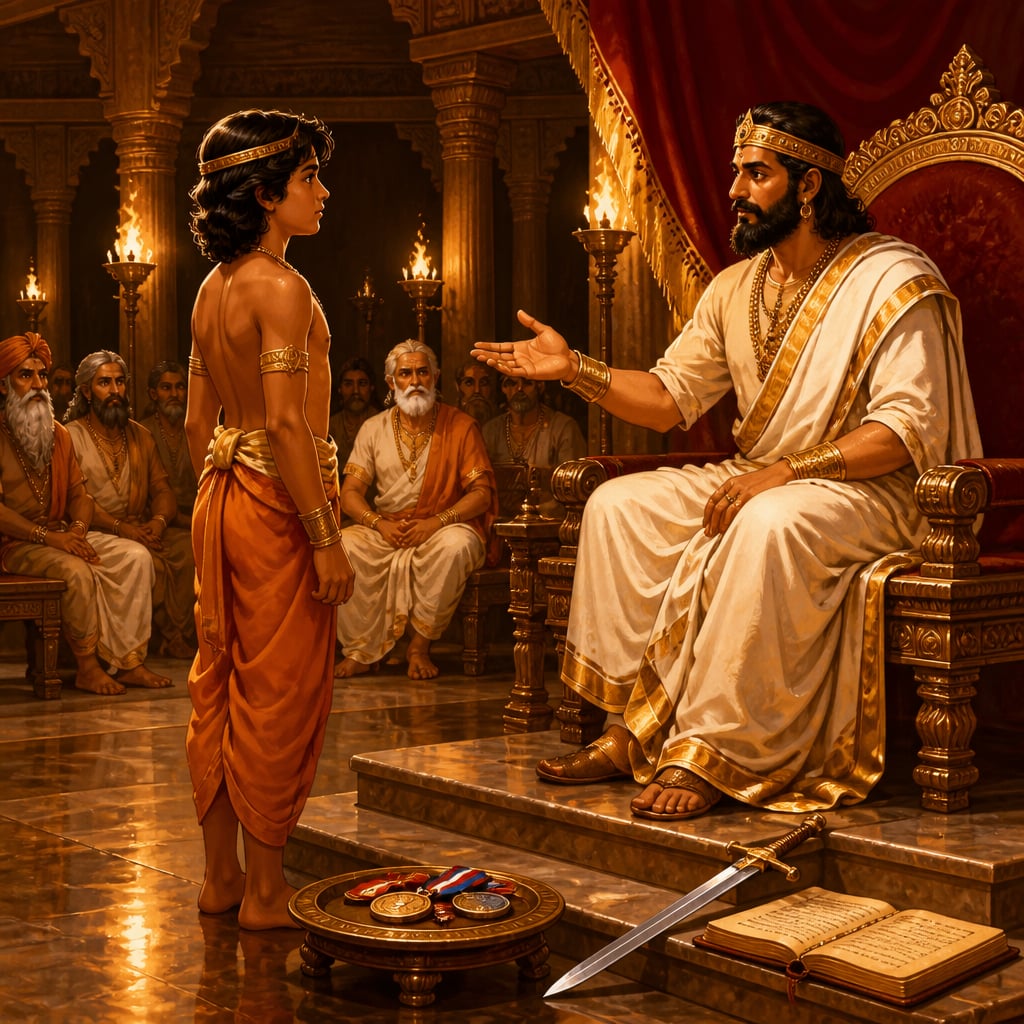
A young prince before his king-father in a torchlit hall

This distinction, between raw power and legitimate authority, lies at the heart of how the Rig Veda understands leadership.

The Three Faces of Power

The Sanskrit language, with its precision, refuses to collapse all forms of power into a single word. The Rig Veda uses multiple terms, each revealing a different dimension:

Bala (बल), raw physical or material strength. The elephant has bala. The flood has bala. It can destroy or protect, but carries no inherent direction.

Ojas (ओजस्), vital energy, the inner fire that animates action. A warrior's courage, a speaker's conviction, a leader's presence, all manifestations of ojas.

Kṣatra (क्षत्र), ruling power, legitimate authority. Unlike bala, which exists in nature, kṣatra is a human responsibility. It implies not just the capacity to rule, but the right to rule, and that right comes with binding obligations.

The Rishis understood something that modern leadership theory is only beginning to rediscover: power without legitimacy is inherently unstable, and legitimacy comes not from conquest but from alignment with a larger order.

A word of caution as we explore this ancient framework: Understanding the Vedic context shows that the kṣatra concept emerged from a society with developed institutions of consent and accountability. This wasn't theoretical philosophy but practical wisdom from communities that had to manage real questions of power, succession, and legitimacy. The insight that power must align with larger order (ṛta) came from lived experience of what happens when it doesn't.

What the Mantras Reveal

In the Rig Veda, we find this principle articulated with stunning clarity:

"yasya kṣatraṃ vṛṣabhāyate dive dive" "He whose ruling power grows strong day by day" (RV 1.54.3)

Note what this verse implies: kṣatra is not static. It must be renewed, strengthened, maintained. A leader's authority is not a permanent possession but a daily practice. The word vṛṣabhāyate, "becomes bull-like", suggests both growth and the responsibility of strength (the bull protects the herd, not itself).

Another revealing verse declares:

"kṣatrasya yonir abhavad ṛtasya" "He became the source of kṣatra, of cosmic order" (RV 4.42.4)

Here, kṣatra and ṛta (cosmic order) are linked at the root. True ruling power emerges from alignment with cosmic truth, not from ambition, not from inheritance, not from mere strength. This is a radical claim: power that violates cosmic order is not true power at all.

Traditional Wisdom: Sayana's Insight

The great 14th-century commentator Sayana, in his Bhashya, explains that kṣatra derives from the root kṣi, "to possess, to rule", but always in the context of dharma. For Sayana, the Vedic conception of power is never abstract; it is always embedded in responsibilities.

Sri Aurobindo, in The Secret of the Veda, takes this further. He interprets kṣatra as the "warrior soul", not just a social function but a spiritual quality. The leader with true kṣatra is one who has conquered the inner enemies (fear, greed, delusion) before attempting to order the outer world.

"The real Kshatriya," Aurobindo writes, "is he who has the divine force within him and uses it to establish the divine order in the world."

This interpretation helps explain why the Rig Veda's prayers for power are never prayers for domination. They are prayers for the capacity to protect, to order, to establish dharma.

The Architecture of Legitimate Power

From these verses and commentaries, we can discern a Vedic architecture of legitimate power:

Component Sanskrit Meaning Modern Parallel
Source Ṛta Cosmic order Constitutional principles
Vehicle Kṣatra Ruling capacity Executive authority
Fuel Ojas Vital energy Organizational culture
Check Vrata Sacred vow Accountability structures
Purpose Rakṣā Protection Stakeholder welfare

Without Ṛta as source, power becomes arbitrary. Without Vrata as check, it becomes tyrannical. Without Rakṣā as purpose, it becomes self-serving.

Living This Today

What does this mean for the modern leader, the CEO, the team lead, the parent, the community organizer?

First, examine the source of your authority. Is it merely positional (someone gave you the title) or is it rooted in something deeper, competence, service, alignment with the organization's true purpose?

Second, distinguish your different powers. You may have bala (resources, budget, headcount) without having kṣatra (the legitimate right to deploy them). Many leadership failures come from confusing the two.

Third, remember that power must be renewed daily. The Vedic insight that kṣatra "grows strong day by day" suggests that authority is earned through consistent action, not claimed through past achievement.

Vedic rishi writing by the Saraswati at dawn

The Rishis, sitting by the Saraswati four thousand years ago, understood something essential: the question is never simply whether you have power, but whether your power has legitimacy, and legitimacy is never self-granted.

Taking This Forward

As we proceed through this chapter, we will explore how this framework plays out: in Indra's rise as the archetype of legitimate power, in the tests that every leader must face, in the dangers of power divorced from responsibility, and in the fundamental obligation of protection that defines true authority.

But first, consider this: in your own sphere of influence, however large or small, where does your authority come from? Is it bala alone? Or have you cultivated true kṣatra?

Research by psychologist Dacher Keltner (UC Berkeley) shows that power acquired through social intelligence and service to the group is more stable than power seized through dominance. His 'power paradox' research confirms the Vedic insight: legitimate authority sustains; raw force corrupts.

Jim Collins' 'Level 5 Leadership' research found that the most effective leaders combine personal humility with professional will, they lead from earned authority, not positional arrogance. This mirrors the kṣatra-ṛta connection.

Systems theory recognizes that legitimacy is an emergent property of systems, not an attribute of individuals. A leader's authority comes from their alignment with the system's purpose, precisely the Vedic claim about ṛta.

Angela Duckworth's research on 'grit' shows that sustained commitment predicts success better than talent. The Vedic 'stand firm' is not about rigidity but about the persistent, daily renewal of commitment.

Consistency is foundational to trust. Patrick Lencioni's work on team dysfunction shows that leaders who waver, whose authority seems contingent on mood or circumstance, undermine organizational stability.

Stable systems require consistent inputs. A leader who is 'firm and unwavering' provides the reliable signal that allows others to coordinate. Inconsistent leadership creates system chaos.

Case studies

Verghese Kurien: Bala to Kṣatra at Amul

In 1949, Verghese Kurien, a young engineer who disliked milk, was posted to Anand, Gujarat. He had technical skills (bala) but no farming background, no Gujarati language, and no personal stake in dairy. Local farmers had just formed a cooperative to fight exploitation by the Polson dairy monopoly. Kurien could have used his government position to extract compliance. Instead, he spent months simply listening to farmers, understanding their constraints, and putting his technical skills in service of their goals.

Kurien transformed his bala (technical expertise, government position) into kṣatra (legitimate authority) by aligning himself with the farmers' purpose, their ṛta. He didn't claim leadership; he earned it by demonstrating that his power would serve their interests. His authority 'grew strong day by day' through accumulated acts of service.

Amul became India's largest food brand. The cooperative model spread nationwide as 'Operation Flood,' making India the world's largest milk producer. Kurien led the movement for 50+ years, not because of his position, but because farmers continually renewed his mandate through trust.

Technical expertise (bala) becomes leadership authority (kṣatra) only when deployed in service of a legitimate purpose. Kurien didn't impose his vision; he aligned his capabilities with the community's needs.

Today's most effective tech founders often succeed not by imposing their expertise but by embedding it within communities they serve. Platform companies like Shopify thrive because they align technical capability with merchant needs, turning engineering skill into lasting market authority.

From 1950 to 2000, India's milk production grew from 17 million tonnes to 84 million tonnes, largely through the cooperative model Kurien championed.

Skandagupta: Power Renewed Against the Hunas

When Skandagupta (455-467 CE) ascended the Gupta throne, the empire faced its gravest crisis. The Hunas (Hephthalites), who had destroyed kingdoms from Persia to Gandhara, were advancing into India. Skandagupta's brothers contested his succession. The treasury was depleted. He could have used his army to secure internal control first, consolidating bala. Instead, he marched immediately against the Hunas, trusting that demonstrated protection of the realm would establish his kṣatra.

Skandagupta embodied the Vedic principle that kṣatra comes from alignment with ṛta, his duty was to protect (rakṣā) before his duty was to consolidate power. By prioritizing the realm's defense over his personal security, he demonstrated that his authority served a purpose larger than himself. His inscriptions explicitly invoke Vedic imagery of the ideal protector-king.

Skandagupta defeated the Hunas decisively, a victory that would not be repeated when they returned fifty years later under weaker rulers. His brothers' opposition collapsed as the realm rallied to the king who had proven his protective function. The Gupta golden age was extended by a generation.

Legitimate authority (kṣatra) is established through demonstrated commitment to one's protective function, not through the assertion of positional rights. Skandagupta's willingness to risk his position to fulfill his purpose paradoxically secured his position.

In corporate turnarounds, new CEOs who immediately address the most urgent threat to the organization, rather than securing their own political position first, consistently earn deeper loyalty. Satya Nadella at Microsoft is a recent example: he prioritized cloud transformation over internal politics and earned a mandate that grew stronger each year.

The Junagadh rock inscription of Skandagupta records the restoration of Sudarsana Lake's dam, demonstrating continued imperial capacity to undertake major public works even after years of warfare.

Reflection

More in Kṣatra: The Nature of Power

All lessons in Kṣatra: The Nature of Power · Rig Vedic Leadership course