Tejas: Personal Power vs Positional Power

Why Titles Cannot Replace Inner Radiance

The Rig Veda distinguishes between power that comes from position and power that radiates from developed inner qualities, tejas. Positional authority can be granted or taken; personal power must be cultivated through inner work. This lesson explores why true leadership capacity requires both, and why tejas without position often accomplishes more than position without tejas.

Two generals faced the same enemy.

The first bore the insignia of command, ranks conferred, authority delegated, troops assigned. His orders were obeyed because disobedience meant punishment. When the battle turned desperate, his soldiers calculated: was the risk of staying greater than the risk of fleeing? Many concluded it was. His lines collapsed.

The second general held the same rank, the same formal authority. But there was something more, a quality his soldiers couldn't quite name. In his presence, they felt capable of more than they were. When he spoke, they didn't just hear commands; they felt conviction. When the battle turned, they didn't calculate. They held. Something in him made them believe they could hold.

The Rishis had a word for that something: tejas.
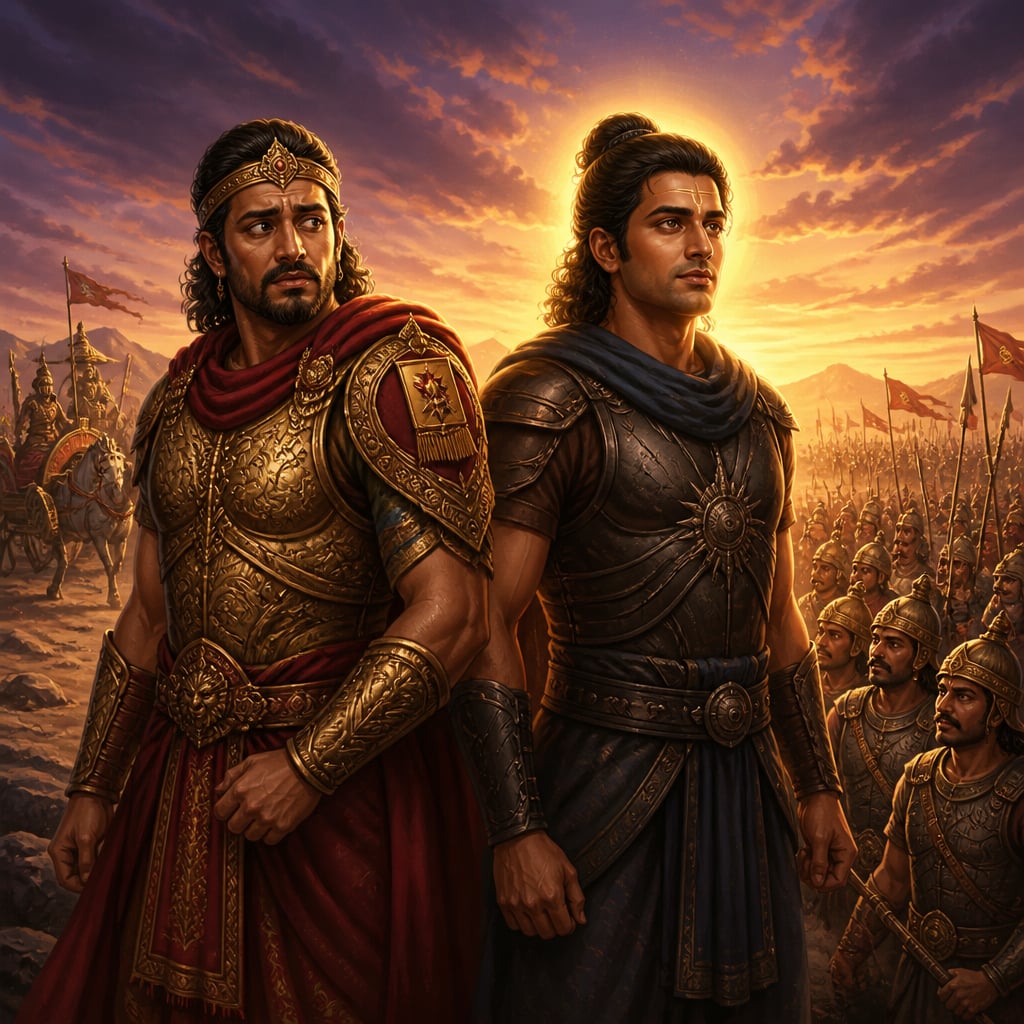
Two generals at dawn, one with inner radiance

What Is Tejas?

The Sanskrit word tejas means "radiance, brilliance, vital energy, spiritual power." It comes from the root tij, "to be sharp, to be bright." Unlike positional power, which exists in organizational charts and can be assigned, tejas is a personal quality that must be cultivated.

This distinction helps explain a persistent pattern in leadership: Understanding the tejas-position distinction helps explain persistent leadership failures: systems that promote based on credentials, connections, or seniority without assessing inner development. The Vedic insight that tejas must be cultivated before position is granted remains relevant for how we select, develop, and evaluate leaders today.

"tejasvinaṃ puruṣaṃ brahmavarcasam" "The man of tejas, radiant with sacred power" (RV 10.128.1)

This verse links tejas to brahmavarcas, the radiance that comes from spiritual development. The leader with tejas doesn't merely hold power; they emanate it. Their authority doesn't depend on the title being recognized; it's visible in their presence.

The Two Sources of Power

The Vedic framework recognizes that effective leadership typically involves two distinct sources of power:

Positional Power (Pada-Bala) Personal Power (Tejas)
Conferred by others Cultivated by self
Exists in role/title Exists in character
Can be removed Cannot be taken
Demands compliance Inspires commitment
Operates through systems Operates through presence
Sufficient for administration Necessary for transformation

Both have their place. Positional power provides the formal authority to allocate resources, make decisions, and represent the organization. Tejas provides the personal capacity to inspire, transform, and lead through crisis.

The problem arises when we confuse them, when we assume that conferring a position automatically confers the inner qualities needed to fill it.

Why Titles Alone Fail

The Rig Veda is clear: positional power without corresponding inner development is hollow. Consider the contrast between Indra and Vṛtra:

Vṛtra held position, he occupied the mountain, controlled the waters, possessed formidable bala. But he lacked tejas, the inner radiance that comes from alignment with purpose. His power was static, defensive, ultimately brittle.

Indra integrating position and inner radiance

Indra possessed both: the positional authority as king of gods and the developed tejas that came from preparation, alignment with ṛta, and accumulated merit. His power was dynamic, creative, generative.

"indrasya ātmā nihito jyotiḥ" "Indra's self is established in light" (RV 3.55.5)

The word jyotiḥ (light) here is related to tejas. Indra's power isn't just formal rank; it's rooted in an inner luminosity that position alone cannot create.

How Tejas Is Developed

If tejas must be cultivated, how does one cultivate it? The Vedic tradition identifies several paths:

Tapas (Disciplined Practice): The inner fire of self-mastery generates tejas. Leaders who have done the hard work of developing themselves, confronting fears, building skills, maintaining discipline, develop a quality that those who've avoided such work lack.

A rishi in deep tapas at a cave-mouth fire

"tapasā tapyamānaḥ" "Burning with tapas" (RV 10.129.1)

The image of "burning" suggests that tejas comes from sustained inner heat, the friction of effort against resistance.

Satya (Truthfulness): Alignment with truth generates radiance; misalignment creates dullness. The leader who habitually deceives loses tejas regardless of their position. The leader who maintains satya, even at cost, accumulates it.

Ṛta-Alignment: Connection to cosmic order amplifies personal power. The leader who serves purposes beyond themselves channels something larger than individual capacity.

Saṃyama (Self-Control): The Vedic tradition emphasizes that scattered energy produces no radiance. Tejas requires concentrated force, the focusing of vital energy rather than its dissipation.

Sri Aurobindo on Inner Power

Sri Aurobindo's interpretation deepens the tejas concept. He identifies Agni, the fire god who is also the inner fire, as the prototype of spiritual power that can be developed.

"Agni is at once a fire of aspiration, a fire of purification, a fire of Tapas, a fire of battle," Aurobindo writes. "He represents the spiritual will."

On this reading, tejas is not a mystical quality but a developed spiritual will, the capacity to hold intention, maintain focus, and act from inner conviction regardless of external circumstance.

The leader with developed tejas has cultivated this inner fire. They don't need external validation because their energy comes from within. They don't waver when positions are threatened because their power isn't contained in positions.

The Limits of Positional Power

Positional power has inherent limitations that tejas transcends:

Position depends on recognition. If others stop acknowledging your title, it evaporates. Tejas doesn't require recognition; it's visible regardless of acknowledgment.

Position operates through systems. When systems break down, in crisis, in chaos, in transformation, positional power fails. Tejas operates through presence and continues functioning when systems don't.

Position produces compliance. People follow positional authority because they must. Tejas produces commitment, people follow because they're drawn to.

Position is zero-sum. Only one person can hold a given position. Tejas is generative, the leader with tejas often develops it in others.

This is why crises so reliably reveal who has tejas and who merely has position. In normal operations, both can function adequately. Under pressure, the difference becomes visible.

The Integration Required

The Vedic ideal is not tejas instead of position but tejas integrated with position. The best leaders have formal authority AND developed inner qualities:

The Rājasūya coronation tested both: formal eligibility for the throne AND personal qualities that would make the reign successful. Candidates could fail on either dimension.

Living This Today

What does the tejas principle mean for modern leadership?

First, invest in inner development, not just career advancement. The credentials, titles, and positions are easier to acquire than the inner qualities needed to fulfill them. Many people reach positions they cannot fill because they neglected this development.

Second, recognize where your power actually comes from. If your influence would disappear the moment your title was removed, you have positional power without tejas. This is a warning sign.

Third, look for tejas when evaluating leaders. Beyond qualifications and experience, ask: Does this person have inner radiance? Do others become more capable in their presence? These are signs of developed tejas.

Fourth, understand that tejas development is ongoing work. Unlike a degree or promotion that's acquired once, inner power requires constant cultivation. The leader who stops developing starts declining.

Taking This Forward

The tejas-position distinction illuminates why some leaders with modest titles accomplish extraordinary things while others with impressive titles accomplish little. Position is what you're given; tejas is what you've cultivated. Both matter, but tejas often matters more.

This chapter has explored the Vedic understanding of power: its legitimate sources (kṣatra and ṛta), its exemplary expression (Vṛtrahan), its testing (parīkṣā), its corruption (adharma), its purpose (rakṣā), and its inner foundation (tejas).

The final lesson synthesizes these insights for the contemporary world, asking: What does this ancient wisdom mean for leaders facing the challenges of 2026 and beyond?

Research on expertise (Ericsson, 'deliberate practice') shows that mastery comes from sustained, focused effort over time, not natural talent alone. The 'burning' of tapas is the psychological equivalent of deliberate practice in character development.

Leaders who have done hard things, facing failures, rebuilding after setbacks, maintaining discipline over years, develop presence that those who've had easy paths lack. The 'battle scars' become visible authority.

Complex challenges require leaders who have developed capacity through prior challenges. Tapas is the accumulated system resilience that comes from having faced and integrated difficulty.

Research on 'charismatic signaling' shows that certain behaviors signal inner confidence: reduced anxiety markers, steady presence, comfort with silence. These are learnable but also reveal genuine versus performed confidence.

Studies on leadership emergence show that groups naturally elevate individuals who display composure under pressure, clarity in confusion, and steadiness in uncertainty, manifestations of tejas that position alone doesn't confer.

Teams sense who has genuine capacity and organize informally around them, regardless of formal hierarchy. This emergent structure reveals who has tejas versus who merely has position.

Case studies

Sam Pitroda: Tejas Without Position

In the early 1980s, Sam Pitroda returned to India from a successful career in the US with a vision: democratize telecommunications for the world's largest democracy. He held no government position, had no political power, and faced an entrenched telecom bureaucracy resistant to change. His only tool was his conviction and his ability to articulate a compelling vision.

Pitroda embodied tejas operating without significant positional power. His radiance came from tapas, years of technical mastery and entrepreneurial accomplishment abroad, and from satya, a vision aligned with India's genuine needs. When he convinced Rajiv Gandhi to support the telecom revolution, it wasn't positional authority that won; it was the perceivable conviction of someone who had done the inner work.

Pitroda's vision manifested as the yellow PCO booths that connected rural India, laying groundwork for the telecommunications revolution. India went from 2 million phones in 1984 to the mobile revolution that followed. Someone with position but without tejas could not have overcome the bureaucratic resistance; Pitroda's inner radiance made the impossible possible.

Tejas can compensate for limited position; position cannot compensate for absent tejas. Pitroda succeeded because his developed capacity, accumulated through years of technical mastery and entrepreneurial challenge, was visible and compelling. The lesson: develop yourself first; positions will find you.

In today's economy, domain expertise often matters more than title or position. Independent consultants, open-source contributors, and thought leaders frequently shape industries without holding formal authority. Their influence grows from demonstrated capability, not from organizational rank.

India's telecom subscribers grew from 2 million in 1984 to over 1 billion by 2020. Pitroda's initial vision, pursued largely without formal authority, fundamentally transformed a nation's infrastructure.

Chandragupta Maurya: Position Built on Tejas

Chandragupta Maurya (c. 321-297 BCE) had no royal position, he was not born to kingship, had no inherited army, and came from obscure origins. Yet he built the largest empire India had ever seen, defeating the Nanda dynasty internally and the successors of Alexander externally. His rise was not positional but based on accumulated tejas.

Chandragupta's story illustrates tejas preceding and generating position. His training under Chanakya was tapas, systematic development of strategic thinking, physical capability, and psychological resilience. His ability to attract followers came not from a title he didn't have but from perceivable quality: people saw in him something that made them believe he could do what he claimed.

Chandragupta unified most of the Indian subcontinent under the Mauryan Empire, established one of history's most sophisticated administrative systems, and created the conditions for the later flowering under Ashoka. His journey from no position to supreme position was powered by tejas that made position possible.

The greatest positions often go to those who developed tejas before seeking position. Chandragupta didn't wait for a title to start leading; his developed quality created the conditions for formal power. Position, in his case, was the consequence of tejas rather than its prerequisite.

Many of today's most influential leaders built their credibility long before receiving formal recognition. Figures like Jensen Huang spent decades developing GPU expertise before the AI boom validated his vision. Position followed capability, not the other way around.

The Maurya Empire under Chandragupta governed approximately 5 million square kilometers with an estimated population of 50 million, making it one of the largest empires in the world at that time.

Reflection

More in Kṣatra: The Nature of Power

All lessons in Kṣatra: The Nature of Power · Rig Vedic Leadership course