The Srinagar Airlift

The Dakota Crews That Saved Kashmir - October 1947

In October 1947, when tribal raiders threatened Srinagar, the IAF mounted history's most daring peacetime airlift. Dakota aircraft flew non-stop, defying mountains and weather, to save the city. Wing Commander KL Bhatia, Air Commodore Mehar Singh, and civilian pilot Biju Patnaik were among the heroes who saved Kashmir.

The Race Against Time

October 26, 1947. Midnight.

In Delhi, telephones rang with desperate news from Kashmir. Tribal raiders - thousands of them, backed by Pakistan, led by army officers - had swept through the valley. Baramulla had fallen. Massacres were underway. Srinagar, the summer capital, lay just 50 kilometers away. By morning, Kashmir might be lost forever.

Maharaja Hari Singh had signed the Instrument of Accession. Kashmir was now legally India's. But legal ownership meant nothing if the enemy reached Srinagar first.

The roads were blocked. Mountain passes would take weeks to clear. There was only one way to save Kashmir: the sky.

And so began the most audacious airlift in Indian military history - a desperate gamble that would succeed against impossible odds, flown by pilots who had no maps, no proper equipment, and no time to prepare.
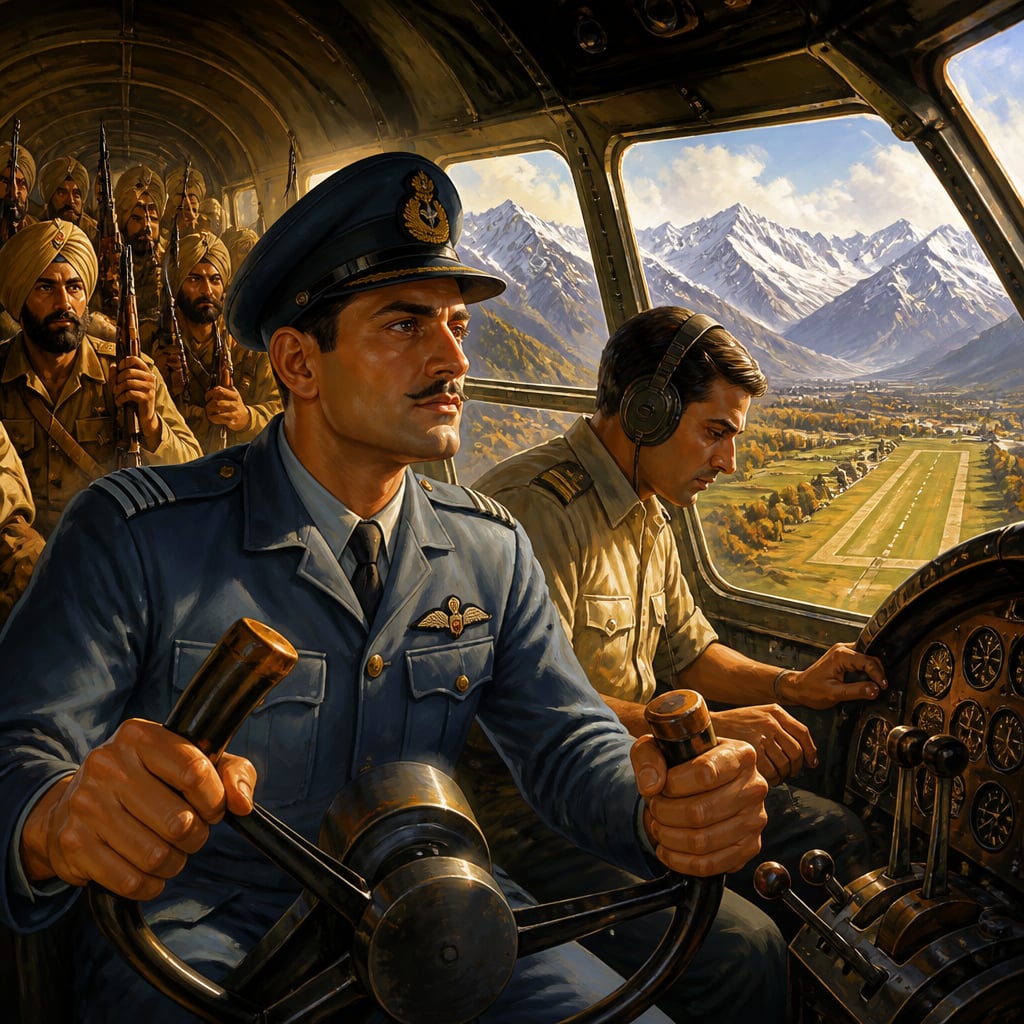
Bhatia lands the first Dakota at Srinagar on 27 October 1947

The Desperate Hour

The Invasion

On October 22, 1947, thousands of tribal raiders from Pakistan's North-West Frontier Province poured into Kashmir. They weren't a ragtag militia - they were armed with modern weapons, transported in Pakistani military trucks, and led by Pakistani army officers and deserters.

The plan was simple: seize Kashmir before India could respond. The tribal lashkar was promised loot, and the valley was rich. Behind them came the real objective - Pakistani regular forces ready to "restore order" once the tribes had done the dirty work.

The raiders moved fast. Muzaffarabad fell on October 24. Baramulla, the gateway to Srinagar, fell on October 26. And then - inexplicably - they stopped.

Instead of pressing on to Srinagar, just three hours away, the lashkar paused to loot Baramulla. They plundered the town, massacred civilians, and attacked St. Joseph's Hospital, killing nurses and patients alike. This pause - this fatal greed - would cost Pakistan Kashmir.

But India didn't know they had stopped. As far as Delhi knew, raiders would be in Srinagar by morning.

The Decision

Maharaja Hari Singh had delayed his decision for months, hoping to stay independent. Now, with his capital hours from falling, he had no choice. On the night of October 26, he signed the Instrument of Accession, making Jammu and Kashmir part of India.

But signing papers didn't save cities. India needed troops in Srinagar - immediately.

Prime Minister Jawaharlal Nehru convened an emergency meeting. The situation seemed hopeless. The only road to Kashmir through Jammu was too slow. The passes were blocked. Moving a brigade by land would take weeks.

Then someone suggested the impossible: an airlift.

The Problem

The idea was audacious. And it was also nearly suicidal.

The Indian Air Force in October 1947 was a skeletal force. It had exactly one transport squadron - No. 12 Squadron - with seven Dakota aircraft. Seven. To airlift an entire infantry brigade.

The Dakotas themselves were World War II workhorses - reliable but slow, with a ceiling that barely allowed them to clear the Himalayan passes. They had no de-icing equipment for high-altitude flying. No pressurization. No oxygen systems for the crew.

The route to Srinagar crossed some of the most dangerous terrain on Earth. The aircraft would have to navigate through clouds, over 15,000-foot peaks, with no navigation aids, no weather reports, and no margin for error.

The Srinagar airstrip was a grass field meant for the Maharaja's personal plane. It had no runway lights, no fire-fighting equipment, no fuel depot, no control tower. If an aircraft crashed on landing, it would block the strip for all others.

And the biggest question: Was the airfield even in Indian hands? For all anyone knew, the raiders had already captured it. The first aircraft might land directly into an ambush.

The orders that went out that night included an extraordinary clause: "Reconnoiter from the air and return to Jammu if the raiders have occupied the airstrip."

In other words: If you see the enemy, don't land. Turn back. Let Kashmir fall.

But the pilots had no intention of turning back.

The Pilots Who Saved Kashmir

Wing Commander KL Bhatia

Squadron Leader Karori Lal Bhatia had taken command of No. 12 Squadron just two months earlier, on August 15, 1947 - Independence Day. He was an experienced pilot who had flown in Burma during World War II, but nothing had prepared him for this.

When the orders came, Bhatia didn't hesitate. He would lead the first flight himself.

At 5:00 AM on October 27, 1947, three Dakotas of No. 12 Squadron taxied onto the runway at Willingdon (Safdarjung) airfield in Delhi. In the lead aircraft, VP-905, sat Bhatia at the controls. Behind him, packed into every available space, were soldiers of 1 Sikh Regiment - the first troops of what would become the largest airlift in Indian history.

The flight took three and a half hours. Three and a half hours of navigating through clouds, dodging peaks, scanning for any sign of the enemy below. Three and a half hours of not knowing if they were flying into a rescue mission or a trap.

At 9:40 AM, Dakota VP-905 touched down on the Srinagar grass strip.

The airfield was clear. The raiders hadn't reached it. Kashmir was still Indian.

Bhatia didn't celebrate. He unloaded his soldiers, turned his aircraft around, and flew back to Delhi for more. Before the day ended, No. 12 Squadron had flown 28 sorties to Srinagar. By November 6, they had airlifted 3,500 troops with all their equipment, ammunition, and supplies.

For his leadership of the airlift, Wing Commander KL Bhatia was awarded the Vir Chakra - one of 13 Vir Chakras that No. 12 Squadron earned in the Kashmir operations. The squadron earned more than two-thirds of all the gallantry awards given to the IAF in the 1947-48 war.

No. 12 Squadron is known to this day as the "Saviours of Kashmir."

Air Commodore Mehar Singh

If any single pilot embodies the spirit of the 1947-48 air operations, it is Mehar Singh - known to all as "Mehar Baba."

Mehar Singh was already a legend before Kashmir. During World War II, his No. 6 Squadron RIAF, flying Hurricane fighters, was called "The Eyes of the 14th Army" by General William Slim. He was the only Indian Air Force officer to receive the Distinguished Service Order (DSO) from the British.

In October 1947, Mehar Singh was Air Officer Commanding of No. 1 Operational Group. When the Kashmir crisis erupted, he didn't stay at headquarters giving orders. He climbed into a Dakota and flew.

Mehar Singh was the first pilot to land at Srinagar. He personally supervised the air bridge, flying sortie after sortie. Within five days, he had inducted an entire infantry brigade into the Kashmir Valley - a feat that left even Lord Mountbatten, the Governor-General, astonished.

"In my war experience," Mountbatten wrote, "I have never come across an airlift of this order being successfully undertaken with such slender resources, and at such short notice."

But Mehar Baba wasn't done.

The Poonch Airlift

Even as Srinagar was secured, another crisis emerged. The town of Poonch, deep in the mountains, was surrounded by raiders. Thirty thousand refugees - Hindu and Sikh civilians who had fled the massacres - were trapped there, starving.

There was no airfield at Poonch. The terrain was impossible. Any attempt to land there was, by every conventional measure, suicidal.

Mehar Singh flew to Poonch anyway.

In November 1947, he landed on a hastily cleared strip that was barely long enough for a Dakota, surrounded by mountains, with no facilities whatsoever. He didn't just make one flight - he established an entire airlift, flying supplies in and refugees out for weeks.

A Government of India press note recorded: "A dare-devil pilot, Mehar Singh, made history when he pioneered flights over the Himalayas across uncharted mountainous routes... He was the first to land at the hurriedly constructed airstrip in the beleaguered town of Poonch and thereafter established the long-drawn airlift operation, thus saving 30,000 refugees."

The Leh Landing

And still he wasn't done.

In May 1948, Ladakh was cut off. Pakistani forces and raiders blocked the roads. The garrison at Leh was surrounded, starving, running out of ammunition. Without resupply, they would fall - and all of Ladakh would be lost.

No aircraft had ever landed at Leh. The airstrip was at 11,540 feet - higher than any runway the Dakota was designed to use. The route crossed passes over 24,000 feet - far above the aircraft's safe ceiling. There were no maps, no de-icing equipment, no pressurization.

Mehar Singh leading Dakotas across the Himalayas to Leh

On May 24, 1948, Air Commodore Mehar Singh led a flight of six Dakotas across the Himalayas. He carried Major General K.S. Thimayya as his passenger. The aircraft climbed to 25,000 feet - a height that would kill unprotected crew within minutes. Mehar Singh and his pilots flew at the edge of consciousness, gasping for breath, their instruments icing over, navigating by instinct through the greatest mountain range on Earth.

And they made it.

Mehar Singh was the first pilot to land at Leh. The supplies he brought saved the garrison. Ladakh remained Indian.

For his extraordinary courage, Mehar Singh was awarded the Mahavir Chakra - India's second-highest military decoration. Today, a statue of Mehar Baba looks over the Leh airfield, commemorating the man who saved Ladakh.

Tragically, his flying would also kill him. On March 11, 1952, Mehar Singh died when his Bonanza aircraft crashed in a freak storm near Delhi. He was just 36 years old.

Biju Patnaik - The Civilian Hero

The IAF couldn't do it alone. With only seven Dakotas, they needed help. And help came from an unexpected source: civilian airlines.

Biju Patnaik was not a military pilot. He was a businessman who had started his own airline - Kalinga Airways - earlier in 1947. But he was also a legendary aviator who had flown with the RAF in World War II and had been involved in secret missions during the Indonesian independence movement.

When Prime Minister Nehru called for help, Biju Patnaik answered.

Biju Patnaik loading 1 Sikh troops at a pre-dawn airstrip

On October 27, 1947, Patnaik flew one of the first civilian aircraft into Srinagar, carrying soldiers of 1 Sikh Regiment. The mission was as dangerous for civilians as for military pilots - more so, since civilian aircraft had even fewer modifications for the mountain flying.

Patnaik flew multiple sorties during the critical first days. His aircraft and those of other civilian volunteers supplemented the IAF's meager transport fleet, helping to establish the air bridge that saved Kashmir.

In later years, Biju Patnaik would become Chief Minister of Odisha - twice. But he always cherished his memories of 1947. When he died in 1997, international obituaries called him a "daring pilot-patriot of India."

What They Achieved

By the Numbers

The scale of what the Dakota crews accomplished is staggering when you consider their resources:

Metric Achievement
Aircraft available 7 IAF + ~6 civilian Dakotas
First day sorties (Oct 27) 28
Troops airlifted (first 10 days) 3,500+
Peak daily sorties 35 per day
Total sorties (Oct-Nov 1947) 704
Vir Chakras to 12 Squadron 13 (out of 19 to entire IAF)

Each Dakota could carry only 21 soldiers per trip. To airlift a brigade of 3,500 men took over 165 sorties just for personnel - plus additional flights for weapons, ammunition, artillery, vehicles, and supplies.

What It Saved

The Srinagar Airlift saved Kashmir for India. Without it:

Instead, the 1 Sikh Regiment arrived in time to establish a defensive perimeter around Srinagar. Within days, they had pushed the raiders back. Within weeks, Indian forces had recaptured Baramulla and stabilized the Valley.

The war would continue for another year, with more battles, more sacrifices, more heroes. But the outcome was decided in those first 24 hours of October 27, 1947, when a handful of pilots flew into the unknown and refused to turn back.

The Legacy

October 27 - Infantry Day

India commemorates October 27 as Infantry Day - a tribute to the soldiers of 1 Sikh Regiment who were the first to land at Srinagar. But the day equally honors the pilots who made that landing possible.

The first aircraft to touch down - Dakota VP-905 - has been preserved and restored. Named "Parshuram" after the warrior-sage of Hindu tradition, it now serves in the IAF's Heritage Flight. It appeared in the 2025 Republic Day parade, a flying memorial to the men who saved Kashmir.

The 12 Squadron Heritage

No. 12 Squadron continues to serve in the Indian Air Force. Its battle honors include "Srinagar," "Poonch," and "Kashmir 1947-48." The squadron badge carries the motto that its pilots earned in October 1947: "Saviours of Kashmir."

What We Remember

The Srinagar Airlift teaches us that courage isn't just about fighting - sometimes it's about flying. The Dakota crews didn't fire a single shot at the enemy. Their weapons were navigation skill, flying ability, and sheer determination.

They flew aircraft that weren't designed for the mission. They crossed mountains that should have killed them. They landed on airstrips that barely deserved the name. And they did it again and again, sortie after sortie, until Kashmir was saved.

In the annals of military aviation, the Srinagar Airlift ranks among the greatest achievements. It was done with almost no resources, almost no time, and almost no margin for error. It succeeded because the men who flew it refused to accept that it couldn't be done.

Lord Mountbatten, who had seen war on every front, called it unprecedented. The world military community studied it as an example of what determined men could achieve.

But for India, it was something simpler: it was the first time the new nation's armed forces proved that they would fight - and fly - for every inch of Indian soil.

No. 12 Squadron - "Saviours of Kashmir" Air Commodore Mehar Singh, MVC, DSO Wing Commander KL Bhatia, VrC Biju Patnaik and the Civilian Volunteers

Jai Hind.

Historical context

1947-48 Kashmir War - The First Test

Independent India was just 73 days old when the Kashmir crisis erupted. The armed forces were still being organized from the divided British Indian Army. Equipment was scarce, training was incomplete, and no one knew if the new nation could defend itself. The Kashmir operations were the first test - and the IAF's transport squadron became the unlikely heroes.

Living traditions

No. 12 Squadron continues to serve in the IAF with the title 'Saviours of Kashmir.' The Dakota aircraft type has been retired but preserved examples remain in the Heritage Flight. October 27 is commemorated annually as Infantry Day. The Srinagar Airlift is studied at military academies worldwide as an example of successful crisis logistics.

Reflection

More in Wings of Valor & Distant Shores

All lessons in Wings of Valor & Distant Shores ยท Param Veer: Forging the Nation (1947-1971) course