The Constrained Warriors - 1962
IAF Helicopter Pilots Who Fought Without Fighting
In 1962, the IAF's fighters were ready but never allowed to strike. Yet helicopter and transport pilots flew desperate missions through Himalayan peaks, under enemy fire, at the edge of exhaustion - evacuating wounded, supplying besieged posts, rescuing retreating soldiers. The untold story of valor without glory.
Wings Clipped, Duty Undiminished
November 1962. The Himalayas.
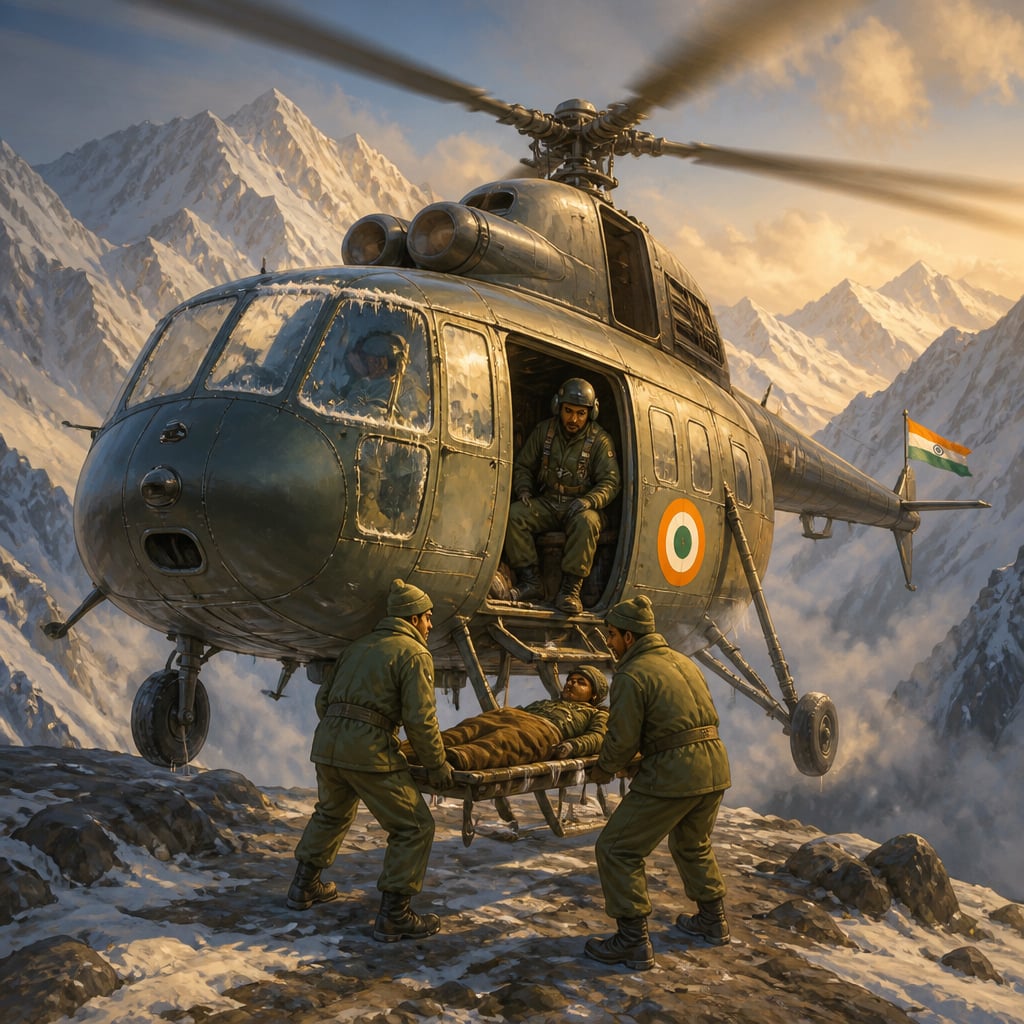
A Mi-4 helicopter struggles against thin air at 15,000 feet. Below, Chinese troops advance through NEFA. The pilot hasn't slept in 36 hours. His fuel is low, his aircraft is overloaded with wounded soldiers, and the helipad ahead is under small arms fire.
Back at base, Vampire jets and Hunter fighters sit idle on the tarmac. Their pilots watch the transport aircraft come and go, knowing they could change the war in hours if only they were allowed to fight.
But the order never comes.
The 1962 war is remembered as India's greatest military defeat. What's forgotten is that half the Air Force was never allowed to fight. The fighters were grounded by political decisions. The helicopters and transports flew until they - and their crews - could fly no more.
This is the story of the constrained warriors.
The Decision Not to Fight
The Fear
When Chinese forces attacked on October 20, 1962, the Indian Air Force was ready. Fighter squadrons equipped with Vampires, Toofanis, Mysteres, and the newly acquired Hunters were positioned at bases across the northeast. They could have attacked Chinese supply lines, strafed advancing columns, and provided close air support to beleaguered Indian positions.
They never got the chance.
The decision to withhold offensive air power came from the highest levels of government. The reasoning was fear - fear that if the IAF attacked Chinese forces, the Chinese Air Force would retaliate by bombing Indian cities. The Intelligence Bureau assessed that China had overwhelming air superiority and that Indian air defenses were inadequate to protect cities like Calcutta, Gauhati, or even Delhi.
The assessment was almost certainly wrong. Chinese air power in Tibet was limited by logistics and altitude. Their bombers lacked the range to strike deep into India and return safely. And the IAF's fighters, operating from home bases, would have had significant advantages over Chinese aircraft operating at the edge of their range.
But the decision was made. Between September 18 and 20, 1962 - even before the main Chinese attack - the government decided that the Air Force would be limited to transport and supply.
The fighter pilots would watch the war from the ground.
The Frustration

For the fighter pilots, the restraint was agonizing.
They could see the transport aircraft returning with wounded. They knew their comrades in the Army were dying on the mountains. They had trained for exactly this situation - close air support in mountainous terrain, interdiction of supply lines, air superiority over the battlefield.
And they were ordered to do nothing.
Years later, a serving Chief of Air Staff would publicly lament the decision. Military historians have criticized it for decades. But in October-November 1962, there was nothing the fighter pilots could do but watch - and wait for orders that never came.
The Helicopter War
What They Were Allowed to Do
While the fighters sat grounded, the helicopter and transport crews flew themselves to exhaustion.
The IAF's transport fleet - primarily Dakotas and Packets - flew continuous supply missions to forward posts. They dropped ammunition, food, and medical supplies to positions that were being overrun even as the aircraft passed overhead.
But the real heroes were the helicopter crews.
The IAF's helicopter fleet in 1962 was tiny - a handful of Mi-4s and Sikorsky H-19s. These aircraft were never designed for the missions they were now being asked to fly: casualty evacuation from altitudes above 15,000 feet, supply drops to helipads under enemy fire, search and rescue in terrain where a single mistake meant death.
They flew them anyway.
Flying at the Edge
From October 20 to November 20, 1962, the pressure on helicopter units was unrelenting. Troops and supplies had to be flown to border posts "virtually around the clock and at extreme altitudes."
The helicopters operated at the very edge of their performance envelope. At 15,000 feet, the thin air reduced lift and power dramatically. Fully loaded, the aircraft struggled to climb. Pilots had to calculate every kilogram of fuel against the weight of wounded soldiers.
And they flew into fire. Chinese troops had reached positions where they could engage the helicopters with small arms and anti-aircraft fire. The pilots had no weapons to shoot back - their aircraft were transport machines, not gunships. They could only dodge, evade, and pray.
The Exhaustion
The acute shortage of helicopter pilots made the situation desperate. Every qualified pilot flew multiple missions daily. There was no rotation, no rest, no relief.
A remarkable solution emerged: fighter pilots - young men trained for combat, not transport - were attached to helicopter units as co-pilots. After takeoff, the exhausted helicopter pilot would hand over controls to the fighter pilot and catch a few minutes of sleep in the cockpit. Just before landing - the most critical phase - the helicopter pilot would be woken to bring the aircraft down.
This is how involved the IAF was. Fighter pilots, forbidden from using their weapons, flew as assistants to transport pilots who were too tired to stay awake.
The Evacuations
As the war turned disastrous, the helicopter crews shifted to a new mission: evacuation.
Indian positions were collapsing across NEFA and Ladakh. Soldiers were retreating through mountains, many wounded, many separated from their units. The helicopters became their lifeline.
Pilots searched for survivors in the eastern valleys of Bhutan - at Sakden, Tashigang Dzong, Devnagiri, Donanga. They flew into the Kameng division of NEFA - Misamari, Chacku, Foothills, Kalaktang. They landed on treacherous cliffs and ridges in the Shyok Valley of Ladakh, fighting strong crosswinds at altitudes where the air itself seemed hostile.
They picked up wounded, demoralized, retreating stragglers. Men who would have died in the mountains went home because a helicopter found them.
The Chaos on the Ground
Tezpur Station
The panic of 1962 reached its peak at Tezpur, the IAF station at the edge of the Assam plains. As Chinese forces approached, arrangements were made to evacuate even this rear-area base.
The helicopter pilots operating from Tezpur were working at the limit of human endurance. They flew until they couldn't fly anymore, then slept for a few hours, then flew again. They didn't know where their next meal would come from - the support infrastructure was collapsing around them.
The Station Commander, Wing Commander Arjun Bhavani, showed the kind of initiative that keeps organizations functioning in chaos. He posted guards around the cookhouse - not to protect it from the enemy, but to prevent the cooks from running away.
It was that kind of war.
The DBO Evacuation

Daulat Beg Oldi (DBO) - one of the world's highest airstrips at over 16,000 feet - had to be abandoned. The Chinese were closing in, and the garrison couldn't hold.
Mi-4 helicopters performed the casualty evacuation under impossible conditions. The altitude was near the helicopter's service ceiling. The weather was brutal. The terrain offered no margin for error - a single mechanical failure, a moment's misjudgment, would mean death on the frozen rock below.
The pilots flew anyway. They brought out the wounded. They saved lives that would have been lost.
They didn't receive medals for it. There were no headlines, no recognition. The war was a defeat, and defeats have no heroes in the public imagination.
But the helicopter crews knew what they had done.
What We Lost - And What We Saved
The Military Assessment
In retrospect, the decision to withhold air power was almost certainly a mistake.
Chinese logistics in Tibet were stretched thin. Their forces depended on supply lines that wound through mountain passes - lines that would have been highly vulnerable to air interdiction. Their air force in the region was limited, operating from high-altitude bases that reduced aircraft performance.
The IAF's Hunters and Vampires could have changed the war. Close air support at Rezang La, at Bum La, at Walong might have turned massacres into defended positions. Attacks on Chinese supply columns might have starved their offensive of ammunition and food.
We will never know. The fighters never flew.
What the Transports Achieved
But we do know what the helicopter and transport crews achieved:
- Continuous supply to forward positions until they were overrun
- Casualty evacuation that saved hundreds of wounded soldiers
- Search and rescue that brought home men who would have died in the mountains
- Logistics support that kept the remnants of Indian forces functioning
The war was lost on the ground. But it wasn't lost in the air - because the transport crews did everything that was asked of them, and more.
The Human Cost
The helicopter pilots paid a price that doesn't appear in casualty lists.
They flew exhausted, beyond the safe limits of fatigue. They operated aircraft beyond their design parameters. They took risks that peacetime safety rules would never have permitted.
Some didn't come back - lost to accidents, mechanical failures, enemy fire. Their names are not remembered as war heroes because they weren't killed in combat. But they died doing their duty, in aircraft that were never meant to do what was being asked of them.
The Lessons
On Political Decisions
The decision to ground the fighters was made by civilians who didn't understand air power. They acted from fear - fear of escalation, fear of Chinese retaliation, fear of what they didn't know.
Military professionals, then and since, have argued that the decision was wrong. But military professionals don't make political decisions in a democracy. The civilian leadership chose caution, and the Air Force obeyed.
This is how it should be. Civilians control the military in democracies. But the 1962 experience taught India that civilian leaders need to understand military capabilities before making military decisions.
On Duty Without Recognition
The helicopter and transport crews did their duty without recognition.
There are no movies about the Mi-4 pilots of 1962. No monuments commemorate the fighter pilots who flew as co-pilots so their exhausted colleagues could sleep. The transport crews who kept flying into positions that were being overrun - they have no holiday named for them.
Duty doesn't require glory. The crews flew because it was their job, because soldiers on the ground needed them, because that's what the Air Force does. Recognition or not, they did what had to be done.
On Fighting Without Fighting
The constrained warriors of 1962 fought a different kind of battle.
They couldn't attack the enemy. They couldn't defend their comrades with weapons. They could only fly - again and again, mission after mission, until their bodies gave out.
That's a kind of courage that doesn't fit into heroic narratives. It's not dramatic. It's not exciting. It's just... endurance. Doing the possible when the impossible is forbidden.
The helicopter pilots of 1962 showed that courage comes in many forms. Sometimes the bravest thing is to keep flying when everyone else has stopped.
The Long Shadow
Never Again
The 1962 experience shaped Indian military doctrine for decades.
Never again would the Air Force be withheld from a major conflict. In 1965, in 1971, in 1999 - whenever India fought, the IAF fought alongside the Army. The lesson of 1962 was learned: air power must be used, or the war will be fought with one hand tied behind the back.
The Transport Tradition
The helicopter and transport squadrons of the IAF carry the memory of 1962 in their institutional DNA.
They know that their mission doesn't get the glory of the fighter pilots. They know that supply runs and casualty evacuations don't make headlines. But they also know that in 1962, when the fighters were grounded, they kept flying.
That's their heritage. That's their pride.
What We Remember
The 1962 war is remembered as a defeat. That's accurate - it was a defeat, a painful one that still shapes India's relationship with China.
But within that defeat were acts of courage that deserve remembrance. Soldiers who held positions to the last man. Officers who died leading their troops. And pilots who flew exhausted, under fire, at impossible altitudes, bringing wounded men home.
The constrained warriors of 1962 didn't fail. They were simply never given the chance to succeed.
Their courage was real. Their sacrifice was real. And their story deserves to be told.
The Helicopter and Transport Crews of 1962 The Constrained Warriors Valor Without Glory
Jai Hind.
Historical context
1962 Sino-Indian War
The 1962 war was India's first major military defeat since independence. The Army was outfought in the mountains by better-prepared Chinese forces. But the Air Force was never allowed to fight - a political decision that has been debated ever since. The transport and helicopter crews did what they could, but offensive air power remained grounded.
Living traditions
The 1962 experience fundamentally changed Indian military doctrine. Never again would air power be withheld from a major conflict. In 1965, 1971, and 1999, the IAF flew combat operations. The transport and helicopter squadrons continue to fly high-altitude missions in Ladakh and the Northeast, maintaining the tradition of those who flew in 1962.
- IAF Museum, Palam: Contains aircraft from the 1962 era, including transport aircraft and helicopters that flew during the war. The museum documents IAF history including the difficult 1962 operations.
Reflection
- The fighter pilots obeyed orders they believed were wrong. When is it right to follow decisions you disagree with? When should you refuse?
- The helicopter pilots received no glory - the war was a defeat. Does it matter if your sacrifice is recognized? Can duty have meaning without acknowledgment?
- Was the political decision to ground the fighters right or wrong? When civilians make military decisions, how should we evaluate them?