The Lone Defender - 1971

Flying Officer Nirmal Jit Singh Sekhon - The Only IAF Param Vir Chakra

Flying Officer Nirmal Jit Singh Sekhon is the only IAF officer to receive the Param Vir Chakra. On December 14, 1971, when six Pakistani Sabres attacked Srinagar, he scrambled alone and engaged them all. He shot down two before falling. His body was never found, but his courage will never be forgotten.

One Against Six

December 14, 1971. Srinagar Airbase.

Flying Officer Nirmal Jit Singh Sekhon is on readiness duty when the sirens wail. Pakistani aircraft - six F-86 Sabres - are incoming. Bombs are already falling.

Sekhon runs for his Gnat. His formation leader, Flight Lieutenant Ghumman, is already rolling. Sekhon follows - taxiing through explosions, taking off into a sky filled with enemy aircraft.

Within seconds, Ghumman is lost in the mountain haze. The IAF has no radar in the Kashmir valley. Ground control can't help.

Sekhon is alone.

Six Sabres. One Gnat. One pilot.

In the air battle that follows, Flying Officer Sekhon will shoot down two enemy aircraft and damage another. He will fight at treetop height against impossible odds. He will never give up.

And he will become the only officer in the Indian Air Force to receive the Param Vir Chakra.
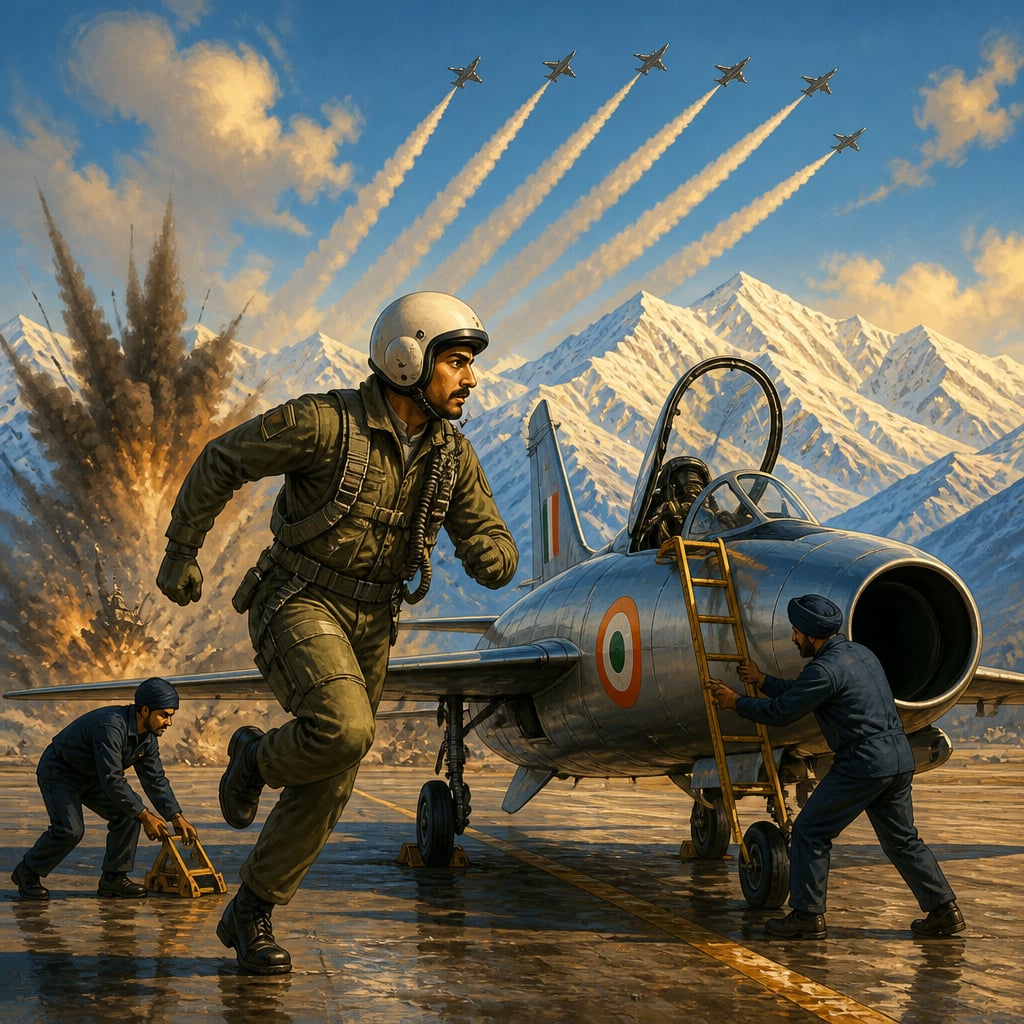
Flying Officer Sekhon scrambles to his Gnat as bombs fall on Srinagar

The 1971 War

The Road to War

The 1971 war was different from 1965. This time, India had a cause beyond territory: the liberation of Bangladesh.

In March 1971, the Pakistani military launched a brutal crackdown in East Pakistan. Operation Searchlight targeted Bengali nationalists, intellectuals, and Hindu minorities. Estimates suggest hundreds of thousands died. Ten million refugees flooded into India.

India couldn't absorb this human tide indefinitely. The burden on West Bengal and the northeastern states was unsustainable. Something had to give.

On December 3, 1971, Pakistan pre-emptively struck Indian airfields in the west. India responded with full-scale war on both fronts. In the east, Indian forces drove toward Dhaka. In the west, they defended against Pakistani attacks while launching counter-offensives.

The war in the west was fought for survival. The war in the east was fought for liberation.

Operation Chengiz Khan

Pakistan's western strategy centered on air strikes against Indian airfields - degrading IAF capability before it could support ground operations.

The operation was called Chengiz Khan - named after the Mongol conqueror. On the first day of war, PAF aircraft struck multiple Indian bases.

Srinagar, deep in the Kashmir valley, was a prime target. The base housed No. 18 Squadron - "Flying Bullets" - equipped with Gnats. If the PAF could neutralize Srinagar, the entire Kashmir air defense would be crippled.

On December 14, 1971, six F-86 Sabres of No. 26 Squadron PAF took off from Peshawar. Their target: Srinagar.

Flying Officer Sekhon

A Pilot from Punjab

Nirmal Jit Singh Sekhon was born on July 17, 1945, in Isewal village near Ludhiana, Punjab. He came from a Jat Sikh family - a community with deep military traditions.

He joined the Indian Air Force in 1967, commissioned as a Pilot Officer on June 4. He trained on the Gnat - the tiny fighter that had earned its reputation as the "Sabre Slayer" in 1965. By 1971, he was a Flying Officer with No. 18 Squadron, based at Srinagar.

Sekhon was 26 years old. He had been in the Air Force for four and a half years. He was about to face the test of his life.

December 14, 1971

The morning of December 14 was like any other wartime morning at Srinagar. Pilots rotated through readiness duty, sitting in or near their aircraft, ready to scramble at a moment's notice.

Sekhon was on readiness. His formation leader was Flight Lieutenant Ghumann. Their Gnats were fueled, armed, and ready.

At approximately 10:30 AM, the attack came.

Six Pakistani Sabres swept in from the northwest, using the mountain terrain to mask their approach. By the time they were spotted, they were already over the airfield, bombs falling, guns firing.

The runway was being hit. Aircraft on the ground were being strafed. The base was under attack.

The Scramble

Most pilots, facing bombs landing on their runway, would have stayed on the ground. Taking off into an active air attack was suicidal - you were a slow, predictable target until you gained altitude and speed.

Sekhon and Ghumann took off anyway.

Ghumann rolled first, Sekhon following as his wingman. They lifted off through explosions, climbing into a sky filled with enemy aircraft.

And then things went wrong.

Ghumann, trying to gain altitude for tactical advantage, climbed into the mountain haze that perpetually shrouds the Kashmir valley. He lost visual contact with the Sabres. Ground control - non-existent at Srinagar due to lack of radar - couldn't help him reacquire.

Sekhon, who had stayed lower, was alone.

Six Sabres. One Gnat. And a pilot who had to make a choice.

The Battle

Engaging the Enemy

Sekhon could have run. His Gnat was fast enough to escape. He could have climbed into the haze like Ghumann, evaded the Sabres, and lived to fight another day.

He chose to stay and fight.

The Sabres had split into pairs for their attack runs. Sekhon engaged the first pair, diving into them with guns blazing.

Sekhon's Gnat in a treetop dogfight with Sabres

The dogfight that followed was fought at treetop height - altitudes so low that a moment's misjudgment would mean death on the mountainside. The Gnat's superior maneuverability counted here; at these altitudes, speed was less important than the ability to turn.

Sekhon got behind one Sabre. He fired. The Pakistani aircraft took hits and went down - Sekhon's first kill.

He turned on a second Sabre. More hits. The aircraft began trailing smoke - confirmed damage, probably fatal.

Two down, four to go.

The Weight of Numbers

But now the other Sabres had seen what was happening. They abandoned their attack runs on the airfield and turned on Sekhon.

One against four.

The Gnat twisted and turned, Sekhon using every bit of skill he had. At treetop height, in the mountain valleys of Kashmir, he fought a battle that should have ended in seconds.

It didn't. Sekhon held his own far longer than anyone could have expected.

But numbers tell. Eventually, one of the Sabres got behind him. Cannon shells tore into the Gnat.

The aircraft flew straight and level for a few moments - the mark of a dead or unconscious pilot. Then it flipped inverted and began to fall.

At the last moment, the canopy flew off. Sekhon had tried to eject. But he was too low, too slow, the aircraft too damaged.

The wreckage of Sekhon's Gnat in a Kashmir gorge

The Gnat crashed into a gorge near the road between Srinagar town and the airbase. Flying Officer Nirmal Jit Singh Sekhon was dead.

He was 26 years old.

What the Ground Crews Saw

The battle had been watched from the ground by the base personnel. They had seen Sekhon take off through the bombing. They had seen him engage the Sabres alone. They had seen him shoot down two enemy aircraft.

And they had seen him fall.

The wreckage of his Gnat was found. His body was not. The mountainous terrain where he crashed made recovery impossible. Despite extensive searches by both Army and Air Force, Flying Officer Sekhon's remains were never found.

He lies somewhere in the Kashmir mountains he died defending.

The Param Vir Chakra

The Only IAF Recipient

Flying Officer Nirmal Jit Singh Sekhon was posthumously awarded the Param Vir Chakra - India's highest wartime gallantry award.

To this day, he remains the only officer of the Indian Air Force to receive the PVC.

The citation notes his "bravery, flying skill and determination" against odds of six to one. It records that he "shot down one enemy aircraft and damaged another" before being overwhelmed.

But the citation doesn't - can't - capture what Sekhon actually did. He took off into an attack. He engaged when he could have escaped. He fought alone when his leader was lost. He kept fighting until his aircraft was destroyed.

That's not just bravery. That's something beyond words.

Why Only One?

Why is Sekhon the only IAF officer to receive the PVC?

It's not because other IAF personnel haven't shown courage. The Air Force has fought in every war India has fought. Its pilots have died in combat, in accidents, in service to the nation.

But the Param Vir Chakra is awarded for a specific kind of courage: conspicuous gallantry in the presence of the enemy, above and beyond the call of duty. The conditions are stringent. The bar is impossibly high.

Sekhon met it because what he did was impossible. He engaged six aircraft alone. He shot down two. He died fighting rather than running.

There may never be another IAF officer who faces those odds and responds that way. Sekhon stands alone - in death as in battle.

The Legacy

A Body Never Found

Flying Officer Sekhon's body was never recovered. Somewhere in the mountains near Srinagar, in a gorge beside the road, lie the remains of a hero.

The lack of a body made closure difficult for his family. His parents - Trilok Singh and Harbans Kaur - never had a grave to visit. The traditional last rites of Sikhism could not be performed.

But in another sense, Sekhon needs no grave. His monument is the sky he defended. His memorial is the freedom of Kashmir's people to live without Pakistani bombs falling on them that day.

Memorials and Honors

Sekhon's sacrifice is commemorated across India:

No. 18 Squadron - Flying Bullets

Sekhon's squadron - No. 18 "Flying Bullets" - carries his memory in its institutional DNA. The squadron has deployed to multiple conflicts since 1971, and new pilots learn Sekhon's story as part of their heritage.

The Gnat has been retired from IAF service, but Sekhon's spirit - the willingness to fight impossible odds rather than abandon the mission - remains.

What He Teaches Us

On Choosing to Fight

Sekhon could have escaped. His aircraft was fast enough. The mountains offered cover. No one would have blamed him for breaking off against six-to-one odds.

He chose to stay.

This is the warrior's choice - the decision that separates those who wear the uniform from those who embody its meaning. Duty isn't about following orders when it's convenient. It's about doing what must be done when every instinct screams to run.

On Fighting Alone

Ghumann was lost in the haze. Ground control couldn't help. Sekhon was alone.

Many battles are fought alone. Your leader may fail. Your support may vanish. You may find yourself the only one who can do what needs to be done.

In that moment, you have a choice: wait for help that may never come, or fight with what you have. Sekhon fought.

On Accepting the Odds

Six against one. The odds were hopeless. Sekhon knew it. He engaged anyway.

Some battles can't be won - but they still have to be fought. The defense of Srinagar that day wasn't about killing all six Sabres. It was about disrupting the attack, protecting the base, buying time.

Sekhon achieved that. The Sabres, forced to fight rather than bomb, did less damage than they would have. The base survived. Sekhon's sacrifice had meaning beyond his own survival.

On Dying Well

Sekhon's Gnat flew straight and level after it was hit - the mark of a pilot who was dead or unconscious. But then the canopy flew off. He tried to eject. Even at the end, he was fighting.

How we face death defines us. Sekhon faced it fighting, trying to survive, never giving up. That's how a warrior dies.

Conclusion: The Lone Defender

On December 14, 1971, Flying Officer Nirmal Jit Singh Sekhon took off into an attack that should have killed him before he left the ground. He engaged six enemy aircraft alone. He shot down two. He fought until his aircraft was destroyed.

His body was never found. His courage will never be forgotten.

He was 26 years old. He had been an officer for four and a half years. He faced odds of six to one and didn't flinch.

The Param Vir Chakra is awarded for "most conspicuous bravery in the presence of the enemy." What Sekhon did that day defines the phrase.

Every IAF pilot who takes off into danger flies in Sekhon's shadow. Every time an Indian aircraft defends Indian skies, Sekhon's spirit is in the cockpit.

He is the Lone Defender. The only IAF officer to receive India's highest honor. The pilot who fought one against six and proved that courage has no arithmetic.

Somewhere in the mountains of Kashmir, his remains lie undiscovered. But his memory lives in every Indian who knows what duty means.

Flying Officer Nirmal Jit Singh Sekhon Param Vir Chakra (Posthumous) July 17, 1945 - December 14, 1971 No. 18 Squadron "Flying Bullets" The Only IAF Officer to Receive the PVC

Jai Hind.

Historical context

1971 Indo-Pakistani War

The 1971 war was India's most decisive military victory. In the east, Indian forces liberated Bangladesh in just 13 days. In the west, the IAF achieved air superiority despite Pakistani pre-emptive strikes. Sekhon's sacrifice at Srinagar was part of the western air defense that allowed ground forces to operate freely.

Living traditions

Sekhon remains the only IAF officer to receive the PVC - a record that may never be equaled. His sacrifice is taught at the Air Force Academy. The commemorative postal stamp featuring his portrait was issued by the Department of Posts. No. 18 Squadron carries his memory as part of its permanent heritage.

Reflection

More in Wings of Valor & Distant Shores

All lessons in Wings of Valor & Distant Shores ยท Param Veer: Forging the Nation (1947-1971) course